The 15 best vision board ideas are a dream life board, a career board, a travel board, a wellness board, a money board, a quotes board, a relationships board, a creative board, a giving board, a seasonal board, a gratitude board, a mood board, a dream job board, an affirmation board and a one-page collage. Each one can work, but only when it shows you the next step as well as the finish line. Below you’ll find all 15, what to put on each, and a simple way to turn any of them into something you act on every day.
What is a vision board, and can it really help you manifest your dreams?
A vision board is a collection of pictures and words, arranged where you’ll see it daily, that shows the life you want to move toward. It can help you manifest your dreams in one honest way: it keeps your attention pointed at what you want, and attention decides which opportunities you notice and which you walk right past.
Let me be straight with you about the research, because it’s more interesting than the hype. Psychologist Gabriele Oettingen has spent years studying what happens when people only daydream about a good outcome. In a 2011 experiment with Heather Kappes, students who vividly imagined a perfect result felt less energized afterward than students who didn’t. Oettingen’s own method, called WOOP, adds the missing half: you picture the wish, picture the best outcome, then name the obstacle and make a plan for it.
A second finding points the same way. In a study by Lien Pham and Shelley Taylor, students who pictured the process of studying for an exam did better than students who pictured getting a high grade. So a picture of the finish line is a lovely thing to look at, and a picture of the doing is the thing that moves your feet. That’s the idea behind everything in this article.
Does that mean a vision board is pointless? No, my friend. It means a board made only of finish lines is half a board. Keep the dream pictures, add the doing pictures, and you’ve got something with real work to do.
How do you choose which vision board idea is right for you?
Choose the board that matches the one area of life asking for your attention right now, then add a second board only when the first one feels finished. A single focused board beats a crowded one, because your eye needs a place to rest. Here’s a quick way to match yourself to an idea.
| If you want to… | Start with this board | Best time frame | Best format |
|---|---|---|---|
| See your whole future at once | Dream life board or collage | 1 to 5 years | Large poster |
| Change your work | Career or dream job board | 6 to 24 months | Desk size or digital |
| Feel calmer and healthier | Wellness, mood or gratitude board | 3 to 12 months | Bedroom wall or mirror |
| Get your money in order | Money board | 6 to 12 months | Near your desk or wallet size |
| Reconnect with people | Relationships or giving board | 3 to 12 months | Kitchen wall or fridge |
| Believe it more deeply | Affirmation or quotes board | Ongoing | Phone lock screen |
If you can’t decide, pick the dream life board. It’s the widest door, and once you see what keeps repeating on it, you’ll know which narrower board to make next.

What are the 15 best vision board ideas?
The 15 best vision board ideas below each cover one area of life, and every one includes what to put on it and one first step you can take this week. Read them all, then circle just one or two. Notice the pattern: every idea ends with a step, because a dream with no first step is just a nice picture.
Idea 1: The dream life board
A dream life board gathers your ideal home, work, relationships and daily rhythm onto one board. Choose 1 picture for each: where you wake up, what you do by midday, who is at your table at night. Ask yourself what an ordinary Tuesday looks like in that life, and find pictures of that, not just the vacation. First step this week: write one sentence under each picture saying what it would feel like to be there.
Idea 2: The career aspirations board
A career board shows the work you want to grow into, including the skills, the title and the kind of colleagues you want. Use pictures of the actual workspace, the tools in the hands of people doing the work, and a short list of skills you’ll build. First step this week: message one person who does that work and ask for 15 minutes of their time.
Idea 3: The travel list board
A travel board collects the places and experiences you want, in the order you want them. Add a photo of the place, the season you’ll go, and one thing you’ll do there, like walking a coastline or learning to cook a local dish. First step this week: open a savings account or envelope with the destination’s name on it and put in a small first amount.
Idea 4: The wellness and self-care board
A wellness board shows the habits and the feeling of a healthy body and a quiet mind. Skip the airbrushed ideal and choose pictures of the habits: a morning walk, a full glass of water, a bed made for sleep, a plate you’d enjoy eating. First step this week: schedule three 20-minute walks in your calendar like appointments.
Idea 5: The financial goals board
A money board makes your numbers visible: the savings goal, the debt you’ll clear, the thing you’re building toward. Pair a picture of what the money is for with the real number written beside it. Numbers you can see lose some of their power to scare you. First step this week: check your actual balance and write it on the board as your starting line. Our guide to a vision board for finances goes much deeper on this one.
Idea 6: The inspirational quotes board
A quotes board gathers a few sentences that reflect your values and steady you on hard days. Choose 5 to 7, not 50. Pick lines that make you breathe out when you read them, then put each beside a picture it fits. First step this week: read your favorite line aloud each morning for 7 days and notice whether it still lands.
Idea 7: The family and relationships board
A relationships board shows the kind of connection you want to build with the people you love. Use real photos of the people, and pictures of the activities you’d like to share: Sunday dinners, a long phone call, a trip with a sibling. First step this week: put one shared plan on the calendar with one person on the board.
Idea 8: The creative hobbies board
A creative board holds the things you want to make or learn just for joy. Pictures of paint on a palette, a guitar by a window, a half-finished quilt all tell your mind that play is allowed. First step this week: set a 25-minute timer and try the hobby once, badly, on purpose.
Idea 9: The community and giving back board
A giving board shows how you want to serve, whether that’s volunteering, mentoring or a monthly donation. Giving is one of the quickest ways to move out of your own worry, so it earns a place. First step this week: pick one local cause and find the date of its next volunteer day.
Idea 10: The seasonal vision board
A seasonal board sets goals for 3 months instead of 12, which makes them easier to hold in your mind. Each season suggests its own pictures: planting in spring, rest in winter. Four small boards a year feel lighter than one giant promise. First step this week: write your single most important goal for this season on the back of the board. Our new year vision board guide shows how to start one at any turning point.
Idea 11: The gratitude board
A gratitude board displays what you already have, so your mind practices abundance before more arrives. Use photos of people, places and small daily pleasures, like a warm mug or a favorite chair. The point is to feel full, and from fullness, wanting is gentler. First step this week: add one new item to the board every evening for 5 days.
Idea 12: The mood board
A mood board captures a feeling through color, texture and light instead of listing goals. If your dream is “peace,” what does peace look like? Maybe pale blue, linen, a still lake, a wooden table. Then bring those colors and textures into your actual room. First step this week: change one thing in your space to match the board, like a throw blanket or a candle.
Idea 13: The dream job board
A dream job board is more specific than a career board: it shows the exact role, workplace, hours and income you want. Write the job title as if it’s already yours, and include a picture of where you’ll work and the people you’ll work with. First step this week: update one line of your resume or profile so it points toward that job.
Idea 14: The affirmation board
An affirmation board is made mostly of words, written in the present tense and in your own handwriting. Short phrases like “I am steady” or “My work is wanted” work best. Pick words you believe about 70 percent, close enough to trust and far enough to stretch you. Our list of 100 vision board affirmations will give you a head start. First step this week: say your top phrase aloud 3 times while looking in a mirror.
Idea 15: The one-page vision board collage
A collage board blends several life areas into a single page, with the largest picture in the center and the rest arranged around it. Give 1 or 2 areas the most space and let the rest be small. A crowded collage becomes wallpaper, so leave breathing room. First step this week: choose your center picture, the one that makes you smile when you look at it, and build outward from there. If you’d like printable templates, grab our free printable vision board kit.
How do you turn any of these vision board ideas into action?
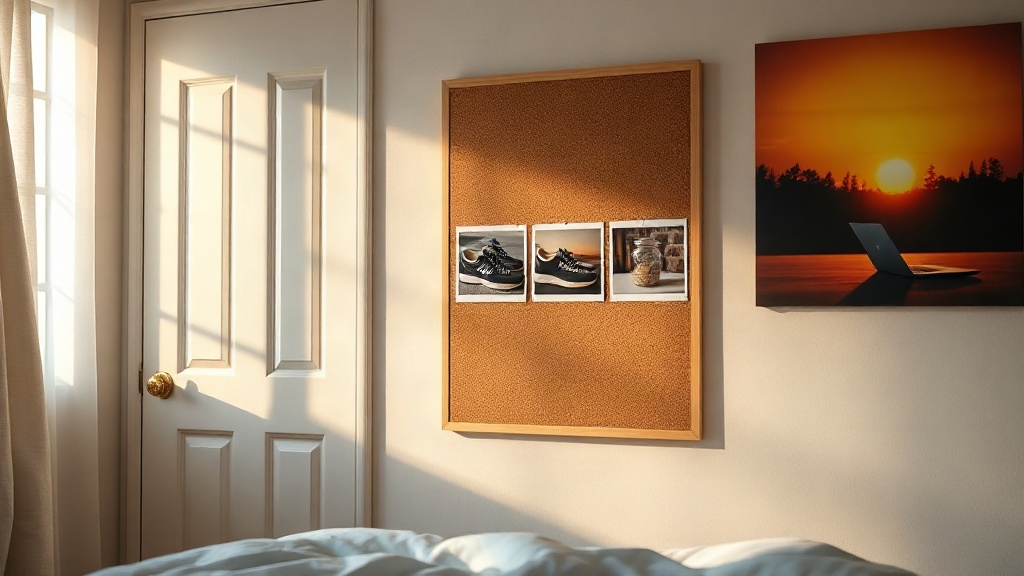
Add a Doing Strip: a row of 3 small pictures along the bottom of your board that show the daily actions that lead to the dream. Most vision board guides skip it, and it’s the piece the research above points toward. The rest of the board shows where you’re going. The strip shows how you’ll walk there.
Here’s how to build it in four short moves.
- Pick the one dream on the board that matters most this season.
- Name three actions you could do in 30 minutes or less, like “send two applications,” “walk after dinner,” or “transfer 20 dollars on Friday.”
- Find a small picture of each action being done, not the result. A hand on a keyboard. Sneakers by a door. A coin jar.
- Add the obstacle in a single line on the back of the board: “When I’m tired after work, I’ll do the 10-minute version.” That’s the planning half of Oettingen’s method, and it has support from decades of work on implementation intentions.
Let’s say your board is a travel board for a trip to Portugal. The postcard-style photo goes at the center. The strip beneath shows a passport application, a jar with coins in it, and a language app. When you pass the board, you don’t only feel the wish, you remember what to do about it today.
Keep the strip honest. If a week goes by and you didn’t do any of the three, don’t scold yourself. Shrink the actions until they’re so small you can’t say no. Two minutes still counts.
Where should you put your vision board?
Put your vision board where your eyes land at least once a day without any effort, such as across from your bed, on the bathroom mirror, or beside your desk. A board hidden in a closet can’t remind you of anything. A board you pass 10 times a day starts to feel like part of the house.
- Bedroom: best for dream life, wellness and gratitude boards, because you see them first and last.
- Desk or office: best for career, dream job and money boards, where the action happens.
- Kitchen or fridge: best for relationship and family boards, since people gather there.
- Phone lock screen: best for affirmation and quote boards. You’ll see it dozens of times a day.
Privacy matters too. Some people like their board on display, and some prefer it inside a closet door or notebook. Either is fine, as long as you actually look at it.
How often should you update your vision board?
Review your vision board every week for 2 minutes and update it every 3 to 6 months, or whenever a goal is reached or no longer feels true. Weekly looking keeps the dream warm. Seasonal updating keeps the board honest, because you change and your board should be allowed to change with you.
When you reach something, don’t just take the picture down. Write the date on it and move it to a “done” page, then add the next picture. Watching the done page grow is quietly powerful, because it’s proof, in your own handwriting, that things you once only pictured have already happened.
When a picture stops giving you any feeling at all, that’s information, not failure. You may have outgrown that wish. Replace it with something that makes you lean forward.
What mistakes make vision boards fail?
The most common mistakes are crowding the board, choosing pictures that belong to someone else’s dream, and looking without ever acting. All three are easy to fix once you spot them.
- Too many goals. If you can’t name what every picture is for, remove half.
- Borrowed dreams. A yacht photo you don’t actually want is just clutter. Keep only pictures that give you a warm feeling in your chest.
- Finish lines only. Add the Doing Strip so the board asks something of you.
- Negative wording. “No more debt” points your mind at debt. “Debt-free and sleeping well” points at the life you want.
- Waiting for perfect. A rough board you made tonight beats a beautiful one you never finish.
The honest truth is that a vision board isn’t magic and no one can promise it will bring you a specific result. What it can do is keep your attention, your choices and your effort leaning in one direction. And that, repeated for months, is how a great many dreams actually come true.
Frequently asked questions
What is the best vision board idea for beginners?
The best vision board idea for beginners is the one-page collage, because it needs only one sheet, about 10 pictures, and an hour of your time. You choose a single center image that makes you smile, then add 6 to 9 smaller pictures and 2 or 3 short words around it.
It works well because it asks you to choose, and choosing is the whole skill. If a first board feels too wide, turn it into a one-area board next, such as health or travel. Add the Doing Strip from the section above so your first board points toward action from day one.
How many pictures should a vision board have?
A vision board should have between 8 and 15 pictures, with one clearly larger image at the center. That range is large enough to cover the areas you care about and small enough that your eye can rest. Past 15, the board tends to blur into wallpaper and you stop seeing individual images.
If you’re building a single-topic board, such as a travel board, 5 to 8 pictures is plenty. The test is simple: point to any picture and say why it’s there in one sentence. If you can’t, take it off. You can always keep spare pictures in an envelope for the next update.
Do vision boards actually work?
Vision boards work as a reminder and a focus tool, but the research doesn’t show that pictures alone cause results. Studies by Gabriele Oettingen found that people who only imagine success often feel less energized, while people who also plan for obstacles follow through more. Pictures of the process, studied by Lien Pham and Shelley Taylor, helped students more than pictures of the outcome.
So the honest answer is yes, when you pair the board with action. Add 3 small pictures of daily steps and one if-then plan, and review the board weekly. Without those, treat it as inspiration, which is still worth having.
Can I have more than one vision board at a time?
Yes, you can keep more than one vision board, and many people do: one big board for the whole life and one smaller board for a single season or project. The only rule is that each board needs its own clear purpose, or the second one just repeats the first.
A practical setup is a dream life collage in your bedroom, a career or money board by your desk, and an affirmation board as your phone lock screen. Three is usually the ceiling before attention scatters. If you find you aren’t looking at one of them, retire it and see which remaining board you miss the least.
Is a digital vision board as good as a physical one?
A digital vision board works just as well as a physical one if you actually see it every day, and that’s the only thing that decides it. A phone lock screen gets looked at many times a day, which is a real advantage over paper hanging in a quiet room.
A physical board has its own strength: cutting, gluing and writing by hand slows you down and makes you choose. Many people do both, making a paper board once and photographing it as a lock screen. Whatever you pick, keep the Doing Strip visible, and set a weekly 2-minute reminder to look at it properly.
What should I do when a picture on my board no longer fits?
When a picture no longer fits, take it down without guilt and replace it with something that matches who you are now. A dream can be finished, outgrown or simply wrong, and any of those is a reasonable reason to change the board.
Ask yourself one question: does this still make me lean forward? If it doesn’t, remove it. If it was a goal you reached, write the date on it and keep it on a done page as proof of progress. If you’re unsure, move it to the edge of the board for a month and see whether you miss it.
The universe loves a clear picture and a willing step. Start your board tonight, and get a free “message from the universe” in your inbox every morning, plus the abundance meditation. For help choosing the right images, see our guide to vision board pictures, and for more examples, browse vision board ideas and examples.
Part of our guide: Vision Boards: The Complete Guide