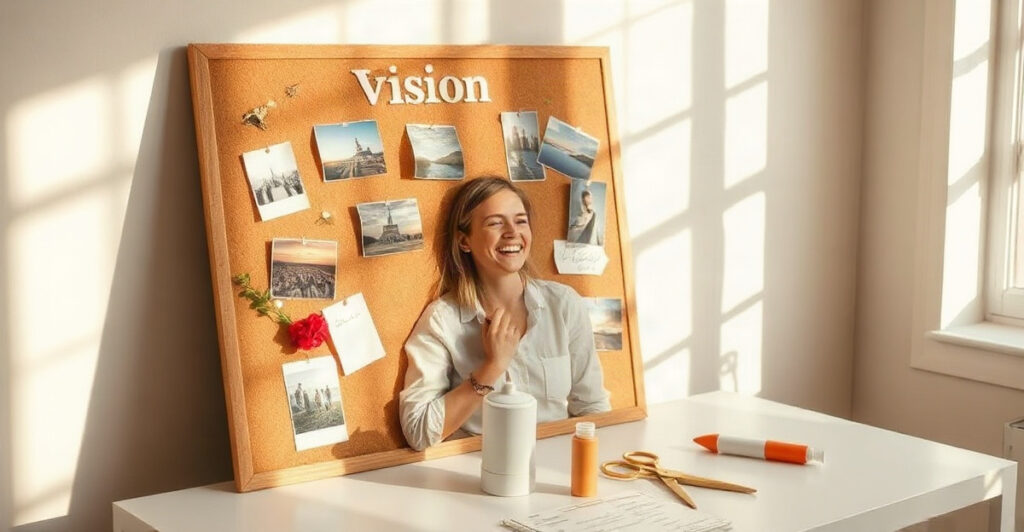
The best vision board ideas start with one clear question: what do you want your everyday life to feel like one year from now? From there, a vision board is images and words arranged where you will see them daily, built by hand or digitally, covering money, love, health, career, travel, and the atmosphere you want to live in. Below are 100+ prompts and 15 board concepts to build from, plus the layout and rules that make boards actually work.
What is a vision board?
A vision board is a collage of images, words, and symbols representing what you want to achieve or feel, placed somewhere you see every day so your attention keeps feeding those goals. The practice entered mainstream culture through books like The Secret (2006) and Oprah’s coverage of it, but collage-as-intention is far older: practitioners of New Thought in the early 1900s called their goal collages “treasure maps,” and high achievers kept them long before the name existed.
How does it work, honestly? The defensible mechanism is attention and priming: a goal you see daily stays top-of-mind, and top-of-mind goals catch opportunities (psychologists call it selective attention, the reason you suddenly notice red cars everywhere after buying one). Motivational research, including work popularized by Gabriele Oettingen’s Rethinking Positive Thinking, adds a caution: visualization works best paired with concrete action steps, which is why the strongest boards include “how” images, not just “what” images. A vision board is a compass, and a compass still needs walking.
What should I put on my vision board?
Put images and words on your vision board for each major life area: money and career, love and relationships, health and body, home, travel, creativity, and the feelings you want more of. The classic beginner mistake is loading up on objects (cars, houses) while skipping the states of being underneath them. The table below shows the working formula for each area: one image, one word, one action.
| Life area | Image that works | Word or phrase | The “how” image |
|---|---|---|---|
| Money | Your target bank balance in real type | “Paid well for work I love” | A calendar with booked work |
| Love | A couple the way you want to be | “Safe love” | A set table for two |
| Health | Yourself mid-hike, strong and lit up | “Strong and energized” | Running shoes by the door |
| Home | The exact kitchen or reading nook | “Home feels like me” | A paint swatch, a houseplant |
| Travel | One real destination, not ten | “I go where I say I will go” | The passport, the map with pins |
| Feelings | Laughing at a kitchen table | “Enough” | Morning light on a made bed |
Grab from the prompts below for depth. The goal is 10 to 20 strong choices, not all of them.
- Money and career: a bank balance screenshot (your target number), your dream job title, a “no” to a job you would decline, a sold-out event, a book deal, a packed calendar of paid work, “I am paid well for work I love.”
- Love and relationships: a couple holding hands the way you want to, a friendship dinner, “safe love,” a wedding or recommitment image, a family scene, “chosen and choosing,” Sunday mornings with your person.
- Health and body: yourself at your strongest, a hike you want to finish, restful sleep, a vegetable-heavy plate, “strong and energized,” yoga at sunrise, a doctor’s clean bill.
- Home: the kitchen you want to cook in, a reading nook, a front door in your favorite color, a garden, “home feels like me,” the view from your future window.
- Travel: one specific destination (specific beats generic), the passport stamp, a market you want to wander, first-class seat or the road-trip map, “I go where I say I will go.”
- Feelings and atmosphere: peace, laughter, “slow mornings,” a tidy bright room, dancing in the kitchen, “enough,” a deep breath. These bind the board together.
- Numbers and dates: the year, your income goal, a debt-free date. Numbers sharpen attention like nothing else.
- The “how” row: a journal, running shoes, a class enrollment, your coach or mentor, a calendar block. Actions belong on boards too.
What are the best vision board examples and layouts?
The strongest vision board layouts are the wheel (goal categories radiating from your photo at the center), the grid (one image per square, one category per row), the word-first board, and the single-scene collage. Format follows personality: detailed people love grids, visual-feeling people love the wheel, and word-lovers do better with a board built around statements. Fifteen concepts to steal:
- 1. The wheel of life: your photo at center, 8 spokes for 8 categories, one image each.
- 2. The year grid: 12 squares, one per month, each a single dominant image and intention.
- 3. Word-first: giant central word (“enough,” “free,” “built”), images arranged as decoration.
- 4. One goal, whole board: every image in service of a single target (the book, the house, the marathon).
- 5. The morning view: built to be exactly what you want to see during 6 a.m. coffee.
- 6. Digital wallpaper board: made in Canva, sized for phone lock screen and laptop.
- 7. Vision board journal page: one collage page per month in your planner or journal.
- 8. Family board: everyone contributes; shared goals in the center, personal goals at the edges.
- 9. Vision wall: an entire wall, poster board blown up to mural scale.
- 10. The anti-vision: what you are leaving behind, with a line through each, plus what replaces it.
- 11. Seasonal board: one 90-day board per quarter instead of one annual board.
- 12. Map board: a world map base with pins and images at every place you intend to stand.
- 13. Money-specific board: income streams, the debt-free date, the savings milestone, the feeling of paying cash.
- 14. Love-specific board: the relationship qualities first, the person-type images second.
- 15. Quiet board: neutral palette, soft images, one word. For people whose goals are internal.
How do you make a vision board step by step?
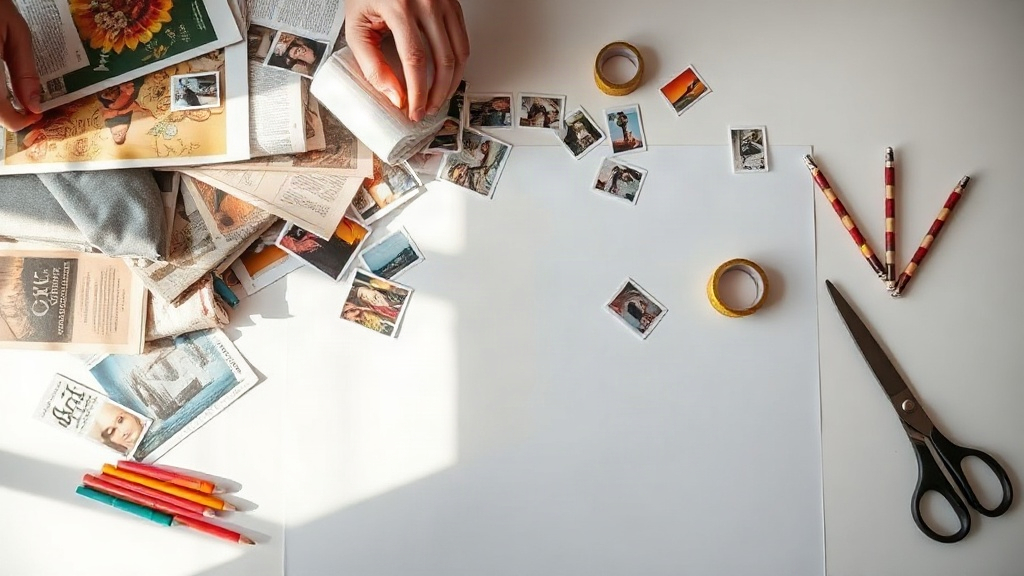
You make a vision board in six steps: get clear on 1 to 3 life priorities, collect images and words that match, choose physical or digital format, arrange with your most important goal in the visual center, place it where you will see it daily, and pair it with one weekly action. The whole build takes 1 to 3 hours. Here is the method that produces boards people still look at in month six.
- Step 1: choose before you cut. Write your top 3 priorities for the year in one sentence each. Boards built from a magazine pile without this step become mood boards about everything and commitments to nothing.
- Step 2: gather with intention. Print Pinterest images (a great source; our guide to a free printable vision board kit gives you a starting set), cut magazines, or save digital images. Pull for feelings, not just objects.
- Step 3: choose the format. Poster board and glue for the ritual, or Canva for convenience. Physical boards carry more emotional weight for most people; digital boards win on daily exposure.
- Step 4: arrange around a center. Your most important goal (or your face, or your word of the year) goes in the visual middle. Leave some breathing room; dense boards stop getting read.
- Step 5: place it in the path of your eyes. Beside the bathroom mirror, above the desk, inside the closet door, or as phone wallpaper. Sightline beats shrine.
- Step 6: attach one action. Under or beside the board, write the single next action for each goal. This one move is what separates boards that come true from boards that fade.
Do vision boards actually work?
Vision boards work as attention and motivation tools when they are specific, seen daily, and paired with action, and they fail as magic when they are vague, hidden, or used as a substitute for doing. The research picture supports the pairing: visualization plus planning outperforms visualization alone (Oettingen’s studies found pure fantasizing can actually reduce effort, because the brain partially pre-enjoys the outcome). Athletes and high performers have used structured mental rehearsal for decades on exactly this understanding.
So the honest rules for a board that works: specific beats generic (a real destination, a real number), feelings beat furniture, seen daily beats beautiful, and paired with action beats wished upon. Build with those four and the board becomes what it should be: a daily alignment tool for a life you are actively constructing.
Frequently asked questions
What are the rules for a vision board?
There are only three that matter: choose goals before images, put it where you will see it every single day, and attach at least one action step to each goal. Everything else (format, size, materials) is preference.
How many goals should a vision board have?
Between 5 and 10 across all categories. Fewer than 5 and the board under-represents your life; more than 10 and attention scatters. One or two goals should clearly dominate the board’s center.
Is it better to make a physical or digital vision board?
Physical boards carry more ritual weight and work best in a fixed spot you pass daily; digital boards win on exposure frequency as phone or laptop wallpaper. Many people do both: physical at home, digital on the phone.
What do you put in the middle of a vision board?
Your single most important goal, your photo, or your word of the year. The visual center is where eyes land first, so it should hold the intention everything else supports.
When should you make a vision board?
Any time works, but the natural peaks are New Year’s, birthdays, and the start of a new season or chapter. A quarterly (90-day) board made at each season change is the most effective rhythm for most people.
A board is a promise you make to your own eyes. Keep it, and pair it with this: get a free “message from the universe” in your inbox every morning, plus the abundance meditation.