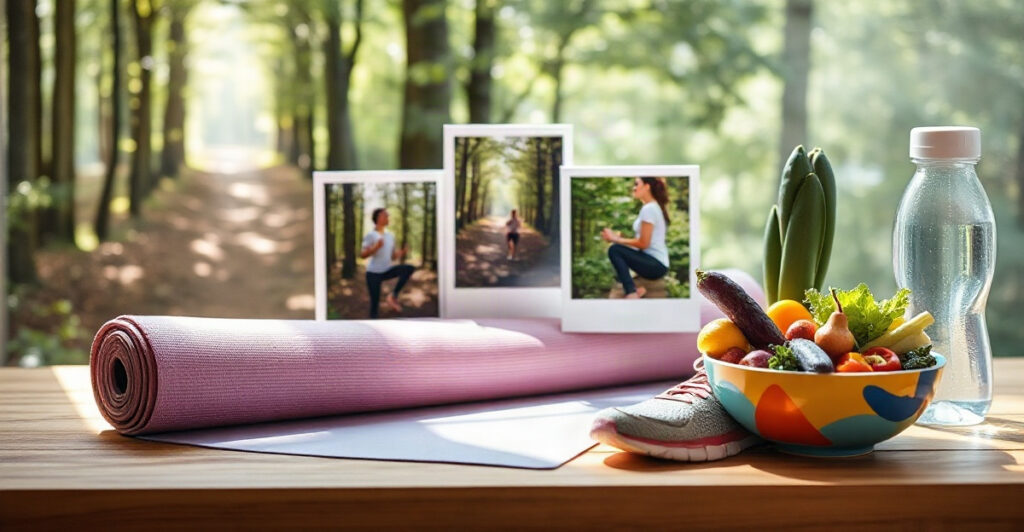
The best health and fitness vision board ideas show the daily actions and the feeling of a healthy life, not just a body you hope to have. Put a few pictures of you moving, eating well, resting and showing up, add one small action line under each, and you have a board that can change what you do tomorrow morning.
Your body has been working for you every second since you were born, and it wants to feel good. A board is simply a way of agreeing with it, on purpose, where you can see it. Let’s build one that does real work.
What is a health and fitness vision board?
A health and fitness vision board is a collage of images and short words that shows the healthy life you want and reminds you to act on it every day. It can be a poster on the wall, a page in a journal, a private Pinterest board, or the lock screen of your phone.
Most people picture a before and after photo. I’d invite you to picture something kinder: the morning walk, the colorful plate, the stretch on the bedroom floor, the easy night of sleep. Those are the pictures your body can actually respond to.
You’ll find three common versions. A workout vision board focuses on movement and strength. A healthy eating vision board focuses on food and how it makes you feel. A whole health board holds both, plus sleep, rest and mood. Pick the one that matches the season of life you’re in right now.
Do health and fitness vision boards actually work?
A board alone does not build fitness, but a board that is paired with a plan can help you follow through, and that is where the results come from. That’s the honest answer, and it’s a hopeful one, because the plan part is entirely in your hands.
Psychologist Gabriele Oettingen has spent about twenty years studying a method called WOOP, which stands for wish, outcome, obstacle and plan. Her site reports that in these studies people roughly doubled their physical activity and ate a healthier diet, and the method works by asking you to dream the future and then picture the inner obstacle that could block it. A board that only shows the dream leaves out half of that recipe.
Peloton’s guide to vision boards makes the same point for runners. It suggests including everyday training moments, like a sunrise and morning dew, instead of only the finish line. You can read the full piece at Peloton’s vision board guide.
So here is how I’d treat a board: as a clarity tool and a daily nudge. It will never lift the weights for you, but it can tell you which direction you walk.
What should you put on a health and fitness vision board?
Put on it the activities you want to do, the foods you want to enjoy, the feeling you want in your body, and one small action for each. Pictures of people, places and things, rather than numbers, give you the most to work with.
Here is a simple way to sort what you collect. Notice that every row has a picture and a line of action, because a picture with no action is only a wish.
| Area | Picture ideas | Small action line | Feeling to board |
|---|---|---|---|
| Movement | A trail, a yoga mat, running shoes by the door, friends walking | “Shoes on, 10 minutes, 4 days a week” | Energy and ease |
| Strength | A weight rack, a person carrying groceries easily, a pull-up bar | “2 strength sessions a week” | Capable and steady |
| Food | A colorful plate, a farmers market, a water bottle, a kitchen table | “1 vegetable at every dinner” | Nourished |
| Sleep and rest | A dim bedroom, a hammock, a cup of tea, a book | “Lights out by 10:30” | Calm and restored |
| Mind | A quiet park bench, a journal, a person meditating | “5 slow breaths after lunch” | Peaceful |
| Check-ups | A calendar page, a doctor’s office, a heart symbol | “Book the yearly visit” | Cared for |
One more thought: being healthy is much more than lowering a number on the scale. Boards built only around weight tend to feel heavy. Boards built around energy, strength and joy tend to feel light, and light is easier to keep looking at.
What are the best workout vision board ideas?
The best workout vision board ideas show a specific activity you’d enjoy repeating, because the exercise you keep doing beats the perfect one you quit. Choose the picture that makes you smile, not the one you think you should want.
- The first 5K: a finish line banner, a pair of worn running shoes, and the line “Walk and jog, 3 days a week.” HealthyWomen uses a 5K as its example goal, and it is a lovely first one.
- The stronger body: a kettlebell, a gym bag, a picture of a person lifting a child or a suitcase with ease.
- The flexible body: a yoga pose, a person touching their toes, a quiet studio with morning light.
- The outdoor life: a mountain trail, a bicycle on a country road, a paddleboard on still water. Choose places you could reach within a drive.
- The social workout: friends at a park, a dance class, a team sport. Peloton’s guide notes that images of connection and belonging, like friends running together, can matter as much as images of the exercise itself.
- The gentle start: a chair, a short walk around the block, a stretching mat. If you’re returning after a long break, this is a perfectly noble board.
Notice that none of these says “lose 20 pounds.” That’s on purpose. You can’t walk a number. You can walk a trail.
What are good healthy eating vision board ideas?
Good healthy eating vision board ideas show the meals you want to enjoy and the way you want to feel after them, not a list of foods you’re banning. A board of “never again” tends to make you hungry just looking at it.
Try pictures of a bowl you’d love to cook, a table with people at it, fresh herbs on a windowsill, a glass of water with lemon, a market stall full of produce. Add a gentle line like “Cook at home 4 nights” or “Water bottle on the desk.” The aim is to make the good choice the easy and attractive one.
Many boards also have a quiet corner for the relationship with food: a picture of a slow meal, a plate with no screen beside it, a person laughing at dinner. That corner often matters more than any recipe. If you have a medical condition, an allergy or a history of disordered eating, please plan your food goals with your doctor or a registered dietitian first. A board should support that care, not replace it.
What is the Show Up Board method?
The Show Up Board method is a three-rung way to plan a health board: a Floor, a Target and a Reach for each picture, so that a bad day still counts as a day you showed up. Most health boards stop at the picture, and a picture can’t tell you what to do on a Tuesday when you’re tired.
- The Floor. The smallest version you’d do even on your worst day. For a workout board it might be “put on my shoes and walk to the mailbox.” It should take 2 minutes or less.
- The Target. The normal version of the habit, like a 30 minute walk, 4 days a week.
- The Reach. The stretch goal that excites you, like the 5K or the first pull-up. It lives at the top of the board, in the biggest picture.
Then add one more thing, borrowed from the WOOP idea: write the most likely obstacle beside each picture and a plan for it. “If it rains, then I do 10 minutes of stretching in the living room.” Short, plain, ready.
Why the Floor matters is the part most people skip. Research on habit formation, summarized by the British Psychological Society, found that missing one day had little lasting effect, while many missed repetitions over time lowered how automatic the habit became. A Floor turns a missed day into a tiny win, and tiny wins are what keep the repetitions coming.
How do you make a health and fitness vision board step by step?
You make one in 6 steps: choose one goal, gather pictures, sort them by area, write the action lines, add the Floor, Target and Reach, and hang it where you will see it daily. Plan on about 60 to 90 minutes.
- Choose one main goal. HealthyWomen suggests making it concrete and achievable, such as running a 5K this year. One main goal, plus two small supporting ones, is plenty.
- Gather supplies. A cardboard sheet or poster, magazines, scissors, glue, a pen. Or a free Canva page, or a private Pinterest board for the digital version.
- Collect pictures that make you feel something. Aim for 8 to 12. If an image doesn’t give you a small lift in your chest, leave it out.
- Sort and place them. Put the Reach picture at the center and the daily-habit pictures around it.
- Add the action lines. Handwritten lines feel warmer than printed ones, and they’re yours.
- Add a personal touch. A photo of you smiling outdoors, or of people you love, as HealthyWomen suggests. Then set it where you will actually pause in front of it.
If you’d like help with the layout, our guide to vision board ideas and examples has 15 layouts to borrow, and the free printable vision board kit saves you the cutting and gluing.

Where should you put it, and how often should you update it?
Put your health board where you pause every day, like beside the bathroom mirror, near your running shoes, or as your phone wallpaper, and review it every week for 66 days. Seeing it is half of the purpose.
The 66 days comes from a study by Lally and colleagues, described by the British Psychological Society, in which 96 undergraduates repeated a new health behavior daily for up to 84 days. Reaching peak automaticity took 66 days on average, but it ranged widely from person to person. The same summary says exercise took about one and a half times as long to plateau as eating or drinking habits. That is good news for patience: if a workout habit feels slow, you’re not failing, you’re being normal.
Use a simple tracker strip along the bottom of the board, one small box per day, and tick your Floor, Target or Reach each day. At day 33, step back and ask which pictures still make you smile. Change the ones that don’t. At day 66, celebrate, then make a new board for the next goal, which is what HealthyWomen also recommends once a goal is reached.
What mistakes should you avoid?
The most common mistakes are boarding only a number, comparing yourself to someone else’s body, and building a board so big that you never start. Each has a gentle fix.
- Boarding only the scale. Swap it for a feeling: energy, strength, ease on the stairs.
- Using someone else’s body as the picture. Your body has its own shape. Pick pictures of activities, not of physiques.
- Too many goals. Three is a board. Twelve is a source of guilt.
- Hiding the board. A board in a drawer is a nice craft project and nothing more.
- Skipping the doctor. If you have a health condition or you’re starting after a long break, talk to your doctor before you set a big physical target.
Remember what you’re doing. You’re not punishing a body into shape. You’re making friends with it.
Frequently asked questions
What should I put on a health and fitness vision board?
Put on it pictures of activities you want to do, meals you want to enjoy, the way you want to feel, and one small action line beside each. A trail, a yoga mat, a colorful plate and a quiet bedroom are all good starting points, because they show a life instead of a number. Aim for 8 to 12 images so the board stays calm to look at.
The limit is that pictures alone do not build habits, so add a line such as “walk 10 minutes, 4 days a week” next to each one. If you’re unsure where to start, begin with the six areas in the table above: movement, strength, food, sleep, mind and check-ups.
Do fitness vision boards really work?
A fitness vision board works best as a reminder paired with a plan, not as a wish on its own. Oettingen’s WOOP research, which her site says helped people roughly double their physical activity, combines the dream with an obstacle and a plan, and a board that includes those parts follows the same logic. A board with only the dream leaves out the part that helps on tired days.
The honest limit is that no study shows a poster alone changes your body. To use a board well, add a Floor, a Target and a Reach for each picture, and write one “if this happens, then I do that” line for your most likely obstacle.
How do I make a workout vision board if I have never exercised?
Start with a gentle workout vision board built around a Floor you can do on your worst day, such as a 2 minute walk or a short stretch. Choose pictures of the kind of movement that looks pleasant to you, whether that’s a walk in a park, a slow yoga class or a swim. The beginner’s Target might be 10 minutes, 3 days a week, and the Reach might be a 5K walk in a few months.
Because exercise habits can take longer to settle than eating habits, as the habit research summary notes, expect it to feel slow at first. See your doctor if you’ve been inactive for a long time or have a health condition, then begin at the Floor.
What is a healthy eating vision board?
A healthy eating vision board is a collage of meals, kitchens, markets and table moments that show how you want to eat and feel, paired with simple action lines. Examples include a bowl you’d love to cook, a water bottle on the desk, and a table with friends, with lines like “Cook at home 4 nights” or “1 vegetable at every dinner.”
It works better when it shows what you’re adding than what you’re banning. The limit is medical: if you have a health condition, an allergy or a history of disordered eating, plan your food goals with a doctor or registered dietitian, and let the board support that plan.
How long does it take for a fitness habit to stick?
On average it took 66 days in the best-known habit study, though the range was wide, from person to person. In that study by Lally and colleagues, summarized by the British Psychological Society, 96 undergraduates tried a daily health behavior for up to 84 days, and about half had not reached a high automaticity score by the end. Exercise took about one and a half times as long as eating or drinking habits.
The same summary says one missed day had little lasting effect, so don’t quit after a slip. Use a Floor action for hard days and a tracker strip on your board, and review it at day 33 and day 66.
Should I put a goal weight on my health vision board?
It’s usually better to board a feeling or an activity than a goal weight. A number tells you little about what to do today, and a board built on the scale can feel heavy to look at. Pictures such as walking a trail, carrying groceries easily or sleeping well give you action to take and a feeling to aim for.
If your doctor has given you a specific health target, such as a blood pressure or cholesterol goal, you can include it as a small line, next to the daily actions that support it. Keep the biggest picture on the board a life you want to live, not a figure to hit.
Where should I keep my vision board so I actually use it?
Keep it where you naturally pause every day: beside the bathroom mirror, near your running shoes, above your desk, or as your phone lock screen. Peloton’s guide suggests placing it above a desk or mirror, or near your running shoes or exercise space. A board in a drawer does nothing.
Review it weekly for the first 66 days, tick the tracker strip, and change any picture that no longer makes you smile. If you share a home, a small copy inside a closet door works well too.
If you’d like a gentle push toward the life you’re picturing, I’d love to send you a free daily message from the universe and an abundance meditation. Get them in your inbox every morning. You can also pair this board with vision board affirmations that match each picture, or plan a fresh start with our new year vision board guide.
Part of our guide: Vision Boards: The Complete Guide