
Manifestation works, but not the way most people think. The real effects come from psychology and neuroscience, not cosmic ordering. When you repeatedly focus on a goal, visualize it vividly, and pair that mental rehearsal with concrete action, your brain actually changes. Attention sharpens. Behavior shifts. Opportunities you would have ignored become visible. That is a real, measurable process. What the evidence does not support is the idea that thinking alone attracts outcomes or that the universe responds to desire.
What manifestation can do:
- Sharpen attention toward goal-relevant opportunities (reticular activating system filtering)
- Strengthen neural pathways tied to goal-directed behavior through neuroplasticity
- Increase approach behavior and persistence through expectancy effects
- Improve stress coping and resilience when paired with positive thinking
What manifestation cannot do:
- Override systemic barriers like discrimination, poverty, or structural inequality
- Guarantee outcomes regardless of circumstances
- Replace professional treatment for mental health, addiction, or financial crisis
- Produce results through thought alone, without corresponding action
Key Takeaways
Manifestation works through psychological mechanisms, not metaphysical ones, and produces real but probabilistic results when paired with consistent, concrete action.
| Point | Details |
|---|---|
| Core verdict | Manifestation produces real effects via attention, neuroplasticity, and expectancy, not cosmic ordering. |
| Main mechanisms | RAS filtering, neural embedding through vivid visualization, and self-fulfilling prophecy drive measurable behavioral change. |
| Research limits | The Manifestation Scale study (N = 1,023) found belief predicts perceived success but not objective outcomes like income or education. |
| Biggest risk | Thought-action fusion and self-blame when goals fail are the most common harms; systemic barriers are real and cannot be thought away. |
| Livethelifeofyourdreams | Offers structured, evidence-informed courses blending neuroscience, Kabbalah, and Law of Attraction with concrete action plans. |
Table of Contents
- How does manifestation work? The brain science behind it
- What the research actually shows about manifestation
- Why manifestation sometimes fails, and what can go wrong
- How to try manifestation safely: a practical routine
- When manifestation is not enough
- Why the evidence-first approach to manifestation is the one worth taking
- Structured guidance for readers who want to go deeper
- Sources
How does manifestation work? The brain science behind it
The most credible explanation for why manifestation practices produce results has nothing to do with metaphysics. It comes down to how the brain filters reality and builds behavioral habits.
Attention and the reticular activating system
Your brain receives millions of sensory inputs every second and discards most of them. The reticular activating system (RAS) acts as a filter, flagging what is relevant to your current goals and concerns. When you repeatedly set a clear intention and visualize a specific outcome, you are essentially reprogramming that filter. You start noticing job openings, conversations, and resources that were always there but previously invisible to you. This is not magic. It is expectation-driven perception, the same mechanism that makes you suddenly notice every red car on the road after you decide to buy one.
Neural embedding and neuroplasticity
Neuroscientist Dr. James R. Doty explains that repeated intention and vivid visualization can “embed” goals in the brain, strengthening neural pathways that increase attention to relevant opportunities. This is a psychological mechanism, not a metaphysical one, and it is well-supported by neuroscience research.
The key word is emotion. Visualization that engages genuine feeling, not rote repetition, produces stronger task-positive network engagement and behavioral follow-through. Picturing yourself crossing a finish line while feeling the pride and relief of that moment is neurologically different from mechanically repeating an affirmation.
Self-fulfilling prophecy and expectancy effects
Psychologists have documented expectancy effects for decades. When you genuinely believe a goal is achievable, you behave differently. You take more risks, persist longer after setbacks, and interpret ambiguous feedback as encouragement rather than rejection. These behavioral differences compound over time. The Pygmalion effect, originally studied in classroom settings, showed that belief in someone’s potential changes how they are treated and how they perform. The same dynamic operates internally when you believe in your own capacity.
Physiological state matters too
Anxiety about outcomes is one of the most common reasons manifestation attempts stall. When you are fixated on whether a goal will happen, you can push your nervous system into sympathetic arousal, the fight-or-flight state. That state narrows creative thinking and reduces the open, receptive attention that makes opportunity recognition possible. Calm, purpose-driven intention tends to produce better results than desperate, high-stakes wishing.

According to New Scientist’s review of the neuroscience, visualization and focused intention can measurably rewire attention and motivation, supporting the claim that manifestation-style practices aid goal pursuit without invoking any metaphysical forces.
What the research actually shows about manifestation
The evidence base for manifestation is real but limited. Here is an honest summary of what studies have found, where they agree, and where the gaps are.
The Manifestation Scale study
The most rigorous direct study of manifestation beliefs comes from researchers Lucas J. Dixon, Matthew J. Hornsey, and Nicole Hartley, who developed an 11-item Manifestation Scale across three studies with a collective sample of 1,023 participants. Their findings were striking and sobering at the same time.
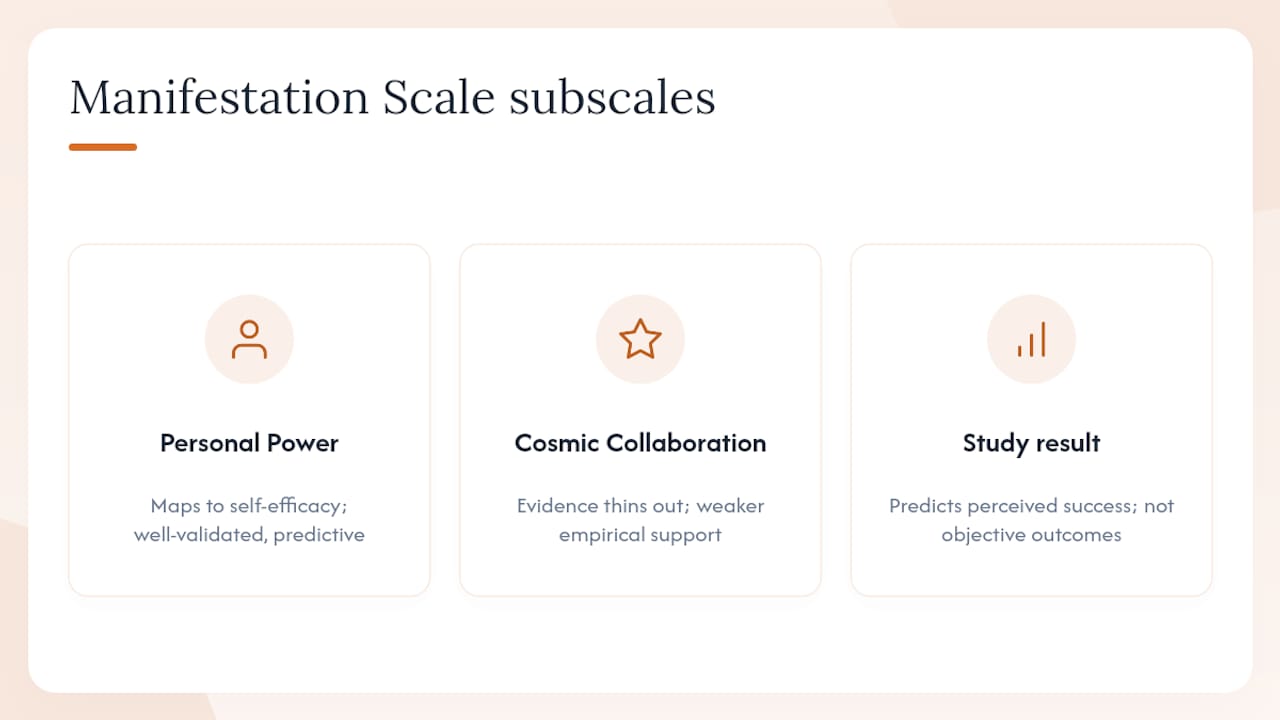
Over one third of participants endorsed manifestation beliefs. Higher scores on the scale predicted stronger perceived likelihood of future success. But those same scores did not reliably predict objective success measures like income or education level. People who believed strongly in manifestation felt more confident about their futures. Their actual outcomes did not consistently improve.
The scale itself has two subscales: Personal Power (belief in one’s own ability to shape outcomes through mindset) and Cosmic Collaboration (belief that the universe or external forces respond to intention). Personal Power maps closely onto self-efficacy, a well-validated psychological construct with strong predictive power. Cosmic Collaboration is where the evidence thins out.
Where psychology and neuroscience agree
Cognitive psychologists largely agree that the core practices inside manifestation, including visualization, positive expectation, and goal rehearsal, map onto established psychological processes. Psychology Today’s analysis notes that these elements align with visualization training, expectancy effects, and self-fulfilling prophecy research. The concern is not with the practices themselves but with the pop-culture framing that strips out the need for action.
The Mayo Clinic’s review of positive thinking finds that optimism is associated with better stress coping and mental health outcomes, both of which indirectly support goal pursuit and resilience. That is a meaningful benefit, even if it falls short of “think it and it appears.”
Where studies agree:
- Visualization and goal rehearsal increase approach behavior and persistence
- Positive expectancy improves stress coping and mental health outcomes
- Belief in personal agency (self-efficacy) predicts better performance across many domains
Where studies conflict or fall short:
- No peer-reviewed evidence supports metaphysical claims (cosmic ordering, universal attraction)
- Manifestation belief predicts perceived success but not objective success measures
- Most studies rely on self-report and correlational designs, limiting causal conclusions
- Sample sizes in many visualization studies are small, and replication is inconsistent
VICE’s long-form coverage of manifestation culture, drawing on The Secret’s cultural history, puts it plainly: manifesting works only when paired with action, and popular narratives routinely oversell the magical interpretation. That framing is consistent with what the peer-reviewed literature actually supports.
The honest synthesis: manifestation works as a psychological system that changes attention, behavior, and decision quality. It does not work as a metaphysical ordering system. Those are two very different claims, and conflating them is where most of the harm originates.
Why manifestation sometimes fails, and what can go wrong
Understanding the failure modes is as important as understanding the mechanisms. Several predictable patterns explain why people try manifestation and get nothing, or worse, end up worse off.
Thought-action fusion
The biggest practical failure is treating thinking as sufficient. When people believe that visualizing an outcome is itself a form of action, they often reduce the concrete steps they take. This is called thought-action fusion, and it is well-documented in the psychological literature. The mental rehearsal is supposed to prime behavior, not replace it. A vision board without a plan is decoration.
Emotional harms and self-blame
When manifestation fails to produce results, the internal logic of many popular frameworks places the blame squarely on the practitioner. You did not believe hard enough. Your vibration was off. You had limiting beliefs. This framing can be genuinely damaging, particularly for people dealing with depression, anxiety, or circumstances shaped by systemic inequality. Telling someone in poverty that they are poor because they think poor thoughts is not just scientifically unsupported. It is harmful.
Systemic limits manifestation cannot address
Discrimination, structural poverty, lack of access to healthcare or education, and other systemic barriers are not solved by mindset shifts. Manifestation practices can help you navigate a system more effectively by sharpening attention and persistence. They cannot change the system itself. Treating manifestation as a substitute for structural solutions, or as an explanation for why some groups succeed and others do not, is both factually wrong and socially harmful.
When overconfidence becomes risky
The Manifestation Scale research found that strong manifestation beliefs can encourage overconfidence in situations where objective conditions do not support optimism. This matters in high-stakes decisions: financial investments, health choices, or career moves where an inflated sense of certainty can lead to real losses.
Pause and reassess if you notice: you are delaying concrete action because you are “trusting the process”; you feel guilty or ashamed when goals do not materialize; you are making financial or health decisions based primarily on belief rather than evidence; or manifestation practice is replacing rather than complementing professional support.
How to try manifestation safely: a practical routine
The evidence points toward a specific combination: clear goals, vivid emotion-engaged visualization, and immediate concrete action. Here is a low-risk daily routine built on that combination.
Daily micro-practice (10–15 minutes)
- Clarify the goal. Write one specific, measurable goal in present tense. “I am building a freelance client base that generates $3,000 per month” is more useful than “I want to be successful.” Specificity is what gives the RAS something to filter for.
- Vivid visualization with emotion. Close your eyes for 3–5 minutes and picture the goal as already real. Engage the senses: what do you see, hear, feel? The emotional engagement is the neurological signal that matters, not the duration.
- Implementation intention. Immediately after visualization, write one concrete action you will take today toward the goal. Use the format: “When [situation], I will [behavior].” Research on implementation intentions consistently shows this format outperforms vague commitments.
- Micro-habit anchor. Attach the visualization to an existing habit (morning coffee, post-workout cooldown) so it runs on autopilot rather than willpower.
- Gratitude note. Write one thing that moved in the right direction today, however small. This trains the brain to notice progress, reinforcing the attention shift the RAS produces.
Weekly check-in template
Copy this into a journal or notes app and review every Sunday:
- Goal check: Is this still the right goal? Has anything changed?
- Action audit: What concrete steps did I take this week?
- Evidence scan: What opportunities or resources did I notice that I might have missed before?
- Emotional state: Am I approaching this from calm purpose or anxious attachment?
- Iterate or stay: Based on the above, do I adjust the goal, the actions, or the approach?
Pro Tip: Calm, purpose-driven goals produce better results than desperate, high-stakes wishing. If you notice anxiety spiking around a goal, that is a signal to either break the goal into smaller steps or examine whether the goal itself is driven by fear rather than genuine desire.
Timeline expectations
Neural embedding takes weeks to months, not days. Realistic timelines for noticing behavioral shifts are 4–8 weeks of consistent practice. Outcomes that depend on external factors (job offers, relationship changes, financial results) take longer and are probabilistic, not guaranteed. Treat the practice as an experiment: run it for 60 days, track what changes, and evaluate honestly.
When manifestation is not enough
Manifestation practices are a useful complement to professional support. They are not a replacement for it.
Seek professional help if you experience any of the following:
- Persistent depression, anxiety, or mood symptoms that do not improve with lifestyle changes
- Suicidal thoughts or self-harm urges
- Addiction or substance dependence
- Severe financial distress (debt crisis, inability to meet basic needs)
- Worsening symptoms after relying primarily on manifestation practices
Where to look for support:
- Licensed therapists and counselors: Psychology Today’s therapist finder (psychologytoday.com/us/therapists) lists providers by location and specialty, including sliding-scale options
- Financial counselors: the National Foundation for Credit Counseling (nfcc.org) offers free and low-cost guidance
- Career coaches: many university career centers offer alumni services at no cost
- Crisis support: the 988 Suicide and Crisis Lifeline is available 24/7 by call or text
Manifestation and professional treatment are not in conflict. Many people find that mindset practices accelerate the work they do in therapy or coaching by building the self-awareness and intentionality that those modalities also develop.
Why the evidence-first approach to manifestation is the one worth taking
Most manifestation content falls into one of two camps. The first oversells the mystical: think it, feel it, receive it, no action required. The second dismisses the whole category as wishful thinking with no scientific basis. Both are wrong, and both leave readers worse off.
The evidence points to something more interesting and more useful. Manifestation practices, when stripped of metaphysical claims and grounded in what psychology and neuroscience actually show, are a legitimate set of attention and behavior-shaping tools. They work because brains are plastic, because expectancy shapes behavior, and because focused attention changes what you notice and pursue. That is not a small thing.
What I find most worth emphasizing, after years of working at the intersection of personal transformation and evidence-based thinking, is that the people who get real results from these practices are almost never the ones waiting for the universe to deliver. They are the ones who use the clarity and motivation that visualization produces to take faster, more targeted action. The practice is the fuel. The action is the engine.
The harm in popular manifestation culture is not the visualization or the journaling. It is the ideology that tells people their circumstances are purely a product of their beliefs, which erases systemic reality and puts all the blame for failure on the individual. A balanced approach holds both truths: your mindset shapes your behavior and your behavior shapes your outcomes, and those outcomes also depend on conditions outside your control.
Structured guidance for readers who want to go deeper
If you have read this far and want a structured program rather than a self-directed experiment, Livethelifeofyourdreams offers digital courses and guides built on exactly the framework this article describes: evidence-informed manifestation that pairs neuroscience-backed visualization and goal-setting with concrete action plans, subconscious reprogramming tools, and accountability structures.

The courses draw on peer-reviewed psychology, Kabbalah principles, and the Law of Attraction, filtered through founder Elvis D. Beuses’s 20-plus years in medical and pharmaceutical careers and his own experience rebuilding after job loss, divorce, and near-deportation. The approach is practical first, spiritual second, and it is designed for people who have tried affirmations and vision boards without lasting results and want to understand why.
Outcomes vary based on individual circumstances, consistency, and the goals you bring. The program pairs mindset practices with concrete action plans because, as the research makes clear, neither works well without the other. Visit Livethelifeofyourdreams to see the current course offerings and find the right starting point for where you are now.
Sources
The sources below are the primary references used in this article. Each is worth reading in full if you want to go deeper on a specific aspect of the evidence.
Neuroscience and mechanisms:
- I’m a Neuroscientist. Here’s Why I Believe in the Power of Manifestation | SELF
- Is Manifesting Magical Thinking or Real Psychology? | Psychology Today
- “The Secret” to Success? The Psychology of Belief in Manifestation – Lucas J. Dixon, Matthew J. Hornsey, Nicole Hartley
- Mayoclinic
- Can imagining a better future really make it come true? | New Scientist
Psychology and evidence review:
Mental health and positive thinking:
Critical and cultural context:
Frequently asked questions
So does manifestation work or not?
The honest version: the universe does not deliver requests, but attention, belief, and expectation measurably change what you notice and do, which changes outcomes. Manifestation works when it is aimed at behavior; it fails as a vending machine.
What evidence supports manifestation ideas?
Goal priming, self-affirmation theory, the bandwidth costs of scarcity, and expectation effects all have solid research. This guide separates those from the claims nobody has ever demonstrated.
What is the most useful daily practice from the evidence?
Write the goal specifically, visualize the process rather than just the outcome, and take one aligned action daily. Each step has research behind it, and together they are most of what works.
Related reading
- Feeling Is the Secret by Neville Goddard: A Guide
- What Is SATS? Neville Goddard’s State Akin to Sleep
- How to Manifest: A Step-by-Step Guide for Beginners
- Neville Goddard: His Teachings, Methods, and Books
- What Is Manifesting? A Clear Guide to How It Works
- Top 7 Money Affirmations That Work Instantly