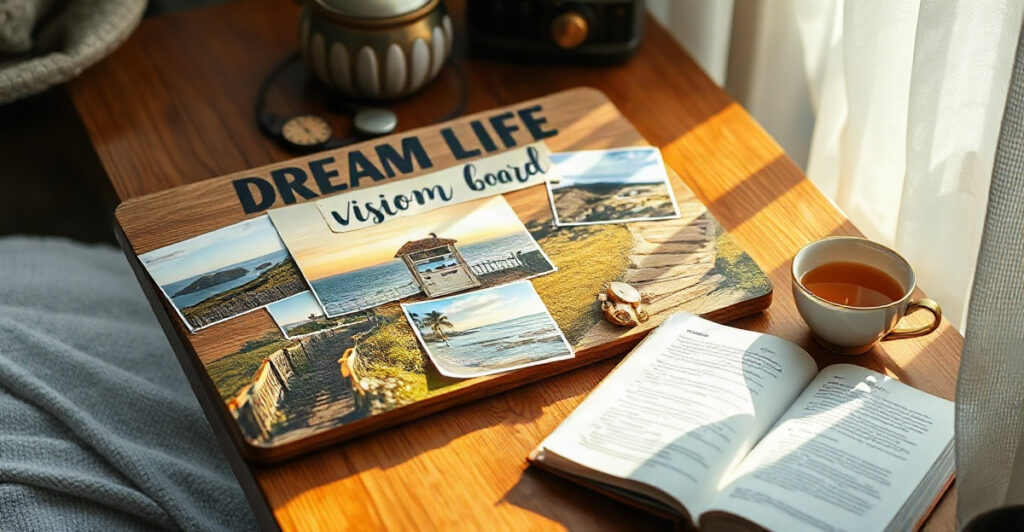
A dream life vision board is a single page of images and words that shows the whole life you want, from your home and work to your health, your money, and the people around you. You make one by picking 6 to 8 life areas, choosing a picture and a few words for each, and then adding one small panel that names what could get in your way. That last piece is what turns a pretty collage into a plan you actually follow.
You already carry the life you’re picturing. The board simply gives it a place to stand where you can see it every day. Let’s build one together, step by step.
What is a dream life vision board?
A dream life vision board is a visual collage of the images, words, and feelings that describe your ideal life, kept where you see it daily. It can be a paper board on your wall, a digital file on your phone, a journal page, or a Pinterest board. The format matters far less than the clarity of what’s on it.
Most people make a board for one goal at a time, like a trip or a new job. A dream life board is wider. It asks the bigger question: if you could shape the whole picture, what would a good day, a good year, and a good decade look like for you?
Think of it the way you’d think of a seed packet. The picture on the front doesn’t grow the plant. But it reminds you what you planted, and it keeps you watering the right bed. A board does the same job for the life you’re growing.
Do dream life vision boards actually work?
A vision board can help, but only when it moves you to act, because the research says that picturing success alone can lower your effort. That is worth knowing before you spend a weekend with scissors and glue.
Psychologist Gabriele Oettingen has studied this for years. In one well-known experiment by Heather Kappes and Oettingen, people who vividly imagined a wished-for outcome felt as if they had already arrived, and their energy dropped. You can read about her method, called mental contrasting, at WOOP My Life. The picture feels so good that the body relaxes, and the work doesn’t get done.
The good news is that the same research points to a fix. When people picture the wish and then also name the real obstacle in their way, they follow through more. Another large body of work on “if X happens, then I will do Y” plans, called implementation intentions, found a medium-to-large effect on goal success across 94 studies in an analysis by Peter Gollwitzer and Paschal Sheeran.
So here’s the honest summary. A board won’t pull your dream life toward you by magic. A board paired with a clear first step and a plan for the likely obstacle is a real tool. That is the version we’re building below.
What should go on a dream life vision board?
Put one image and 1 to 3 words for each major area of your life, usually 6 to 8 areas. More than 8 and the board turns into noise. Fewer than 5 and you’ll find whole parts of your life missing when you look back.
Use the table below as a starting menu. Skip any area that doesn’t call to you, and rename the ones that do.
| Life area | Question to ask yourself | Image idea | Words to try |
|---|---|---|---|
| Home | Where do I wake up, and how does it feel? | A sunlit kitchen, a garden, a quiet porch | Peaceful, mine, light |
| Work and purpose | What do I do with my best hours? | A desk by a window, hands making something | Meaningful, creative, free |
| Money | What does enough let me do? | A savings jar, an open door, a paid-off bill | Enough, steady, generous |
| Health and energy | How do I want my body to feel by evening? | A morning walk, a bowl of fresh food | Strong, rested, calm |
| Relationships | How do I show up, and who do I welcome in? | A shared table, a hand held, friends laughing | Kind, honest, close |
| Travel and play | Where do I want to be curious? | A trail, a coastline, a train window | Wonder, rest, adventure |
| Spirit and peace | What quiets me and reminds me who I am? | A candle, still water, an open journal | Present, grateful, whole |
| Learning and growth | What do I want to become good at? | A stack of books, an instrument, a class | Curious, brave, growing |
Notice that the words in the last column describe a feeling, not just a thing. “Enough” tells you more than a picture of a pile of money ever could. When you choose feelings, your board keeps working even if the exact details change.
If you want hundreds of images and layouts to borrow from, our guide to vision board ideas and examples is a good companion to this page.
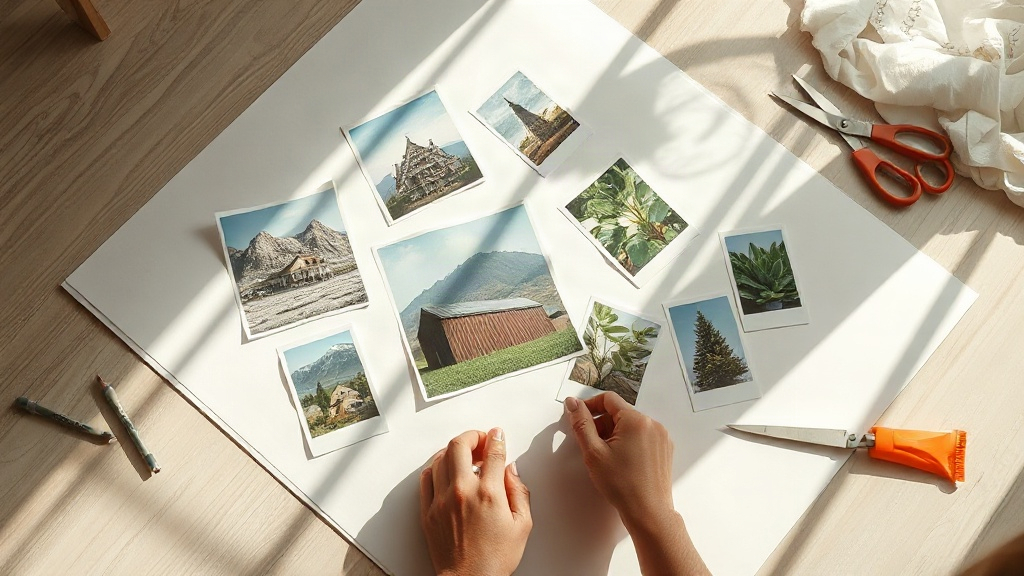
How do you make a dream life vision board step by step?
You make a dream life vision board in 7 steps: quiet your mind, choose your areas, choose your medium, gather images and words, arrange them, add an obstacle strip, and place the board where you’ll see it. The whole thing takes about 90 minutes if you don’t overthink it.
- Get quiet for 10 minutes. Sit with a notebook and ask, “What do I actually want, apart from what I’m supposed to want?” Write whatever comes. This is your raw material.
- Choose 6 to 8 life areas. Use the table above. Write each area at the top of its own notebook line.
- Choose your medium. A physical board is best if you want to touch and cut. A digital board is best if you want to carry it on your phone. The comparison table below helps you decide.
- Gather images and words. Collect more than you need, then cut it down. Pick the ones that make your chest feel a little lighter. If a picture gives you a pang of “I could never,” keep it only if the pang is excitement, not dread.
- Arrange with a center. Place one image of your overall feeling in the middle, such as a sunrise or an open road. Group the life areas around it in a loose grid, and leave some white space so the board can breathe.
- Add the obstacle strip. A small panel in one corner that names your most likely obstacle and your plan for it. We’ll cover this in detail below.
- Place it and look at it. Put it where your eyes land twice a day, such as next to the bathroom mirror or on the phone lock screen. Spend 60 seconds with it each morning, and say one sentence aloud about the life you’re growing.
That is the whole method. Everything else is decoration, and decoration is fun, so enjoy it, but don’t let it replace steps 1 and 6.
Should you make a physical or digital dream life vision board?
Choose physical if you want a ritual and a board you’ll walk past often, and digital if you want it with you all day. Neither is more powerful. The one you’ll look at is the right one.
| Format | Best for | Cost | Main risk |
|---|---|---|---|
| Physical poster board | A calm, hands-on ritual and a visible wall piece | Low: board, glue, magazines | It can end up facing a wall where you never see it |
| Digital collage (Canva, slides) | Easy editing and a phone wallpaper | Free to low | It can sit in a folder and never get opened |
| Pinterest board | Collecting hundreds of ideas fast | Free | Scrolling replaces choosing, and the board gets too big |
| Journal or binder spread | Privacy, and adding notes beside the images | Low | You must remember to open it |
Many people do both. They collect on Pinterest, then pick the best 8 to 12 images for a physical board. That keeps the board small and chosen, which is the point.
How do you add healthy relationship goals to your dream life vision board?
Describe the qualities of the relationship and the habits you’ll bring, instead of pasting a picture of a specific person. A board that says “kind, honest, close” gives you something to practice every day. A board that says “him” gives you only something to wait for.
Healthy relationship goals sit in three buckets. First, who you want to be inside a relationship, such as patient, truthful, or playful. Second, what you want to welcome in, such as steady communication and shared laughter. Third, a weekly practice that proves you mean it, like a phone-free dinner or a real apology when you’re wrong.
This works for a partner, for family, and for friends. If your board is about finding a partner or growing the one you have, we’ve written a full guide on love and relationship vision board ideas that goes deeper, and our page on manifesting love pairs well with it.
What is an obstacle strip, and why does your board need one?
An obstacle strip is a small panel on your board that names the most likely thing to stop you and the exact action you’ll take when it appears. It is the piece the top vision board guides leave out, and it’s the piece the research supports most.
Here is how to write one. Pick your single most important dream, then finish this sentence honestly: “The thing most likely to stop me is ______.” Then write your plan: “If that happens, then I will ______.” Put it on a strip of paper in a corner of the board, or in a small text box on a digital one.
- Money dream: “If I feel the urge to spend my savings on a bad day, then I’ll move $20 into my savings first and wait 24 hours.”
- Health dream: “If I’m too tired to walk after work, then I’ll put my shoes on and walk to the end of the street.”
- Relationship dream: “If I feel the urge to snap in a hard conversation, then I’ll take 3 slow breaths before I answer.”
Doesn’t it feel a little less magical? That’s okay. Magic doesn’t pay the rent. A small plan, written where you’ll see it, is what makes the feeling on the board show up in your Tuesday.
Where should you put your vision board, and how often should you look at it?
Put it where you pass it at least twice a day, and spend one calm minute with it each morning. A board hidden in a closet does nothing. A board you see while brushing your teeth is a gentle daily reminder.
Good spots include the wall beside your bathroom mirror, the inside of a closet door you open every morning, your desk, or your phone’s lock screen. If you share a home, a private journal board or a phone wallpaper keeps it yours without a conversation about it.
When you look, don’t just stare. Pick one image and ask, “What is one small thing I can do today that belongs to this?” Then do it. Looking plus doing is the whole practice.
How do you review your board every 90 days?
Every 90 days, sit with your board for 20 minutes and mark each item as keep, move, or retire. A review keeps your board alive, and it keeps you from clinging to a dream that no longer fits.
| Decision | When to choose it | What to do |
|---|---|---|
| Keep | It still makes you feel light and you took a step on it | Leave it, and write the next step |
| Move | You still want it, but you haven’t acted | Shrink it to a 10-minute action and place it at the center |
| Retire | The excitement is gone, or it was someone else’s idea | Take it off with thanks and replace it |
Retiring a goal is not failing. Seeds you planted last season don’t all belong in this season’s garden. Be kind to the person who chose them, and keep what still grows.
What should you not put on a dream life vision board?
Leave off other people’s goals, a specific person you want to change, vague wishes with no feeling, and anything that makes you feel less than. A board is for what pulls you forward, not for what makes you compare.
- Someone else’s dream. If a luxury car is there because your friends would be impressed, take it off.
- A named person’s behavior. You can’t board someone into loving you or changing. Board the life you’ll live either way.
- Pure punishment goals. “Lose 20 pounds” with a photo of a stranger’s body shames you daily. “Strong and rested” with a picture of a morning walk invites you.
- Too many things. If a board has 40 images, none of them is the point.
Should you share your vision board or keep it private?
Share it only with someone who supports you, and keep it private if sharing makes you defensive or invites advice you don’t want. There is no rule that says a board must be public.
A supportive friend can ask, “How’s the board going?” once a month, and that single question can keep you honest. A critical relative can drain the joy before a dream has roots. A seedling doesn’t need an audience, it needs soil. Let the first weeks be yours.
What if you look at your board and feel nothing?
If you feel nothing, your board is probably built from what you think you should want, so start over with a blank page and a quiet 10 minutes. Feeling flat is information, not failure.
Ask yourself which image still stirs you and which ones feel like homework. Keep the stirring ones and remove the rest. Sometimes a board with only 3 images that you love beats a crowded one you don’t.
Starting from scratch is a normal part of the practice. Each new board is clearer than the last, because you now know a little more about what you want.
Frequently asked questions
How long does it take for a dream life vision board to work?
There is no fixed timeline, because a vision board doesn’t work by itself. What you can measure is your own action: most people feel clearer within 1 to 2 weeks of daily looking, and the first visible results come from the small steps you take, usually within 30 to 90 days.
The reason is simple. The board directs your attention, and your attention directs your choices. If you set one 10-minute step per week for each major dream, 12 weeks gives you about 12 steps toward it. That is why the 90-day review matters. If nothing has moved after a full quarter, shrink the goal and try again.
How many images should a dream life vision board have?
Aim for 8 to 15 images in total, one or two for each of 6 to 8 life areas. That is enough to cover your whole life without becoming noise, and few enough that you can remember the board with your eyes closed.
The reason is attention. A busy board spreads your focus across too many things, and you end up seeing a pattern instead of a message. If you’re unsure, start with 6 images and add one only when it earns its place. A center image of your overall feeling, plus a small obstacle strip, makes a board feel finished.
Can you make a dream life vision board for free?
Yes, you can make a complete dream life vision board for free using old magazines, a piece of cardboard, a glue stick, and a pen. A free digital version works too, using any free design tool or a Pinterest board you keep private.
The cost isn’t the point. The clarity is. A free board with 8 images you chose carefully will serve you better than an expensive kit with 50 pictures you didn’t. If you’d like a head start, our free printable vision board kit gives you the layout and the prompts so you only need to add your own pictures and words.
What is the difference between a vision board and a dream board?
There is almost no difference: both are collages of images and words that show what you want. The term “dream board” tends to be used for a long-term wish list, while “vision board” often implies a plan with a timeframe. Many people use the words interchangeably.
What matters more is whether your board has a first step attached. A dream board with no action is a wish. A vision board with a 90-day review and an obstacle strip is a plan. Use whichever name you like, and build the plan part either way. If you’re making a board for a calendar milestone, our guide to a new year vision board shows how to time it.
Should a vision board include money goals?
Yes, a dream life board should include money, because money touches almost every other area of your life. Choose a feeling word such as “enough” or “steady” alongside a concrete image, like a paid-off bill or a savings jar, so the goal is both emotional and measurable.
The limit is that a picture of wealth does not create wealth. Pair the image with one habit, such as moving a set amount into savings each payday. For more detail, read our guide to a vision board for finances. Be honest about your starting point, and let the board show the next step, not just the faraway mansion.
Is it okay to have a vision board for just one area, like love or health?
Yes, a single-area board is a good place to start, especially if one part of life feels louder than the rest. A focused board on relationships, health, or a home move can be clearer and easier to keep up than a whole-life board.
The trade-off is balance. If every board you make is about work, other areas can quietly shrink. A simple habit is to make a focused board when you need it and a whole-life board once a year. Treat the one-area board as a close-up of one corner of your bigger picture.
If this practice speaks to you, there’s more waiting. Get the free daily “message from the universe” and abundance meditation in your inbox, and let each morning remind you that the life you’re picturing is already trying to find you.
Part of our guide: Vision Boards: The Complete Guide