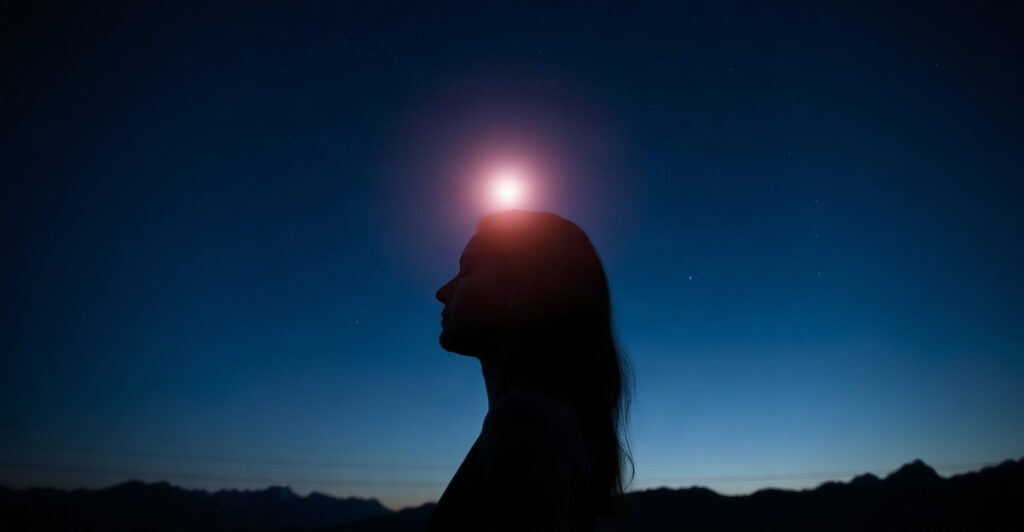
You open your third eye through daily meditation focused on the space between your eyebrows, breathwork, mindful sensory practice, and time. There is no switch and no shortcut. The third eye (the sixth chakra, ajna in Sanskrit) is traditionally understood as the center of intuition and inner vision, and opening it is the patient practice of learning to trust what you perceive before you can prove it. Here is the method, step by step, plus the signs it is working and how to stay grounded while it does.
What is the third eye?
The third eye is the sixth of the seven chakras (ajna, meaning “perceive” or “command” in Sanskrit), located at the center of the forehead between the eyebrows, and it is traditionally associated with intuition, insight, and inner vision. The chakra system comes from ancient Indian tantric texts, and the ajna chakra appears in sources like the classical yoga tradition described by Britannica as a center of perception beyond the physical senses. Across cultures, the symbol recurs: the eye of Horus in Egypt, the dot (bindi) on the forehead in Hindu practice, stone-age carvings of a central forehead eye.
Set expectations honestly, because honest practice is what lasts. Opening the third eye is not about gaining X-ray vision. Practitioners describe it as a gradual sharpening of intuition: knowing who is calling before the phone rings more often than chance explains, sensing a person’s mood the moment they enter a room, seeing images or scenes behind closed eyes during meditation. If you want a grounded, non-mystical description, it is attention training that consistently surfaces information your conscious mind had not assembled yet.
What are the signs your third eye is opening?
The common signs are pressure or warmth at the center of the forehead, more vivid dreams, seeing light or color behind closed eyes, sharper intuition, sudden waves of emotion, and a growing sense of connection to people and places. Not everyone gets every sign, and none of them arrive on a schedule. The most frequently reported ones, drawn from decades of practitioner accounts:
- Forehead sensation: a gentle pressure, tingling, or warmth between the brows, especially during meditation.
- Vivid dreams: dreams that feel more like visits, with detail and emotion that carry into the day.
- Closed-eye light: colors, moving patterns, or brief images behind closed eyes (meditators call these phosphenes, and practitioners read them as the eye learning to look inward).
- Intuition with teeth: hunches that turn out correct so often you stop dismissing them.
- Emotional release: unexpected tears or laughter, old memories surfacing, a sense of things being cleared out.
- Heightened sensitivity: noise, crowds, and screens feel louder, and quiet feels better.
If signs get intense (sleep disruption, anxiety, feeling unmoored), slow down. This is not a failure. Traditional teaching is consistent on this point: open gradually, and stay grounded with food, walking, sleep, and ordinary life.

How do you open your third eye step by step?
You open the third eye through a daily sequence: settle the body, breathe into the forehead point, focus attention there during meditation, visualize an indigo light, sit in silence, then close by grounding. The whole sequence takes 15 to 20 minutes, and the consistency matters far more than the length. Here are the seven steps.
- 1. Prepare the body. Sit comfortably with the spine tall, eyes closed, shoulders soft. An empty stomach or a light one helps, because heaviness pulls attention down.
- 2. Settle with the breath. Take 10 slow breaths, exhaling longer than you inhale. The nervous system has to downshift before subtle perception gets a word in.
- 3. Bring attention to the forehead point. Rest your attention gently at the center of the forehead, as if looking at a candle about a foot from your face. Gentle is the operative word. Straining creates headaches, not visions.
- 4. Breathe into that spot. With each inhale, imagine cool light entering at the forehead. With each exhale, imagine the area softening and widening. Do this for several minutes.
- 5. Visualize the indigo eye. Picture a deep indigo sphere of light at the point, slowly opening like an iris. Hold the image loosely. If it drifts, let it drift back.
- 6. Sit in the silence after. This is the actual opening. Release the visualizations, release the technique, and simply be aware of being aware. Images, colors, or insights may come. Receive them without chasing them.
- 7. Ground to close. Rub your palms together, warm your face, feel your feet on the floor, and name three ordinary things you can hear. Ending grounded is what lets daily life stay steady.
Practice daily for 30 days before you evaluate anything. The ajna tradition treats this as a muscle, and muscles answer to repetition, not enthusiasm.
How long does it take to open your third eye?
Most committed practitioners report the first signs (forehead sensation, vivid dreams, stronger intuition) within 2 to 6 weeks of daily practice, with deeper development continuing over months and years. There is no fixed timetable, and anyone promising one in a weekend is selling something. The honest variables are practice consistency, how much quiet your life contains, and how willing you are to trust subtle perception once it starts. A person who meditates 20 minutes daily and journals their dreams will move faster than someone doing an hour once a week, for the same reason daily stretching beats a single Sunday marathon.
A realistic first-month arc looks like this. Week 1, nothing noticeable except a calmer mind after practice, which is itself the nervous system learning to downshift. Week 2 or 3, the forehead sensation usually shows up first, often mid-practice, sometimes at odd moments like while washing dishes. Weeks 3 and 4, dreams turn strangely detailed and you start catching hunches with better odds. Some people skip straight to week-4 experiences in week 1, and some get nothing for 6 weeks and then everything at once. Both are normal. The only real failure mode is quitting in week 2 out of boredom, which is also the most common one.

Which foods, crystals, and tools support the third eye?
Tradition pairs the third eye with indigo and purple crystals (amethyst, lapis lazuli, sodalite), foods of deep color, and fasting-adjacent light eating, though the tools support the practice rather than replace it. These pairings come from the chakra color system, where each energy center resonates with a color band and the things that carry it.
| Tool | Tradition’s picks | How practitioners use it |
|---|---|---|
| Crystals | Amethyst, lapis lazuli, sodalite | Held at the forehead during meditation or kept at the practice spot. Our guide to crystals for manifestation shows the wider method. |
| Foods | Blueberries, blackberries, purple grapes, eggplant, red cabbage | Eaten lightly before practice, in line with the chakra color system. |
| Sound | The mantra “OM,” chanted aloud or silently | Chanted at the forehead point so the vibration gives wandering attention a rail to ride. |
| Scent | Frankincense, sandalwood, lavender | Diffused during practice, or dabbed diluted at the temples. |
| Teas | Lavender, chamomile, mugwort (in dreamwork traditions) | Sipped in the evening to deepen the vivid-dream side of practice. |
Treat all of these as atmosphere. The practice is attention. Crystals and scent make the practice pleasant enough to keep showing up for, and showing up is the whole game.
How do you stay grounded while opening your third eye?
You stay grounded by keeping ordinary life deliberately ordinary: regular meals, walks outside, physical work or exercise, real conversation, and sleep, especially on days when intuition runs hot. Every serious tradition warns about the same imbalance: fascination with inner experience at the expense of the outer one. The root chakra (at the base of the spine) is considered the anchor, and grounding practices (barefoot walking, gardening, cooking with your hands, weight training) are prescribed as seriously as the meditation itself.
Practical guardrails that work: cap formal practice at 30 to 40 minutes a day, keep a journal so experiences get processed instead of amplified, and keep one or two people in your life you can tell the unedited version to. If practice starts making daily functioning harder rather than easier, that is the signal to rest, not to push.
Frequently asked questions
What does it feel like when your third eye opens?
Most practitioners describe a pressure, tingling, or warmth at the center of the forehead, more vivid inner imagery and dreams, and a quiet confidence in intuition that replaces second-guessing. The experience is usually gradual rather than a single dramatic event.
Can opening your third eye be dangerous?
It is not dangerous when practiced gradually with grounding, but pushing hard can bring sleep disruption, anxiety, or emotional overload. Cap your practice time, stay grounded with ordinary routines, and slow down if life starts feeling less stable.
How do I know if my third eye is blocked?
Traditional signs of a blocked ajna include mental fog, chronic self-doubt, dismissing your own intuition, feeling spiritually disconnected, and over-reliance on pure logic. A blocked third eye is simply an untrained one, and it responds to the same daily practice.
Does the third eye exist physically?
The pituitary and pineal glands are located near where the third eye is pictured, and some traditions link them, but the third eye itself is a subtle-energy and attentional concept, not an anatomical organ. The practices work whether you understand them energetically or as attention training.
Can you open your third eye without meditation?
Slowly, yes: dream journaling, time in nature, art practice, and sensory awareness exercises all develop the same perception. But there is no substitute for the direct attention training of meditation, which is why it anchors every traditional method.
Learning to trust what you perceive before you can prove it is a form of courage, and courage compounds. If you want a daily companion for it, get a free “message from the universe” in your inbox every morning, plus the abundance meditation.