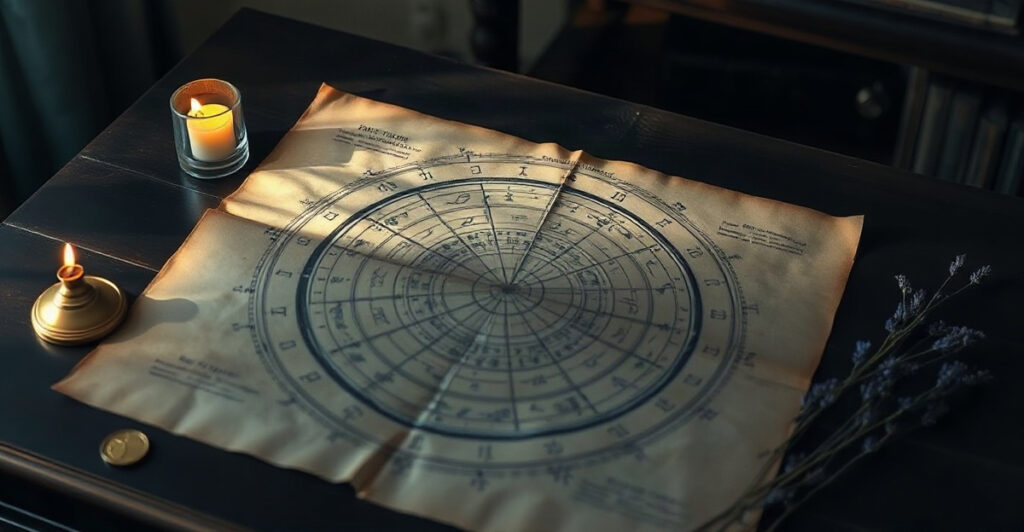
You read a birth chart in three layers: the planets (what is happening), the zodiac signs (how it happens), and the 12 houses (where in your life it happens). Find your Sun, Moon, and Rising first, then walk your planets house by house and each one describes a real department of your life, from money to love to career. Here is the full method, with all 12 houses explained so you can read your own chart tonight.
What is a birth chart?
A birth chart (or natal chart) is a snapshot of exactly where every planet was in the sky at the moment and place you were born, mapped onto a wheel of 12 houses that represent the departments of human life. Astrology’s premise is that this snapshot is meaningful: the sky is a clock, and your chart is the time you arrived. The practice of casting such charts goes back over 2,000 years to Hellenistic Egypt, where astrologers developed the house system still used today, as the Britannica history of astrology traces from Babylonian omen-reading through Greek mathematical refinement.
You need three things to generate one: birth date, exact birth time, and birthplace. The time matters more than people expect, because the wheel rotates roughly one degree every 4 minutes, and the Rising sign changes approximately every 2 hours. If you do not know your time, a birth certificate or hospital record is worth chasing down. (Some chart calculators will also chart for noon, with the Rising sign marked unreliable.)
What are the big three in astrology?
Your big three are the Sun sign (your core identity), the Moon sign (your emotional inner world), and the Rising sign (the lens you meet the world through and the sign on your first house). These three carry most of a chart’s personality information, and they are the right place for any beginner to start. Most people know their Sun. Far fewer know that the Moon changes signs every 2.5 days, so two people born the same week can have completely different emotional wiring. The Rising sign is set by birth time alone and colors everything: it is said to describe your body, mannerisms, and first impression.
Read them as a trio, because that is the first honest reading there is. A Virgo Sun with a Sagittarius Moon and a Scorpio Rising is a different creature than a Virgo Sun with a Pisces Moon and a Libra Rising, even though horoscopes would call both people “a Virgo.” The big three is where the chart stops being a party trick and starts being specific.
What do the 12 houses in a birth chart mean?
The 12 houses are the sectors of the chart wheel, and each one rules a department of life: identity, money, communication, home, creativity, health, partnership, transformation, travel, career, community, and the inner life. Planets show what is active, signs show how, and houses show where. The houses are the “where,” and the order is not random: the chart begins with the self (house 1) and travels outward through possessions, mind, home, romance, work, and other people, ending with the collective and the unseen (house 12).
| House | Rules | In one line |
|---|---|---|
| 1st | Self, body, first impressions | How you arrive in a room |
| 2nd | Money, possessions, self-worth | What you own and how you value it |
| 3rd | Communication, siblings, short trips | How you think and speak daily |
| 4th | Home, family, roots, the mother figure | Where you come from and rest |
| 5th | Creativity, romance, children, play | How you shine and have fun |
| 6th | Daily work, health, routines | Your habits and service |
| 7th | Partnership, marriage, contracts | Who you choose and how you commit |
| 8th | Shared money, intimacy, transformation | What merges, ends, and is reborn |
| 9th | Travel, higher learning, belief | How you expand your world |
| 10th | Career, reputation, public role | What you are known for |
| 11th | Friends, community, long-term hopes | Who you build the future with |
| 12th | The subconscious, solitude, spirituality | What works beneath the surface |
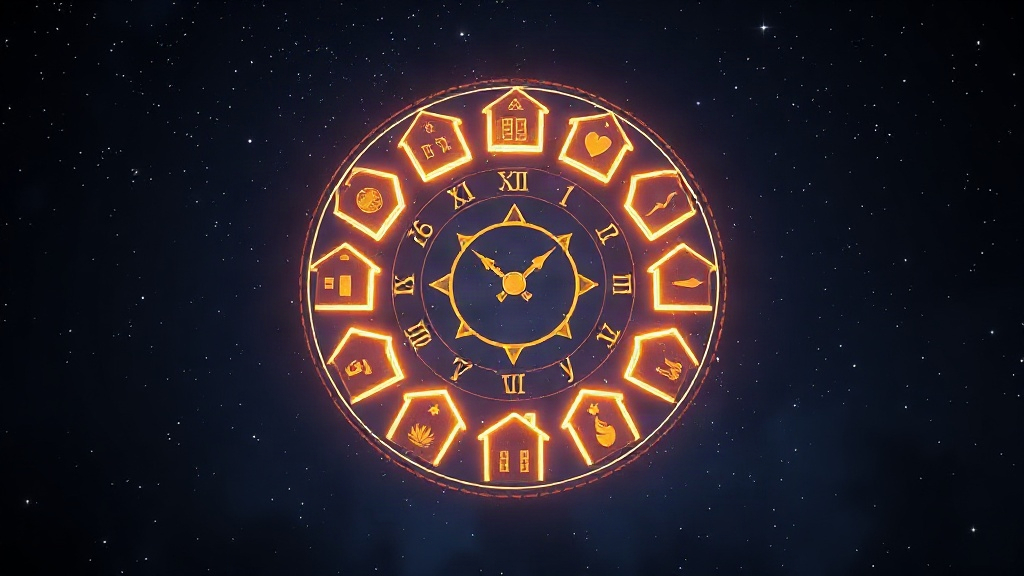
How do you actually read your birth chart step by step?
You read a birth chart by working through a fixed sequence: generate the chart, read the big three, find your chart ruler, then walk each planet through its house and sign, and finally note any clusters or empty areas. Follow these steps in order and the chart reads like a story instead of a wall of symbols.
- Step 1: generate the wheel. Use any accurate calculator with your date, exact time, and place. Print it or keep it open. You will reference it for years.
- Step 2: read the big three. Find the Sun, Moon, and Rising signs and read one paragraph on each. Write your three lines down; they anchor everything after.
- Step 3: find your chart ruler. This is the planet that rules your Rising sign (Mars for Aries, Venus for Taurus and Libra, Mercury for Gemini and Virgo, the Moon for Cancer, the Sun for Leo, Pluto for Scorpio, Jupiter for Sagittarius, Saturn for Capricorn, Uranus for Aquarius, Neptune for Pisces). Its sign and house describe a major life theme.
- Step 4: place each planet. Go planet by planet and read the pairing: “Venus in Scorpio in the 5th house” means love (Venus) expressed with depth and intensity (Scorpio) in romance and creativity (5th house). One sentence per planet.
- Step 5: notice the clusters. Three or more planets in one house or sign is a stellium, and that department of life runs hot in your story. An empty house is not a missing life area; it simply runs on the sign and its ruler alone.
- Step 6: write it down. Keep your one-sentence-per-planet reading in a journal. Charts reward rereading the way journals do.
What do the planets mean in a birth chart?
Each planet represents a drive: the Sun your identity, the Moon your emotions, Mercury your mind, Venus your love and values, Mars your ambition, Jupiter your luck and growth, Saturn your discipline and limits, and Uranus, Neptune, and Pluto the generational forces of change, dreams, and power. The inner planets (Sun through Mars) move fast and describe you personally. The outer three move slowly and describe your whole generation, only mattering personally when they fall in a loaded house or aspect your inner planets.
The fastest useful reading: your Venus and Mars together describe how you love and pursue, your Mercury describes how you think and learn, and your Saturn describes where you feel tested and where mastery is eventually earned. Those three pairs alone generate more self-recognition than most people get from a decade of sun-sign horoscopes.

What are aspects in a birth chart?
Aspects are the measured angles between planets (conjunction 0°, sextile 60°, square 90°, trine 120°, opposition 180°), and they show which parts of your personality cooperate and which ones argue. Trines and sextiles are flowing: those planets help each other. Squares and oppositions are friction: those planets create the productive tensions you spend your life mediating. Conjunctions fuse two planets into one voice. Degree precision matters here (standard orbs run about 8 degrees), and our guide to astrology degrees explains exactly how that measuring works.
Beginners should read only the five major aspects at first. A chart with a Venus-Saturn square tells you love and discipline are in lifelong negotiation; a Moon-Jupiter trine tells you emotional generosity comes naturally. These two facts, read honestly, explain more real behavior than any sun sign ever will.
What does an empty house in a birth chart mean?
An empty house does not mean that life area is absent or doomed: every house influences your life whether or not it holds a planet, and empty houses are read through their sign and ruling planet. This is the most common beginner fear, and it is unfounded. With only 10 planets and 12 houses, empty houses are the norm. Find the sign on the empty house’s cusp, find that sign’s ruler, and read that planet’s condition as the house’s story. Empty 7th house with Libra on the cusp? Your partnerships are ruled by Venus wherever she sits, and that is where the love story lives.
Frequently asked questions
What is the most important part of a birth chart?
The big three: Sun, Moon, and Rising. Together they cover identity, emotional wiring, and outward style, and they are the fastest route to a reading that actually fits. After those, the chart ruler and any stellium carry the most weight.
Do I need my exact birth time to read my chart?
You need it for the Rising sign and all house placements, which is roughly half the chart’s information. Without a birth time you can still read planetary signs and aspects, but get the time from a birth certificate if you possibly can.
Can I read my birth chart without knowing astrology?
Yes, with the step-by-step method in this article: look up your placements, then read each planet-sign-house combination as a single sentence. The vocabulary is finite, and one honest evening with your own chart teaches more than months of generic horoscopes.
What is a stellium in a birth chart?
Three or more planets in the same sign or house. A stellium concentrates enormous energy in one life department and usually marks it as a central theme of the person’s life story.
How accurate is birth chart reading?
Treat it as a mirror for self-reflection rather than a measured science: its value is in the specific vocabulary it gives you for patterns you already half-see. The practices work as structured introspection, not prediction, and they are most powerful when you verify everything against your own experience.
Your chart is a map, but you are the traveler. If you want a daily companion for the journey, get a free “message from the universe” in your inbox every morning, plus the abundance meditation.