A manifestation journal is a focused daily writing practice built around one clear desire, written in first-person present tense with sensory detail, closed out with a short gratitude note. It works by training your attention and rehearsing action, not by wishing anything into existence. Start with 10 to 15 minutes tomorrow morning: script the moment you already achieved your goal, then write three things you’re grateful for right now.
TL;DR:
- Structured, vivid scripting that includes sensory detail and present tense can condition your mind more effectively than vague journaling.
- Repeating intentions through specific methods like the 3-6-9 or 55×5 can reinforce beliefs, but should be paired with emotional engagement to avoid turning into a chore.
- Writing by hand engages motor and memory circuits, making the visualization more impactful and helping uncover subconscious resistance.
- Consistent practice over 21 to 30 days is necessary to produce real identity change rather than temporary mood boosts.
- Addressing resistance and avoiding toxic positivity by naming difficult emotions ensures the practice remains effective rather than reinforcing avoidance.
Table of Contents
- What Manifestation Journaling Actually Does for You
- The Psychology Behind Why Writing It Down Works
- Your First 30 Days: A Simple Daily Protocol
- Scripting Templates and Prompts You Can Copy Today
- Why Manifestation Journaling Stops Working (and How to Fix It)
- What I’ve Learned Watching People Script Their Way Forward
- Ready for a Structured Path Instead of Guesswork?
- Sources
- FAQ
What Manifestation Journaling Actually Does for You
Manifestation journaling differs from a regular diary in one crucial way: it has a job to do. A diary records what happened. A manifestation journal rehearses what you want to happen, using specific writing techniques rather than open-ended reflection. That distinction matters because vague journaling produces vague results, while structured scripting produces a clearer target your brain can track better than vague journaling.
The practice works on four levels. First, it forces specificity. You can’t script “more money” the way you can journal “I felt anxious today.” Scripting demands a number, a date, a scene. Second, it shapes what psychologists call your attentional filter, better known as the reticular activating system, which decides which of the thousands of stimuli hitting your brain each day actually reach conscious awareness. Third, it activates behavior. A person who writes “I signed the contract for my new apartment on Tuesday” is more likely to actually schedule apartment viewings than someone who thinks “I hope I find a place soon.” Fourth, it surfaces the beliefs quietly blocking you. Try scripting financial abundance for five minutes and notice what pops up: doubt, guilt, a memory of a parent saying money is hard to come by. That resistance is data, not a failure.
Manifestation journaling isn’t one technique. It’s a family of related practices:
- Scripting, writing a scene from your desired future as if it’s already happened, in vivid present-tense detail.
- Intention setting, short daily statements that name a specific outcome and the timeframe you’re aiming for.
- Gratitude priming, noting what’s already going right, which primes your brain to notice more of the same.
- Belief work, directly naming and rewriting a limiting belief that surfaces during scripting.
- Future-self letters, a longer-form letter written from the perspective of the person you’re becoming.
Most practitioners rotate between two or three of these rather than sticking to just one.
The Psychology Behind Why Writing It Down Works
Writing a vivid, first-person account of a desired outcome does something a passing thought never does: it engages language centers, memory circuits, and emotional processing at the same time, which makes the imagined scene register more like an actual memory than a daydream, according to ManifestFlow’s analysis of scripting manifestation. Researchers call this episodic future thinking, and it’s the same mental machinery you use to remember your last vacation, just pointed forward instead of backward.
Handwriting adds another layer. The physical act of forming letters recruits motor cortex activity that typing doesn’t reproduce in the same way, which is part of why people report scripting by hand feels more “sticky” than scripting on a phone.
Short, focused sessions written in first person and present tense, packed with sensory detail and emotional tone, are the version of scripting most likely to actually condition new patterns rather than just producing pleasant daydreams.
That guidance, from ManifestationRoutine’s scripting research, lines up with a broader body of work on expressive writing. A University of Michigan study cited by BetterUp’s guide to journaling found that daily expressive writing can reduce depressive symptoms, which matters here because a calmer, less reactive nervous system is what lets you actually notice opportunities instead of scanning for threats all day.
The practical rules that fall out of this research are specific, not vague. Write in first person present tense: “I am,” not “I will be.” Include sensory detail: what you see, hear, and feel in the scene, not just what happened. Keep sessions to 10 to 15 minutes. Repeat consistently over time to build the practice into a habit.

This guidance comes from Elvis D. Beuses, founder of Livethelifeofyourdreams, who spent over two decades in the medical and pharmaceutical industry before building a personal transformation practice grounded in both peer-reviewed psychology and older wisdom traditions like Kabbalah. His approach to manifestation deliberately avoids the mysticism-only framing that dominates a lot of manifestation content, insisting instead that scripting and belief work hold up against actual behavioral science.
Your First 30 Days: A Simple Daily Protocol
Pick your medium before you pick your prompts. A dedicated notebook, kept in one place, works better for most people than a notes app, mostly because handwriting slows you down enough to actually feel the sentence rather than just typing it out on autopilot. If you’re someone who loses momentum without visual proof, a physical journal you can flip back through also gives you something typing rarely does: evidence.
Here’s the session structure that keeps a 10 to 15 minute practice from turning into either a rushed to-do item or a 45-minute spiral:
- Reset for three minutes. Close your eyes, take a few slow breaths, and let your shoulders drop. You’re not scripting from a scattered, phone-scrolling headspace.
- Script for 10 to 15 minutes. Pick one specific desire and write the scene of you already having it, first person, present tense, sensory detail included.
- Close with gratitude. Three lines, no more: things already true in your life that you’re grateful for right now.
- Release and stand up. Physically close the journal. This small ritual signals to your brain that the session is finished, not an open loop you’ll keep chewing on all day.
Morning sessions tend to outperform evening ones, mainly because whatever you write first thing tends to color how you interpret the rest of your day. That said, an evening session is still far better than no session.
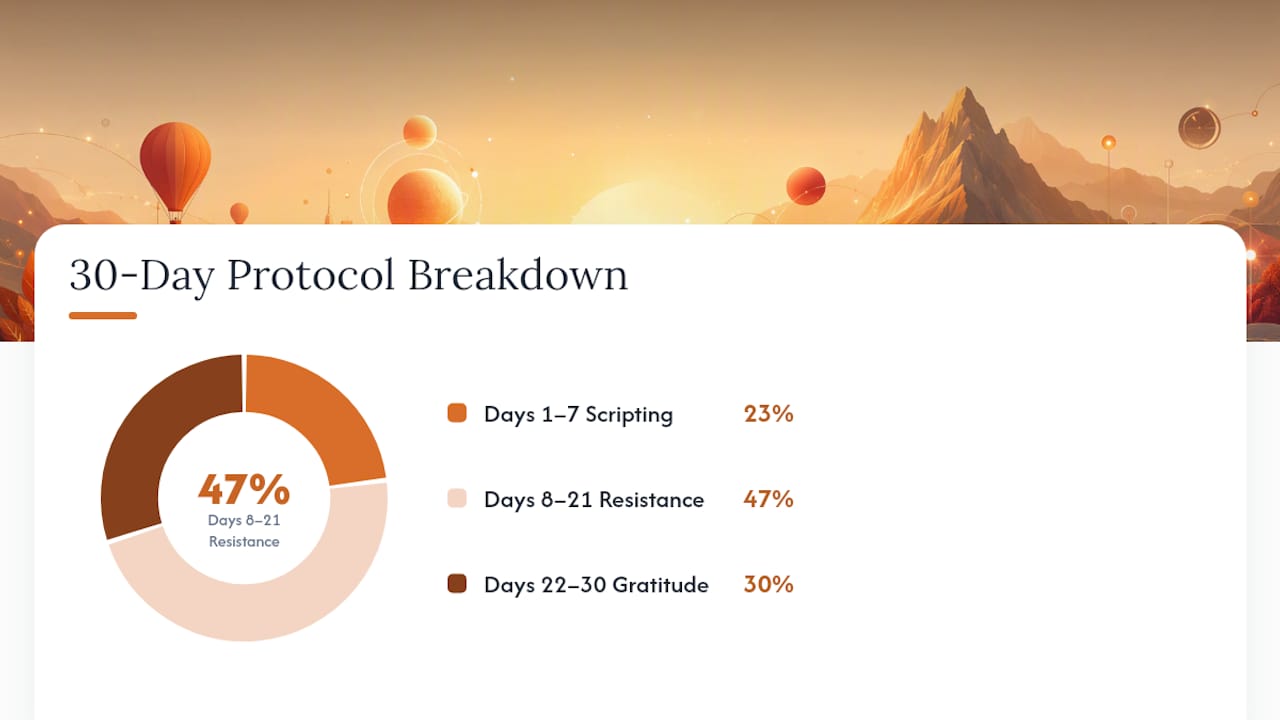
Your first 30 days should look roughly like this: days 1 through 7, pick one desire and stick with it without switching targets. Days 8 through 21, keep scripting daily and start noticing where resistance shows up on the page. Days 22 through 30, add a gratitude line about progress you’ve actually noticed, even something small. ManifestationRoutine’s guidance on scripting consistency points to 21 to 30 days as the minimum runway for this kind of repeated narrative writing to start producing identity-level change rather than a temporary mood boost.
Pro Tip: Keep your phone in another room during the session. A single Instagram scroll before you script will flatten your emotional register right when you need it sharpest, and it’s the single easiest habit to break for better results.
Scripting Templates and Prompts You Can Copy Today
Scripting works best as a scene, not a list. Here’s a short worked example for financial abundance:
“I’m sitting at my kitchen table on a Sunday morning, coffee in hand, checking my banking app. The number makes me smile. I remember exactly how it felt three months ago to worry about this account, and now that worry is just a memory. My hands feel warm around the mug. I text my sister: ‘We should celebrate this weekend.’ I feel calm, steady, like this is simply how things are now.”
Notice what’s doing the work there: a specific day, a physical sensation, a small action (the text), and an emotional contrast with the old worried version of you.
Beyond straight scripting, three structured repetition methods show up constantly in manifestation circles:
- The 3-6-9 method: write your intention 3 times in the morning, 6 times midday, and 9 times before bed. Good for reinforcing a single belief fast, though it can feel mechanical if you don’t vary the wording slightly each round.
- The 3-3-3 method: write your goal 3 times, for 3 minutes, on 3 consecutive days, then rotate to a new but related intention. Lighter commitment, useful if daily scripting feels heavy.
- The 55×5 method: write one affirmation 55 times over 5 consecutive days. Best used for cracking a single stubborn belief rather than as your everyday practice.
Combining a full scripting session with a short repetition method can increase effectiveness, according to some reports. Scripting builds the emotional scene; the repetition method locks in the language, according to ManifestationRoutine’s breakdown of scripting techniques.
A grouped prompt bank helps when you sit down and blank on what to write. Sequencing prompts from release to gratitude to embodiment to action stops you from skipping past hard material straight to forced positivity, a pattern ManifestationRoutine’s prompt research flags as a common failure point.
Clarity prompts: What does success actually look like in six months? What am I avoiding naming out loud?
Belief work prompts: What would I have to believe about myself for this to already be true? Where did I first learn the opposite belief?
Alignment prompts: What’s one action today that matches the person I’m scripting toward? Where am I saying yes out of fear instead of desire?
Gratitude prompts: What’s already better than it was a year ago? Who supported me this week without me asking?
A 10 to 15 minute morning session should lead with one clarity or belief prompt, move into full scripting, and close with two gratitude lines. An evening completion ritual can be shorter: one line naming something that went well, one line releasing a worry from the day.
Why Manifestation Journaling Stops Working (and How to Fix It)
Most people who quit journaling don’t quit because the practice failed. They quit because they hit one of a handful of predictable walls.
- Toxic positivity. Forcing yourself to feel grateful while ignoring real frustration doesn’t process the frustration, it just buries it. UW Medicine’s research on toxic positivity makes clear that naming difficult emotions is necessary, not a detour from the work.
- Mechanical repetition. Writing the same sentence 55 times with zero feeling attached turns scripting into a chore instead of a rehearsal.
- Attachment to timing. Checking constantly for proof it’s “working” creates the exact anxious, scarcity mindset the practice is meant to dissolve.
The fixes are almost always simpler than people expect. If positivity feels forced, add a belief-work prompt before you script, and let yourself write the ugly sentence first. If repetition feels dead, cut the session shorter rather than longer. If you’re anxious about outcomes, pair journaling with one small, measurable action each week, like sending one job application or having one honest money conversation, so progress has somewhere real to show up.
Progress looks less dramatic than most people expect going in: more clarity about what you actually want, a noticeably calmer response to setbacks, and small external wins that used to feel unlikely.
What I’ve Learned Watching People Script Their Way Forward
The biggest misconception about manifestation journaling is that it’s about attracting something from outside yourself. It isn’t. It’s a rehearsal tool, and rehearsal only works if you eventually get up and perform. I’ve watched people script beautifully detailed futures for months while avoiding the one uncomfortable conversation or application that would have actually moved them there.
The people who get real results are the ones who let the journal surface their resistance instead of writing around it. One reader described scripting a promotion for weeks before realizing, mid-session, that she’d never actually asked for it. She had the conversation two weeks later. The journal didn’t cause the promotion. It made the avoidance visible enough to finally deal with.
, Elvis
Ready for a Structured Path Instead of Guesswork?
If you’ve read this far, you already know journaling works better with structure than with a blank page and good intentions. That’s exactly the gap Livethelifeofyourdreams was built to close: a guided program that pairs evidence-informed scripting methods with the deeper belief and subconscious work that a prompt list alone can’t reach.

Inside, you’ll find a structured course, downloadable scripting and gratitude prompts organized by theme, and teaching that blends neuroscience with older wisdom traditions like Kabbalah rather than treating manifestation as pure mysticism. It’s built for readers who’ve already tried journaling and affirmations on their own and want something with more scaffolding behind it. Visit the Livethelifeofyourdreams program page to see what’s included and find the resource that matches where you’re starting from.
Sources
For readers who want to keep researching beyond this guide, a few sources are worth your time. ManifestFlow’s piece on scripting manifestation covers the episodic future thinking mechanism in more depth. ManifestationRoutine’s scripting guide and its prompt library are useful for practical templates. BetterUp’s journaling overview summarizes the mental health research. UW Medicine’s toxic positivity explainer is worth reading before you start any gratitude-heavy practice.
- Scripting Manifestation, How to Write Your Reality | ManifestFlow
- How to start journaling | BetterUp
- Toxic positivity, Right as Rain (UW Medicine)
FAQ
How Do You Write a Manifestation Journal?
Pick one specific desire, write it as a present-tense scene with sensory detail for 10 to 15 minutes, and close with two or three lines of gratitude for what’s already true in your life.
What Is the 3-6-9 Journaling Method?
The 3-6-9 method has you write your intention 3 times in the morning, 6 times at midday, and 9 times before bed to reinforce a single belief through repetition.
What Is the 3-3-3 Journal Method?
The 3-3-3 method involves writing your goal 3 times, for 3 minutes, on 3 consecutive days, then moving to a related intention, making it a lighter alternative to full scripting.
What Is the 777 Rule of Manifestation?
Definitions of repetition methods vary across manifestation content, and the 777 rule isn’t a technique with strong research backing the way scripting or expressive writing has. If you come across it, treat it as one more repetition variant rather than a proven method.
How Long Should a Manifestation Journaling Session Last?
Most guidance points to 10 to 15 minute sessions, done daily or close to it, for at least three to four weeks before you evaluate whether a technique is working for you.
Frequently asked questions
What should I write in a manifestation journal?
Three things work best: scripted scenes of the goal already achieved, daily gratitude with specifics, and a weekly log of what the practice produced. The guide gives page templates for each.
How is journaling different from just visualizing?
Writing forces specificity and leaves evidence. A visualization can drift; a written scene can be reread, compared, and improved, which is what turns practice into progress.
How often should I journal for manifestation?
Daily short entries beat weekly marathons. Five minutes in the morning, plus a weekly review, is the whole system.
Quick reference
| Page type | What to write | When |
|---|---|---|
| Scripting page | The goal already achieved, present tense, sensory detail | Two mornings a week |
| Gratitude page | Three specific things, no repeats from yesterday | Nightly |
| Evidence log | Openings noticed and actions taken that week | Sunday, 10 minutes |