Self-sabotage is any repeated behavior or thought pattern that undermines your own stated goals, usually running on autopilot below full conscious awareness. The Frontiers in Psychology review on self-handicapping describes it as a protective mechanism, not a character flaw. Your first move this week: pick one repeated pattern you recognize and track it.
- Write down what happened right before you procrastinated, picked a fight, or quit early.
- Note the emotion in one word: fear, boredom, shame, relief.
- Rate the urge to sabotage from 1 to 10 before you act on it.
Pro Tip:
Set a phone reminder for 8 p.m. that just says “What did I avoid today?” Answer in one sentence. That single habit surfaces your pattern faster than a week of overthinking.
Structured techniques from CBT, DBT, and IFS have solid backing for interrupting these loops, and you’ll see all three broken down below.
Key Takeaways
Self-sabotage is a learned protective pattern, not a willpower failure, and it responds best to a combination of awareness, targeted therapy techniques, and small repeated wins.
| Point | Details |
|---|---|
| Name the pattern first | Track one repeated behavior this week using a simple trigger log before trying to fix anything. |
| Look for repetition, not one bad day | Sabotage across multiple contexts (work, relationships, health) is the real diagnostic signal. |
| Match the technique to the layer | Use CBT for beliefs, DBT for emotional overwhelm, and IFS when internal conflict is driving the behavior. |
| Watch your upper limit | Sabotage often strikes right after praise, near deadlines, or right before increased visibility. |
| Escalate when patterns persist | Seek a therapist experienced with self-sabotage if daily functioning, substance use, or safety is affected. |
Table of Contents
- What Is Self-Sabotage and How Does It Actually Work?
- Why Do People Self-Sabotage in the First Place?
- What Are the Warning Signs of Self-Sabotaging Behavior?
- How Do You Stop Self-Sabotaging Yourself, Step by Step?
- When Should You See a Professional for Self-Sabotage?
- How Does Livethelifeofyourdreams Approach Self-Sabotage?
- The Gap Between Self-Help Advice and What Actually Changes Behavior
- Frequently Asked Questions
- Sources
What Is Self-Sabotage and How Does It Actually Work?
Self-sabotage rarely announces itself as sabotage. It shows up as “being realistic,” “not being ready yet,” or “just needing more time to prepare.” That’s the trick: the behavior wears a disguise that feels reasonable in the moment.
The pattern operates on an unconscious or semi-conscious level, which is why willpower alone rarely fixes it. According to the Frontiers in Psychology review, much of this behavior functions as self-handicapping: creating an obstacle in advance so that if you fail, you can blame the obstacle instead of your ability. Miss a deadline because you started too late, and you never have to find out whether your best effort was good enough.
The giveaway isn’t a single bad day. It’s repetition across different contexts:
- The same pullback right before a promotion, a launch, or a first date.
- The same excuse pattern showing up at work, in relationships, and in health goals.
- Relief immediately after quitting or avoiding, followed by regret hours later.
That relief-then-regret sequence is the diagnostic signal. It means the behavior is doing a job for you, even when it costs you what you say you want.
Why Do People Self-Sabotage in the First Place?
Self-sabotage usually traces back to something that once worked. A behavior that protected you at age eight can quietly wreck your career at thirty-five.
Attachment and early conditioning.
Inconsistent caregiving or childhood instability teaches a nervous system to expect disappointment, so it learns to create distance before someone else can. Healthline’s breakdown of self-sabotage points to this as one of the most common root causes: protective behaviors formed young that later misfire in adult goals.
Fear of success, not just fear of failure.
Success changes your identity, your visibility, and sometimes your relationships. If people close to you have never seen you succeed, doing so can feel like abandoning them or exposing yourself to scrutiny you’re not ready for.
ADHD and executive function.
Self-sabotage frequently overlaps with ADHD, but the Medical News Today overview is clear that sabotage is a behavioral outcome, not a diagnostic symptom. Difficulty initiating tasks or regulating attention can look identical to sabotage from the outside while having a different mechanism underneath.
Affect regulation.
Sometimes the behavior isn’t about fear at all. It’s the fastest available way to reduce an unbearable feeling right now, even if it costs you tomorrow.
Reframing sabotage as protection rather than a personal failing tends to lower shame and make people far more willing to actually change the behavior, a shift both Healthline and clinical writers point to as a turning point in treatment.
What Are the Warning Signs of Self-Sabotaging Behavior?
Sabotage has favorite hiding spots. It tends to show up right before visibility increases, right after praise, or right at the deadline that matters most.
- Procrastination that targets your most important task specifically, while less important work gets done easily.
- Quitting right before a breakthrough, like leaving a job right before a promotion decision or dropping a project at 90 percent complete.
- Push-pull in relationships, pursuing closeness and then creating conflict once things get stable.
- Perfectionism that never ships, where “not ready yet” becomes a permanent state rather than a temporary one.
- Self-medicating with substances, food, or scrolling right after a win, as if success itself needs to be numbed.
Pro Tip:
Ask yourself two questions after any stall: “What would happen if I actually succeeded at this?” and “Who would I have to become?” The answers usually name the exact fear driving the pattern.
How Do You Stop Self-Sabotaging Yourself, Step by Step?
Stopping the pattern takes a sequence, not a single insight. Each step below builds on the last.
1. Build awareness and find your upper limit.
Track the specific moment sabotage tends to strike, whether it’s after praise, near a deadline, or right before visibility increases. Practitioners call this your “upper limit,” the point where things are going well enough that an old, protective pattern kicks in to bring things back down, a concept detailed by Body Brain Alliance’s research on self-sabotage.

2. Interrupt the pattern before it completes.
A mindfulness pause between urge and action helps break the automatic chain. Pair it with an if-then plan: “If I feel the urge to cancel this meeting, then I will wait 24 hours before deciding.”
3. Challenge the belief with CBT.
Write down the automatic thought driving the behavior (“I’ll embarrass myself”), then list actual evidence for and against it. This is a standard CBT thought record, and it works because it forces the belief into daylight where it usually doesn’t hold up.
4. Regulate the feeling with DBT skills.
When the urge is pure emotional overwhelm rather than a belief problem, distress tolerance skills like paced breathing or the “urge surfing” technique from DBT help you ride out the spike without acting on it.
5. Talk to the part of you doing this.
IFS (Internal Family Systems) framing treats the sabotaging behavior as a “part” trying to protect you, not an enemy to defeat. Ask it directly: what are you afraid would happen if you stopped doing this? The answer is often more revealing than any thought record.
6. Scaffold your environment.
Break goals into micro-steps small enough that skipping them feels obviously wrong. Tell one other person your specific goal and timeline. Healthline’s tips for overcoming self-sabotage emphasize this kind of environmental design over relying on motivation alone.
7. Rewrite the identity through repetition.
Every completed micro-goal is evidence against the old story. Multiple small wins in a row can shift self-image more effectively than a big win followed by a crash.
8. Add spiritual practice as a supplement, never a substitute.
Visualization, affirmations, or manifestation rituals can reinforce a new identity once the therapeutic groundwork is in place. Use them alongside CBT or DBT work, not instead of it, especially if trauma or a diagnosable condition is part of the picture.
When Should You See a Professional for Self-Sabotage?
Self-directed tools help most people make real progress. Some situations call for a clinician instead of, or alongside, that self-work.
- Daily functioning is breaking down at work, school, or home.
- Substance use is escalating as a coping tool.
- You’re experiencing suicidal thoughts or persistent self-harm urges.
- The same pattern has resisted every self-help strategy you’ve tried for months.
Prioritize therapists trained in CBT, DBT, or IFS, since each targets a different layer: CBT for beliefs, DBT for emotional regulation, IFS for internal conflict. Ask directly about their experience treating self-sabotage, their typical methods, and a realistic timeline. If executive function seems like the real barrier, request an ADHD assessment. Psychology Today’s guidance on self-sabotage notes the pattern often resurfaces inside therapy itself, so a clinician experienced with it specifically matters more than general credentials alone.
How Does Livethelifeofyourdreams Approach Self-Sabotage?
Elvis D. Beuses built Livethelifeofyourdreams after two decades in medical and pharmaceutical work, paired with his own experience of divorce, job loss, and a near-deportation that forced him to rebuild from very little. That combination shapes the brand’s method: peer-reviewed psychology first, spiritual practice layered on top, never the reverse.
- Courses pair CBT-style trigger tracking with manifestation and visualization exercises.
- Downloadable guides include journaling prompts drawn from evidence-based self-sabotage research.
- A sample exercise: each morning, name one “upper limit” moment from yesterday, then write one affirmation that directly counters the fear behind it.
Beuses’s own story, chronicled in his international bestseller Cómo Vencer el Miedo, argues that fear and scarcity conditioning operate the same way in a corporate office as they do in a struggling immigrant’s first year abroad. The tools to interrupt that conditioning don’t change with the setting.
His approach reaches a 240,000-subscriber YouTube audience built largely on that personal transformation framing, combined with practical technique.
Readers who want the full structured version of this work, including guided rituals and habit scaffolds, can explore the manifestation and personal transformation courses at Livethelifeofyourdreams, built to sit alongside therapy rather than replace it.
The Gap Between Self-Help Advice and What Actually Changes Behavior
Most self-sabotage advice stops at “just be more disciplined,” which is close to useless once you understand the research. Discipline can’t out muscle a protective pattern that’s operating below conscious awareness. That’s the piece conventional productivity content consistently misses.
What the evidence actually supports is treating the behavior as information first. The procrastination, the quitting, the push-pull in relationships: these are data points about what you’re protecting yourself from, not proof you lack character. CBT and DBT give you tools to work with that data directly instead of white-knuckling through it.
Where I’d push back on both camps, therapeutic and spiritual: pure affirmation work without behavioral tracking tends to fade after a few weeks, and pure CBT without any identity work leaves people technically “fixed” but still feeling like frauds. The combination matters more than either half alone.
Start with the trigger log. Not the affirmations, not the therapist search, just one week of honest tracking. Everything else in this piece works better once you know your actual pattern instead of guessing at it.
Frequently Asked Questions
What is the fastest way to stop self-sabotage?
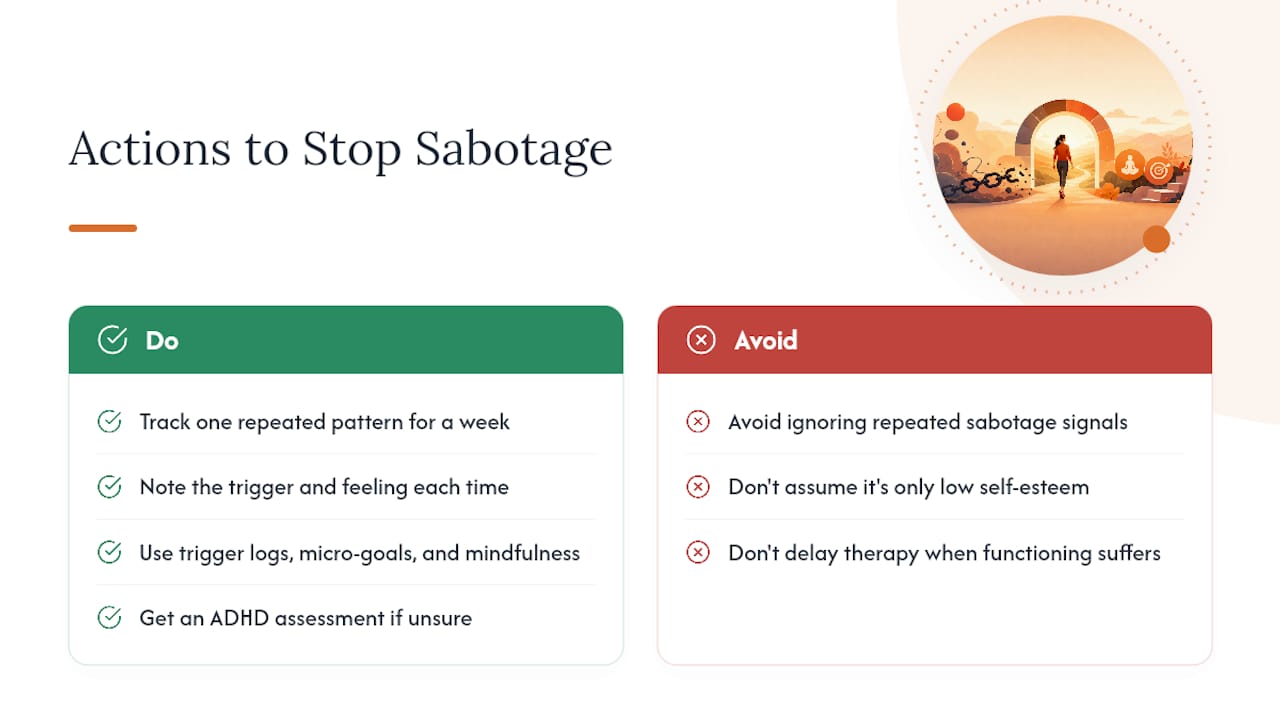
Start by tracking one specific repeated pattern for a week, noting the trigger and emotion each time it happens. Awareness of the exact moment sabotage strikes is the prerequisite for every other technique.
Why do I self-sabotage when things are going well?
This usually points to an “upper limit,” a threshold where success feels unfamiliar or unsafe, often tied to fear of increased visibility, identity conflict, or not having seen success modeled growing up.
Can self-sabotage be linked to ADHD?
Yes, executive function challenges from ADHD can produce behavior that looks like sabotage, but sabotage itself is a behavioral outcome rather than a diagnostic symptom, so an ADHD assessment can clarify which is driving the pattern.
Is self-sabotage the same as low self-esteem?
They overlap but aren’t identical. Self-sabotage is a specific behavior pattern that can stem from low self-esteem, fear of success, trauma, or affect regulation issues, so the underlying cause matters more than the label.
Do I need therapy to stop self-sabotaging, or can I do it alone?
Many people make real progress with self-directed tools like trigger logs, micro-goals, and mindfulness. Therapy becomes important when the pattern affects daily functioning, involves substance use, or has resisted self-help for months.
Sources
- Healthline: Self-sabotage, causes and how to stop
- Medical News Today: Self-sabotage overview and tips
Continue reading
- 7 Law of Attraction Tips That Work When Everything Else Failed
- The 12 Universal Laws of Attraction: What They Are & How to Use Them
- 45 Things to be grateful for in my life today
- 100 “I Am” Daily Affirmations That Will Transform Your Mindset & Manifestation Power
- The Ultimate Guide to Manifesting Mantras, Quotes, Sayings & Affirmations: 300+ Powerful Examples to Transform Your Reality
- Top 7 Money Affirmations to Transform Your Wealth Mindset