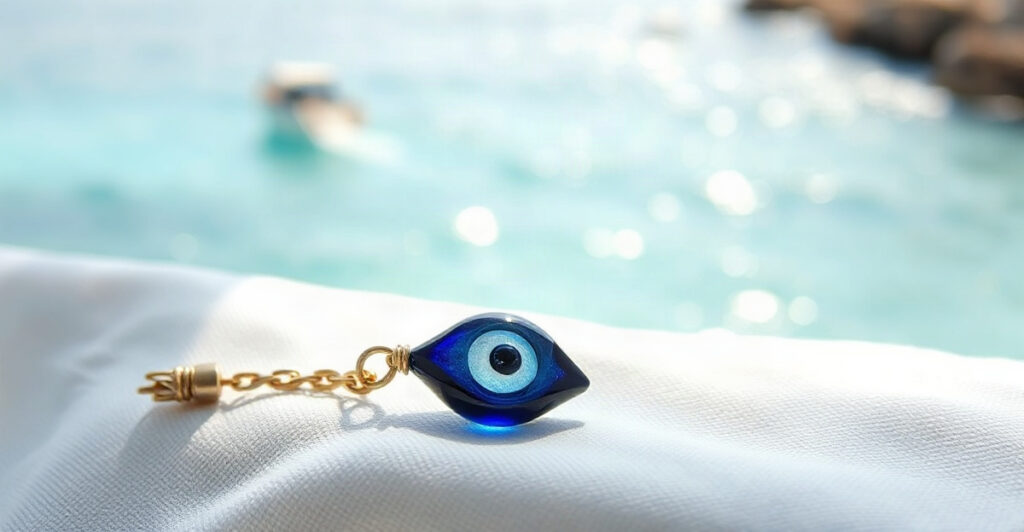
Evil eye protection comes down to three layers: wearing a deflecting talisman (the blue nazar eye, the hamsa hand), keeping your good fortune quiet enough that envy has nothing to bite, and cleansing your energy when you suspect something has already landed. The evil eye itself is a curse transmitted through envy, usually unintentionally, and belief in it spans the Mediterranean, the Middle East, South Asia, and Latin America, going back at least 5,000 years. Here is how to recognize it, block it, and clear it.
What is the evil eye?
The evil eye is a curse believed to be cast by a resentful glance or comment, most often without the sender meaning any harm, that brings misfortune, illness, or bad luck to its recipient. The concept is one of the oldest continuous folk beliefs on earth: archaeologists have found evil-eye amulets in Mesopotamian sites going back thousands of years, and the belief appears in ancient Greek and Roman texts (Plutarch wrote on it), the Hebrew Bible, the Quran’s traditions, and Hindu culture. Anthropologists call it one of humanity’s most widespread superstitions precisely because cultures that never met each other invented it independently.
The mechanism, in every version, is envy. When something good happens to you (a new car, a glowing pregnancy, a thriving business, a happy relationship) and someone looks at it with jealousy, even a flicker of it, their gaze is believed to transmit harm. This is why so many traditional cultures share a reflex: when complimenting a baby, immediately add a protective phrase like “God bless” or “masha’allah.” The praise feeds the family; the phrase deflects the envy.
What are the signs you have the evil eye?
The traditional signs are a sudden run of unexplained bad luck, heaviness or fatigue that rest does not fix, persistent yawning during prayer or talk of your good news, headaches, loss of appetite, and things breaking or going wrong shortly after you celebrated or shared them. Folk diagnostic traditions are remarkably consistent across cultures, and the pattern matters more than any single symptom:
| Sign | What people report | How it differs from ordinary trouble |
|---|---|---|
| Sudden misfortune | Several things go wrong at once, right after a high point | Ordinary bad luck does not cluster after celebrations |
| Heavy fatigue | Body feels weighted, sleep does not restore | Doctors find nothing wrong |
| Involuntary yawning | Yawning while showing off or being complimented | The classic folk test in Mediterranean and Middle Eastern traditions |
| Unexplained mood drop | Anxiety or sadness with no cause, especially after guests left | Lifts quickly after cleansing rituals |
| Physical complaints | Headaches, eye strain, appetite loss, hiccups (in babies) | Traditional cultures test newborns against the eye first |
An honest caveat belongs right here: fatigue, headaches, and low mood deserve a doctor before they deserve a folk diagnosis. Traditional practitioners themselves say this. The evil eye is understood to act on energy and fortune, and nothing about believing in it asks you to skip medical care.
How do you protect yourself from the evil eye?
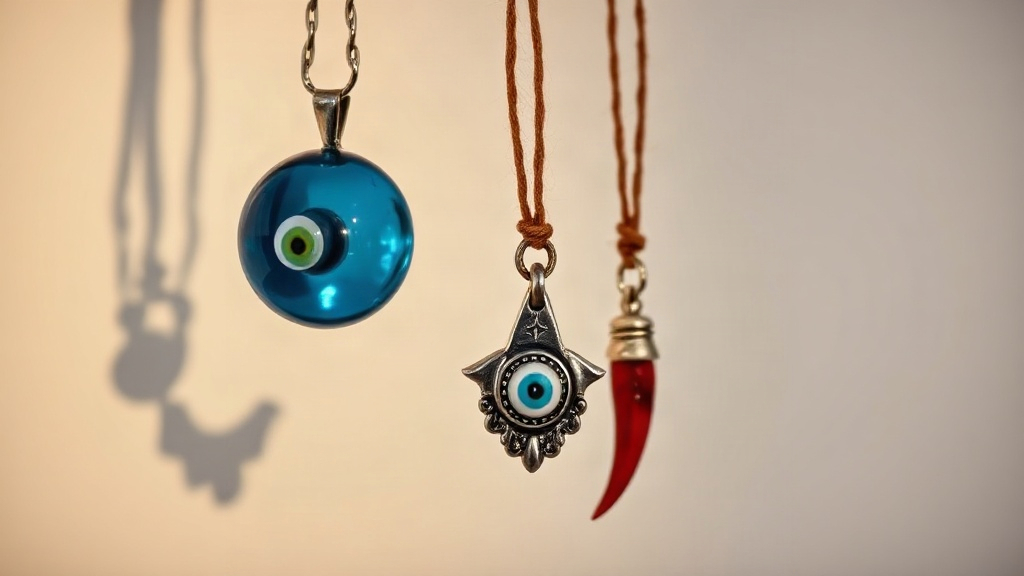
You protect yourself with a deflecting talisman worn or placed where you live and work, modesty about your blessings, and regular energetic cleansing. The three layers work together: the talisman absorbs or bounces the envious gaze, the modesty gives it less to land on, and the cleansing clears whatever slipped past. Here is the full toolkit.
- The nazar (blue glass eye): the famous dark-blue eye amulet of Turkey and Greece, worn as jewelry or hung in homes, cars, and shops. It is a deflector: it looks back at the gaze instead of you. When a nazar cracks or shatters, tradition says it absorbed a hit for you, and it should be replaced, not mourned.
- The hamsa (open palm): the palm-shaped amulet used across the Middle East and North Africa, sometimes with an eye at its center. Palm up it invites blessing, palm down it deflects harm.
- The Italian cornicello: the red horn charm of Naples, worn against envy, often paired with gold in Italian tradition precisely because gold attracts admirers.
- Red thread: in Kabbalah tradition, a thin red string worn on the left wrist (the receiving side) to block negativity from entering.
- Mirrors and reflective objects: small convex mirrors or reflective ornaments hung near entrances bounce the gaze away from the household.
- Salt: a bowl of coarse salt near the door, or a pinch thrown over the shoulder, is the humblest and most universal deflectant.
- Plants: tradition assigns protective roles to rosemary by the door, aloe vera on the patio, and the string-of-pearls plant, each believed to absorb envy before it reaches the household.
If you work with crystals more than amulets, our guide to crystals for manifestation covers protective stones (black tourmaline, obsidian, and amethyst) that practitioners use for the same purpose.
How do you cleanse the evil eye if you already have it?
Traditional cleansing methods include the egg cleanse (rubbing a raw egg over the body, then cracking it into water to read the result), smoke cleansing with incense or dried herbs, salt baths, and ritual prayer such as the Islamic ruqyah or Christian prayers against the evil eye. The egg cleanse (limpia in Latin American tradition) is the most famous: the egg is rolled over the body from head to feet, absorbing the affliction, then cracked into a glass of water where its patterns are read. Smoke cleansing passes incense smoke around the body and through each room. A handful of salt in a warm bath, with the intention of releasing what is not yours, is the gentlest version and the best starting point.
Whatever the method, the frame of mind matters as much as the mechanics. The traditions agree on this: cleansing is done calmly, with the certainty that it works, followed by ordinary life. Fear feeds exactly the energy these rituals are meant to clear.

Can you give yourself the evil eye?
Yes, and most traditions consider self-inflicted evil eye the most common kind: boasting, oversharing good news, or excessive pride invites the affliction without anyone else doing anything. This is the belief’s deepest lesson, and the reason it survived 5,000 years. Cultures that carry the evil eye also carry its etiquette: celebrate fully in private, share accomplishments with humility, and let results speak louder than announcements. The Mediterranean saying captures it: praise the wine, and it turns to vinegar.
Modern manifestation teaching lands on the same ground from a different direction. Guarding your vision (keeping nascent dreams quiet until they have roots) is standard advice in our manifestation journaling guide, and it is the evil eye tradition translated into psychology: early dreams are fragile, and scattering them to every passing opinion drains them.
What does the evil eye mean spiritually?
Spiritually, the evil eye belief teaches that energy is exchanged through attention, that envy is real and protectable, and that humility is a form of self-care rather than self-erasure. Whether you take the curse literally or read it as a metaphor for how envy and gossip affect people, the practices it produced (modesty, talismans, cleansing rituals, blessing what you admire) all function as hygiene for social energy. There is real wisdom in a tradition that hands you something to do with the feeling that someone’s resentment is dragging on you, rather than leaving you to marinate in paranoia.
Wear the eye if it comforts you. Share your joys with people who can hold them. Cleanse when the air feels heavy. And when you compliment someone’s blessing, add the blessing back. That reflex, repeated worldwide for millennia, might be the whole teaching.
Frequently asked questions
What does the evil eye symbol mean?
The blue nazar eye symbolizes a gaze that looks back: it deflects envious attention away from the wearer and onto itself. The eye is a shield, not a curse, despite often being mistaken for one.
Is wearing the evil eye bad luck?
No. Wearing the amulet is considered protective across every tradition that uses it. The symbol represents defense against envy, and the only “bad luck” associated with it is the cracked talisman, which simply did its job and should be replaced with thanks.
What color evil eye is for protection?
Dark blue is the classic all-purpose protection color. Light blue guards general peace and health, orange guards happiness and playfulness, green invites balance, and red is for energy and courage in some traditions.
Where should I hang an evil eye in my house?
Traditional spots are near the front entrance (where visitors and their energy arrive), above or beside windows, in the living room where guests gather, and over a home office desk. Anywhere admiration and attention flow toward your life.
What should I do if my evil eye bracelet breaks?
Tradition says it absorbed an attack meant for you. Thank it, dispose of it respectfully (wrap it and discard, or bury it), and replace it. Many practitioners see the break as proof the protection was working.
Can the evil eye affect babies and children?
In most traditions, babies are considered the most vulnerable, which is why cultures worldwide pin blue eye charms to strollers and add protective phrases when praising a child. A hospital-safe version for newborns is a small charm clipped to clothing rather than worn on the skin.
Protecting your energy is protecting your dreams, and every layer helps. If you want a daily companion for the work, get a free “message from the universe” in your inbox every morning, plus the abundance meditation.