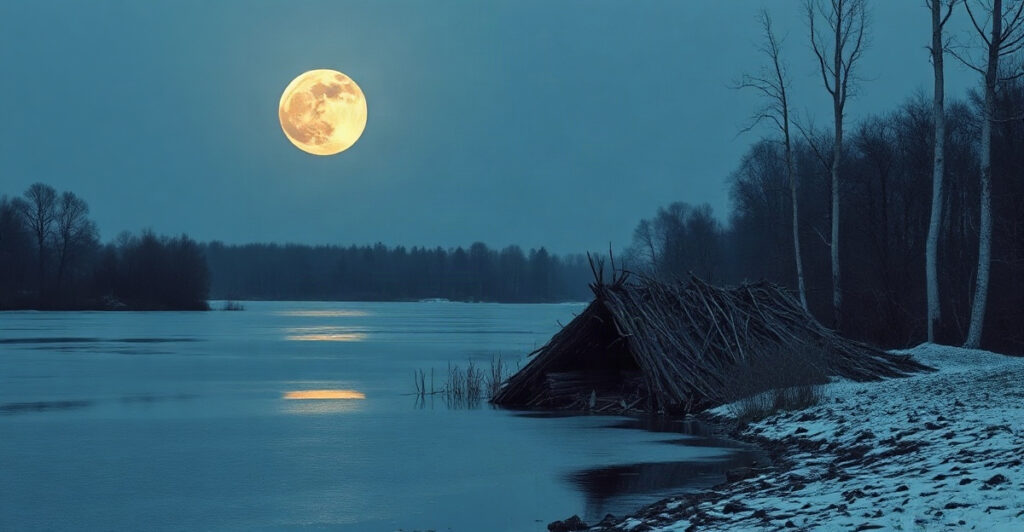
- What it is: the Beaver Moon is the traditional name for the full moon that falls in November.
- Where the name comes from: trappers set their beaver traps in November, before the swamps and lakes froze. The name is credited to the Algonquin people and was later used by European colonists.
- Other names: Frost Moon, Freezing Moon and full frost moon.
- The spiritual theme: preparation, shelter and release. Astrologers describe the mood as release, resolution and illumination.
- When to look: the moon looks full the night before and the night after. Check an almanac for the exact hour in your time zone, because it changes every year.
What is the Beaver Moon?
The Beaver Moon is the traditional name for the full moon that falls in November. It’s one of the old names given to each full moon of the year, names that follow the seasons and the work people did in them.
The moon itself is the same moon you see every month. What changes is the story we attach to it. In November that story is about getting ready for winter.
Think about what that means for a second. Out of all the names people could have chosen for the first real cold of the year, they didn’t pick something mystical. They picked an animal that spends the whole autumn working.
Why is it called the Beaver Moon?
It’s called the Beaver Moon because November was the month when trappers set their beaver traps. It was the last chance to stock up on warm beaver furs before the swamps and lakes froze over for the winter.
The name is usually credited to the Algonquin people, and it was later adapted by European colonists in North America. The Old Farmer’s Almanac helped make it the name that stuck.
There’s a second explanation you’ll see, and it’s softer. In this version the moon is named for the beavers themselves, busy finding shelter and finishing their work before the cold sets in. Both stories point at the same thing, an animal and a season in a hurry.
Which one is right? Sources disagree, and nobody can show you the first person who said the words. It’s fine to hold both. The name works whether it came from the trap line or from the pond.
What other names does the November full moon have?
The November full moon is also called the Frost Moon, the Freezing Moon, or the full frost moon. Mental Floss notes that “beaver moon” is the one that stuck, but the others were used too, and they say the same thing in a different way: the cold has arrived.
Some sources add a few more names, like the Digging Moon and the Deer Rutting Moon. Naming varied from place to place and from nation to nation, so treat any single list as one view and not the final word.
| Name | What the name points to |
|---|---|
| Beaver Moon | Trap-setting season, or beavers preparing for winter |
| Frost Moon | The first hard frosts of the northern autumn |
| Freezing Moon | Ponds and swamps beginning to freeze |
| Full frost moon | The same idea, a different wording, noted by Mental Floss |
When is the Beaver Moon, and how do you see it?
The Beaver Moon is the full moon that falls in November, and its exact date and hour change every year. For the time in your own time zone, check an almanac or a moon calendar such as timeanddate.com.
You don’t have to be exact to enjoy it. The moon looks full the night before and the night after the peak, so you have three evenings to step outside.
For the best view, go out around midnight and find a dark spot, away from streetlights if you can. Some years the November full moon is also a supermoon, which means it’s a little closer to us and a little larger in the sky. Whether it is one this year is easy to look up.
Dress warm. This is a November moon, and the cold is part of the lesson.

What is the spiritual meaning of the Beaver Moon?
The spiritual meaning of the Beaver Moon is preparation. It asks one plain question: what do you need to do now, so that the winter feels safe?
Astrologers add a layer of their own. A full moon is the moment when the sun and the moon sit opposite each other in the sky, and astrologers read that as a time when things come into the open. For this moon they describe the mood as release, resolution and illumination.
Popular astrology writing also attaches themes like adaptability and preparation to the Beaver Moon. These are interpretations, and you’re free to take them or leave them. They aren’t science, and a good teacher will say so.
What I like about this moon is that it asks very little of you that sounds strange. It doesn’t ask you to believe in anything. It asks you to look at your life the way a beaver looks at a pond in November and ask, where is the water leaking?
What can the beaver teach you?
The beaver teaches that safety is built, a little at a time, before you need it. A beaver doesn’t wait for the ice. It builds a lodge, repairs its dam, and stores food where it can reach it all winter.
Look at that from your own side. You also have a lodge, which is the set of things that keep you steady when life gets hard. Your savings. Your sleep. Your health. The two or three people you can call at midnight.
Most of us only check those things when they break. The Beaver Moon is a gentle reminder to check them while the weather is still good.
And notice what the beaver doesn’t do. It doesn’t build alone out of fear, and it doesn’t build a palace. It builds enough. That’s the whole teaching, you don’t need a perfect life to feel safe, you need a sound one.
How do you work with the Beaver Moon? A simple ritual
You work with the Beaver Moon by building your lodge on paper, one small repair at a time. This takes about 20 minutes, and you can do it any night of the three nights around the full moon.
- Light a candle and sit down with a notebook. A single candle is plenty. Turn your phone face down.
- Write what needs shelter. Name 3 things in your life that you want to keep safe through the winter. They can be a person, a habit, a project, or your own health.
- Write what needs stocking. Next to each one, write the one thing it needs from you. Rest, money, a phone call, an hour a week.
- Write what you’re letting go of. Name 1 thing that costs you energy and gives nothing back. The full moon is an old symbol of release, so this step belongs here.
- Say one sentence out loud. Something like, “I am getting ready, and I am getting ready calmly.” Then blow out the candle.
That’s all. It isn’t magic and it doesn’t need to be. The power is in naming the repair before it’s urgent.
If you like to use crystals or breathwork, Bustle’s astrologer suggests meditation, breathwork, yoga and grounding crystals for this moon. Use them if they help you slow down. They’re a way to settle, and the plan on the page is what does the work.
What is the 7-day follow-through?
The 7-day follow-through turns the ritual into action. A full moon ritual with no action is just a nice evening, and a beaver doesn’t live on nice evenings.
Day 1: do the smallest repair on your list. Make the call, or move the money, or book the appointment.
Day 2: clear one thing that drains you. A drawer, an inbox, a subscription you don’t use.
Day 3: tell one person what you’re building. Saying it out loud makes it real, and it gives someone the chance to help.
Day 4: rest on purpose. Go to bed an hour early. A lodge isn’t built by someone who is worn out.
Day 5: stock one thing for the cold months, whether that’s food, a warm coat, or a list of calming things you can do on dark evenings.
Day 6: look at your list again and cross off what’s done. Notice how that feels.
Day 7: choose one thing to keep doing every week until spring. One thing, not ten.
This is the part no one else gives you. Anyone can say the Beaver Moon is about preparation. A week of small actions is how you prove it to yourself.
What is documented, and what is interpretation?
The name and its trapping history are reported by the almanac and by writers who cite it. The spiritual meanings are interpretation, and it helps to keep the two apart so you always know what you’re standing on.
Here’s an honest table. It’s short on purpose, because we shouldn’t claim more than the sources do.
| Claim | What the sources support |
|---|---|
| November’s full moon is called the Beaver Moon | Well supported. The Old Farmer’s Almanac and Mental Floss both use the name. |
| The name comes from the Algonquin people | Commonly credited. Sources differ on exact origins, and some describe it more loosely as a Native American tradition. |
| It marks the time to set beaver traps before the freeze | The most repeated explanation, reported by Mental Floss and others. |
| It is a time of release, resolution and illumination | An astrologer’s interpretation, reported by Bustle. It’s meaningful to many people, but it isn’t established fact. |
| It is a good moon for manifesting | A popular belief with no scientific support. Use it as a reason to plan, not as a promise. |
Does that make the ritual less real? Not at all. A habit doesn’t need ancient permission to work. If it helps you walk into winter steadier than you walked in last year, it did its job.

How does the Beaver Moon connect to the rest of the season?
The Beaver Moon is the first of the winter moons, and the weeks after it lead straight into the solstice and the new year. If you build your lodge now, the later festivals feel like a celebration and not a scramble.
When the solstice arrives, you can read about the old midwinter feast in our guide to Yule, or the sun’s turning point in the winter solstice meaning. For a quiet ritual at that time, try the winter solstice ritual.
If you want to plan the year ahead, our guide to your personal year number pairs well with the list you wrote tonight.
Frequently asked questions
What is the Beaver Moon?
The Beaver Moon is the traditional name for the full moon that falls in November. It’s named for the season when trappers set beaver traps, or for beavers preparing for winter.
Why is it called the Beaver Moon?
The most common explanation is that November was the time to set beaver traps before the swamps froze. The name is credited to the Algonquin people and was later used by European colonists.
What are the other names for the November full moon?
It’s also called the Frost Moon, the Freezing Moon and the full frost moon. Naming varied by region and by nation.
Is the Beaver Moon always a supermoon?
No. Some years the November full moon is a supermoon, which means it sits a little closer to Earth, but many years it isn’t. Check a moon calendar for the current year.
What is the spiritual meaning of the Beaver Moon?
Its spiritual meaning is preparation and release. Astrologers describe the mood as release, resolution and illumination, which is an interpretation and not a scientific claim.
How can I celebrate the Beaver Moon?
Light a candle, write down what needs shelter, what needs stocking and what to let go of, then say one sentence aloud and follow up with one small action each day for a week.
Build before the cold arrives
The universe keeps sending you signs. Get one in your inbox every morning, join the free daily message from the universe. Want a ritual for the start of a new cycle? Try our new moon manifestation guide.