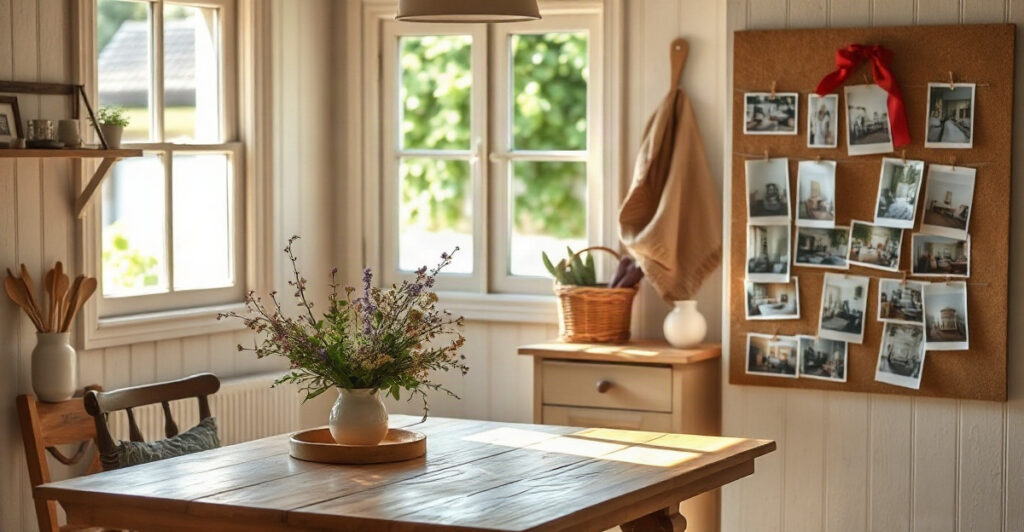
A dream home vision board is a collection of pictures and a few words that show how you want to live and feel at home, not only how the rooms look. To make one, start with the feeling you want, gather 8 to 10 pictures that match it, place the strongest one in the middle, and add a small row of pictures that show the next steps you can take this month. Below you’ll find the questions to ask first, the pictures to choose, a way to lay them out, and one extra step most guides skip: bringing a piece of the dream into the home you live in today.
What is a dream home vision board?
A dream home vision board is a visual plan for the place you want to live, made of pictures, colors, materials and words that capture both the look and the feeling of that home. It’s a close cousin to a mood board, but the two do different jobs. A mood board mostly shows appearance. A vision board also shows how you want to live, who gathers there, and what a Tuesday evening feels like.
That difference matters because a house is the container for your daily life. If you pick pictures only because they’re pretty, you end up with a collage that looks nice and tells you nothing. If you pick pictures because of how they make you feel, the board starts to tell you what to say yes to, and what to say no to.
You may also hear it called a dream house vision board or a home aesthetic vision board. They all mean the same thing: a board for the place you want to call home. The only real choice is whether yours is a decorating plan, a life plan, or both. I’d say both, because your rooms shape your habits more than most of us admit.
Where should you start before you pick any pictures?
Start by answering a few honest questions about the home you have now and the way you want to feel in the next one. Pictures come easily. Clarity takes a little quiet time, and it saves you from collecting 200 images that point in 6 directions.
The home renovation team at Three Birds Renovations suggests a set of 7 questions for a renovation board. They cover how you live now and why you want to change, who benefits most, how you want to feel, what your dream home looks like, what gets in the way of enjoying your home, what would add ease or joy, and what you never want to see again. I like that last one a lot. Knowing what you don’t want is half of knowing what you do.
Take 10 minutes with a notebook and answer these in plain words:
- How do I feel in my home right now? Rushed, cramped, calm, tired?
- How do I want to feel when I walk through the door? Use 3 to 5 feeling words, such as “rested,” “open,” “welcome.”
- Who lives here, and who visits? A home for one is different from a home for six.
- What gets in the way? Clutter, no light, no place to sit, a kitchen too small to cook in.
- What do I never want to see again? Name it, so it stays off the board.
Those feeling words become your filter. When you’re scrolling and a picture makes you pause, ask whether it matches one of your words. If it does, keep it. If it only looks expensive, let it go.
Which pictures belong on a dream home vision board?
The best pictures for a dream home board show light, layout, materials and moments, because those are the things that create the feeling of a home. A whole mansion photo tells you almost nothing. A picture of morning sun on a kitchen table tells you plenty.
Use the table below as a menu. You don’t need every row. Pick the 4 or 5 that match your feeling words.
| Picture type | What it shows you | Search words to try | Feeling it supports |
|---|---|---|---|
| The front door and entry | How you arrive and what greets you | “welcoming front porch,” “entryway bench” | Welcome, ease |
| Light and windows | How much daylight you need | “sunlit kitchen,” “large windows living room” | Openness, energy |
| The kitchen table | Where people actually gather | “farmhouse table,” “round dining table” | Connection |
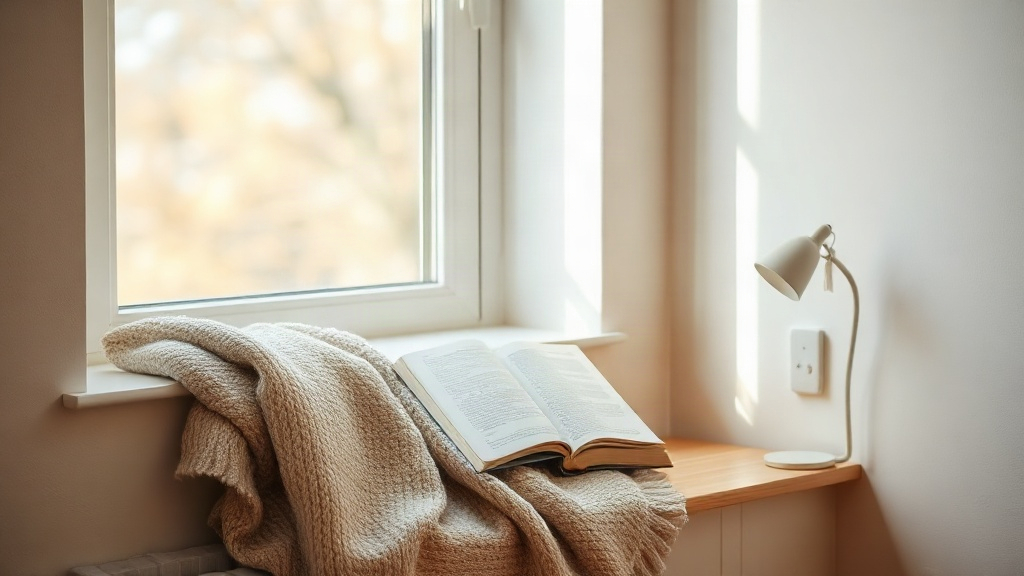
| A quiet corner | Where you rest and think | “reading nook,” “window seat” | Calm |
| Bedroom | Sleep, softness, order | “calm bedroom linen,” “bedside lamp” | Rest |
| Outdoor space | Garden, patio, view | “small backyard garden,” “porch swing” | Peace, play |
| Materials | Wood, stone, linen, metal, tile | “warm oak floor,” “stone countertop” | Grounded, cozy |
| Place and neighborhood | Where the home sits | “walkable village street,” “quiet lakeside town” | Belonging |
One more kind of picture is worth adding: a photo of a real moment at home that you’d like more of. A pot on the stove, a friend on the couch, a child’s drawing on the fridge. Those pictures keep the board about life, not about furniture.
How do you find the right dream home pictures?
You find the right pictures by gathering widely from a few sources, saving anything that makes you pause, and then cutting hard. The Ruoff Mortgage blog suggests looking through old magazines, home catalogs and coffee table books, along with home design blogs, Pinterest, decor shops and even real estate listings, then saving or screenshotting anything that sparks a feeling.
Real estate listings are an underrated source. They show actual floor plans and real rooms at real sizes, so you can see what a 12 by 14 foot kitchen looks like when someone has done it well. A designer showroom photo may be lovely and still impossible in your space.
When you search, use descriptive words instead of the word “dream.” “Cottage kitchen with open shelves” gives you something real. “Dream kitchen” gives you a thousand pictures of kitchens that all look alike. Keep a single folder on your phone or computer named after your board, and drop every saved picture there. Three Birds suggests organising saved images into boards or folders as you go, which makes the cutting step much easier later.
Pay attention to repetition. After about 30 saves, look at them together and ask what keeps showing up. Maybe it’s wood, or white walls, or big windows, or a garden you can see from the sink. That repeated thing is your real taste, and it’s more useful than any trend.
How many pictures should a dream home vision board have?
A dream home vision board works best with 8 to 10 pictures, plus a few words. Three Birds goes as far as saying to choose no more than 10 inspiration images that match your short vision statement and your feeling words, and I think that limit is wise. More pictures means more arguments between them.
It helps to gather 30 and cut to 10. Lay everything out and ask of each one: does this match my feeling words, and does it match a real need in the way I live? Pictures that fail both tests go back in the folder. Pictures that pass one are on probation. Pictures that pass both go on the board.
The same Three Birds method asks you to write your vision in 3 to 5 words, describe the feeling in a few more, and even invent a hashtag for it. You don’t have to post the hashtag anywhere. A short phrase like “sunlit and slow” or “a house that hosts” is a handy label to read aloud when you look at the board.
What is your home style, and how do you spot it?
Your home style is the pattern of colors, textures, shapes and materials you keep choosing, and you can find it by looking for repeats among your saved pictures. You don’t have to call it by a name like farmhouse or mid-century modern, though those names are handy when you shop. The Ruoff blog lists styles such as mid-century modern, industrial, farmhouse and French country, and notes that you can look for patterns like warm woods and vintage touches, or crisp lines and metallic finishes.
The Freelancer guide to dream home mood boards breaks a good board into 6 elements: patterns, colors, pictures, textures and materials, typography and key furnishings. That’s a useful checklist. Ask yourself which of the 6 you’ve already covered, and which are missing.
| Element | What to look for in your saved pictures | How to use it at home |
|---|---|---|
| Colors | Which 2 or 3 colors repeat? | Pick a core palette, then add one accent |
| Materials | Wood, stone, linen, leather, metal? | Choose the most important material first and build around it |
| Shapes | Round tables or square? Arched doors? | Repeat one shape in 3 places |
| Light | Bright and open, or soft and low? | Pick bulbs and curtains to match |
| Key pieces | One sofa, one table, one chair that keeps appearing | Save for those first |
Freelancer also recommends placing your most important material first and building the rest around it. If a warm oak table sets the tone for you, let the chairs, the lamps and the wall color answer to the table. That one decision simplifies a dozen others.
And don’t forget the home you have now. Three Birds makes the point that it’s wise to understand your home’s existing style before choosing a look, because working with the architecture you already have is usually cheaper than fighting it. A 1920s bungalow, for example, tends to look better leaning into its own character than pretending to be a different kind of house.
How do you lay out a dream home vision board?
Lay out a dream home vision board with one large anchor picture in the center, a ring of 4 to 6 medium pictures around it, and a thin strip of small action pictures along the bottom. Leave empty space around everything. A board that breathes gets looked at. A crowded one becomes wallpaper.
- Choose the anchor. This is the single picture that gives you the feeling fastest, often a room full of light or a table full of people.
- Add your feeling words in your own handwriting near the anchor.
- Place medium pictures for entry, kitchen, quiet corner, bedroom and outdoor space around it.
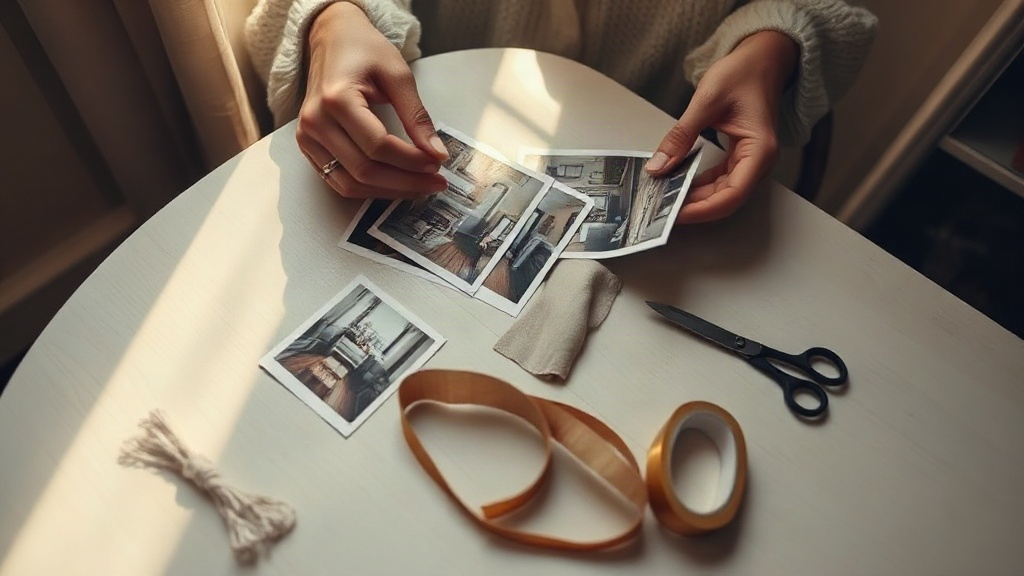
- Add one materials swatch or sample if you can: a paint chip, a bit of fabric, a scrap of wood.
- Finish with the doing strip, described below.
Physical samples matter more than they seem to. A picture of a linen curtain doesn’t tell you how it feels or how it looks in your own light. A snip of the real thing taped to the board does. If you’re working with a designer or a partner, the Freelancer guide notes that a stricter, organized board can help a designer understand what you want, and you can start messy and tighten it later.
What is the Borrow List, and why does it matter?
The Borrow List is a short written list, beside your board, naming one feature of each dream picture that you can bring into the home you live in right now, this month. It’s the step that turns a board you admire into a home you start living in, and I haven’t seen it in the top guides on this topic.
Here’s how it works. Next to each medium picture, write one small, cheap, doable borrowing.
- Sunlit kitchen picture: wash the window over the sink and move the plant there.
- Reading nook picture: clear one chair, add one lamp, and put a book on the arm.
- Warm wood table picture: oil the table you have, or put a wooden board in the center.
- Garden picture: buy one pot of herbs for the step.
- Welcoming entry picture: give the front door a wipe and set a small bench or hooks.
Why does this matter? Because your mind learns a lot from small proofs. If you wait for the big house before you live the feeling, the feeling stays in the future and gets heavier every month. When you borrow even one piece today, your daily life starts to match your picture. And it gives you better information, too. If you borrow the reading nook and never sit in it, maybe that picture was someone else’s dream, and you’ve learned that for the price of one lamp.
A good rule: no borrowing should cost more than you’d spend on a nice dinner out. The point is not to redecorate. The point is to let the dream touch your Tuesday.
Do pictures of your dream home help you get it?
Pictures can help you decide and act, but the research is clear that picturing only the finished result isn’t enough, and sometimes it works against you. In a set of 4 experiments by psychologists Kappes and Oettingen, people who indulged in positive fantasies about a desired future showed lower energy and, in one study, achieved fewer of their goals over the following week, as the British Psychological Society’s Research Digest reports. The authors suggest that fantasies which also face obstacles may be better for gathering the energy to act.
There’s a second finding worth knowing. As described in an article on the Nir and Far site about visualizing your goals, researchers Lien Pham and Shelley Taylor at UCLA split college students into two groups. One group pictured getting an A, and the other pictured the process of studying, such as going to a dorm room, closing the door and turning off distractions. The process group did better on the real exam.
What does that mean for your board? It means the picture of the finished home is the beginning, not the whole plan. Add pictures of the doing: a savings jar, a calendar page, a hand holding a paint brush, a phone calling a real estate agent. Honest limit: these studies were not about vision boards in particular, and nobody has proven that a board will get you a house. Think of the board as a way to keep your attention on what you chose, paired with steps you really take.
That’s the doing strip. Along the bottom of your board, add 3 to 5 small pictures that show this month’s actions. Change them as you finish them. It’s a quiet way to keep the dream and the work in one glance.
What is a home aesthetic vision board?
A home aesthetic vision board is a dream home board that leads with the look and mood of your space, such as soft neutrals, cottage charm or clean modern lines, before the practical details. It’s the version people most often build on Pinterest, and it’s a fine starting point as long as you pair the look with a feeling.
To build one, pick your 3 core colors, your lead material and your overall mood in a short phrase, such as “quiet cottage” or “warm minimal.” Then choose 8 pictures that all fit that phrase. If you want more help with the look-first approach, our guide to aesthetic vision board ideas goes deeper into palettes and moods, and our guide to a dream life vision board shows how to connect your home to the rest of your life.
Just remember that an aesthetic is a surface. Under it, ask what the space is for. A home that looks calm but has no place to rest isn’t calm. A home that looks plain but has one good chair by a window can be.
What is a prayer vision board for your home?
A prayer vision board is a vision board you pair with a few quiet minutes of prayer, thanks or intention, so the pictures become a way of giving thanks and asking, not only wanting. It’s a personal practice rather than a set of rules, and people shape it to their own faith and words.
For a dream home board, one beautiful addition is a gratitude picture: a photo of the home you live in now, taken on a good-light day. Place it near the bottom of the board, and put a few words beside it, such as “thank you for this place that holds me.” That small picture does something good. It keeps the board from becoming a list of what you lack, and it reminds you that the dream is growing out of a life you already have.
Then, each morning or evening, look at the board for a minute, say a short prayer or thank-you in your own words, and read your Borrow List. Ask for help with the next small step. Nothing about this needs to be fancy. A minute of quiet attention is enough. If prayer isn’t part of your life, a minute of simple thanks works the same way.
How do couples and families make a dream home board together?
Couples and families should each make a short board alone first, then compare them side by side and build a shared board from what overlaps. That order protects each person’s real wants from being drowned out by the loudest voice in the room.
Give each person 20 minutes and a limit of 6 pictures. Then lay them out on the table. Circle every match, such as two of you choosing the same kind of kitchen or a big window. Those overlaps become the center of the shared board. For the differences, ask a simple question instead of arguing: what feeling were you looking for in this picture? Two people can want very different rooms and the very same feeling. One person wants an open plan to feel connected, the other wants a library corner to feel calm, and both can have a version of what they need.
For children, give them one picture each, of their own space, and let them place it. It’s a lovely way to make a home feel like theirs, and it gives you a peek into what matters to them.
Should a dream home vision board be digital or physical?
Choose a physical board if you want to slow down and feel your choices, and a digital board if you want to edit quickly and share with others; many people do both. The Freelancer guide recommends digital for its easy editing, and mentions tools such as Canva, Milanote, Mural and Pinterest. Three Birds also names Canva as the tool they use for their own projects.
| Format | Best for | Watch out for |
|---|---|---|
| Physical board | Real samples, daily presence on a wall, slow decisions | Harder to change, easy to overcrowd |
| Digital board | Fast edits, sharing with a partner or designer | Out of sight, out of mind |
| Both | Making it by hand, then photographing it as a phone wallpaper | Keeping the two in sync |
If you go digital, set the board as your phone lock screen, so you see it many times a day. If you go physical, hang it where your eyes land without effort: beside the bathroom mirror, above your desk or on the side of the fridge. You can print our free printable vision board kit if you’d like a ready-made layout to start with.
How do you turn the board into real choices?
You turn the board into real choices by using it as a filter every time you spend money, pick a color or decide whether to say yes to a house, a rental or a repair. That’s how Three Birds describes the board’s best use: a reference for choosing tiles, paint, wallpaper and finishes, and a shared direction for the architect, the builder and you.
Before a purchase, hold it up to the board in your mind. Does it match the feeling words? Does it match the materials and palette? If yes, buy with confidence. If no, wait a week. Most impulse buys fail this test, and the money you don’t spend becomes part of the doing strip.
If your dream home depends on saving a down payment or finishing a big repair, pair your pictures with a money plan. Our guide to a vision board for finances shows how to connect a picture to an account and an amount.
How often should you update your dream home board?
Update your dream home board every 3 to 6 months, or sooner after a big change such as a move, a new baby, a job shift or finishing a project. Tastes change, and Freelancer notes that a board can take anywhere from two weeks to two years to feel right. That’s normal.
At each review, do three things. Move finished doing pictures to a “done” page, so you can see progress. Swap any picture that no longer makes you lean forward. Add a new Borrow List item for each medium picture. Keep the feeling words unless they’ve truly changed.
Common mistakes to avoid:
- Too many pictures. Past 10, the eye can’t land anywhere.
- Pictures that make you feel behind. If a photo makes you feel small, replace it.
- No feeling words. Without them, you’re decorating, not envisioning.
- No next step. A board with no doing strip is a poster.
- Waiting for the big house. Borrow something this week.
A home is where your life gets lived, so let the board be about the living. Start with the feeling, choose pictures you can feel, borrow one thing today, and let the rest unfold at its own pace.
Frequently asked questions
How do you make a dream home vision board?
To make a dream home vision board, write 3 to 5 feeling words, gather about 30 pictures that match them, cut down to 8 to 10, and arrange them with one large anchor picture in the center. Add a short phrase for the whole board, such as “sunlit and slow,” and a few words in your own handwriting.
Then add a strip of 3 to 5 small pictures along the bottom that show this month’s real steps, such as a savings jar or a paint sample. Studies on process versus outcome pictures suggest that the steps matter as much as the finished image. Hang the board where you see it daily, and update it every 3 to 6 months.
What should you put on a dream house vision board?
Put pictures on a dream house vision board that show light, layout, materials and real moments: a sunlit kitchen, a table where people gather, a reading nook, an outdoor space, the front door, and the neighborhood you want. Add one or two textures, such as a paint chip or a scrap of wood, so the board has real samples next to the photos.
Leave off anything that only looks expensive, since a picture you feel nothing for is decoration. For example, a plain porch swing you’d actually use beats a mansion pool you wouldn’t. Add 3 to 5 feeling words and a photo of the home you live in now, with a word of thanks beside it.
How many pictures should a home vision board have?
A home vision board should have 8 to 10 pictures, with one anchor picture about twice the size of the rest. Three Birds Renovations recommends no more than 10 inspiration images that match your short vision statement and your feeling words, and fewer pictures keep the board readable at a glance.
A phone wallpaper version works best with 4 to 6. To get there, gather 30 and cut, asking of each picture whether it matches your feeling words and a real need in your daily life. Keep the cut pictures in a folder, because some will fit your next update in 3 to 6 months.
What is the difference between a mood board and a vision board for your home?
A mood board for your home mainly shows appearance, such as colors, patterns, textures and furniture, while a vision board also shows how you want to live and feel in the space. Three Birds Renovations draws this same line, noting that vision boards capture lifestyle and feeling and not only looks.
In practice, a mood board helps a designer or builder understand your style, and a vision board helps you decide what the home is for. Many people build both: a vision board first for the feeling and the plan, then a stricter mood board with exact colors and samples. If you only have time for one, start with the vision board and add the samples later.
Can a dream home vision board help you buy or build a home?
A dream home vision board can help you decide what you want and keep you pointed at it, but it will not produce a house by itself. The honest research is mixed: studies by Kappes and Oettingen found that positive fantasies about a finished future lowered energy, and a UCLA study by Pham and Taylor found that students who pictured the process of studying did better than those who pictured the grade.
So pair your pictures with action. Add a doing strip, write a Borrow List, and connect the board to a real savings or repair plan. For example, a picture of your future porch beside a picture of a coin jar and a monthly amount tells your mind what to do next.
What is a prayer vision board and how does it work for a home?
A prayer vision board is a vision board paired with a short daily moment of prayer, thanks or intention, so the pictures become a way to give thanks and to ask for guidance. For a home, you might add a photo of the place you live in now with a few words of gratitude, then spend a minute each morning with the board and your Borrow List.
It’s a practice of attention, not a guarantee, and no study shows that prayer boards change outcomes. What you can count on is the effect on you: you stay thankful, clear and ready for the next small step.
The universe loves a clear picture and a willing step. Start collecting yours tonight, and get a free “message from the universe” in your inbox every morning, plus the abundance meditation. If you want more ways to choose and place your pictures, read our guide to vision board pictures next.
Part of our guide: Vision Boards: The Complete Guide