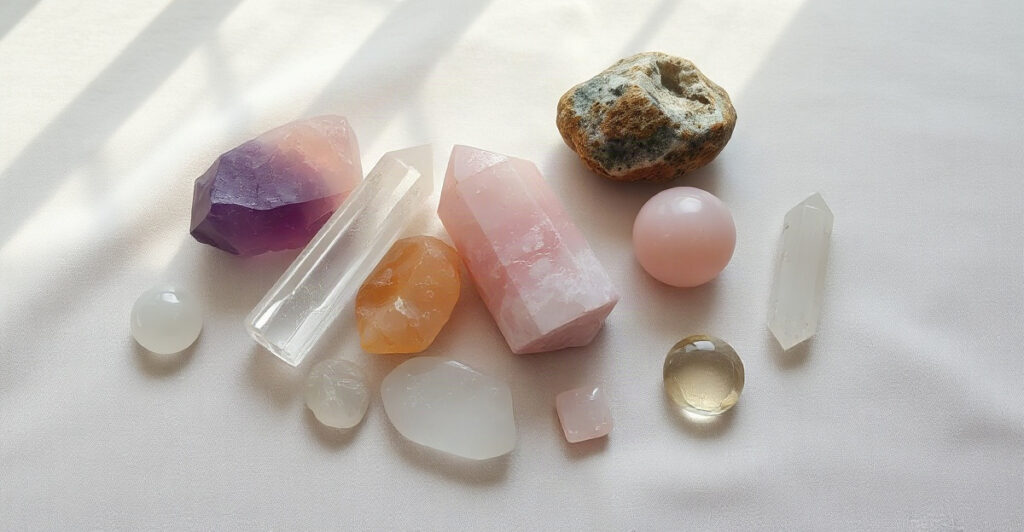
Crystals are solid materials whose atoms are arranged in a repeating, orderly pattern, and in spiritual practice they are used as focus objects for intention, meditation, and ritual. This guide covers what crystals are, the main types, the most popular stones and their meanings, how to cleanse and use them, and an honest look at the evidence.
Whether you are drawn to crystals for their beauty, as a mindfulness tool, or as part of a manifestation practice, you will leave this page knowing how to start well and spend wisely.
What are crystals?
A crystal is a solid whose atoms, ions, or molecules are arranged in a highly ordered, repeating three-dimensional structure called a crystal lattice. Quartz, salt, diamond, and snowflakes are all crystals in this scientific sense.
In everyday spiritual use, “crystals” is a looser term that covers true crystals like amethyst and quartz, as well as some materials that are not strictly crystalline, such as obsidian, which is a volcanic glass. What they share is a natural origin, a distinctive look, and a long history of symbolic meaning across cultures.
- Geological view: minerals formed over long periods as atoms bond in a fixed geometric pattern, per standard mineralogy.
- Cultural view: stones used for adornment, protection, and ceremony in ancient Egypt, China, Greece, and many Indigenous traditions.
- Modern spiritual view: tools that help a person set an intention, calm the mind, and mark a practice as meaningful.
What are the different types of crystals?
Crystals are grouped by the geometry of their internal lattice into 7 crystal systems, which is the answer to the common question about the “7 main types of crystals.”
| Crystal system | Lattice shape | Common examples |
|---|---|---|
| Cubic (isometric) | Equal axes at right angles | Pyrite, fluorite, garnet, diamond |
| Tetragonal | Two equal axes, one longer | Zircon, apophyllite, rutile |
| Hexagonal | Six-sided prisms | Beryl, aquamarine, emerald |
| Trigonal | Three-fold symmetry | Quartz, amethyst, calcite, tourmaline |
| Orthorhombic | Three unequal axes at right angles | Topaz, peridot, celestite |
| Monoclinic | Three unequal axes, one slanted | Selenite, malachite, jade, moonstone |
| Triclinic | Three unequal, all slanted axes | Labradorite, turquoise, kyanite |
You do not need to memorize this to use crystals, but it explains why stones grow in such different shapes, and why quartz points look so different from a cube of pyrite.
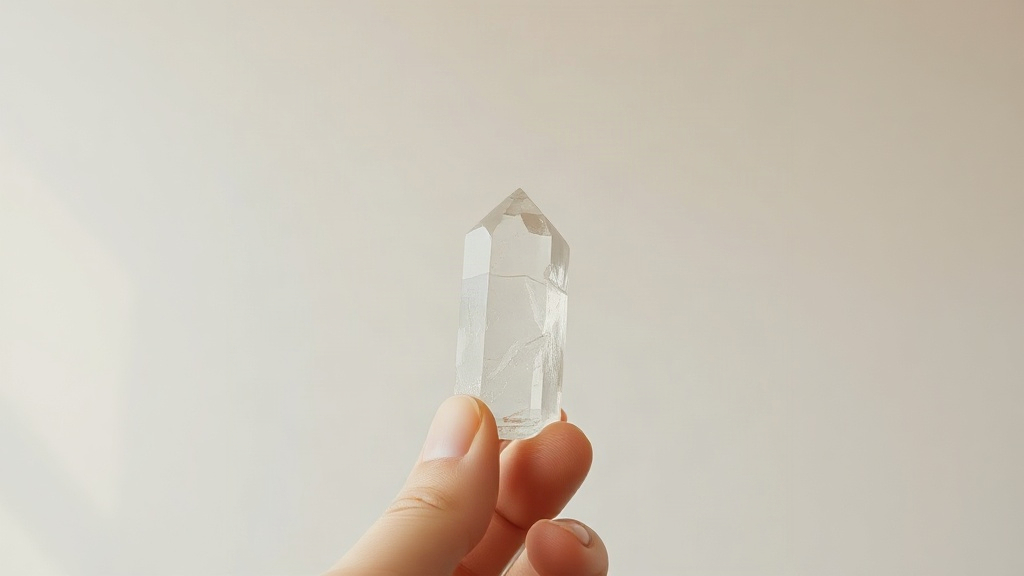
What are crystals used for in spiritual practice?
In spiritual practice, crystals are used as physical anchors for a specific intention, so that holding or seeing the stone brings your focus back to what you are working on. The stone is a reminder and a ritual object, not a battery.
Common uses:
- Meditation: holding a stone to steady attention and give the hands something to rest on.
- Intention setting: choosing a stone for a goal, such as calm, confidence, or focus, and keeping it where you will see it.
- Grids and altars: arranging stones in a pattern on a manifestation altar to mark a practice space.
- Carrying and wearing: a pocket stone or bracelet as a touchpoint through the day.
- Sleep and rest: a calming stone on the nightstand as part of a wind-down routine.
Used this way, a crystal works like a wedding ring or a worry stone: the meaning is something you assign and then let the object hold for you.
A concrete example: someone preparing for hard conversations at work might choose a piece of black tourmaline, keep it in their left pocket, and touch it before walking into a meeting. The stone does not change the meeting. It gives them a physical cue to take one slow breath and remember the tone they want to hold. Over a few weeks that small repeated pause is the actual benefit, and the crystal is what makes them remember to take it.
This is also why people often say a stone “stopped working.” Usually the ritual around it faded, the stone ended up in a drawer, and the reminder went with it. Keeping the practice visible matters more than which stone you picked.
Do crystals actually work?
There is no scientific evidence that crystals emit energy or heal the body, and controlled tests suggest their effects come from expectation and focus rather than the stones themselves. That does not make them useless, but it does shape how you should use them.
The most cited research is a study by psychologist Christopher French and colleagues, presented to the British Psychological Society in 2001. Participants held real quartz or a fake glass crystal after a guided visualization. Many reported tingling, warmth, and a sense of wellbeing, and there was no meaningful difference between the real and fake groups. People who believed in crystal power reported stronger sensations, whichever stone they held.
What that points to:
- The ritual has real value. Pausing, breathing, and setting an intention calms the nervous system on its own.
- Belief amplifies the effect. Expectation is a genuine driver of felt experience, well documented in placebo research.
- Focus changes behavior. A stone that reminds you of a goal makes you act on it more often.
- They are not medicine. Crystals should never replace medical or mental health care.
Held honestly, crystals are a mindfulness and motivation tool with a pleasant sensory hook, and that is a fair reason to use them.
A common objection is that calling crystals “just placebo” dismisses people’s real experiences. That is worth taking seriously. The placebo response is not fake; it produces measurable changes in pain, mood, and stress, and it works even when people know a ritual is symbolic. The honest position is not “crystals do nothing,” it is “crystals help through attention, meaning, and expectation, not through a special energy field.” If a stone helps you slow down and act on a goal, you are getting a genuine benefit. The caution is only about claims that a crystal can treat illness or replace care, which it cannot.
What are the most popular crystals and their meanings?
The most popular crystals each carry a traditional theme that practitioners use to match a stone to a goal. These meanings come from folklore and modern crystal books, not from science.
| Crystal | Common theme | Often used for |
|---|---|---|
| Clear quartz | Clarity, amplification | Focus, setting a clean intention |
| Rose quartz | Love, self-compassion | Relationships, gentleness with yourself |
| Amethyst | Calm, intuition | Stress relief, sleep, meditation |
| Citrine | Confidence, abundance | Motivation, money mindset, creativity |
| Black tourmaline | Protection, grounding | Feeling steadier in busy or draining settings |
| Selenite | Clearing, peace | Resetting a space or other stones |
| Carnelian | Courage, drive | Starting projects, physical energy |
| Labradorite | Transformation, imagination | Change, creative work |
| Green aventurine | Opportunity, luck | New ventures, a hopeful outlook |
| Tiger’s eye | Confidence, balance | Decisions, steadying nerves |
Pick the theme that matches what you are working on. The label matters less than the reminder it gives you.
You can also pair stones for a combined intention. A common one is rose quartz with clear quartz, read as “self-kindness, amplified,” kept together on a desk. Another is black tourmaline with amethyst on the nightstand, for “grounded and calm before sleep.” Keep pairings to two or three stones so the intention stays clear rather than turning into a vague pile. If you cannot say in one sentence what a group of stones is for, you have too many.

What are the top 7 healing crystals for beginners?
The best starter set is 7 versatile stones that cover calm, love, focus, protection, energy, clearing, and abundance. With these you can address most common intentions.
- Clear quartz for focus and general use.
- Amethyst for calm and better sleep.
- Rose quartz for self-kindness and relationships.
- Citrine for confidence and motivation.
- Black tourmaline for grounding in stressful settings.
- Selenite for clearing your space and other stones.
- Carnelian for drive and starting things.
How do you choose your first crystal?
Choose your first crystal by naming one goal, then picking the stone whose traditional theme matches it and that you find genuinely pleasing to look at. Attraction to a stone is a fine reason to choose it, since you are more likely to keep it in view.
Practical tips:
- Start with one or two, not a whole collection.
- Buy a size you will actually carry or display. A palm stone beats a large cluster you tuck away.
- Trust plain appeal. If a stone keeps drawing your eye, that is enough.
How do you cleanse and charge a crystal?
You cleanse a crystal to reset its association with past intentions or moods, and you charge it to renew its link to your current goal. Both are symbolic acts, and the method matters less than doing it with attention.
| Method | How | Caution |
|---|---|---|
| Moonlight | Leave the stone out overnight, especially on a full moon | Bring fragile stones in before dew or rain |
| Sunlight | An hour or two of morning sun | Amethyst, rose quartz, and citrine can fade in strong sun |
| Selenite or clear quartz | Rest the stone on a selenite plate or quartz cluster | None; a safe default |
| Sound | Ring a bell or bowl near the stone | None |
| Water | Brief rinse under running water | Never use on selenite, malachite, pyrite, or any soft or soluble stone |
To charge a stone, hold it, take a few slow breaths, and state your intention for it in one clear sentence. That is the whole practice.
When to cleanse: when you first bring a stone home, after someone else handles it, after a heavy or emotional stretch, and any time it just feels “off” to you. There is no fixed schedule. Once a month is plenty for most people, and a stone you use for one steady intention may not need it at all.
A worked example: you buy an amethyst at a busy market. At home you rinse your hands, set it on a selenite slab overnight, and in the morning you hold it, breathe, and say “this stone reminds me to wind down by 10.” You put it on the nightstand. That is cleanse, charge, and place, done in under 5 minutes, and you do not need to repeat it unless your intention changes.
How do you use crystals for manifestation?
To use a crystal for manifestation, pair it with a specific written intention and a daily habit, so the stone becomes a cue that pulls you back to the goal. The stone supports the practice; it does not do the work.
- Write the intention in the present tense on a small card.
- Choose a matching stone, such as citrine for confidence or rose quartz for a relationship.
- Pair them. Set the stone on the card where you will see it each morning.
- Use a 2 minute ritual. Hold the stone, read the intention, picture it done, then take one small action.
- Review weekly. Update the card as things move.
For a deeper walkthrough, see our guide to how manifesting works, and use the crystal as the physical reminder inside that routine.
An example that shows the shape of it: someone wanting to change careers writes “I do work that uses my writing and pays me well” on a card, sets a piece of citrine on top, and keeps both by the coffee maker. Each morning they hold the citrine for a minute, read the line, picture one specific scene from that future job, then send one message or spend 20 minutes on a portfolio piece. The citrine is not finding them a job. It is making sure they do the small daily action instead of forgetting. After two months the notebook is full of evidence of steps taken, and that momentum is the real result.
Which crystals should beginners be careful with?
Some popular stones are soft, water-soluble, or contain toxic elements, so beginners should handle them dry and wash their hands after contact. This is about basic safety, not superstition.
- Malachite: contains copper. Do not put it in water and keep dust away from your face.
- Selenite: dissolves in water. Keep it dry.
- Pyrite: contains iron sulfide and can release residue. Handle dry, wash hands.
- Cinnabar: contains mercury. Best avoided by beginners entirely.
- Galena, stibnite, realgar: toxic. Display only, no handling.
When in doubt, keep a stone out of water and off your skin during long contact, and look it up before you buy.
Where should you buy real crystals?
Buy crystals from sellers who name the stone and its origin, show clear photos of the exact piece, and price in line with the market. Very cheap “rare” stones and rainbow-bright names are red flags for dyed or synthetic material.
- Ask for the specific mineral name, not just a marketing label.
- Watch for dyed stones: unnaturally even, vivid color, especially in agate, howlite sold as turquoise, and “aqua aura.”
- Compare prices across a few shops before buying anything expensive.
- Prefer sellers with clear sourcing statements.
For a full breakdown of shops, online stores, and fake-spotting, see our guide to where to buy crystals.
Frequently asked questions
What are the top 7 healing crystals?
A common beginner set is clear quartz for focus, amethyst for calm, rose quartz for self-kindness, citrine for confidence, black tourmaline for grounding, selenite for clearing, and carnelian for drive. Together they cover most everyday intentions.
What are the 7 main types of crystals?
The 7 crystal systems, grouped by lattice geometry, are cubic, tetragonal, hexagonal, trigonal, orthorhombic, monoclinic, and triclinic. Quartz and amethyst are trigonal, while pyrite and fluorite are cubic.
Do crystals really work?
There is no scientific evidence that crystals emit energy or heal the body. Controlled tests show people report the same sensations from fake crystals as real ones. Their value comes from ritual, focus, and belief, which are genuine but not unique to the stones.
How do you cleanse crystals?
Common methods are moonlight overnight, brief morning sunlight, resting the stone on selenite or clear quartz, or sound from a bell or bowl. Avoid water for selenite, malachite, pyrite, and any soft or soluble stone.
Which crystals are unsafe to put in water?
Selenite dissolves, and malachite, pyrite, and cinnabar can release copper, iron sulfide, or mercury. Keep these dry, handle them briefly, and wash your hands afterward.
Put your crystals to work
Choose one goal, match it to one stone, and set that stone where you will see it every morning with a written intention beside it. Keep the ritual to 2 minutes and pair it with a single daily action.
For a gentle daily prompt while you build the habit, join our free message from the universe and abundance meditation.