
Fear of failure is a persistent anxiety about making mistakes or falling short that pushes people toward avoidance, procrastination, and self-sabotage, and in its most severe form (atychiphobia) it becomes a diagnosable phobia. Both are treatable. Clinicians most often use cognitive behavioral therapy and exposure therapy, the two approaches with the strongest track record for this kind of anxiety.
Start here:
- Self-check: Notice the last time you avoided starting something. Was the fear about the task, or about what failing would say about you?
- One small exposure: Pick a low-stakes task you’ve been avoiding and do a rough, imperfect version of it today.
- When to call a clinician: If avoidance is costing you jobs, relationships, or sleep, or you’re having panic attacks, talk to a doctor or therapist this week.
Key Takeaways
Fear of failure is driven mainly by shame and contingent self-worth, and it responds well to a combination of graded exposure, cognitive reframing, and values-based practice.
| Point | Details |
|---|---|
| Shame is the real driver | Fear of failure tracks more closely with shame and self-handicapping than with the actual odds of failing. |
| Watch for red flags | Panic attacks, major life interference, or thoughts of self-harm mean it’s time to see a clinician. |
| Exposure works gradually | A four-week graded exposure plan retrains your response better than avoidance or forced confidence. |
| Mindset is modifiable | Shifting from fixed to growth mindset reframes failure as feedback instead of a verdict on your worth. |
| Combine clinical and values work | Livethelifeofyourdreams pairs exposure-style challenges with values clarification to support progress alongside therapy. |
Table of Contents
- What Fear of Failure Really Means
- How Do You Know If Fear of Failure Is Affecting You?
- What Causes Fear of Failure to Develop?
- When Does Fear of Failure Become a Clinical Problem?
- What Treatments Actually Work for Fear of Failure?
- What Does the Research Say About Overcoming Fear of Failure?
- What Happens After Treatment: Outlook and Prevention
- Why Blending Clinical Tools With Values Work Matters
- Can a Guided Program Help You Overcome Fear of Failure?
- Frequently Asked Questions About Fear of Failure
- Sources
What Fear of Failure Really Means
Almost everyone feels a jolt of nerves before a big presentation or a first date. That’s normal performance anxiety, and it fades once the moment passes. Fear of failure becomes something else when it’s chronic: when the anxiety shows up before you even attempt something, and it’s strong enough to make you quit trying altogether.
The clinical version, atychiphobia, sits at the far end of that spectrum. It’s extreme, persistent, and it interferes with daily functioning, not just occasional discomfort.
Underneath both versions is usually the same psychological engine: contingent self-worth, where your value as a person feels tied to your performance. Miss the mark, and it doesn’t feel like a bad outcome. It feels like proof you’re not enough.
- Normal worry: Temporary avoidance, resolves once the task passes.
- Pathological fear: Chronic avoidance, real impairment, sometimes panic.
How Do You Know If Fear of Failure Is Affecting You?
Fear of failure rarely announces itself directly. It hides inside habits that look like something else entirely, procrastination, chronic perfectionism, or a pattern of quitting projects right before they’re finished.
Watch for these signs:
- Procrastination on tasks tied to evaluation or judgment (job applications, creative work, big asks).
- Perfectionism that delays finishing anything until it’s “ready,” which is never.
- Self-sabotage, quitting or under-preparing right before a real test of skill.
- Avoidance of entire categories of opportunity: promotions, relationships, auditions.
- Catastrophic thinking, jumping straight from “I might fail” to “my life falls apart.”
- Physical anxiety, racing heart, nausea, or tension before evaluative moments.
It shows up differently depending on where you look: procrastinating on a pitch at work, avoiding vulnerability in a relationship, or shelving a creative project the moment it gets hard.
Pro Tip:
Ask yourself one question right now: “If I attempted this and it went badly, would I recover, or would it define me?” If your honest answer is “define me,” that’s a strong signal fear of failure, not just normal caution, is steering the decision.
What Causes Fear of Failure to Develop?
Shame, not fear of the failure itself, is usually the real driver. Psychological research including work referencing McGregor and Elliot found that people high in fear of failure report significantly more shame and self-handicapping behavior than people who aren’t bothered by the prospect of falling short. The fear isn’t really about the outcome. It’s about what the outcome might reveal.
Several risk factors tend to feed that shame response:
- Conditional praise growing up (love or approval that depended on achievement).
- Harsh or public criticism after early mistakes, especially in front of peers.
- Perfectionist household or cultural standards that treated mistakes as unacceptable.
- Public humiliation experiences, being laughed at, corrected harshly, or singled out.
There’s also a modifiable cognitive layer at play. Fixed mindset thinking, the belief that ability is static, tends to amplify fear of failure because every failure reads as a verdict on fixed limits. A growth mindset treats the same failure as data. That reframe alone changes how threatening failure feels.
When Does Fear of Failure Become a Clinical Problem?
Fear of failure crosses into clinical territory when it starts costing you real opportunities, not just comfort. Watch for these red flags:
- Persistent avoidance that’s damaging your career, relationships, or education.
- Panic attacks triggered by evaluation, deadlines, or performance situations.
- Major interference with daily functioning, not just occasional discomfort.
- Signs of depression, substance use, or thoughts of self-harm tied to failure fears.
Fear of failure rarely travels alone. It commonly overlaps with generalized anxiety disorder, social anxiety, depression, and obsessive checking patterns tied to perfectionism.
If any of those red flags apply, start with your primary care doctor or a therapist. In the UK, that usually means a GP referral or self-referral to an NHS talking therapies service (formerly known as IAPT), which typically involves an initial assessment followed by CBT or guided self-help sessions.
What Treatments Actually Work for Fear of Failure?
The clinical toolkit here is well established. Cognitive behavioral therapy and exposure therapy are the most consistently effective treatments for phobic-level fear of failure, and acceptance and commitment therapy (ACT) is a strong complement when perfectionism or rigid thinking is part of the picture. Medication sometimes enters the picture when depression or generalized anxiety are riding along with the phobia, though it’s rarely the primary treatment.
A graded exposure plan works because it retrains your nervous system gradually instead of forcing a leap. Here’s a simple four-week structure:
- Week 1: List ten feared tasks, ranked from mildly uncomfortable to terrifying. Attempt the easiest one.
- Week 2: Repeat the easiest task twice, then attempt the next one on your list.
- Week 3: Move to mid-list tasks. Journal your anxiety level before and after each attempt.
- Week 4: Attempt a task in the top third of your list. Review your journal for patterns in what actually happened versus what you predicted.
Alongside exposure, cognitive reframing, values clarification, and small behavioral experiments help loosen the grip of contingent self-worth. Track progress in a simple log: what you attempted, your predicted outcome, and the actual result. The gap between the two is usually the most convincing evidence you’ll find.
Pro Tip:
Design your first behavioral experiment small enough that failing it costs you nothing real. The goal isn’t to succeed. It’s to prove the sky doesn’t fall when you don’t.

What Does the Research Say About Overcoming Fear of Failure?
The clinical consensus is consistent: CBT and exposure work well for phobic-level fear of failure, and some evidence even points to brief, focused CBT interventions producing meaningful change faster than people expect.
Under threat, fear narrows your goals and your options. It pushes you toward familiar, safer strategies even when those strategies are less effective, a pattern researchers call threat rigidity.
That single insight reshaped how this article approaches self-help: exposure and mindset work aren’t just about reducing anxiety. They’re about deliberately choosing approach goals over safety behaviors, which is the only way to break the rigidity loop.
What Happens After Treatment: Outlook and Prevention
Most people improve. CBT and exposure produce effects that hold up over time, especially when practice continues after formal treatment ends. Recovery from fear of failure isn’t usually about eliminating the fear. It’s about no longer letting it make decisions for you.
Maintenance matters as much as initial treatment:
- Run a monthly “failure review” of what went wrong and what you learned.
- Set values-based goals instead of purely outcome-based ones.
- Keep taking small, ongoing micro-exposures even after the acute fear fades.
- Build peer support or coaching into your routine for accountability.
Pro Tip:
Once a month, write down one thing that didn’t go as planned and one useful thing it taught you. This normalizes failure as information rather than indictment, and it’s the single habit most likely to prevent relapse.
Why Blending Clinical Tools With Values Work Matters
The clinical evidence on CBT and exposure is solid, but I’ve come to believe the lasting shift happens when people also do the deeper work of untangling their self-worth from their performance. That’s the piece clinical treatment alone sometimes leaves on the table, and it’s the piece values-based, transformation-focused programs are built to address. Elvis D. Beuses spent over 20 years in the medical and pharmaceutical field before building programs around exactly this intersection of evidence and mindset.
Can a Guided Program Help You Overcome Fear of Failure?
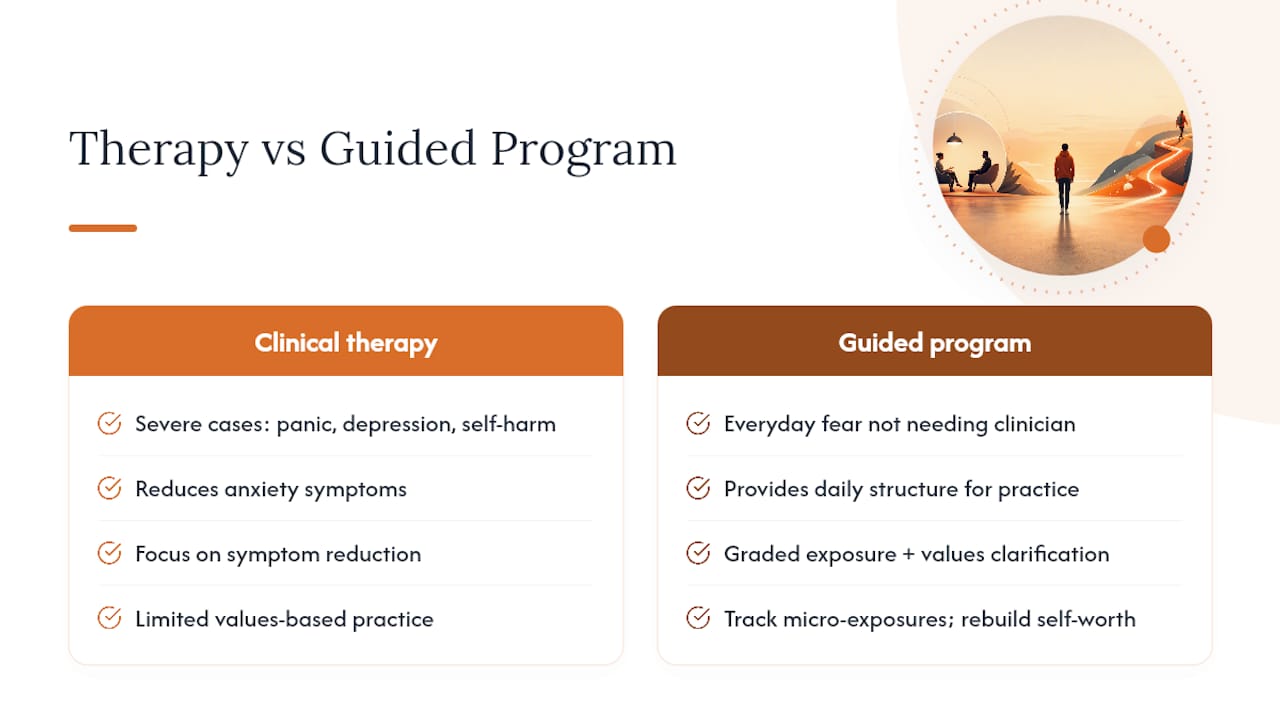
If your fear of failure is severe, causing panic attacks, major depression, or thoughts of self-harm, a structured course is not a substitute for a licensed therapist. See a clinician first.
For everyone else working through the everyday version of fear of failure, a guided program can fill a real gap. Clinical therapy is excellent at reducing anxiety symptoms, but it doesn’t always give you a daily structure for practicing values-based goal setting, tracking micro-exposures, or rebuilding self-worth that isn’t tied to outcomes.

That’s the specific gap Livethelifeofyourdreams was built to fill. Its guided programs combine graded exposure style challenges with the values clarification work that clinical sessions rarely have time to cover in depth, drawing on both psychology research and the personal transformation frameworks the brand is known for. If you want a structured next step alongside, or after, professional care, visit the Livethelifeofyourdreams programs and resources page to see which guide fits where you’re starting from.
Frequently Asked Questions About Fear of Failure
Is fear of failure the same as low self-esteem?
No. Low self-esteem is a general negative view of yourself; fear of failure is specifically about anticipating that a task or attempt will go badly and what that would mean for your self-worth. The two often overlap but aren’t identical.
How is fear of failure different from procrastination?
Procrastination is the behavior; fear of failure is often the cause. People delay tasks not from laziness but because starting means risking an outcome that feels threatening to their self-worth.
Can fear of failure actually cause failure?
Yes, indirectly. Threat rigidity narrows your options and pushes you toward safer, less effective strategies, which can make the feared outcome more likely rather than less.
How long does treatment for fear of failure usually take?
It varies by severity, but focused CBT and exposure approaches can produce meaningful change in weeks rather than months for many people, especially when paired with consistent practice between sessions.
Is fear of success related to fear of failure?
They’re closely linked. Both often stem from discomfort with visibility, judgment, or change, and both respond to similar tools: values clarification, graded exposure, and separating your identity from any single outcome.
Sources
- Atychiphobia (Fear of Failure): Causes & Treatment
- Fear of Failure in Sport: A Literature Review (McGregor & Elliot referenced)
- Fixed vs growth mindset (The Decision Lab reference guide)
- How to Overcome Fear of Failure: Your Ultimate Guide
- Why Fearing Failure Makes It More Likely | Psychology Today
Related reading
- How to Stop Self-Sabotage and Actually Follow Through on Your Goals
- How to Overcome Fear and Transform Your Life (The Ultimate Guide)
- Signs You Have A Strong Aura: 18 Powerful Clues Your Energy Is Magnetic
- Top 7 Affirmations for Money and Wealth
- Top 7 Love Affirmations To Attract Specific Person
- Top 7 Affirmations for Wealth and Prosperity