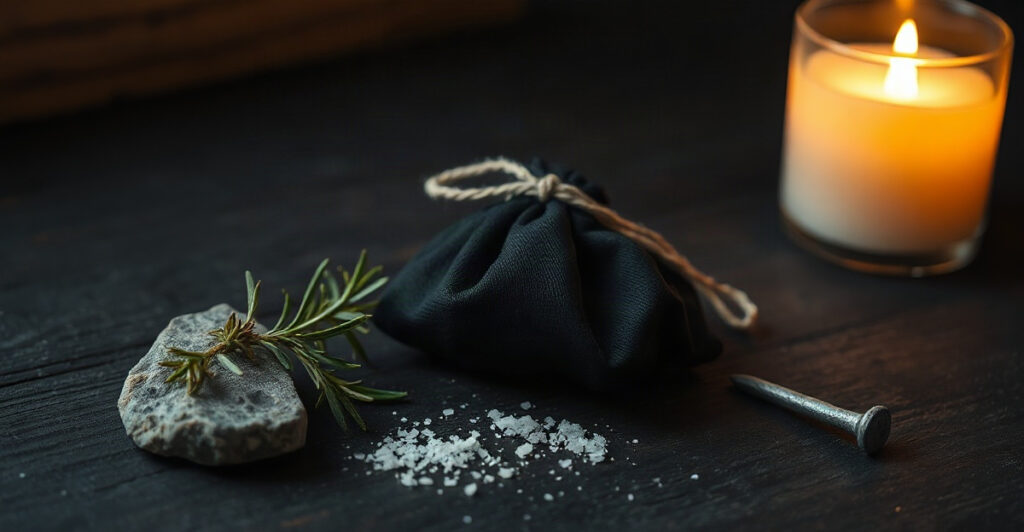
Protection charms are small objects, an amulet, a talisman, or a herb-filled charm bag, carried or worn to shield your energy, your home, and your peace of mind. They work when you make them with focus, charge them with a clear intention, and treat them as a daily reminder to hold your boundaries.
This guide covers what protection charms are, the difference between an amulet and a talisman, how they actually work, the strongest materials to use, how to make and charge a charm bag, and how to care for it over time.
What are protection charms, and do they work?
A protection charm is a physical item that has been given a single job: to keep harmful energy, people, or influences away from the person who carries it. Humans have used them for thousands of years, from carved stone amulets in ancient Egypt to a pinch of salt in a pocket.
They work in two honest ways. First, tradition and symbol: a charm connects you to a long line of people who used the same practice, which lends it weight. Second, attention: every time you touch the charm, you remember your intention to stay protected, and you act a little more carefully. Britannica’s entry on amulets traces how widespread the practice has always been.
What a charm does not do is remove your responsibility to lock the door, leave a bad situation, or set a spoken boundary. It supports those actions. It does not replace them.
What is the difference between an amulet, a talisman, and a charm bag?
The three overlap, but each has a traditional job: an amulet repels, a talisman attracts, and a charm bag combines several ingredients for one goal.
| Type | Traditional job | Typical form | Best for |
|---|---|---|---|
| Amulet | Passive protection, repels harm just by being present | A natural object or symbol: stone, shell, eye bead, iron nail | Everyday shielding, worn or carried |
| Talisman | Actively draws a specific benefit you charge it for | A made or engraved object: metal disk, ring, carved sigil | A named outcome, like safe travel or courage |
| Charm bag | Blends herbs, stones, and words for one focused intention | A small cloth pouch, tied and carried | Custom protection you refresh over time |
In daily use, people say “charm” for all three. Pick the form that you will actually keep on you, since a charm in a drawer does nothing.

How do protection charms actually work?
A protection charm works by anchoring an intention in an object you handle often, so the intention stays active in your mind and your behavior. The charm is a memory device with a long tradition behind it.
- It sets a boundary you can feel. Holding a solid object while you name what you will not accept makes an abstract limit concrete.
- It cues you all day. A ring you twist or a pouch in your bag is a small, repeated nudge back to “I am safe and I hold my line.”
- It carries accumulated focus. Each time you charge or thank the charm, you add to the meaning it holds for you.
A real example: someone dreading a tense family visit keeps a small black tourmaline in their left pocket. Every time their hand brushes it during the day, they take one breath and remember they can leave the room. The stone did not change the relatives. It changed how often the person remembered their own exit.
Takeaway: the charm holds the intention. You still have to live it.
What materials make the strongest protection charm?
The strongest protection materials are the ones with the longest protective tradition and a texture you notice: black stones, iron, salt, and sharp or pungent herbs.
| Material | Traditionally guards against | How to carry it |
|---|---|---|
| Black tourmaline | General negativity, draining people | Loose in a pocket or in a charm bag |
| Obsidian or jet | Psychic pressure, bad dreams | Worn as a pendant, kept by the bed |
| Iron nail or horseshoe | Ill intent, unwanted spirits | By the front door or in a car |
| Black salt (salt and ash) | Gossip, hostility, threshold crossing | A pinch in a sealed vial in your bag |
| Rosemary or rue | Stagnant energy, envy | Dried, in a charm bag (skip rue if pregnant) |
| Blue eye bead (nazar) | The evil eye, envious looks | On a keyring, bag zipper, or bracelet |
You do not need all of it. One black stone and a sprig of rosemary in a scrap of cloth is a complete charm. If you want to add candle work, pair the charm with a black protection candle.
How do you make a protection charm bag step by step?
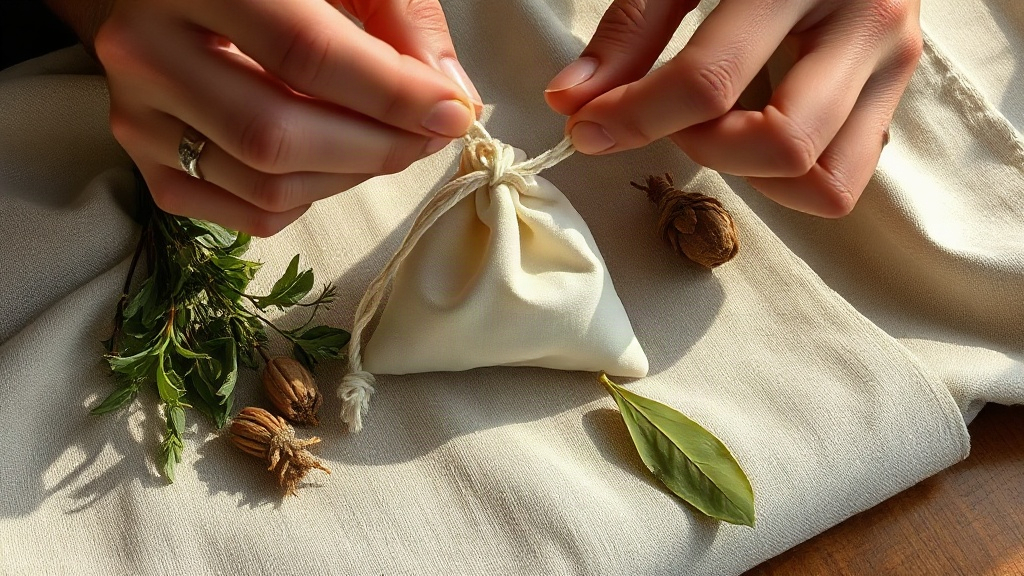
To make a protection charm bag, choose a color and 3 to 5 ingredients for protection, cleanse them, add them to the pouch while stating your intention, and tie it closed with knots.
- Pick the pouch. Black or white cloth, about the size of your palm. A tied square of fabric works.
- Choose 3 to 5 ingredients. For example: black tourmaline, a pinch of salt, dried rosemary, a small iron washer, and a bay leaf.
- Cleanse them. Pass each through incense smoke or hold it under running water for a few seconds, then dry it.
- Write a word. On the bay leaf or a slip of paper, write one word like “safe” or “shielded.”
- Fill the bag. Add each item one at a time, saying what it is for: “Salt, hold the line. Iron, turn back harm.”
- Tie it with 3 knots. With each knot say, “This charm protects me. It is sealed.”
- Carry it in your bag, pocket, or car. Keep it out of sight.
Keep herbs dry and the bag small, so it is easy to carry every day.
How do you charge and activate a protection charm?
You charge a protection charm by holding it, focusing hard on the feeling of being safe, and picturing that feeling filling the object until it feels “full.” Then you name its job out loud.
- Breath charging: hold the charm at your chest, take 10 slow breaths, and on each exhale imagine calm, solid protection flowing into it.
- Element charging: rest it overnight on a windowsill under the moon, or briefly in sunlight, or beside a dish of salt.
- Word charging: say clearly, “Your job is to keep me safe and to turn back what wishes me harm. Thank you.”
Recharge it whenever it feels flat, after a hard event, or once a month at the new moon. A charm you never revisit slowly becomes just an object again.
How do you care for, cleanse, and retire a charm?
Cleanse a protection charm regularly, keep it private, and retire it respectfully once its work is done or it breaks. A charm that has “taken a hit” often cracks, tarnishes, or feels heavy.
- Cleanse monthly: incense smoke, moonlight, or a bowl of dry salt overnight. Avoid soaking porous stones or salt-based charms in water.
- Keep it to yourself: tradition says a charm handled or questioned by others loses focus. At minimum, do not let people play with it.
- Retire it when it breaks: thank it, then bury it off your property, or wrap it and bin it away from home. Do not keep a cracked protective stone.
- Replace it with a fresh charm made the same way. The practice is the point, not the specific rock.
Common protection charm mistakes
The most common mistakes are making a charm once and forgetting it, carrying too many competing charms, and using a charm to avoid a real decision.
- Set and forget. Charms need recharging. Tie it to the new moon so you remember.
- Charm overload. One focused charm beats five vague ones fighting for attention.
- Skipping the practical step. A charm supports leaving a bad job or blocking a number. It is not a substitute.
- Letting everyone handle it. Keep it private and out of sight.
- Ignoring damage. A cracked protective stone has done its job. Retire it, do not keep carrying it.
- No clear intention. “Good vibes” is not a job. “Turn back people who drain me” is.
Pair your charm with an energy reset like a cleansing bath when you have had a rough stretch.
Frequently asked questions
Do protection charms really work?
Protection charms work as focus tools with a long tradition behind them. They keep your intention to stay safe active in your mind and your choices. They do not replace practical steps like locking doors, blocking contacts, or leaving harmful situations.
What is the best crystal for a protection charm?
Black tourmaline is the most popular protection crystal for everyday carry, since it is traditionally used to deflect general negativity and draining people. Obsidian, jet, and hematite are also common choices, especially for psychic pressure and bad dreams.
What is the difference between an amulet and a talisman?
An amulet gives passive protection and repels harm simply by being present, often a natural object or symbol. A talisman is actively charged to attract a specific benefit, such as courage or safe travel, and is usually a made or engraved item.
How often should you cleanse a protection charm?
Cleanse a protection charm about once a month, and also after any difficult event. Use incense smoke, moonlight, or a bowl of dry salt overnight. Avoid water for porous stones and any salt-based charm.
What do you do when a protection charm breaks?
When a protection charm breaks, tarnishes, or suddenly feels heavy, treat it as having absorbed something. Thank it, then bury it away from your home or wrap it and dispose of it off the property, and make a fresh charm the same way.
Can you make a protection charm without crystals?
Yes. Salt, iron, rosemary, bay leaves, a written word, and a knotted cord make a complete protection charm. The tradition relies on common household items, and the intention and regular recharging matter more than the materials.
Make one this week
Choose one thing you want protection from, gather 3 simple ingredients, and build a small charm bag tonight using the steps above. Recharge it at the next new moon so it stays active.
For a daily message to keep your energy steady while you hold your boundaries, join our free message from the universe and abundance meditation.
More to explore
- Create a Beauty Altar for Aphrodite in 7 Steps
- Low Effort Witchy Makeup Magic: 5-Minute Everyday Glam
- How to Cast a Circle for Manifestation and Protection
- Beginner Manifestation Altar Guide: Items and Their Uses
- Glamour Magic: Confidence, Beauty and Self-Love Rituals
- Kabbalah Magic Teachings to Attract Abundance: The Complete Guide to Manifesting Prosperity Through Ancient Mystical Wisdom