
Quantum physics does not prove that thoughts change physical reality. No experiment, equation, or peer-reviewed theory supports the claim that focused intention rearranges matter outside your skull. The apparent “results” people get from manifestation come from psychology, not physics: the Reticular Activating System filters what you notice, neuroplasticity reshapes habits through repetition, and even speculative brain theories like Penrose and Hameroff’s Orch‑OR stop well short of claiming your mind can bend the outside world.
- The verdict: No mainstream physics supports “thoughts collapse reality.”
- The real mechanism: Attention, behavior, and brain rewiring do the work.
- The speculative outlier: Orch‑OR discusses consciousness, not magic.
Key Takeaways
Manifestation techniques produce real results through psychology and behavior change, not through quantum physics, which offers no mechanism for thoughts altering external reality.
| Point | Details |
|---|---|
| Quantum physics doesn’t validate manifestation | No experiment shows thought collapsing wavefunctions or reshaping macroscopic events. |
| “Observer” means a detector, not a mind | Physicists use “measurement” to describe physical interactions, not human awareness. |
| Decoherence blocks brain-scale quantum effects | Thermal noise destroys fragile quantum states almost instantly at biological temperatures. |
| RAS and neuroplasticity explain real results | Attention filtering and repeated mental rehearsal drive the behavior changes people notice. |
| Livethelifeofyourdreams pairs intention with action | The brand’s courses combine ancient wisdom with neuroscience-backed, trackable steps. |
Table of Contents
- Is Quantum Manifestation Real? The Claims You’ll Actually Hear
- Quantum Physics Terms People Misuse, Translated
- Why Applying Quantum Rules to Everyday Life Is a Category Error
- What Actually Explains Why Manifestation Sometimes Works
- How to Practice Visualization the Evidence-Based Way
- Red Flags of Pseudoscience in Manifestation Programs
- How Quantum Language Ended Up in Self-Help Culture
- The Bottom Line on Quantum Manifestation
- Why Livethelifeofyourdreams Takes This Approach
- An Evidence-Informed Path Beyond Quantum Claims
- Frequently Asked Questions
- Sources
Is Quantum Manifestation Real? The Claims You’ll Actually Hear
Quantum manifestation marketing recycles a handful of talking points, dressed up in borrowed physics vocabulary. Recognizing the pattern is half the battle.
- “Your thoughts collapse the wave function.” Sold as proof that observation (meaning your attention) determines outcomes in the physical world.
- “Quantum entanglement links your mind to what you want.” Framed as a cosmic Wi-Fi signal connecting you to a job, partner, or bank balance.
- “The quantum field responds to your vibration.” A vague energy claim with no defined mechanism, unit, or testable prediction.
- “Everything is frequency, and you can tune your reality.” Borrows the language of wave physics while ignoring what a frequency actually measures.
The rhetorical trick is consistent: cite a real, weird-sounding physics term, strip its technical meaning, and let the reader fill in the gap with wishful thinking. It works because quantum mechanics genuinely is strange, which makes almost any claim sound plausible to someone without a physics background.
Quantum Physics Terms People Misuse, Translated
Here’s what these words actually mean in physics, stripped of the marketing gloss.
- Observer / measurement. Technical definition: a physical interaction between a quantum system and a detector or environment. Plain English: it means a machine bumped into a particle, not that a person thought about it.
- Superposition / wavefunction. Technical definition: a mathematical description of the probabilities of a particle’s possible states before measurement. Plain English: it’s a prediction tool, not evidence the particle is “waiting for your permission” to become real.
- Entanglement. Technical definition: two particles share correlated properties regardless of distance, confirmed through experiments. Plain English: it lets you build secure communication links, not send intentions to the universe.
- Decoherence. Technical definition: the process by which quantum systems lose their delicate quantum properties through interaction with their environment. Plain English: it’s why nothing at the size of a human brain behaves like a single particle.
Fact check:
Researchers demonstrated the UK’s first long-distance ultra-secure quantum communication link, proving entanglement’s real value for encryption. It transmits secure data. It does not transmit wishes.
The word “observer” causes the most damage in manifestation marketing. Physicists use it to describe a detector interacting with a particle, and mainstream science commentary is explicit that this has nothing to do with human consciousness or awareness. Confusing a lab instrument with a wishing mind is the single most common error in this entire genre of claims, and once you spot it, half the manifestation pitch deck falls apart.
Why Applying Quantum Rules to Everyday Life Is a Category Error
Quantum effects happen at the scale of atoms, in conditions of extreme cold and isolation. Your brain runs at 98.6°F, surrounded by trillions of jostling molecules. That environment triggers thermal decoherence almost instantly, destroying any fragile quantum state before it could plausibly influence a decision, let alone an external event like a job offer.
Applying a rule that governs isolated particles to a warm, wet, three-pound organ interacting with a whole universe of other matter is like using rules of chess to explain a football game. Different scale, different rules, different game entirely.
Here are three claims you’ll see repeated, and the actual physics response to each:
Claim: “The observer effect proves consciousness collapses the wave function and shapes reality.”
Rebuttal:“Observer” means a detector or measuring device, not a mind. Decoherence, not awareness, explains why quantum weirdness disappears at macroscopic scale.
Claim: “Quantum entanglement means your mind is connected to what you desire.”
Rebuttal:Entanglement produces statistical correlations between particles with a shared origin. It cannot transmit information, intentions, or wishes, by the laws of physics itself.
Claim: “Everything is energy vibrating at a frequency you can control with belief.”
Rebuttal:Frequency is a measurable physical property with units (hertz). Belief has no known method of altering the vibrational frequency of external objects.
What Actually Explains Why Manifestation Sometimes Works
If it’s not quantum physics, why do some people swear visualization and affirmations changed their lives? The honest answer sits in mainstream cognitive science, and it’s more interesting than the mystical version.
- Reticular Activating System (RAS): This brainstem network filters incoming sensory data and prioritizes what matches your current goals or focus, which is why a car model you’ve been eyeing suddenly seems to appear everywhere.
- Confirmation bias: Once you decide something is meaningful, your brain preferentially notices and remembers evidence that supports it while filtering out contradictions.
- Expectancy effects: Believing an outcome is likely changes your behavior in small, cumulative ways, which shifts the actual odds of that outcome.
- Goal-setting theory: Writing specific, structured goals reliably improves follow-through compared to vague wishes, a finding that shows up consistently across decades of workplace psychology research.
- Neuroplasticity: Repeated mental rehearsal strengthens neural pathways tied to a skill or behavior, which is part of why visualization helps athletes and public speakers perform better.
Reality check:
None of these mechanisms require quantum mechanics. They’re well-documented in psychology and neuroscience, they don’t depend on unproven physics, and they explain outcomes that quantum manifestation claims can’t: consistent, replicable, measurable behavior change.
Speculative theories like Roger Penrose and Stuart Hameroff’s Orch‑OR hypothesis do explore whether quantum processes occur inside neurons, but even that minority, unproven proposal never claims consciousness can reshape events outside the body. Stephen Hawking was famously skeptical of tying consciousness to quantum mechanics at all, and that skepticism from one of the most respected physicists of the last century is worth remembering every time a course promises “quantum-level manifestation.”
How to Practice Visualization the Evidence-Based Way
Visualization and intention-setting aren’t useless. They’re just misattributed. Used correctly, they’re behavioral tools, not physics experiments.
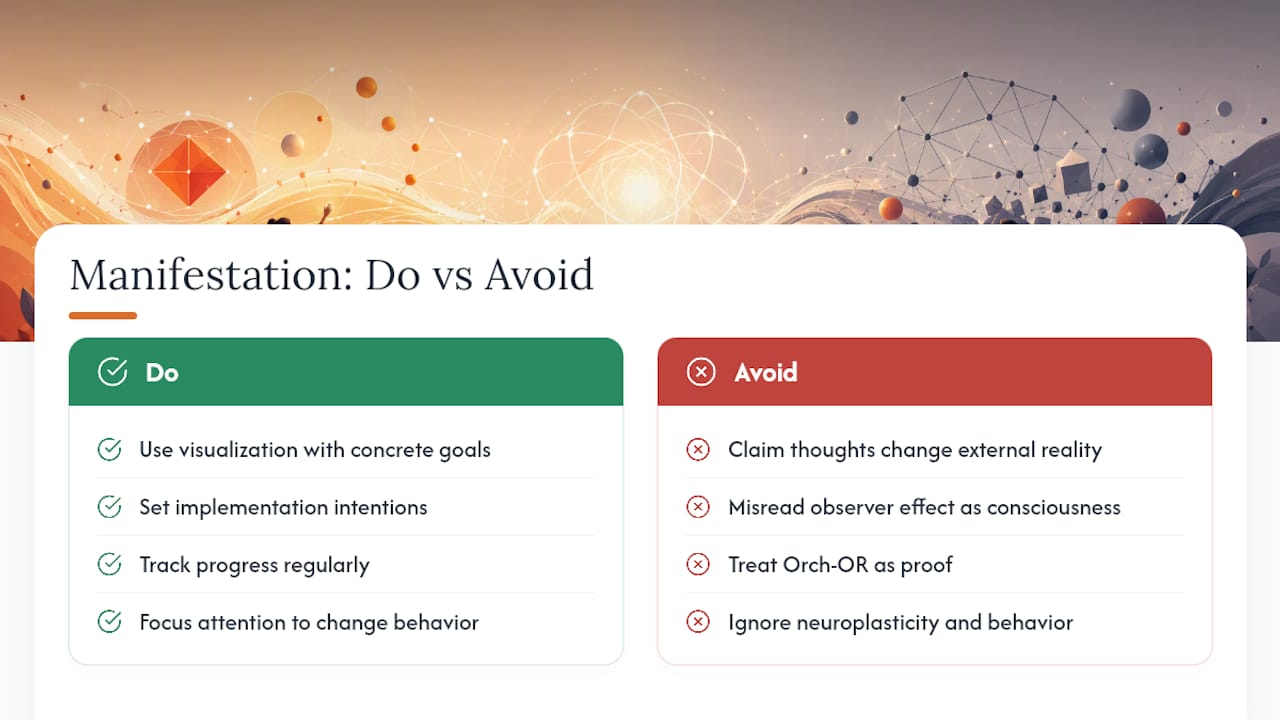
- Set one concrete goal. Specificity beats vague wishing; “save $3,000 by June” outperforms “attract abundance.”
- Visualize the outcome and the process. Picture the result, then picture yourself doing the actual steps: sending the email, making the call, saving the paycheck.
- Attach implementation intentions. Link each step to a specific cue: “After I pour my morning coffee, I’ll spend ten minutes on my business plan.”
- Schedule micro-behaviors. Break the goal into small, repeatable actions you can track weekly.
- Measure and adjust. Review progress against a real metric, then change your approach based on what the data shows, not on how you feel.
Pro Tip:
Pair visualization with a written if-then plan. “If it’s Monday at 7 a.m., then I review my goal sheet” turns a mental image into a behavioral trigger, which research on implementation intentions shows dramatically increases follow-through.
Livethelifeofyourdreams builds its programs around this exact structure: intention paired with a plan, a schedule, and a way to measure whether it’s working, rather than a promise that belief alone rearranges outcomes.

Red Flags of Pseudoscience in Manifestation Programs
Some programs are honest about using visualization as a psychological tool. Others dress up vague promises in quantum language to sound legitimate. Watch for:
- Claims that can’t be tested or falsified in any way.
- Heavy sales pressure or countdown timers pushing an immediate purchase.
- Guarantees of specific outcomes (money, relationships, health) with no accountability.
- Physics jargon used without a working definition or citation.
- No system for tracking progress or measuring results.
- Testimonials as the only form of evidence, with zero data behind them.
Pro Tip:
Ask any program directly: “What would prove this doesn’t work?” A program that can’t answer isn’t offering science, it’s offering a story.
Before enrolling anywhere, ask for the evidence base, request specifics on measurable outcomes, and check whether the plan involves real action steps or just belief and repetition.
How Quantum Language Ended Up in Self-Help Culture
Quantum mechanics has unsettled physicists since its discovery in the early 20th century, which made it ripe for misinterpretation the moment it left the lab.
- 1920s-1930s: Quantum theory reveals genuinely strange behavior at the subatomic scale, confusing even its founders.
- 1970s-1980s: Writers like Fritjof Capra blend Eastern spirituality with quantum metaphors in books that were poetic, not scientific claims.
- 2004: The documentary What the Bleep Do We Know? popularizes the idea that thoughts shape reality, presenting fringe interpretations as settled science.
- 2010s-2020s: Social media compresses the message further, stripping nuance until “quantum” becomes shorthand for “magic, but scientific-sounding.”
Journalists have traced this pattern closely, describing how the wellness industry adopted quantum language precisely because the science is counterintuitive enough to feel authoritative without being widely understood.
The Bottom Line on Quantum Manifestation
Quantum physics does not validate the claim that focused thought reshapes external, macroscopic reality. What actually works, when manifestation practices show results, is measurable psychology: attention, goal structure, repeated action, and neuroplastic change.
- Test any method by tracking real outcomes, not just how you feel.
- Choose programs that require action, planning, and feedback.
- Use the visualization steps above instead of vague “vibration” language.
- Treat quantum terminology in a wellness pitch as a warning sign, not a credential.
Why Livethelifeofyourdreams Takes This Approach
I’ve spent years watching manifestation advice split into two camps: purely mystical programs that ignore evidence, and purely clinical psychology that ignores the emotional and spiritual pull that gets people to actually start. Neither serves the reader who wants results and honesty at the same time.
- Elvis D. Beuses spent over 20 years in the medical and pharmaceutical industry before founding Livethelifeofyourdreams.
- His approach pairs ancient wisdom traditions like Kabbalah with peer-reviewed neuroscience and psychology, not unproven physics.
- His book, Cómo Vencer el Miedo, became an international bestseller built on that same evidence-first framing.
An Evidence-Informed Path Beyond Quantum Claims
Most manifestation content asks you to believe first and measure never. Livethelifeofyourdreams flips that: every exercise ties back to a concrete step, a schedule, or a way to track whether it’s actually changing your behavior, not just your mood for an afternoon.

The programs draw on the same psychological mechanisms covered above, RAS training, neuroplasticity-based habit work, and goal-structuring exercises, wrapped in a framework that respects the spiritual side of personal growth without pretending physics backs it up. That’s the core difference from “quantum-only” programs: this approach gives you something to do and something to measure, instead of something to simply believe.
If you’re ready to replace vague wishing with a structured, evidence-informed plan, start by exploring Live The Life Of Your Dreams and see how the courses translate intention into daily, trackable action.
Frequently Asked Questions
Is quantum manifestation real?
No. Quantum mechanics has no mechanism by which personal thoughts or intentions alter external, macroscopic events. The results people attribute to it come from attention, behavior change, and neuroplasticity.
Does the observer effect prove consciousness creates reality?
No. “Observer” in physics refers to a detector or measuring device interacting with a particle, not a conscious mind. This is one of the most common misreadings in quantum manifestation claims.
What is the Reticular Activating System, and how does it relate to manifestation?
The RAS is a brainstem structure that filters sensory input based on what you’re currently focused on, which explains why goals you concentrate on seem to show up more often in daily life.
Are Roger Penrose’s ideas about consciousness proof of manifestation?
No. His Orch‑OR hypothesis, developed with Stuart Hameroff, is a speculative and unproven theory about consciousness in the brain. It never claims thoughts can reshape external physical reality.
Can visualization still help even without a quantum explanation?
Yes. Visualization paired with concrete goals, implementation intentions, and progress tracking is well-supported by psychology, and it works regardless of whether you use quantum language to describe it.
Sources
- The Wellness Industry Is Manifesting a Quantum World – The Atlantic
- Researchers demonstrate the UK’s first long-distance ultra-secure communication over a quantum link
- Penrose: Consciousness and the foundations of physics
- Quantum mechanics and consciousness connection (AAAS Scientia overview)
Related reading
- Feeling Is the Secret by Neville Goddard: A Guide
- Neville Goddard: His Teachings, Methods, and Books
- What Is Manifesting? A Clear Guide to How It Works
- 369 Manifestation Method (The Complete Guide)
- Manifestation Journaling: A Practical Guide to Scripting Your Reality
- Top 7 Affirmations For Wealth And Prosperity