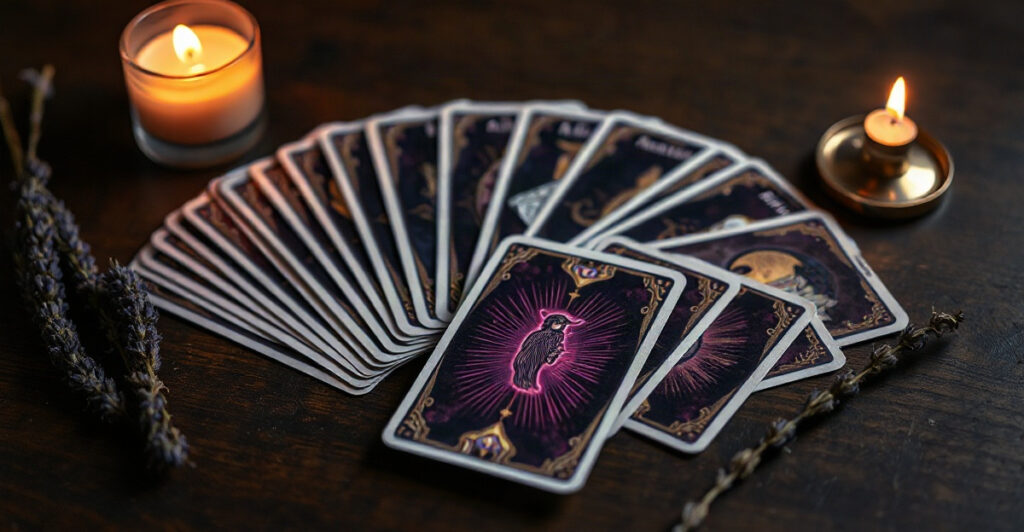
Tarot is a deck of 78 symbolic cards that you read by combining the card’s traditional meaning with your own intuition about the question you asked. A beginner can give an honest, useful first reading on day one with a single card, a notebook, and one good question. The mystical reputation makes it look like a closed club. It is not. Here is the calm, complete first guide.
What is tarot, really?
Tarot is a 78-card picture system for thinking clearly about your life. The deck splits into two parts: the 22-card Major Arcana, which traces big life themes like beginnings, setbacks, and turning points, and the 56-card Minor Arcana, which covers daily life through four suits. When you lay cards out and reflect on their images, you are pairing an old symbol with a current situation. The insight comes from that pairing.
Think of the deck as a mirror rather than a fortune machine. The cards do not tell you that a specific event will happen on a specific date. They hold up imagery that helps you see your own assumptions, fears, and options more clearly. That is why tarot pairs so well with journaling and manifestation work. If you already keep a scripting journal, tarot slots into the same weekly rhythm.
The deck most decks descend from is the Rider-Waite-Smith, illustrated in 1909 under the occultist Arthur Edward Waite. Waite also wrote The Pictorial Key to the Tarot, a public-domain guide to every card, and it is still one of the best free references for a beginner.
What do you need before your first reading?
You need three things: a deck, a notebook, and a question. Nothing else. The crystals, cloths, and moon rituals are lovely, but they are optional dressing.
- A standard 78-card deck. Choose one with imagery you actually enjoy looking at, because you will learn through the pictures. The classic Rider-Waite-Smith is the easiest to learn from, since nearly every guide and app assumes its imagery.
- A notebook. Write down every reading: the date, the question, the cards, and what you think they mean. This record is how you improve. After a month you will see patterns in how you read and how accurate your hunches run.
- One clear question. “What do I need to know about my new job?” beats “tell me my future” every time. Tarot works best on open, honest questions about things you can actually influence.
If you want a small ritual to open a reading, light a candle and take three slow breaths. A simple version of this appears in our guide to setting up a manifestation altar, and the same setup works beautifully for tarot.
How do you start reading tarot as a complete beginner?
Start with a one-card-a-day practice for your first two weeks before you attempt any spread. Pulling and interpreting a single card daily builds the two skills every reader needs: knowing the cards and trusting your instincts. Here is the routine.
- Shuffle while holding your question. Ask it silently in your own words. Shuffle until the deck feels done. There is no correct number of shuffles.
- Cut and draw one card. Lay it face up where you can see it clearly.
- Look before you look it up. Spend 60 seconds describing the picture out loud. What is the figure doing? What is the mood? Your first impression matters more than the guidebook at this stage.
- Check the traditional meaning. Compare your impression with a reference. Note where they matched and where they did not.
- Write one sentence linking the card to your question. “The Seven of Swords suggests I am avoiding a direct conversation about the project deadline.” That sentence is the reading.
- Revisit it in the evening. Did the card’s theme show up during your day? This closing step is what turns card-pulling into actual learning.
How do tarot spreads work?
A spread is a fixed layout where each card position has a defined job. The position gives the card its role: one card might mean “the obstacle” and the next “the resource you already have.” You interpret each card through its position, then read the layout as one story. Three spreads cover almost everything a beginner needs.
| Spread | Cards | Best for | Time needed |
|---|---|---|---|
| Daily draw | 1 | A theme or lesson for the day ahead | 5 minutes |
| Past / Present / Future | 3 | Understanding how a situation developed and where it is heading | 10 to 15 minutes |
| Situation / Obstacle / Action | 3 | Decision-making and problem solving | 10 to 15 minutes |
| Celtic Cross | 10 | A deep look at one complex situation | 45 minutes or more |
Learn the three-card spread first and you can answer most questions for years. The Celtic Cross is worth learning eventually, but it overwhelms beginners, and an overwhelmed reader produces vague readings.
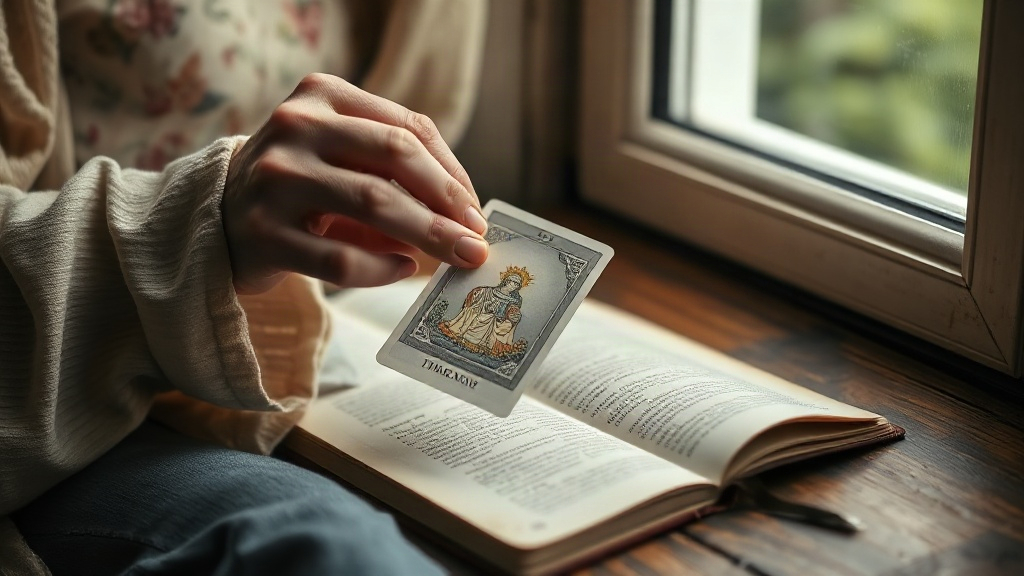
What do the four suits mean?
Each suit of the Minor Arcana maps to one area of daily life. Once you know the four domains, you can guess a card’s theme before you look it up, the same way you sense the mood of a photo before reading its caption.
- Cups cover emotions, relationships, and intuition. Water imagery runs through them.
- Pentacles cover money, work, health, and the physical world. Earthy, practical, slow.
- Swords cover thoughts, conflict, truth, and communication. Fast and often sharp.
- Wands cover passion, creativity, action, and new ventures. Fiery and impulsive.
The numbers add a second layer. Aces are beginnings, fives are conflict or disruption, tens are completion. Combine suit plus number plus image, and you have most of the Minor Arcana covered before memorizing anything.
How do you interpret a single card?
You interpret a card by answering three questions in order: what is happening in the picture, what does the tradition say, and what does that mean for my question? Beginners fail in two opposite ways. Some read only the guidebook, and their readings sound like an encyclopedia. Others ignore the tradition entirely and project whatever they want onto the cards. The three-step order keeps both instincts in balance.
Take The Fool, card zero of the Major Arcana. The picture shows a young traveler stepping happily toward a cliff edge with a small dog leaping beside him. The tradition says: new beginnings, innocence, a leap of faith. Applied to your question about moving cities, the card reads as encouragement to take the step, with the honest note that the dog is barking a warning too. That is a complete interpretation, and you produced it in under 5 minutes.
Reversed cards (a card appearing upside down in the layout) trip up every beginner. Here is the permission you need: many professional readers simply do not use reversals for the first year. If a card comes out reversed, you can either read it as its upright meaning turned inward and blocked, or flip it and read it upright. Choose one approach, write it in your notebook, and stay consistent.
What is the Fool’s journey through the Major Arcana?
The 22 Major Arcana tell one story, usually called the Fool’s journey, where the soul-character moves from naive beginnings to complete self-understanding. The Fool starts at zero, steps off the cliff, and meets teachers and tests along the way: The Magician (focused will), The High Priestess (inner knowing), The Tower (sudden upheaval), and finally The World (completion and wholeness). Reading the Majors as chapters of one story makes them far easier to remember than 22 separate definitions.
When a reading is dominated by Major Arcana cards, tarot readers take it as a sign the situation touches big life themes rather than daily logistics. A spread with mostly Minor Arcana says the question is about ordinary, workable details. This one distinction instantly makes your readings feel more coherent.
How often should you read tarot?
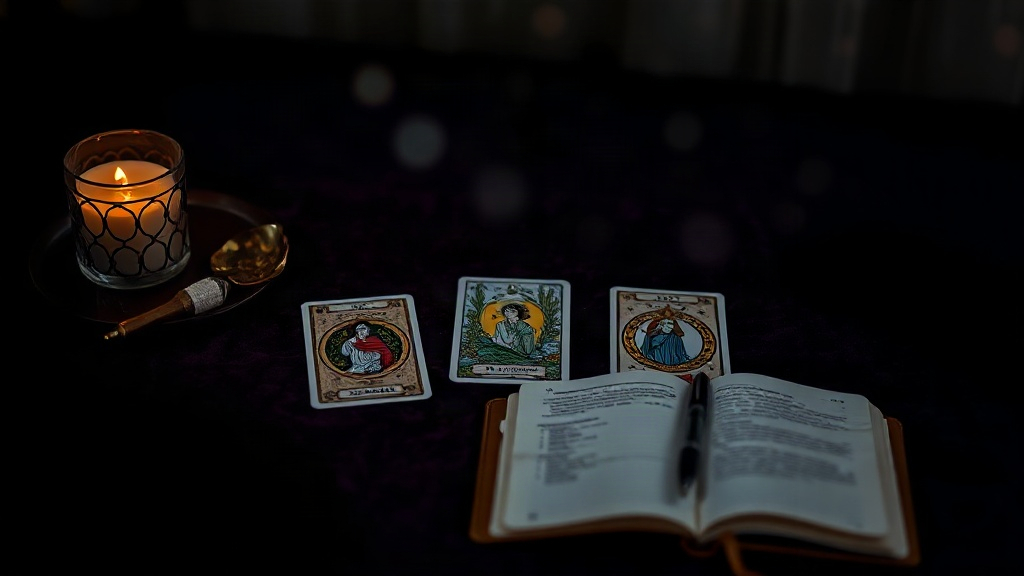
Once a day is ideal, once a week is enough to keep improving. The daily draw takes 5 minutes and compounds fast, because you get immediate feedback each evening when you check how the card’s theme played out. A weekly three-card reading on Sunday evening works well as a planning ritual. Many readers combine it with their manifestation review: pull Situation / Obstacle / Action for the week, then write intentions in their journal. Our guide to manifestation journaling shows the writing side of that pairing.
Two cautions from experienced readers. First, do not re-draw because you disliked the answer. Asking the same question repeatedly until the deck “relents” is the fastest way to lose trust in your own readings. Second, tarot does not replace professional advice on health, legal, or financial matters. It is a tool for reflection, and honest readers say so plainly.
What are the most common beginner mistakes?
The most common mistake is trying to memorize all 78 meanings before giving a single reading. Memorization without practice evaporates. Learn cards as you meet them in real readings, 5 to 10 at a time, and the deck teaches itself to you. The other mistakes are just as fixable:
- Asking vague questions. “What about love?” returns vague cards. “What do I need to understand about my hesitation to start dating again?” returns useful ones.
- Reading cards in isolation. Always connect each card to its neighbors and its position. A spread is one sentence, not a list of separate words.
- Treating a scary card as a prophecy. The Tower does not mean your building will collapse. It means a structure in your life, a belief, a job, a relationship pattern, is ready to come down so something honest can replace it.
- Skipping the notebook. Untracked readings never improve. The written record is where the learning happens.
Give yourself 90 days of the daily draw and you will not recognize your first month’s readings. The deck rewards patience the same way any practice does.
Frequently asked questions
Do I need psychic abilities to read tarot?
No. Tarot rewards observation, honesty, and practice, the same three things journaling rewards. Your intuition develops as a skill through the daily draw, and the guidebook covers the rest.
Can I read tarot for myself?
Yes, and most readers do. The one risk is bias: when you want a specific answer, you will see it. A good antidote is writing your interpretation before you check the guidebook, and re-reading it a week later.
Is tarot against religion?
That depends on your tradition, and honest readers respect the question. Many people treat tarot as a psychological and reflective tool rather than a divination practice. If your faith has concerns, pray on it and decide for yourself.
How long does it take to learn tarot?
About 90 days of daily one-card practice to read confidently for yourself, and a year or more to read fluently for others. The Rider-Waite imagery makes the process faster because every card tells its meaning in pictures.
Do I have to use reversals?
No. Many experienced readers use upright meanings only. If you skip reversals, simply flip reversed cards upright and read them normally, and note your choice in your tarot journal.
Should I cleanse a new tarot deck?
It is optional. If a small ritual helps you mark the deck as yours, shuffle it thoroughly, sleep with it near your bed for a night, or pass it through incense smoke. The real preparation is simply using it.
Whatever brought you to the cards, the deeper work underneath every reading is learning to trust your own inner voice. If you would like a daily companion for that work, get a free “message from the universe” in your inbox every morning, plus the abundance meditation. And when you are ready to go deeper into card meanings, start with our guide to The Fool tarot card, the first card of the journey.