The most effective rule for consistency and manifestation is simple: consistency beats intensity, every time. Spend 5 to 20 minutes a day on a repeatable sequence, gratitude, visualization, a written affirmation, then one action that moves you toward the goal. Do that for 30 days straight and you’ll notice sharper attention, faster follow-through, and small wins stacking up. Skip a day, don’t spiral. Just restart tomorrow.
TL;DR:
- Repetition of a short, structured routine builds neural focus and attentional bias, increasing awareness of opportunities related to your goals within weeks.
- Simplifying the practice to just gratitude and affirmation can lower friction, making consistent habit formation easier and more sustainable.
- Progress depends on regular, daily reinforcement over at least 30 days, with noticeable micro-results and shifts in attention occurring gradually.
- Tracking and reviewing small wins weekly helps reinforce belief and maintain motivation, even after missed days.
- Underlying psychological tools like goal-setting and gratitude are proven to move results forward, regardless of belief in mystical laws.
Table of Contents
- What Does a Daily Manifestation Routine Actually Look Like?
- Why Does Daily Repetition Actually Work?
- How Do You Build a Habit That Actually Sticks?
- What Happens When You Miss a Day (and How Do You Recover)?
- How Long Before Consistency and Manifestation Show Results?
- An Evidence-Informed Take on Manifestation Practice
- Where to Get Structured Support for Daily Practice
- Sources
- FAQ
What Does a Daily Manifestation Routine Actually Look Like?
Do this before you touch your phone. The first waking window is when your mind is quietest, and that’s the moment habit researchers say is easiest to hijack for something new.
The full sequence runs five steps:
- Centering breath (60 to 90 seconds): slow inhale, longer exhale, three to five rounds.
- Gratitude with reasons (2 to 3 minutes): name three things, then say why each one matters, using Bible verses about thankfulness for inspiration. The specificity is what makes it work.
- First-person visualization (3 to 5 minutes): picture yourself already living the outcome, not watching it happen from the outside.
- Written affirmation (2 minutes): one core sentence, written by hand, repeated three, six, or nine times depending on which version you prefer.
- One aligned action: something concrete you do that same day toward the goal.
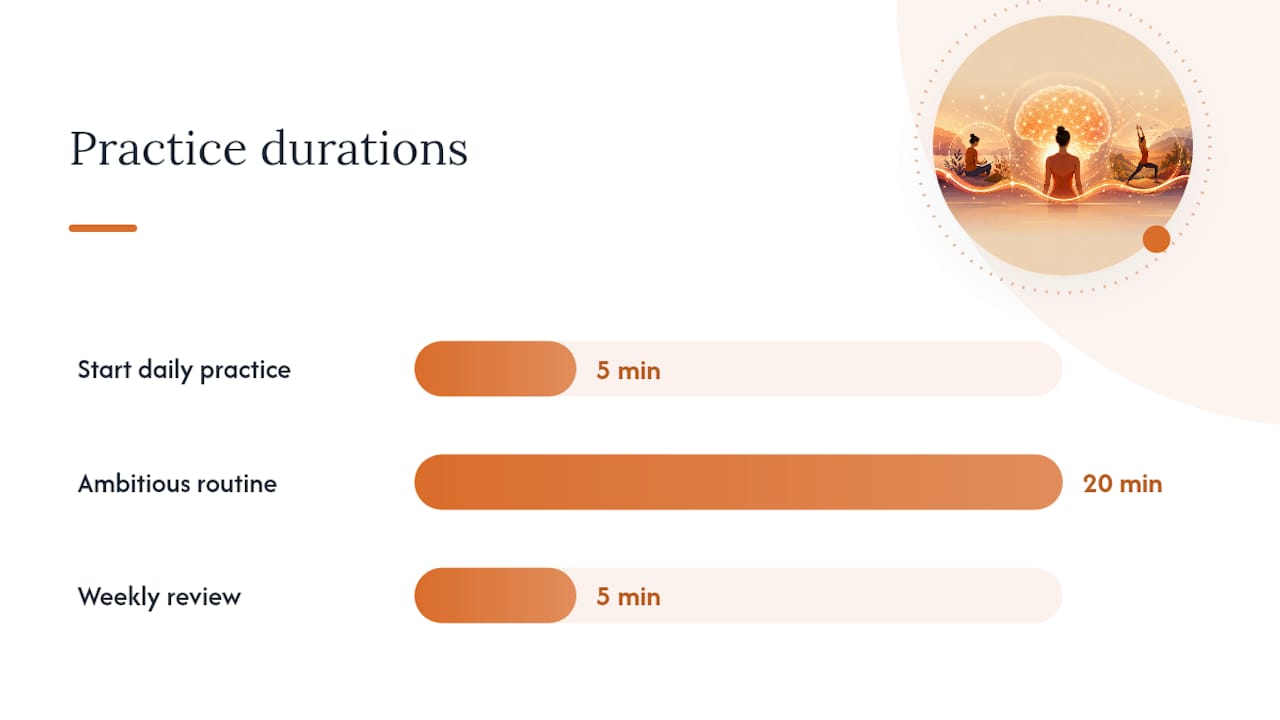
That’s the 20-minute version. Most people don’t have 20 minutes every morning, so here’s how it compresses:
- 10-minute version: breath (30 seconds), gratitude (2 minutes), visualization (3 minutes), affirmation (1 minute), then pick your action later in the day.
- 5-minute version: gratitude (2 minutes), one line of visualization, one written affirmation. Skip the formal breathing, and do the aligned action on autopilot.
Attach the routine to something you already do daily, brewing coffee, brushing your teeth, waiting for the shower to heat up. A mindful, short morning routine built around breathing, intention, and one small action tends to stick better than an elaborate ritual you can only manage on weekends.
Why Does Daily Repetition Actually Work?
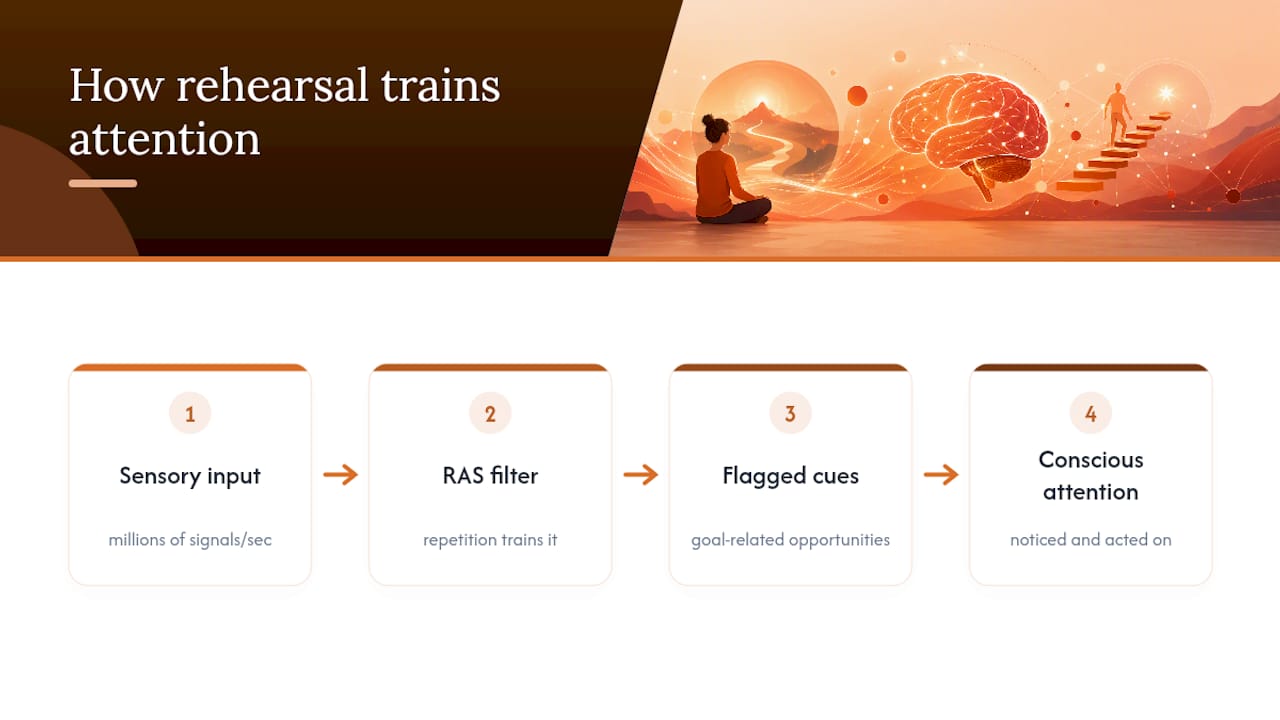
Your brain has a filtering system called the reticular activating system, or RAS, that decides which of the millions of signals hitting your senses each second actually reach conscious attention. Repetition trains that filter. If you rehearse a goal every morning, your RAS starts flagging opportunities related to it, a job posting, a comment, a name, that it would have otherwise ignored. That’s not magic. It’s attentional bias, and it’s well documented in cognitive psychology.
Habit formation runs on a simpler loop: cue, routine, reward. Tiny-habits research consistently finds that small, low-friction actions repeated daily outperform big, sporadic efforts, which is exactly why a short daily practice matters more than one long session on a Sunday. Consistency across 30 or more days retrains attention and habit systems more reliably than any single intense sitting.
Mindfulness and visualization have real, if modest, evidence behind them. Meta-analyses tied to programs referenced in the Mindful.net morning routine research show measurable improvements in mood and attention. What the evidence does not show is that thinking about a goal rearranges outside events on its own.
The law of attraction itself has no empirical support. What actually moves the needle are the psychological mechanisms underneath it: goal setting, cognitive reframing, and gratitude, tools that work whether or not you believe in cosmic ordering.
That distinction, drawn out clearly in a critical look at the law of attraction, matters for how you practice. Use the routine to change what you notice and what you do, not as a substitute for doing it.
How Do You Build a Habit That Actually Sticks?
Willpower fades. Systems don’t. Building manifestation habits that survive past week two comes down to reducing friction and giving yourself feedback loops that don’t depend on motivation.
- Start absurdly small. Five minutes, not twenty. You can always extend once the habit is automatic; you can’t sustain an ambitious routine that collapses under a busy Tuesday.
- Anchor it to an existing cue. Right after you wake up, right after coffee, right before you open email. The cue does the reminding so you don’t have to.
- Track it visibly. A streak counter, a checkbox on the wall calendar, a one-line journal entry. Tracking practice and adding a slightly longer weekly session helps consolidate habits and reinforce belief through evidence logging.
- Review weekly, not daily. Daily self-judgment breeds burnout. A five-minute Sunday review, what worked, what didn’t, what needs adjusting, keeps you honest without the guilt.
- Build in accountability. A practice partner, a weekly check-in text, or a scheduled phone reminder all work. The goal is a nudge, not a scorecard.
- Cut friction the night before. Lay out your journal, set your alarm across the room instead of on your nightstand, silence notifications until after your routine. Every extra step between waking up and starting is a chance to skip it.
Pro Tip: Keep your affirmation and gratitude prompts somewhere you’ll physically see them, a sticky note on the mirror, a card by your coffee maker. Willpower is unreliable. Visual prompts aren’t.
One missed day is not evidence the whole thing failed. It’s data. Adjust and continue.
What Happens When You Miss a Day (and How Do You Recover)?
Perfectionism kills more manifestation practices than laziness does. The moment a missed day turns into a story about being “not disciplined enough,” most people quietly stop rather than face that narrative again. Reframe the miss as information, not failure.
- Do a compressed two-minute version the next morning instead of skipping again.
- Pick one aligned action for that day, even a small one, to rebuild momentum fast.
- Log one piece of evidence, something small that went right, to counter the “I failed” story before it takes hold.
If the resistance isn’t about logistics, if you notice a pattern of self-sabotage every time things start going well, that’s usually a deeper issue than routine design. A short daily practice can’t fix a belief system actively working against your goals; that calls for structured work on the underlying pattern, not another tweak to your morning sequence.
How Long Before Consistency and Manifestation Show Results?
Expect a slow build, not a switch flip. Here’s the realistic arc:
- Week 1 to 3: mostly attentional. You start noticing relevant conversations, opportunities, or resources you’d have missed before, small synchronicities rather than dramatic shifts.
- Day 30: the habit itself starts running on autopilot, and micro-results become more consistent because you’re taking the aligned action more reliably.
- Day 90: measurable shifts in both belief and behavior. This is where most people report the routine feels less like effort and more like identity.
Log evidence weekly in a simple notebook or notes app: one line on what you noticed, one line on the action you took. Review it monthly. Progress isn’t the goal arriving fully formed. It’s the frequency of small wins increasing.
An Evidence-Informed Take on Manifestation Practice
Elvis D. Beuses built his approach to manifestation on an unusual combination: two decades in medical and pharmaceutical work, paired with his own experience of losing a marriage, a job, and nearly his residency status before rebuilding from scratch. That background shows up in how Livethelifeofyourdreams frames practice: gratitude, visualization, and affirmation work not because they summon outcomes from nowhere, but because they rewire attention and belief patterns that were otherwise running on autopilot against you.
The honest version of manifestation isn’t mystical shortcuts. It’s daily repetition doing quiet neurological work, plus enough humility to keep taking action while you wait for the pattern to shift. That combination, spiritual practice grounded in something falsifiable, is the whole premise behind the guidance Elvis has built out for readers who’ve tried journaling and affirmations before and want something with more structure behind it.
, Elvis
Where to Get Structured Support for Daily Practice
Reading about consistency and building it are two different problems. If you’ve tried affirmations or visualization before and watched them fade by week two, the gap usually isn’t motivation, it’s not having a structured, day-by-day system that adjusts as old patterns resurface. Rewire Limiting Beliefs in 8 Micro Shifts gives you exactly that: a lesson-by-lesson framework combining CBT and neuroscience with the gratitude, visualization, and action steps covered here, so you’re not rebuilding the routine from scratch every week.

If your pattern looks less like forgetting and more like self-sabotage, stalling right when things start improving, the 8-week Upper Limit Problem program targets that specific block directly. Both programs include structured lessons, templates, and accountability check-ins built around the same principle this article covers: small, repeatable practice beats sporadic intensity. Start with the rewiring course if you want the full daily framework, and check the lesson breakdown to see which fits where you’re stuck right now.
Sources
- Using science to manifest success | Psychology Today
- Mindful
- Is the law of attraction bogus? | ZME Science
FAQ
What Is the Most Powerful Manifestation Method?
There’s no single “most powerful” method backed by evidence. What consistently works best is pairing short daily visualization and gratitude practice with one concrete action toward your goal, repeated for 30 days or more.
What Is the 777 Method in Manifestation?
The 777 method involves writing an affirmation multiple times daily over several days. It’s a popular repetition ritual, though its effects likely come from the same attentional and habit mechanisms as any consistent daily practice rather than anything unique to the specific number of repetitions or days.
What Is the 10-10-10 Rule for Manifestation?
The 10-10-10 rule typically means visualizing your goal for 10 minutes, writing about it for 10 minutes, and speaking or affirming it aloud for 10 minutes. Definitions vary by source, so treat it as one structured template rather than a fixed standard.
What Are the 3-6-9 Method Affirmations?
The 3-6-9 method has you write an affirmation multiple times at different points during the day. Like the 777 method, its value likely comes from repetition reinforcing attention and belief, not from the specific numbers themselves.
How Long Does It Take to See Results From Daily Manifestation Practice?
Most people notice attentional shifts within one to three weeks, habit consolidation and steadier micro-results by day 30, and measurable belief and behavior changes by day 90 of consistent practice.
Quick reference
| Key | Practice |
|---|---|
| Days 1-7 | Anchor only: same time, same place, two minutes |
| Days 8-14 | Add feeling: say it like it already happened |
| Days 15-21 | Add action: one aligned step per day |
| Days 22-30 | Keep the streak, log what changed weekly |
| Missed a day | Resume next morning, no doubling up |
Frequently asked questions
What Is the Most Powerful Manifestation Method?
There’s no single “most powerful” method backed by evidence. What consistently works best is pairing short daily visualization and gratitude practice with one concrete action toward your goal, repeated for 30 days or more.
What Is the 777 Method in Manifestation?
The 777 method involves writing an affirmation multiple times daily over several days. It’s a popular repetition ritual, though its effects likely come from the same attentional and habit mechanisms as any consistent daily practice rather than anything unique to the specific number of repetitions or days.
What Is the 10-10-10 Rule for Manifestation?
The 10-10-10 rule typically means visualizing your goal for 10 minutes, writing about it for 10 minutes, and speaking or affirming it aloud for 10 minutes. Definitions vary by source, so treat it as one structured template rather than a fixed standard.
What Are the 3-6-9 Method Affirmations?
The 3-6-9 method has you write an affirmation multiple times at different points during the day. Like the 777 method, its value likely comes from repetition reinforcing attention and belief, not from the specific numbers themselves.
How Long Does It Take to See Results From Daily Manifestation Practice?
Most people notice attentional shifts within one to three weeks, habit consolidation and steadier micro-results by day 30, and measurable belief and behavior changes by day 90 of consistent practice.
You might also like
- Signs You Have A Strong Aura: 18 Powerful Clues Your Energy Is Magnetic
- 150 Best Manifestation Quotes That Will Transform Your Life
- Fear of Failure: Evidence-Based Steps to Move Forward
- Manifestation Meaning: Definition, Examples & Origin
- How to Manifest: A Step-by-Step Guide for Beginners
- What Is SATS? Neville Goddard’s State Akin to Sleep