The most effective way to rewire limiting beliefs is CBT-style cognitive restructuring paired with real-world behavioral experiments and repeated practice. Awareness alone doesn’t shift a belief; you need weeks of small, deliberate tests that give your brain new evidence to work with. The full protocol, sources, and step-by-step plan follow below.
TL;DR:
- Rewiring limiting beliefs requires weeks of deliberate behavioral experiments and evidence-based testing, not just awareness or positive affirmations.
- You should regularly log specific predictions and outcomes to combat confirmation bias and ensure evidence overrides old beliefs over time.
- Hidden schemas behind surface thoughts are often rooted in core templates like scarcity, worthlessness, or fear of failure, requiring deep examination.
- Socratic questioning and cognitive restructuring focus on uncovering logical gaps in beliefs with targeted questions that promote small, manageable shifts.
- Consistent practice over several weeks is necessary to rewire neural pathways, with longer support needed for beliefs rooted in early conditioning.
Table of Contents
- What Does It Mean to Rewire Limiting Beliefs?
- Step-by-Step Plan to Rewire a Limiting Belief
- How Do You Identify Hidden Limiting Beliefs?
- Cognitive Restructuring and Socratic Questioning Explained
- Behavioral Experiments: How to Test a New Belief in Real Life
- Why Self-Compassion Speeds Up Belief Change
- How Long Does It Take to Rewire a Limiting Belief?
- Why This Approach Holds Up Under Scrutiny
- A Belief I Had to Test to Break
- Structured Support for Rewiring Beliefs at Scale
- Sources
- FAQ
What Does It Mean to Rewire Limiting Beliefs?
Rewiring a limiting belief means replacing an unhelpful, unexamined assumption with a more accurate one, verified through evidence rather than willpower. That’s the standard clinical term for what’s happening here: cognitive restructuring, the core mechanism behind Butler et al.’s 2006 meta-analysis, which found CBT techniques effective across 16 different disorders. The phrase “rewire” borrows from neuroplasticity, the brain’s demonstrated capacity to build new neural pathways through repeated experience, but the mechanism doing the actual work is closer to a courtroom process than a mystical one. You gather evidence, cross-examine the belief, and render a new verdict based on what’s true rather than what feels familiar.
This matters because most self-help advice skips straight to positive affirmations, and the brain usually rejects those outright if they contradict existing evidence. Telling yourself “I am a millionaire” when your bank account says otherwise doesn’t convince your nervous system. Testing a smaller, believable claim does.
Step-by-Step Plan to Rewire a Limiting Belief
Here’s the ordered protocol clinicians and researchers point to when they describe belief change that actually holds up over time.
- Name the belief in one sentence. Write it exactly as your inner voice says it, not a softened version. Example: “I’ll never be taken seriously in meetings.”
- Rate your conviction from 0 to 100. This gives you a baseline to track movement later.
- List the evidence you think supports it. Be specific. Vague evidence (“people just don’t respect me”) won’t hold up to scrutiny.
- Cross-examine that evidence. Ask whether it’s actually proof, or just a memory that felt bad. Psychology Today’s 2025 analysis notes that awareness of a false belief is necessary but not sufficient. The real shift happens when new evidence overrides the old.
- Draft a believable alternative belief. Not “I’m brilliant in meetings,” but “I’ve made solid points in meetings before, and I can prepare better for the next one.”
- Design one small behavioral experiment. Pick a low-stakes way to test the new belief this week.
- Run the experiment and record the outcome in writing. Compare your prediction to what actually happened.
- Repeat weekly, raising the stakes slightly each time. Each disconfirmation of the old belief adds real weight to the new one.
Running through the meeting example: conviction starts at 80. The evidence review reveals two vague memories and one moment where a colleague genuinely dismissed an idea, unrelated to the speaker’s competence. The alternative belief becomes “I contribute useful points when I prepare.” The experiment: speak up once with a prepared point at the next meeting. The outcome gets logged, and conviction drops to 55 after one clean disconfirmation.
Pro Tip: Keep a two-column log: what you predicted would happen, and what actually happened. Reading it back after a month makes confirmation bias, your brain’s habit of only noticing evidence that fits the old belief, much harder to miss.

How Do You Identify Hidden Limiting Beliefs?
Surface thoughts are the ones you can hear yourself think: “I’m bad at public speaking.” Hidden schemas run deeper. They’re the organizing assumptions behind the thought, things like “I’m fundamentally not enough” or “Success always comes at a cost.” Practitioner research on schema patterns describes these as filters that shape what you notice and remember, quietly reinforcing themselves through selective attention.
A few diagnostic prompts surface them fast:
- Finish the sentence “I can’t ___ because ___” five times without editing yourself.
- Ask what you’d attempt this year if you knew you couldn’t fail, then notice what excuse shows up first.
- Track a recurring frustration for a week and ask what belief would make that reaction make sense.
- Notice the story you tell about why past attempts didn’t work.
Common templates worth checking against your own list: “I’m not the type of person who succeeds at X,” “Money is scarce and hard to keep,” “Wanting more makes me selfish,” and “If people really knew me, they’d pull away.” Most limiting beliefs examples trace back to one of these four templates in disguise.
Cognitive Restructuring and Socratic Questioning Explained
Cognitive restructuring is the process of examining a thought’s evidence, then replacing it with a more accurate one. Socratic questioning is the specific tool used to get there: a set of pointed questions that expose gaps in the belief’s logic rather than arguing against it directly. Forbes’ 2024 roundup of psychologist-recommended tactics frames this as evidence review plus targeted questioning, not blind positivity.
Useful questions include: What’s the evidence for and against this? Would I judge a friend this harshly for the same situation? Is there a more balanced way to see this? What would I need to see to change my mind?
While questioning a belief, check it against common distortions, patterns CBT worksheets are built to catch:
- All-or-nothing thinking (“If I’m not the best, I’ve failed”)
- Overgeneralization from one event to a permanent rule
- Mind reading, assuming you know what others think of you
- Discounting the positive, dismissing evidence that contradicts the belief
The goal isn’t to leap to “I’m amazing.” It’s a 5 to 10 percent shift: “I struggle with this sometimes, but I’ve handled harder things before.” That kind of statement is small enough for your brain to actually accept, which is precisely why it works better than an inflated affirmation.
Behavioral Experiments: How to Test a New Belief in Real Life
A behavioral experiment follows a fixed format: prediction, test, observation, record. You state what you expect to happen if the old belief is true, take an action that would reveal whether it’s accurate, then write down what actually occurred.
- Low stakes: Ask a coworker a question you’d normally hold back, predicting embarrassment.
- Moderate stakes: Share an idea in a small meeting, predicting it will be dismissed.
- Higher stakes: Apply for a role or opportunity you’ve assumed is out of reach.
- Sustained stakes: Maintain a new boundary in a relationship for two consecutive weeks.
| Element | What to record |
|---|---|
| Prediction | What you expect will happen, and how confident you are (0 to 100) |
| Action taken | The exact behavior, kept small and specific |
| Observation | What actually happened, in plain facts |
| Belief rating after | Updated conviction score for the original belief |
Practitioners generally recommend starting at the lowest stakes level and staying there until you’ve collected several clear disconfirmations before scaling up. Precision matters here: a vague prediction (“it’ll probably go badly”) is nearly impossible to disprove, while a specific one (“she’ll interrupt me within a minute”) gives you a clean result either way. Scale gradually, and treat any ambiguous outcome as a signal to run the same experiment again rather than a reason to abandon it.
Why Self-Compassion Speeds Up Belief Change
Setbacks during this process are normal, and how you respond to them determines whether you keep experimenting or quit. Kristin Neff’s self-compassion research finds that self-compassion reduces shame and increases persistence during behavior change, which matters directly here: a failed experiment interpreted with harsh self-judgment often ends the whole process.
Three practices worth pairing with the cognitive work:
- A self-compassion break: pause, name the difficulty out loud, and offer yourself the same words you’d give a friend.
- A brief grounding exercise before running an experiment, three slow breaths, feet on the floor, to lower anticipatory anxiety.
- A short compassionate letter to yourself after a disconfirming result, written in third person to create distance from the sting.
Layer these in right after you log an experiment’s outcome, especially a disappointing one. That’s the moment old beliefs try to reassert themselves.
How Long Does It Take to Rewire a Limiting Belief?
Neuroplasticity research indicates that consistent practice over several weeks is what actually reshapes neural pathways, and clinicians commonly treat a period of consistent practice over several weeks as a realistic window for a durable shift. Daily micro-practice (a two-minute evidence review, one small experiment per week) beats occasional intense effort.
- Weeks 1 to 2: identify the belief, establish baseline conviction, run first low-stakes experiment.
- Weeks 3 to 6: increase experiment frequency, track conviction weekly.
- Weeks 7 to 12: scale stakes, consolidate the alternative belief into daily decisions.
- Maintenance: revisit the log monthly, watch for the original trigger situations, and rerun an experiment if conviction creeps back up.
Some beliefs, especially those rooted in early conditioning, resist brief work entirely. If a belief traces back to childhood and hasn’t budged after consistent effort, that’s a signal for schema therapy or longer-term support rather than a sign the method failed.
Why This Approach Holds Up Under Scrutiny
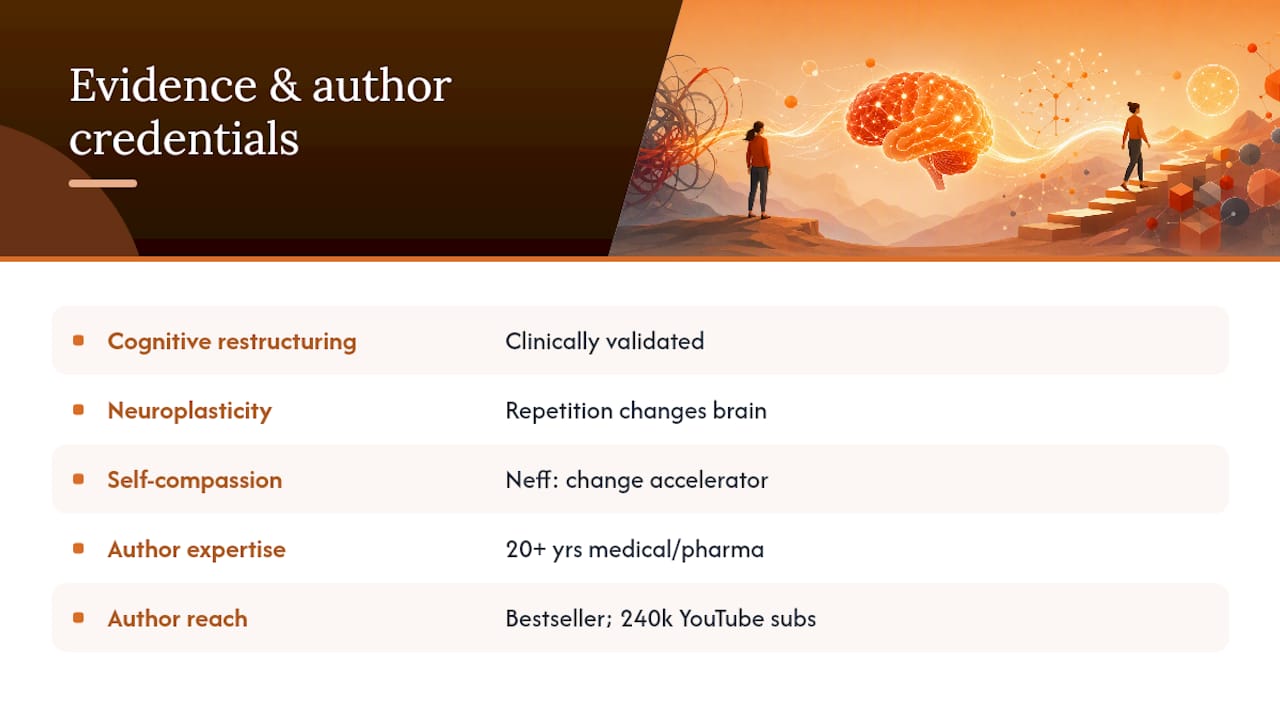
This protocol isn’t improvised. It draws on cognitive restructuring validated across dozens of clinical conditions, neuroplasticity research on how repetition changes the brain, and Kristin Neff’s work on self-compassion as a change accelerator. Elvis D. Beuses built Livethelifeofyourdreams on the premise that manifestation advice needs this kind of backing, not just optimism. His background spans over 20 years in medical and pharmaceutical work alongside his own experience rebuilding after divorce, job loss, and near-deportation, documented in his international bestseller Cómo Vencer el Miedo and shared with the 240,000 subscribers on his YouTube channel.
A Belief I Had to Test to Break
I once believed that asking for help meant I’d failed, a belief built over two decades before I ever questioned it. The step that mattered most wasn’t the affirmation. It was the first small experiment: asking one person for help and recording what actually happened instead of what I assumed would happen. If you’re starting this protocol, don’t skip the recording step. Your memory will lie to protect the old belief. Go back to the step-by-step plan above and commit to logging the first experiment this week.
, Elvis
Structured Support for Rewiring Beliefs at Scale
Reading a protocol is one thing. Running it consistently for 8 to 12 weeks, alone, without anyone checking whether you actually logged that experiment, is where most people quietly drop off. Livethelifeofyourdreams built its guided programs specifically to close that gap: workbook templates for evidence review, structured behavioral-experiment trackers, and a community layer for accountability, so the belief-testing work above doesn’t stay a good intention.

The resources are built for readers who’ve already tried journaling and affirmations without lasting results and want something with more structure behind it: evidence-based frameworks paired with the wealth psychology and subconscious reprogramming work Livethelifeofyourdreams is known for. If you’re ready to move from reading about the protocol to actually running it with support, explore the full program details and see which resource fits where you’re starting from.
This article is general information, not a substitute for advice from a qualified doctor. Consult a qualified healthcare professional about your own circumstances before acting on anything here.
Sources
- Butler et al. (2006) meta-analysis on CBT effectiveness
- Self-Compassion research overview, Kristin Neff
- Overcoming self-limiting beliefs, Psychology Today (2025)
- 3 ways to change self-limiting beliefs, Forbes (2024)
FAQ
What Is the Root Cause of Limiting Beliefs?
Most limiting beliefs form through early conditioning, painful experiences, or repeated messages absorbed before you had the ability to question them, then persist through confirmation bias, which filters out contradicting evidence.
What Does Tony Robbins Say About Limiting Beliefs?
Robbins frames limiting beliefs as stories we’ve mistaken for facts, arguing that changing behavior and taking new action is what breaks their hold, a view consistent with the behavioral-experiment approach outlined above.
What Are Five Common Limiting Beliefs?
Frequent examples include “I’m not smart enough to succeed,” “Money is scarce,” “I don’t deserve love,” “I’ll fail if I really try,” and “Wanting more makes me greedy.”
What Are Ten Common Limiting Beliefs People Hold?
Beyond the five above, common ones include “I’m too old to start over,” “People like me don’t get opportunities like that,” “I have to do everything myself,” “Rest means I’m lazy,” “I’m defined by my past mistakes,” and “If I succeed, I’ll lose people I love.”
How Do You Know if a Behavioral Experiment Worked?
Compare your written prediction to the actual outcome. A meaningful drop in your conviction score signals the experiment gave your brain real disconfirming evidence.
Frequently asked questions
What are limiting beliefs, exactly?
Repeating sentences about what is possible for you, like “I always mess this up,” that were learned rather than chosen. They steer attention and behavior long after their original situation ended.
Why micro shifts instead of big breakthroughs?
Because beliefs unlearn through the same mechanism they learned: small, repeated, evidenced experiences. Eight tiny shifts practiced daily outperform one dramatic epiphany that never gets tested.
How does CBT fit into this?
Cognitive behavioral therapy supplies the testing frame: catch the thought, check the evidence, run a behavioral experiment. The guide adapts each step for self-practice.
Keep exploring
- Habit Stacking: Quick Micro-Stacks That Actually Stick
- Synchronicity and Opportunities: A Practical Guide
- Beliefs and the Placebo Effect: What Actually Changes Behavior
- Turn Visualization Techniques Into Action With One Tiny Daily Task
- Self-Fulfilling Prophecy: What It Is and How to Change It
- Priming Psychology: A 4-Week Routine for Abundance