
Priming psychology, in the manifestation sense, is the deliberate use of affirmations, imagery, journaling, and sensory cues to reprogram your subconscious and set your mind toward attracting what you want. The fastest way to start: write one implementation intention right now. “When I sit down with my morning coffee, I will spend two minutes writing my top goal and one concrete step I’ll take today.” That single if-then sentence is not motivational fluff. It links a reliable cue to a specific response, which is exactly how priming converts intention into automatic behavior.
- Your first action (do this in five minutes): Write “When [specific cue], I will [specific goal-related action]” on paper or in your phone notes. Keep it to one sentence. That is your priming anchor for the next four weeks.
Key Takeaways
Priming psychology for manifestation works when implementation intentions, multi-sensory imagery, and WOOP obstacle planning are combined into a short, daily cue-linked routine practiced consistently over four weeks.
| Point | Details |
|---|---|
| Write one if-then plan today | Use the format “When [cue], I will [action]” and keep the cue specific and unmistakable. |
| Add multi-sensory visualization | Write, read aloud, and feel the outcome for 60–90 seconds daily; frequency matters more than session length. |
| Run WOOP for every major goal | Name your top internal obstacle and write a plan for it before relying on positive imagery alone. |
| Measure for two full weeks | Track cue adherence and action initiation before changing anything in the routine. |
| Livethelifeofyourdreams | Offers structured courses and resources that combine this neuroscience-backed approach with spiritual tradition for lasting results. |
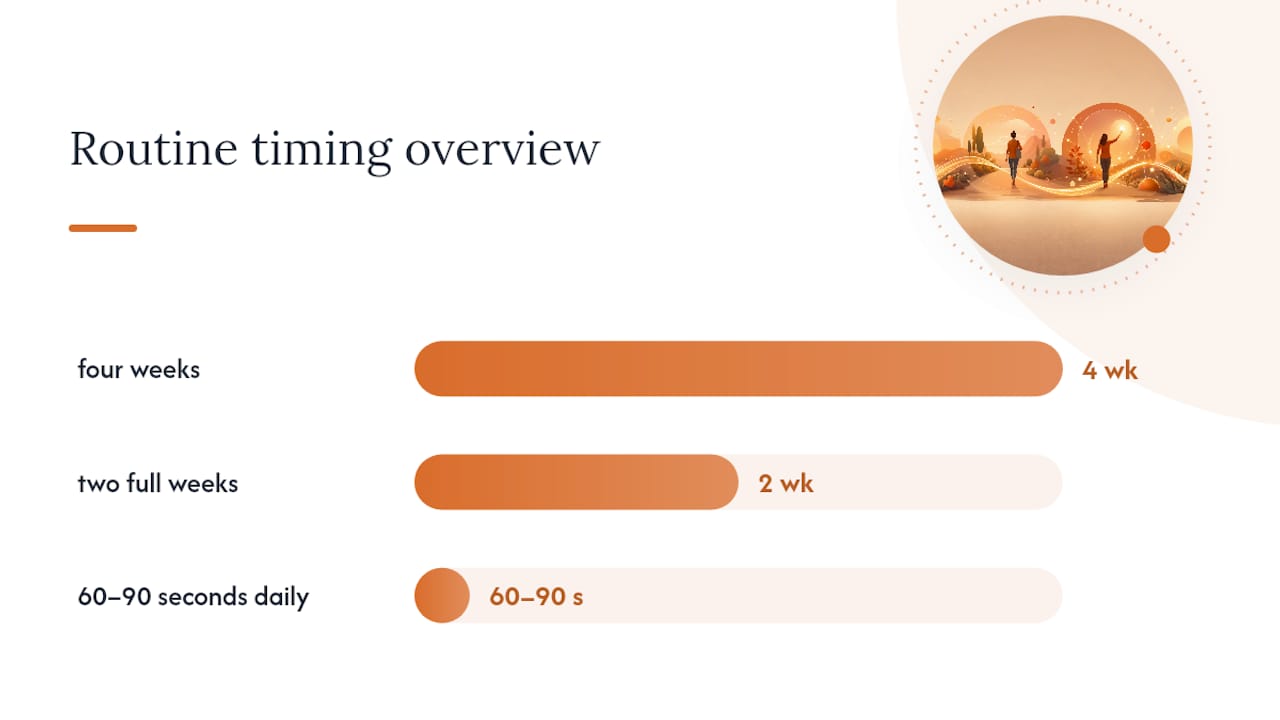
Table of Contents
- What makes priming psychology work for manifestation?
- How to follow the 4-week priming routine
- Ready-to-use templates you can copy today
- How to know it’s working and what to fix when it isn’t
- Why the science supports this combination
- The structured path from intention to results
- Sources
What makes priming psychology work for manifestation?
The techniques below are not interchangeable. Each one targets a different bottleneck between intention and action. Use them together and they compound.
Implementation intentions (if-then plans)
Gollwitzer’s research shows that if-then plans automate action initiation by creating a strong mental link between a situational cue and a goal-directed response. The moment the cue appears, the behavior fires without requiring willpower. That is the mechanism: you delegate control to the environment rather than relying on motivation in the moment.
Structure every plan as: “When [situation X], I will [response Y].” Be specific about the cue. “When I wake up” is weaker than “When I pour my first cup of coffee.”
WOOP and mental contrasting
Pure positive visualization feels good but can quietly drain motivation by tricking the brain into treating the imagined outcome as already real. WOOP (Wish, Outcome, Obstacle, Plan) fixes this by forcing you to name the most likely internal obstacle before you plan around it. That obstacle step is the mechanism that channels motivational energy into concrete action rather than letting it evaporate into fantasy.
Multi-sensory imagery and repetition
A neuroscientist writing for SELF describes manifestation as “embedding your intention” through repeated, multi-sensory re-activation: write it, read it aloud, visualize it with feeling, then repeat. Each cycle makes the brain more attuned to goal-relevant cues in daily life. One vivid session is not enough. Frequency matters more than duration.
Habit stacking and time-of-day effects
Attach your priming routine to an existing habit (morning coffee, brushing teeth, opening your laptop) so the environmental cue does the triggering. Research on goal cognition and chronotype shows that concrete planning, thinking about how rather than why, predicts greater next-day goal progress. Morning chronotypes benefit most from concrete if-then planning early in the day. Evening types can shift the routine without losing the effect.
Routines themselves reduce decision fatigue and stabilize daily behavior, which is why a short, repeated priming practice outperforms a long, occasional one.
Affirmations: what works and what backfires
Experimental evidence shows that unconditional positive self-statements can worsen mood for people with low self-esteem. The fix is to frame affirmations as possibilities or evidence-based observations rather than flat declarations. “I am becoming someone who attracts financial opportunities” lands differently than “I am rich.” Pair every affirmation with a concrete next step and it shifts from wishful thinking to priming.
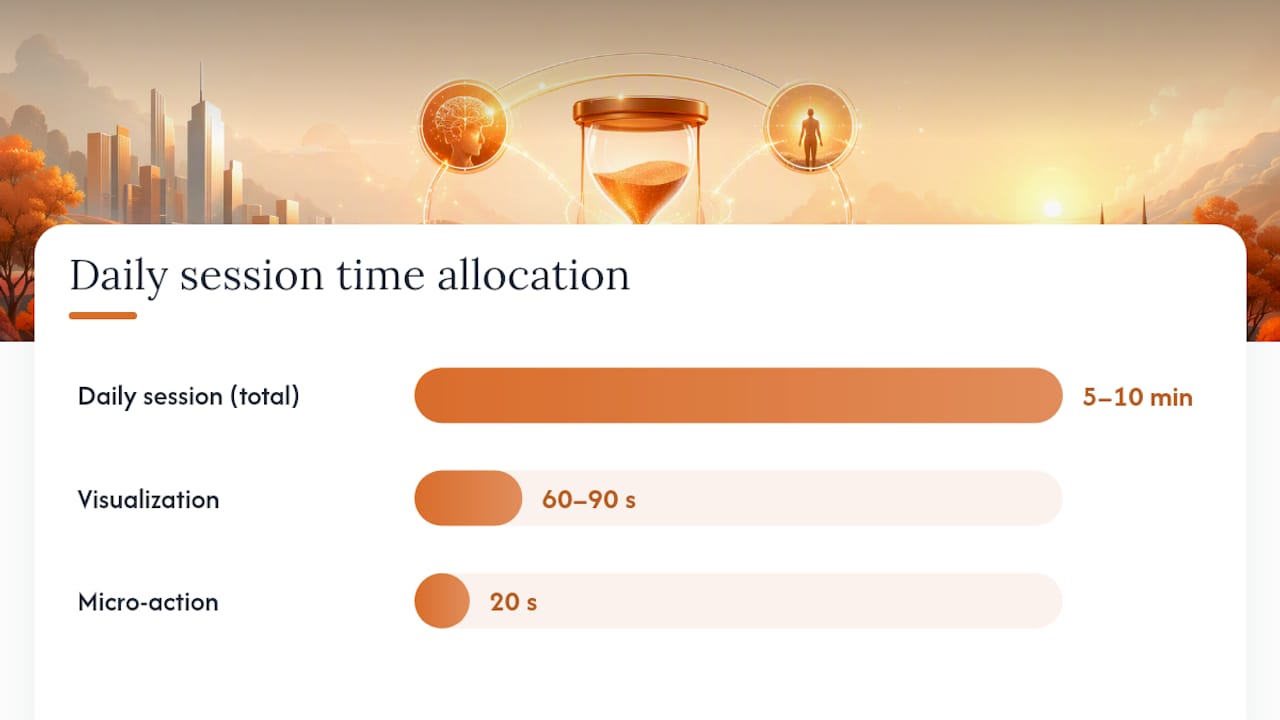
Pro Tip: After your visualization, immediately do one 20-second micro-action tied to your goal: send one email, write one sentence, make one call. That micro-implementation closes the loop between mental priming and real behavior, which is where most manifestation practices break down.
How to follow the 4-week priming routine
Each week builds on the last. Keep daily sessions to five to ten minutes. Short and consistent beats long and sporadic.
| Week | Focus | Daily Practice | What to Measure |
|---|---|---|---|
| 1 | Clarify the goal | Write your if-then plan; one-minute visualization | Did you complete the cue? Yes/No |
| 2 | Embed with senses | Add read-aloud affirmation + felt-sense imagery | Cue adherence rate (days per week) |
| 3 | Obstacle planning | Run a full WOOP session; update your if-then plan | Action initiation: did the cue trigger the behavior? |
| 4 | Scale and review | Add a second if-then plan; review weekly progress | Subjective progress score (1–10) |
Daily micro-routine (adapt to your chronotype):
- At your chosen cue moment, read your written intention aloud.
- Spend 60–90 seconds on multi-sensory visualization: see the outcome, feel it, hear what you would hear.
- Read your if-then plan once.
- Do your 20-second micro-action immediately.
- Log one word in your journal: the emotion you felt.
Morning chronotypes should front-load concrete planning (steps 3 and 4) before abstract inspiration. Evening types can reverse the order, starting with imagery and ending with the plan.
Ready-to-use templates you can copy today
Affirmation templates
- Low self-esteem framing: “I am learning to recognize financial opportunities when they appear.”
- Higher confidence framing: “Money flows to me as I take consistent, focused action.”
- Evidence-based framing: “I have already [specific past win], which shows me I can [next goal].”
If-then plan templates
- Money: “When I open my laptop each morning, I will spend five minutes on one income-generating task.”
- Relationships: “When I feel the urge to scroll social media, I will send one genuine message to someone I want to connect with.”
- Opportunities: “When I finish lunch, I will spend three minutes reviewing my goal and identifying one door I can knock on today.”
WOOP worksheet (copy into your journal)
- Wish: What is the one outcome I want most right now? (one sentence)
- Outcome: What is the best result if I achieve it? (feel it for 30 seconds)
- Obstacle: What is the most likely internal obstacle? (one word or phrase: fear, distraction, self-doubt)
- Plan: “When [obstacle] arises, I will [specific coping response].”
Filled example: Wish: land one new client this month. Outcome: financial breathing room and proof I can grow. Obstacle: fear of rejection. Plan: “When I feel afraid to reach out, I will send the message before I think about it for more than 30 seconds.”
Journaling prompts
- “Why does this goal matter to me at a deeper level, and what is the one smallest action I can take today?”
- “What did I notice today that was connected to my goal, even slightly?”
How to know it’s working and what to fix when it isn’t
Success signals: You start the cue-linked behavior without deliberating. You notice goal-relevant opportunities you would have missed before. Your emotional response to the goal shifts from anxiety to anticipation.
Common failure modes:
- Vague cues (“sometime in the morning”) that never reliably fire
- Skipping the micro-action and treating visualization alone as enough
- Relying on positive fantasy without the WOOP obstacle step, which research confirms reduces rather than increases directed effort
- Affirmations that feel false, triggering the backfire effect documented in low self-esteem studies
Troubleshooting steps: Tighten the cue to a single, unmistakable moment. Shorten the micro-action to under 30 seconds. Add the WOOP obstacle step if you have been skipping it. Run the adjusted routine for two full weeks before concluding it is not working.
Stop or reassess if the practice is reinforcing avoidance of concrete planning, encouraging financial risk without a real plan, or substituting visualization for skill-building. Evidence-based critiques of manifesting consistently show that belief without action and skill development produces poor outcomes.
Pro Tip: Place a physical object (a specific mug, a sticky note, a journal) at your cue location. The object becomes a visual trigger that fires the routine even on low-motivation days, a behavioral nudge that costs nothing to set up.
Why the science supports this combination
- Implementation intentions automate action initiation by delegating behavior control to environmental cues, reducing the need for willpower at the moment of action.
- WOOP/mental contrasting prevents the demotivating effect of pure positive fantasy by forcing explicit obstacle identification before planning.
- Multi-sensory imagery and repetition strengthen neural attunement to goal-relevant cues; a neuroscientist’s framework frames this as “embedding” intention through repeated write-read-visualize cycles.
- Concrete planning timing matters: research on goal cognition shows that thinking about how to pursue a goal predicts greater next-day progress, especially for morning chronotypes who plan early.
- Affirmations show mixed evidence. They work when integrated with values, evidence, and a concrete plan. Used in isolation for people with low self-esteem, they can backfire.
- Manifestation beliefs are genuinely common. A validated Manifestation Scale study across a collective sample of 1,023 participants found that over one third of people endorse manifestation beliefs, with the research also flagging increased risk-taking as a potential downside when belief is not balanced by concrete planning.
Multi-sensory visualization is more effective than passive contemplation when paired with a plan and immediate action.
About Elvis D. Beuses and Livethelifeofyourdreams
- Elvis D. Beuses brings more than 20 years of medical and pharmaceutical industry experience to the study of behavior change, goal pursuit, and subconscious reprogramming.
- His personal background, navigating divorce, job loss, and near-deportation, grounds the guidance in real-world stakes rather than theory alone.
- He is the author of the international bestseller Cómo Vencer el Miedo and the founder of Livethelifeofyourdreams, a platform that blends peer-reviewed psychology and neuroscience with Kabbalah and Law of Attraction principles.
- The clinical familiarity with behavior change that comes from a pharmaceutical career maps directly onto the implementation intention and WOOP frameworks covered here.
A direct word on what actually moves the needle
Most people who try manifestation practices quit within two weeks, not because the tools are wrong but because they treat visualization as the finish line. The research covered here points to the same conclusion from multiple angles: intention without a cue-linked plan stays intention. The if-then structure is what converts a wish into a behavior that fires automatically. WOOP is what keeps that behavior grounded in reality rather than drifting into passive optimism.
Spiritual framing and neuroscience are not in conflict here. They describe the same process from different angles. What matters is whether you are doing the practice daily, whether the cue is specific enough to trigger reliably, and whether you are taking a real action immediately after. Combine those three and the four-week routine becomes something you can actually measure.
The structured path from intention to results
If you have read this far, you already know more about how priming actually works than most people who have been journaling and affirming for years without traction. The gap is almost always the same: no cue, no plan, no obstacle step.
Livethelifeofyourdreams was built for exactly this reader. The courses go deeper than a single article can: structured modules that walk you through subconscious reprogramming, scarcity-to-abundance conditioning, and the Kabbalah and Law of Attraction frameworks that complement the neuroscience covered here. You get the spiritual depth and the behavioral mechanics in one place, without having to stitch together a dozen sources. Visit Livethelifeofyourdreams to find the program that fits where you are right now and start the four-week routine with full support behind it.
Sources
- Implementation Intentions
- I’m a Neuroscientist. Here’s Why I Believe in the Power of Manifestation | SELF
- The psychology of manifestation (article in PMC)
- The Simple Technique for Achieving Your Goals | Psychology Today
- Positive Self-Statements: Power for Some, Peril for Others
- Goal cognition at the beginning and the end of the day (Collabra DOI)
Frequently asked questions
Does priming actually work?
Subtle, dramatic priming effects from the older literature largely failed to replicate, and this guide says so plainly. What survives is goal priming: cues that remind you of an active goal measurably shape attention and choices.
What is an example of priming I already experience?
App icons, phone wallpaper, the note on your fridge. Any cue you see daily is priming something; the routine’s job is making those cues deliberate.
How is this different from affirmations?
Affirmations are what you say; priming is what your environment says back all day. The four week routine pairs a morning affirmation with cues placed where decisions happen.
Keep exploring
- Beliefs and the Placebo Effect: What Actually Changes Behavior
- Self-Fulfilling Prophecy: What It Is and How to Change It
- Turn Visualization Techniques Into Action With One Tiny Daily Task
- Improve Nervous System Regulation in 4 Weeks, Backed by Science
- Identity Shifting: How to Make Change Actually Stick
- Rewire Limiting Beliefs in 8 Micro Shifts With CBT and Neuroscience
- Wie funktioniert Manifestation wirklich genau?
- Manifestation wissenschaftlich erklärt: Was wirkt?
- Selbstsabotage im Alltag erkennen und stoppen