
Identity shifting is the process of deliberately changing how you see yourself so your behavior follows automatically instead of fighting itself every day. It works because your brain treats identity as evidence, not as a decision. Once you collect enough proof that you’re “someone who exercises” or “someone who finishes things,” the behavior stops requiring motivation.
Here’s a start you can do in five minutes:
- Pick one identity statement (“I am someone who reads daily,” not “I want to read more”).
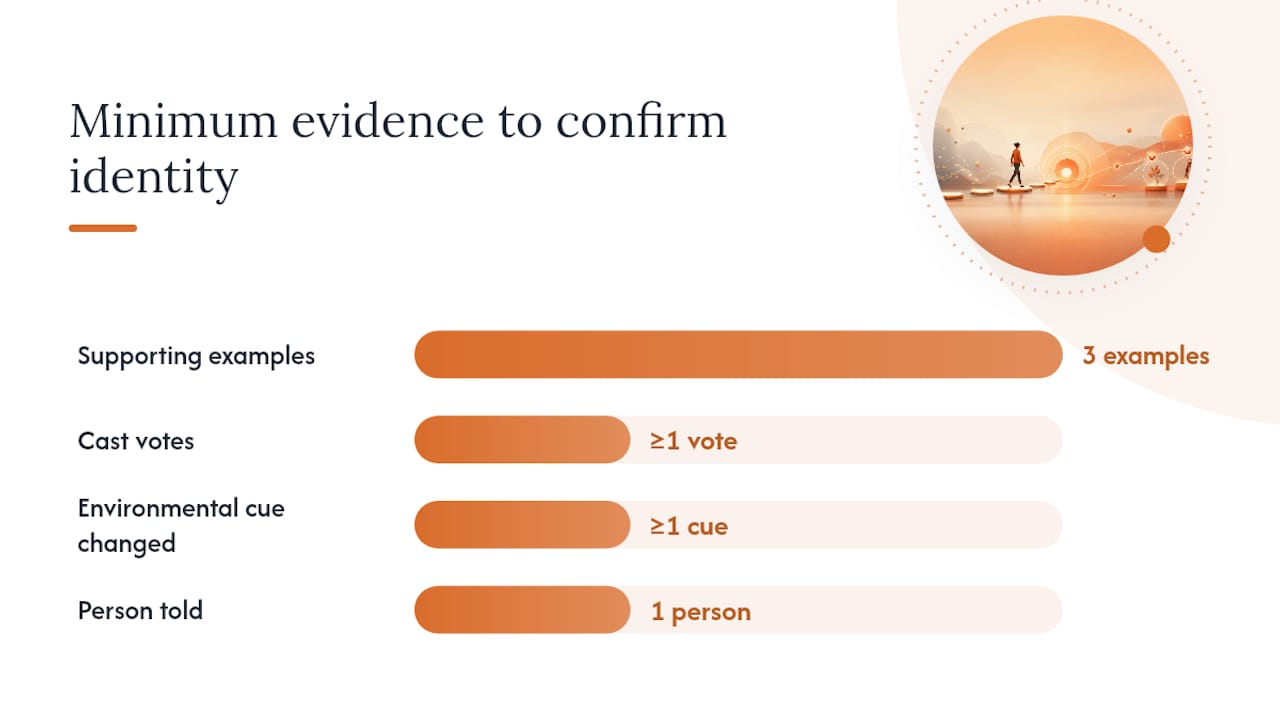
- Cast one tiny vote right now that matches it (read one page, not a chapter).
- Change one physical cue in your space (put the book on your pillow instead of the shelf).
Not every action counts as a vote. This matters more than people think.
- Counts as a vote: doing the small thing, even imperfectly, even for two minutes.
- Doesn’t count: planning to do it, telling someone you’ll do it, or feeling motivated about it.
- Counts as a vote: showing up on a bad day at 20% effort.
- Doesn’t count: a perfect day that never gets repeated.
Key Takeaways
Identity shifting works by treating small repeated actions as votes that gradually overwrite an old self-concept, and it holds under stress in a way that motivation-based change does not.
| Point | Details |
|---|---|
| Start with the smallest vote | Pick an action so easy it barely feels like progress, then repeat it daily. |
| Track votes, not just outcomes | Count how often the identity-matching action happens rather than only the end result. |
| Expect months, not days | Micro-shifts appear in weeks; structural, stress-proof identity change takes months. |
| Treat slips as data | A missed day isn’t failure evidence; a small rescue vote restores momentum fast. |
| Consider a guided program | Livethelifeofyourdreams offers structured courses that walk through identity statement design and vote-building step by step. |
Table of Contents
- What Is Identity Shifting, Exactly?
- Why Identity Shifting Actually Changes Behavior
- How Do You Actually Shift Your Identity Step by Step?
- What Exercises Help You Practice Identity Shifting?
- How Long Does an Identity Shift Take to Stick?
- What Gets in the Way of Identity Shifting?
- What Do Real Identity Shifts Look Like?
- What Research Backs Identity Shifting?
- Ready for a Guided Path Through Identity Shifting?
- Sources
What Is Identity Shifting, Exactly?
Identity shifting is a structural change to how you define yourself, not a mental pep talk. There’s a real difference between telling yourself “I’m confident today” and actually rewiring the self-concept that generates confident behavior without you thinking about it. The first is a conscious reframe. It works for an afternoon. The second is durable because it changes implicit self-concept encoding, the automatic programs that run your behavior when you’re stressed, tired, or not paying attention, according to a breakdown from ENCODED. That’s also why conscious reframes tend to collapse the moment pressure shows up, while structural shifts hold.
Research on identity shifting identifies several distinct types people move through: behavioral, linguistic, cognitive, physical, food-related, and affective shifts, often triggered by social pressure to avoid risk or gain acceptance, according to a qualitative study of young adults. A linguistic shift might be as simple as framing your identity as a non-smoker instead of focusing on trying to quit smoking. A cognitive shift changes what you notice first when you walk into a room.
The difference from outcome-based goals is where the “who” comes before the “what.”
Outcome-based goal: a specific target to lose weight.
Identity-based goal: focusing on becoming a person who moves their body regularly.
The first gives you a finish line. The second gives you a self-concept that keeps working after you cross it.
A concrete before-and-after: someone who struggled with morning routines gradually incorporates reading one page before checking their phone. Nothing else changes at first. No 5 a.m. wake-up, no new morning routine. Just one repeatable vote that the old identity wouldn’t have cast.
Why Identity Shifting Actually Changes Behavior
The mechanism is simpler than most self-help content makes it sound. Every action you take is treated by your brain as a small piece of evidence about who you are. Do something once, and it’s a data point. Do it repeatedly, and it becomes a pattern your brain starts defending, according to James Clear’s writing on identity-based habits. That’s the “vote” framing: you’re not trying to convince yourself with words, you’re outvoting your old identity with actions.

This is why change based solely on willpower often burns out, since it requires overriding self-concept repeatedly. Identity change asks you to update the self-concept once, then let it run the behavior for you. Clear frames every action as a vote for the type of person you want to become, and the strategy emphasizes tiny, repeated actions that gradually build consistent identity evidence, according to his work on identity votes. Reverse-engineering the question, asking “what would someone with this identity actually do right now?”, tends to outperform pure willpower because the brain defaults to actions that match existing self-belief, particularly under stress, according to Psychology Today.
There’s also a neurological angle worth naming plainly: repetition is how the brain encodes anything as automatic. The hundredth rep of a small vote costs far less mental effort than the first, because the behavior has started moving from effortful and conscious to implicit and automatic.
Pro Tip: Start with the smallest vote that’s almost embarrassing in how easy it is. If your brain can argue with the size of the action, it’s too big. A vote so small it doesn’t trigger resistance is the whole point, not a compromise.
How Do You Actually Shift Your Identity Step by Step?
This is the part most identity-shifting content skips. Here’s a process you can run end to end, not just a mood board of affirmations.
- Decide who you want to be. Not a goal, a person. “A calm parent,” not “less yelling.” “A writer,” not “publish a book.”
- Audit your current evidence. What have you already done, even accidentally, that supports this identity? Most people have more proof than they realize. Find three examples.
- Pick the smallest possible vote. Smaller than feels meaningful. If it doesn’t feel almost too easy, cut it in half again.
- Script your identity statement. Write it in the present tense, first person, and make it something today’s smallest vote can actually make true.
- Design your environment and social supports. Remove one friction point and add one visible cue. Tell one person, if that helps rather than adds pressure.
- Track votes, not outcomes, and iterate weekly. Review what worked, shrink what didn’t, and adjust the statement if it stopped being plausible.
Use this checklist to confirm you’ve actually done the work, not just thought about it:
- Identity is written as a sentence you could say out loud without flinching.
- Smallest vote takes under five minutes.
- At least one environmental cue changed (visible object, removed obstacle, or new default).
- A tracking method exists, even a paper tally.
- You’ve cast the vote at least once before reading further.
Identity statement template: “I am someone who [specific behavior], especially when [hard condition].” Example for health: “I am someone who moves my body daily, especially on days I don’t feel like it.” For focus: “I am someone who does one focused task before checking messages.” For creativity: “I am someone who makes something small every day, even a rough draft.”
Pro Tip: The biggest process failure is claiming the identity before you have evidence for it. Saying “I am a runner” while owning zero running shoes and having run zero times creates internal friction your brain will resist. Pair the statement with a vote small enough that it’s already true, or becomes true within minutes.
Guides on identity-based habit tracking recommend naming the identity explicitly in your tracker, “reader,” “runner,” “calm parent,” rather than tracking the raw behavior alone, because seeing the identity label reinforces the self-concept every time you check the box, according to a practical habits guide.
What Exercises Help You Practice Identity Shifting?
Reading about identity change and practicing it are different skills. These exercises close that gap.
The 7-day micro-experiment. Pick one identity, one vote, seven days. No streak-breaking rules, no ideal version. Just: did the vote happen, yes or no, each day. Review on day 8.
The 2-minute morning vote. Before checking your phone, do the smallest version of your new identity’s behavior. Two minutes, timer optional. This works because it happens before the day’s decision fatigue kicks in.
The public commitment exercise. Tell one person your identity statement and your smallest vote, not your big goal. “I’m someone who writes daily, starting with two sentences a night” invites less judgment and more accountability than “I’m writing a novel.”
Affirmation format that actually works: testable, present tense, tied to action. Weak: “I am confident and successful.” Strong: “I am someone who speaks up once in every meeting.” The second one you can verify by Friday.
Environment tweaks that remove friction fast:
- Put the object you need (book, running shoes, journal) somewhere your eyes land first.
- Delete or hide the app that competes with your new vote during the vote’s usual time window.
- Set one visible reminder where the old behavior used to happen.
- Prep the vote the night before so morning-you has zero setup steps.
Pro Tip: Run the 7-day experiment before you tell yourself this is a permanent life change. Treat it as data collection, not a verdict on your character. That framing alone reduces the odds you’ll quit after one missed day.
How Long Does an Identity Shift Take to Stick?
Micro-shifts, the first sense that “this is becoming normal,” typically show up within days to a couple of weeks of consistent votes. Structural change, where the new identity survives stress, bad days, and no motivation, takes months, not weeks. That’s a different timeline than most goal-setting advice implies, and it’s worth adjusting your expectations before you start.
Track the right things:
- Track: number of votes cast, percentage of days with at least one vote, consistency after a missed day.
- Don’t track only: the outcome metric (pounds lost, pages published) while ignoring whether the vote happened at all.
- Track: how quickly you recover after a slip, that recovery speed is itself evidence of identity strength.
- Don’t track: perfect streaks as the only measure of success. One missed day in a 30-day tracker isn’t failure data, it’s one data point among thirty.
A simple tally, tally marks on paper, a habit app, a checkbox on the fridge, beats a complicated system every time, because the goal is visible evidence, not analytics.
What Gets in the Way of Identity Shifting?
The failure modes are predictable, and most of them come from impatience rather than a flawed method.
- Too-big votes. If the action requires motivation, it’s too big. Shrink it until it’s almost boring.
- Identity before evidence. Claiming the identity with zero supporting action creates dissonance your brain will resolve by rejecting the claim, not by trying harder.
- All-or-nothing thinking. One missed vote doesn’t erase the pattern. Treating it as total failure is what actually erases the pattern.
- Social friction. People who know your old identity may resist the new one, sometimes without meaning to. This is common, documented in research on identity shifts tied to social pressure, and not a sign you’re doing it wrong.
- Identity loss anxiety. Feeling unmoored when an old identity fades is real. If it comes with persistent distress, that’s a signal to bring in outside support, not push harder alone.
Red flags worth pausing for: shifting identity to escape genuine problems instead of grow past them, or feeling like you’re performing a self that isn’t yours at all. Either signals it’s time to slow down, not speed up.
When you slip, the recovery move is small on purpose: cast one rescue vote today, reframe the miss as data rather than character evidence, and tell your accountability person the plain truth. Momentum returns faster than most people expect.
Pro Tip: The smallest possible rescue vote after a slip works better than a “comeback” plan. Trying to make up for three missed days with one big effort usually creates the next slip.
What Do Real Identity Shifts Look Like?
Health: Someone who avoided the gym entirely became someone who puts on running shoes and walks to the mailbox, nothing more, for two weeks. By week three, the walk extended itself without being told to.
Creative work: A person who called themselves “not a writer” started writing two sentences before bed. Within a month, the identity statement changed from “trying to write” to “someone who writes at night,” and the sentence count grew on its own.
Social confidence: Someone anxious in group settings committed to one comment per meeting, nothing more. After six weeks, speaking up stopped requiring a mental rehearsal beforehand.
Each of these adapts to constraints. Time-poor people shrink the vote further, not the timeline. Facing social resistance, tell fewer people, and pick votes nobody needs to witness. Any of these three becomes a 7-day experiment simply by tracking daily and reviewing on day 8.
What Research Backs Identity Shifting?
The identity-as-habits framing comes largely from James Clear’s synthesis of behavior change research, arguing that lasting habits form when they’re proof of a decided identity rather than a checklist item, detailed in his identity-based habits writing. The distinction between durable structural shifts and fragile conscious reframes is explored by ENCODED, which argues only implicit encoding changes survive stress. Academic grounding for identity shift as a broader psychological phenomenon, including in mediated and online contexts, comes from identity shift theory research published in media psychology literature.
Identity change that holds under pressure is different from identity change that only holds on a good day. That distinction is the whole difference between a phase and a shift.
If identity questions bring up ongoing distress, grief, or a sense of losing yourself entirely, that’s a conversation for a therapist or counselor, not a self-guided exercise. This process supports habit and self-concept change. It isn’t a substitute for mental health care.
A closing note on what actually works
The gap between people who talk about identity shifting and people who experience it comes down to one habit: they stopped waiting to feel like the new person before acting like one. Evidence-first, not motivation-first, is the whole method, and it’s the part most manifestation advice skips in favor of visualization alone. Try the smallest vote today. It’s worth noticing what happens by day seven.
Ready for a Guided Path Through Identity Shifting?
Reading the steps is one thing. Having a structured program that walks you through choosing your identity statement, designing your votes, and rebuilding your environment is another, especially when old scarcity thinking or self-sabotage keeps pulling you back to the identity you’re trying to leave. Livethelifeofyourdreams was built around exactly that gap: turning identity-based transformation into a guided sequence instead of a scattered pile of tips you have to piece together yourself.

The programs at Livethelifeofyourdreams combine the evidence-based identity mechanics covered here with deeper work on subconscious reprogramming, so the shift holds even when old conditioning resists it. If you’re ready to move past the 7-day experiment stage into a full identity transformation plan, visit Livethelifeofyourdreams to see the current guided programs and start with the entry-level resource available there.
Sources
- Identity-Based Habits: How to Actually Stick to Your Goals This Year | James Clear
- What Is an Identity Shift? The Psychology of Real Change | ENCODED
- Identity shifting study (qualitative study on diverse young adults) | Springer PDF
- An explication of identity shift theory (media psychology / identity shift theory) | Hogrefe eContent
Frequently asked questions
How long does identity shifting take?
Expect weeks to months of daily reps, not a weekend breakthrough. Identity changes through accumulated evidence, one small confirming action at a time.
Is identity shifting the same as faking it?
No. Faking is performance without evidence; identity shifting is acting from the new self in small ways and collecting real proof until the label fits.
Which identity should I shift first?
The one that makes everything else easier, usually something like “I am someone who keeps promises to myself.” It compounds into every other change.
More to explore
- 3 Tests to Stop Confirmation Bias in Goals, Backed by Neuroscience
- Improve Nervous System Regulation in 4 Weeks, Backed by Science
- Stop Costly Outbursts in 8 Weeks: Emotional Regulation for Success
- Neuroplasticity and Habits: Rewire Your Brain in 4 Weeks
- Priming Psychology: A 4-Week Routine for Abundance
- Rewire Limiting Beliefs in 8 Micro Shifts With CBT and Neuroscience