
Your brain can physically rewire itself to make new behaviors automatic and old ones weaker. That is what neuroplasticity means for habit change: every time you repeat a cue→action→reward sequence, you strengthen the neural pathway that runs it, and every time you interrupt an old sequence and substitute a new one, you begin to weaken the original circuit.
The three things that move the needle fastest:
- Design the cue and the tiny action together. A precise, consistent cue triggers the basal ganglia’s stimulus-response system; a small enough action removes the friction that stops you from starting.
- Target the right brain systems. Your prefrontal cortex handles goal-directed control early in learning; your basal ganglia (specifically the putamen) take over once a behavior becomes automatic. Work with both.
- Expect 2–5 months for a health-related habit to feel truly automatic, though individual timelines range widely and simple behaviors can show habit-like qualities in days.
The 4-week starter plan later in this guide turns these principles into a day-by-day protocol you can run immediately.
Table of Contents
- How neuroplasticity actually creates and stabilizes habits
- What the research actually shows about habit timelines and limits
- 7 evidence-based steps to build a new habit using neuroplasticity
- How to override an unwanted habit, not just suppress it
- Lifestyle factors that make your brain more plastic
- Common myths about habits that neuroscience corrects
- Your 4-week habit starter plan
- How this guide integrates peer-reviewed neuroscience with practitioner experience
- Key Takeaways
- Why motivation alone keeps failing you
- What Livethelifeofyourdreams offers readers who want guided support
- Useful sources for further reading
How neuroplasticity actually creates and stabilizes habits
Neuroplasticity is the brain’s capacity to change its own structure and function in response to experience. It is not a single mechanism but a family of them, and the ones most relevant to habit formation are worth knowing by name.
Synaptic potentiation and long-term potentiation (LTP) are the cellular foundation. When two neurons fire together repeatedly, the synapse between them strengthens, a principle often summarized as “neurons that fire together wire.” LTP is the sustained version of that strengthening and is widely regarded as the cellular basis of learning and memory.
Myelination speeds up the process. As a neural pathway is used more often, the axons carrying its signals get wrapped in myelin, a fatty sheath that accelerates transmission. A well-myelinated habit circuit runs faster and with less conscious effort, which is why a deeply practiced behavior feels effortless.
BDNF (brain-derived neurotrophic factor) is the growth protein that makes all of this possible at scale. Harvard Health notes that aerobic exercise raises BDNF levels, which supports hippocampal neurogenesis and synaptic plasticity. Think of BDNF as fertilizer for the circuits you are trying to build.
There is an important distinction between passive and active plasticity. Passive plasticity happens to you through repeated exposure. Active, or self-directed, plasticity happens when you consciously reflect on cues and rewards, engaging the prefrontal cortex to deliberately shape which circuits get strengthened. Healthline’s synthesis of the evidence frames self-directed neuroplasticity as the key lever that separates intentional habit design from accidental conditioning.
Individual differences matter. Younger brains generally show faster synaptic change, but adult neuroplasticity is well-documented across the lifespan. Genetics, baseline stress levels, sleep quality, and neurodiversity (ADHD, autism spectrum conditions) all affect the rate and ease of rewiring. None of these factors eliminate plasticity; they shift the timeline and the strategy.
What the research actually shows about habit timelines and limits
The “21 days to a new habit” claim has no credible empirical basis. The actual evidence is messier and more useful.
Healthline’s synthesis reports that health-related habits typically take 2–5 months to feel automatic, with individual variation spanning roughly 4 to 335 days in survey data. Simple behaviors in stable contexts form faster; complex behaviors with variable cues take longer.
| Measure | Typical range | Source |
|---|---|---|
| Health-related habit automaticity | 2–5 months | Healthline / habit research synthesis |
| Simple task habit-like behavior | Days to weeks | Lab overtraining paradigms |
| BDNF elevation after aerobic exercise | Acute spike; sustained with regular training | Harvard Health / Neurosity |
| Neuroimaging evidence type | fMRI (correlational) + TMS (causal) | PMC fMRI/TMS study |
Overtraining effects are real and measurable. The fMRI/TMS study showed that overtrained S-R sequences produce reaction-time switch costs when you try to override them, meaning the more automatic a habit becomes, the more cognitive effort it takes to stop mid-sequence. This is why breaking a deeply ingrained habit feels harder than building a new one from scratch.
A 2026 Nature Communications study and a bioRxiv preprint both point to something counterintuitive: decision-making strategy (why you act) and action execution (how you act) are controlled by distinct cortical pathways. You can update your motivation to change without immediately changing the behavior, because the execution pathway has its own plasticity timeline. This explains why people who genuinely want to quit a habit still slip, and why motivation alone is an unreliable change mechanism.
What the research cannot yet tell us is how well lab findings generalize to real-world habits. Most overtraining studies use artificial button-press tasks with hundreds of repetitions in a single session. Real habits form over weeks in variable environments. The ScienceDirect feature review acknowledges this ecological gap directly, noting that human real-world habits show more strategic flexibility than lab paradigms suggest.
7 evidence-based steps to build a new habit using neuroplasticity
Each step below is tied to the neural mechanism that makes it work, not just behavioral advice floating free of biology.
1. Pick a precise, stable cue. Vague intentions (“I’ll exercise more”) produce weak S-R encoding. A specific cue, “after I pour my morning coffee,” gives the basal ganglia a reliable trigger to latch onto. Consistency of context is what drives sensorimotor chunking.
2. Design a tiny starting action. The smaller the action, the lower the activation threshold. A two-minute version of the behavior you want still fires the circuit and starts myelination. Scale up only after the cue-action link feels automatic.
3. Attach an immediate reward. Dopamine’s prediction-error signal fires at the moment of reward, not hours later. A brief moment of genuine satisfaction, even just saying “done” out loud, is enough to reinforce the circuit. Delayed rewards (losing weight in three months) do not reliably strengthen the S-R link formed today.
4. Use deliberate practice with error correction. Repetition without feedback produces plateau, not growth. Neurosity’s guide to neuroplasticity exercises emphasizes that measurable brain changes come from practice that includes error signals and increasing challenge. After each session, ask: what went wrong and what would I do differently?
5. Stack the new habit onto an existing one. Implementation intentions (“When I do X, I will do Y”) leverage the existing cue-action link of a current habit as the trigger for the new one. This is habit stacking, and it works because you are borrowing an already-encoded cue rather than building one from scratch.
6. Repeat in a stable context. The PMC neuroscience review is clear that stable contexts are what drive sensorimotor chunking. Varying the location, time, and surrounding conditions slows automaticity. Lock the context down early; vary it only after the habit is established.
7. Track and reflect daily. Writing down whether you completed the habit engages the prefrontal cortex in a brief review loop. This is not just accountability theater; it is the self-directed neuroplasticity mechanism that keeps goal-directed control active while the basal ganglia is still building the automatic pathway.
Micro-habit templates you can copy:
- Exercise: “After I put on my shoes in the morning, I do 5 push-ups. Done = I say ‘strong’ aloud.”
- Journaling: “After I sit at my desk with coffee, I write 3 sentences. Done = I close the notebook deliberately.”
- Reducing scrolling: “When I pick up my phone before bed, I put it face-down and read one page of a book instead.”
Pro Tip: Add a small novelty element every 1–2 weeks, a new route for your walk, a different journaling prompt. Novelty spikes dopamine and encoding, which accelerates circuit consolidation without requiring you to restart the habit from scratch.
How to override an unwanted habit, not just suppress it
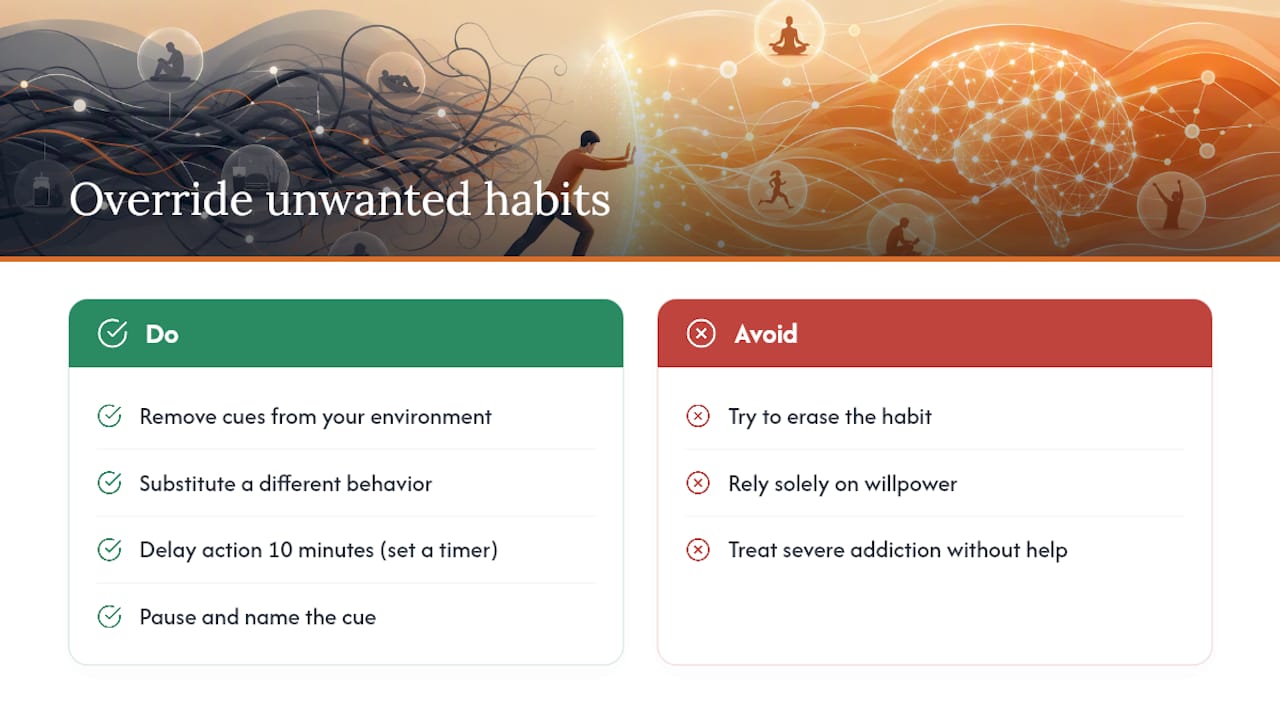
You do not erase a habit. The S-R link encoded in the putamen stays there. What you can do is make a competing pathway stronger and remove the cues that activate the old one. Scientific American’s review of habit circuitry frames it plainly: habit change means weakening S-R links and building competing associations, not deleting the original.
Cue control is the highest-leverage tactic. If the cue never fires, the habit loop never starts. Remove the cigarettes from the house, log out of social media apps, put the junk food at the back of the cabinet. Environmental redesign is not willpower; it is circuit management.
Substitution replaces the action while keeping the cue and reward structure intact. You keep the same trigger and the same reward, but you insert a different behavior in the middle. This works because the dopaminergic reward signal will reinforce whatever action precedes it, old or new.
Delay and distraction create a pause long enough for the prefrontal cortex to re-engage. A 10-minute delay between cue and action gives goal-directed circuits time to evaluate whether the habitual response is actually what you want. Set a timer. The urge usually weakens.
Reward reshaping changes what the habit delivers. If the reward driving a habit is stress relief, a new behavior that also relieves stress (a short walk, box breathing) can compete for the same dopamine signal.
Mindful interruption is the self-directed neuroplasticity move: when you notice the cue, pause and name it. “I see the cue. I am choosing.” That brief act of labeling re-engages the prefrontal cortex and weakens the automatic S-R firing.
Pro Tip: Write an implementation intention for the override: “When [old cue] happens, I will [new action] instead.” The specificity encodes a competing S-R link before the moment of temptation arrives.
A note on clinical limits. When a behavior persists despite genuine motivation to stop, causes significant distress, or involves substances, the circuitry involved may extend beyond ordinary habit systems into addiction or compulsive pathways. These cases benefit from professional support, whether a therapist, psychiatrist, or addiction specialist, rather than self-directed habit redesign alone.
Lifestyle factors that make your brain more plastic
Neuroplasticity is not fixed. The rate at which your brain can rewire depends heavily on what you do every day, and several lifestyle factors have strong evidence behind them.
Aerobic exercise is the most reliably documented lever. It raises BDNF, supports hippocampal neurogenesis, and improves synaptic plasticity. Harvard Health’s neuroplasticity guide lists aerobic exercise as a top-tier intervention for maintaining cognitive fitness and plasticity across the lifespan. Even moderate-intensity sessions, 20–30 minutes most days, produce measurable BDNF responses.
Aerobic exercise produces an acute BDNF spike and, with regular training, sustained elevation that supports the synaptic changes underlying new habit formation.
Harvard Health / Neurosity neuroplasticity guide
Sleep is where consolidation happens. During slow-wave and REM sleep, the brain replays newly encoded sequences, strengthening the synaptic connections formed during waking practice. Cutting sleep short does not just make you tired; it interrupts the consolidation window that turns today’s practice into tomorrow’s stronger habit. Aim for 7–9 hours, keep a consistent sleep schedule, and avoid screens in the hour before bed.
Diet affects plasticity through metabolic and inflammatory pathways. Mediterranean and MIND dietary patterns are associated with higher BDNF levels and better cognitive resilience. High-sugar, ultra-processed diets do the opposite, promoting neuroinflammation that impairs synaptic plasticity.

Stress management matters because chronic stress elevates cortisol, which suppresses BDNF and shrinks the hippocampus over time. Mindfulness meditation has shown measurable effects on prefrontal cortex thickness and top-down control, which is exactly the circuitry you need for self-directed habit change. Even 10 minutes of daily breath-focused meditation supports the PFC engagement that keeps goal-directed behavior online.
Novelty and deliberate learning keep plasticity high by continuously generating prediction errors, the dopamine signals that drive encoding. Learning a new language, a musical instrument, or a complex physical skill all produce cortical reorganization. You do not need to master any of them; the learning phase itself is the stimulus.
- Aerobic exercise: 20–30 minutes most days; prioritize it on days you practice a new habit
- Sleep: 7–9 hours; consistent schedule; no screens 60 minutes before bed
- Diet: Mediterranean/MIND patterns; reduce ultra-processed foods
- Stress: daily mindfulness or breath work, even briefly
- Novelty: one new skill or learning activity per week alongside your habit practice
Common myths about habits that neuroscience corrects
Myth: It takes 21 days to form a habit. This figure traces back to a misreading of a plastic surgeon’s observation about phantom limb adjustment, not habit research. The actual evidence, summarized by Healthline, shows a range of roughly 4 to 335 days depending on the behavior and the person. The 21-day myth persists because it is reassuring, not because it is accurate.
Myth: Willpower is enough to override a deeply automatic habit. Willpower is a prefrontal cortex function, and the PFC is exactly the system that gets outgunned by a well-trained S-R circuit in the putamen. The fMRI/TMS research shows that overtrained habits produce measurable switch costs even in motivated participants. Willpower helps you initiate change; it cannot substitute for environmental redesign and competing circuit training.
Myth: A relapse means you have to start over. Neurally, this is wrong. The new circuit you built does not disappear after one slip. What a relapse does is temporarily reactivate the old S-R pathway. The corrective move is to return to the new behavior at the next available cue, not to restart a day count.
“Changing your motivation does not automatically change your behavior, the execution pathway has its own plasticity timeline and can persist independently of your intentions.”
Synthesized from Nature Communications 2026 research and the bioRxiv cortical plasticity preprint
Myth: Repetition alone builds strong habits. Repetition without feedback produces a plateau. The Neurosity guide and deliberate practice research both show that error signals and increasing challenge are what drive continued plasticity. Mindless repetition encodes a mediocre version of the behavior; deliberate practice with correction encodes a better one.
On individual differences: Age slows but does not stop plasticity. People with ADHD may find cue salience and reward timing more critical than neurotypical individuals. Genetic variation in dopamine receptor density affects how strongly reward signals reinforce new circuits. These are not excuses; they are calibration data for setting realistic timelines and choosing the right tactics.
Your 4-week habit starter plan
This plan applies the neural mechanisms directly. Run it for one target habit at a time.
1. Week 1: Cue, tiny action, reward, and tracking
Choose one specific cue that already happens daily (after coffee, after brushing teeth). Write your implementation intention: “When [cue], I will [tiny action], then [immediate reward].” The action should take under two minutes. Track completion with a simple checkmark each day. Do not scale the action yet.
2. Week 2: Deliberate practice and friction removal
Add one element of error correction: after each session, write one sentence about what felt off and what you will adjust. Remove one environmental obstacle that makes the habit harder (lay out gym clothes the night before, delete the app from your home screen). Tell one person about the habit for social accountability.
3. Week 3: Scale slowly and add novelty
Increase the action by a small, specific amount (5 push-ups becomes 8; 3 journal sentences becomes a paragraph). Add one novelty element to the habit, a new route, a new prompt, a new variation. Measure your perceived automaticity on a 1–10 scale each day. You are looking for the score to rise, not for perfection.
4. Week 4: Consolidate and build a fallback plan
Lock the context: same time, same place, same cue. Write a specific “if-then” fallback plan for the most likely disruption: “If I miss the morning cue because of travel, I will do the habit at [backup time] instead.” Review your 4-week tracking log and note the trend, not the individual days.
Daily tracking template:
| Date | Cue fired? | Action completed? | Reward given? | Automaticity (1–10) | Notes |
|---|---|---|---|---|---|
| Day 1 | Yes/No | Yes/No | Yes/No | , | What felt off? |
Example entry: Day 8, Cue: after morning coffee. Action: 5 push-ups. Reward: said “strong” aloud. Automaticity: 4/10. Note: forgot on Day 6 during a meeting; will set a phone reminder as backup cue.
How this guide integrates peer-reviewed neuroscience with practitioner experience
The scientific claims in this guide are drawn from peer-reviewed sources: a PMC review of habit neuroscience, a human fMRI/TMS study with causal evidence, a ScienceDirect feature review of cognitive neuroscience approaches to real-world habits, and 2026 research from Nature Communications on cortical pathway dissociation. Where a claim is directly supported by one of those studies, it carries a citation link. Where a step is a practitioner adaptation, such as the specific micro-habit templates or the 4-week plan structure, it is grounded in the mechanisms the research describes but represents applied translation, not a direct experimental finding.
Elvis D. Beuses brings over 20 years in the medical and pharmaceutical industry alongside personal experience navigating divorce, job loss, and near-deportation, experiences that grounded his understanding of how deeply automatic fear-based and scarcity-based habits resist purely intellectual change. His 240K-subscriber YouTube channel and international bestseller reflect a body of work that consistently bridges peer-reviewed evidence with the lived reality of behavior change.
For readers who want to go deeper into the primary literature, the sources section at the end of this guide lists the core studies with direct links.
Key Takeaways
Neuroplasticity enables habit change by physically rewiring cue→action→reward circuits in the brain, and the most effective approach combines precise cue design, deliberate practice, and lifestyle supports that raise BDNF and consolidate learning during sleep.
| Point | Details |
|---|---|
| Timelines are wide, not fixed | Health-related habits typically take 2–5 months; individual range spans from about 4 to 335 days. |
| Two brain systems to work with | Prefrontal cortex handles early goal-directed control; basal ganglia/putamen encodes automaticity over time. |
| Relapse does not erase progress | The new circuit persists after a slip; return to the cue at the next opportunity rather than restarting. |
| Lifestyle accelerates rewiring | Aerobic exercise raises BDNF, sleep consolidates circuits, and chronic stress suppresses both. |
| Livethelifeofyourdreams | Offers structured, neuroscience-grounded programs for readers who want guided habit change beyond this free plan. |
Why motivation alone keeps failing you
Most habit-change advice treats motivation as the main variable. Get motivated enough, the thinking goes, and the behavior will follow. The neuroscience says otherwise, and understanding why changes how you approach the whole project.
The 2026 Nature Communications research makes the mechanism explicit: the cortical pathway controlling why you act and the pathway controlling how you act are separate. You can genuinely want to change and still find the old behavior firing, because the execution circuit has its own plasticity timeline that does not automatically update when your intentions do. This is not a character flaw. It is architecture.
What actually works is treating behavior change as an engineering problem rather than a motivation problem. You redesign the environment to remove the cues that fire the old circuit. You build a competing S-R link with a precise cue, a tiny action, and an immediate reward. You use sleep and exercise to accelerate the consolidation of the new pathway. And you stop measuring success by how motivated you feel on a given morning.
The spiritual traditions that Livethelifeofyourdreams draws on, from Kabbalah to Law of Attraction principles, have always understood that transformation requires both inner intention and outer structure. The neuroscience now shows exactly what that outer structure needs to look like at the level of circuits and synapses. Neither the intention nor the structure works without the other.
What Livethelifeofyourdreams offers readers who want guided support
The free 4-week plan in this guide gives you the framework. For readers who want structured accountability, community support, and neuroscience-grounded exercises built into a complete program, Livethelifeofyourdreams goes further.
The courses and guides at Livethelifeofyourdreams combine the peer-reviewed habit mechanisms covered here with subconscious reprogramming work, affirmations, and visualization practices drawn from Kabbalah and Law of Attraction principles, all calibrated to the specific challenge of overcoming scarcity conditioning and self-sabotage. This is not a generic productivity course. It is designed for people who have already tried journaling, affirmations, and willpower-based approaches and found them insufficient on their own.
The concrete next step: visit Livethelifeofyourdreams to browse the current courses and downloadable resources, or sign up for the email newsletter to receive daily prompts, habit cues, and evidence-informed guidance directly in your inbox.
Useful sources for further reading
These are the primary and secondary sources behind the claims in this guide. For each study, note the sample size, the task ecology (lab vs. real-world), and whether the evidence is correlational (fMRI) or causal (TMS, intervention).
- Creatures of habit: the neuroscience of habit and purposeful behavior
- How the brain makes and breaks habits | Scientific American
- Training S-R links and neural correlates of habit control (fMRI/TMS study)
- Tips to leverage neuroplasticity to maintain cognitive fitness as you age
- Feature Review Leveraging cognitive neuroscience for making and breaking real-world habits
- The Science of Habit: How to Rewire Your Brain
- Region- and stage-specific cortical plasticity shapes the multifaceted process of habit formation | bioRxiv
- Best neuroplasticity exercises for a better brain | Neurosity
- Region-specific cortical plasticity and dissociation of decision strategy and execution (Nature Communications)
Recommended
Frequently asked questions
How long does it take to rewire a habit?
The famous 21 days is a myth; real research shows a range from about three weeks to most of a year, averaging around two months. The four week plan here gets you past the hardest stretch.
Does neuroplasticity mean anyone can change?
Within reason, yes: the brain keeps plasticity for life. Change is slower with deeply practiced patterns, which is exactly why small daily repetitions outperform dramatic overhauls.
What is the fastest way to make a habit stick?
Stack it onto an existing anchor, shrink it until it is almost embarrassing, and never miss twice. The guide’s micro-stack section walks through each.
More to explore
- Turn Visualization Techniques Into Action With One Tiny Daily Task
- Improve Nervous System Regulation in 4 Weeks, Backed by Science
- Stop Costly Outbursts in 8 Weeks: Emotional Regulation for Success
- 3 Tests to Stop Confirmation Bias in Goals, Backed by Neuroscience
- 94 Studies Show Implementation Intentions That Work in 7 Days
- Rewire Limiting Beliefs in 8 Micro Shifts With CBT and Neuroscience
- Powerful Guided Meditation To Reduce Anxiety and Stress in 20 Minutes
- MEDITATION MUSIC TO RELAX
- relaxing music for stress relief with sounds of nature