The most effective approach is multi-sensory mental rehearsal, practiced in short daily bursts and paired with one small real-world action. Aim for short daily sessions, built around vivid sight, sound, touch, and emotion rather than a vague mental snapshot., sound, touch, and emotion rather than a vague mental snapshot. Start with process visualization, scripting, and a physical anchor like a vision board, and treat the image as a rehearsal, not a wish.
TL;DR:
- Combining process visualization with physical anchors and multisensory experience improves the likelihood of sustained mental rehearsal.
- Short, daily sessions of two to ten minutes, especially when paired with a small immediate action, build consistent habits over time.
- Using outcome visualization alongside process rehearsal enhances skill development, while calming imagery aids stress management.
- When mental images are weak or absent, scripting or watching relevant videos can serve as effective substitutes.
- Engaging neural circuits through detailed imagery supports better performance, especially in sports and goal achievement.
Table of Contents
- What Are the Best Visualization Techniques to Try First?
- How Do You Build a Daily Visualization Routine That Sticks?
- Which Technique Fits Your Goal: Achievement, Stress, or Performance?
- What If Your Mind Wanders or You Can’t Picture Anything?
- Why Does Visualization Actually Work?
- Why Blend Ancient Practice With Modern Research?
- Ready to Turn Vision Into a Structured Daily Practice?
- Sources
- FAQ
What Are the Best Visualization Techniques to Try First?
Many think of “visualization” as simply looking at a vision board, but it’s one among several techniques with varying effectiveness. The techniques below cover the range that actually holds up in practice, from goal setting to sports performance.
- Vision board. Collect images and words representing your goal on a physical or digital board; look at it briefly each morning. Best for keeping long-term goals visible when motivation dips. Pair it with writing one sentence about why the goal matters that day.
- Guided imagery. Follow a recorded voice through a calming or motivating scene, eyes closed, for 5 to 10 minutes. Works best for stress relief and pre-sleep wind-down. Try it before bed rather than mid-task.
- Process visualization. Rehearse the specific steps of an action (a presentation, a race, a hard conversation) rather than just the win. This is the version sports psychology research links most strongly to real performance gains, because rehearsing the steps trains the sequence your body or mind will actually execute.
- Outcome visualization. Picture the finished result in detail, including how success feels physically. Best combined with process visualization, never used alone for skill building.
- Scripting. Write a present-tense narrative describing your ideal day or outcome as if it’s already happening. Useful when mental images feel flat or hard to summon.
- Candle or apple exercise. Stare at a simple object briefly, close your eyes, and try to hold its exact image in your mind. This trains raw visualization capacity before you apply it to bigger goals.
- Mental rehearsal for athletes. Visualize the full sequence of a physical performance, including breath and muscle tension, immediately before competing. Best used in the final minutes before a game, match, or lift.
- Best possible self. Imagine your life in the future if things go well, and write down what that looks like across health, work, and relationships.
Pro Tip: Include multiple senses in every session, such as sight, sound, and physical sensation. A goal you can smell or feel in your hands sticks better than one you only “see.”
How Do You Build a Daily Visualization Routine That Sticks?
A routine only works if it’s short enough to survive a bad week. Here’s the sequence that holds up over months, not just the first excited days.
- Prepare. Sit somewhere quiet, phone away, for two to ten minutes.
- Relax. Take five slow breaths to drop your shoulders and settle your attention.
- Build the scene. Picture the setting in detail: what you see, hear, and touch.
- Add emotion. Let yourself actually feel the pride, relief, or calm the moment would bring. MSU Extension’s guidance on visualization notes that engaging multiple senses and real emotion strengthens motivation far more than a flat mental picture.
- Anchor. Pick one physical cue, a word, a touch on your wrist, a specific breath, that you’ll use to recall the image later.
- Take one tiny action. Immediately after the session, do one small thing connected to the goal: send an email, lace up your shoes, write one line of the script.
Morning sessions build momentum for the day; evening sessions before sleep tend to calm and consolidate. A few minutes per session, repeated daily, is typically sufficient, according to BetterUp’s practical breakdown of visualization exercises. If you’re chasing several goals at once, focus on a few creations at a time with small daily actions, to keep attention manageable and effective.
Pro Tip: Pair visualization with exposure. Watching short videos of the outcome you want, competition footage, a home you’re saving for, strengthens the mental image faster than imagination alone.
Which Technique Fits Your Goal: Achievement, Stress, or Performance?
Different aims call for different combinations, and expecting one technique to do everything is where most people stall out.
- Goal achievement: Combine outcome visualization with process visualization and scripting. Schedule short rehearsal sessions and attach one concrete micro-action to each.
- Stress relief: Use calming guided imagery, slow breath-focused visualization, and progressive sensory grounding, working from feet to head or room to room.
- Athletic performance: Lean on process visualization with specific sensory cues (the feel of the grip, the sound of the crowd) inside a consistent pre-performance routine.
Set realistic expectations. Visualization sharpens focus and rehearsal quality; it doesn’t replace training, preparation, or actual repetition.
What If Your Mind Wanders or You Can’t Picture Anything?
A wandering mind isn’t failure, it’s the default setting. Gently redirect attention back to the scene rather than restarting or judging the session. Shortening sessions to two or three minutes and using a guided recording, like the approach outlined by the Open University’s stress management resources, solves most drop-off.
If you genuinely can’t form mental pictures, a condition sometimes called aphantasia, imagery isn’t your only option. Scripting engages the same emotional and motivational pathways through language instead of pictures. Vision boards, tactile anchors, and short outcome videos work as substitutes for people whose imagination runs weak on visuals.
- Mind wandering: shorten the session, use a guided track, return without self-criticism.
- Weak or absent imagery: switch to scripting, physical vision boards, or watching relevant footage.
- Persistent anxiety, intrusive imagery, or performance-blocking fear: talk to a therapist or sports psychologist rather than pushing through alone.
Pro Tip: A little skepticism keeps you honest and consistent. Total skepticism just becomes an excuse to skip the practice altogether.
Why Does Visualization Actually Work?
Imagining an action and performing it activate overlapping neural circuits, which is part of why rehearsal in your head can sharpen real-world execution. Your brain’s Reticular Activating System also filters what you notice; feeding it a clear, repeated image shifts what stands out to you day to day, from opportunities to relevant conversations.
The clearest evidence comes from sports science. A review of mental imagery research in sport performance found that imagery loaded with process detail, the actual steps and sensations of an action, improves motor performance more reliably than imagining the outcome alone.
Imagery rehearsing the sequence of a skill, rather than just the win, shows a stronger link to improved performance in athletes.
Simplicity matters too. HBS Online’s work on data visualization techniques makes a point that applies just as well to mental imagery: a simple, well-chosen representation beats a complicated one you can’t reliably repeat. The same logic applies to mental rehearsal, a clear, repeatable scene beats an elaborate ritual you abandon after a week.
Why Blend Ancient Practice With Modern Research?
Visualization isn’t new. Traditions from Kabbalah to early athletic training used mental imagery long before neuroscience explained why it works. Livethelifeofyourdreams builds on that lineage while grounding it in current research on imagery and motor performance, offering structured courses, guided meditations, and scripting templates rather than leaving readers to guess at a method on their own.

Ready to Turn Vision Into a Structured Daily Practice?
If you’ve tried visualization before and felt like nothing happened, the missing piece is usually structure, not effort. Livethelifeofyourdreams builds that structure directly into its guided programs: daily routines with set timing, scripting templates instead of a blank page, and guided meditations that handle the imagery for you when your own imagination runs thin. Where most free advice hands you a technique and leaves the follow-through to chance, these resources sequence the practice so a session actually leads to a next action.
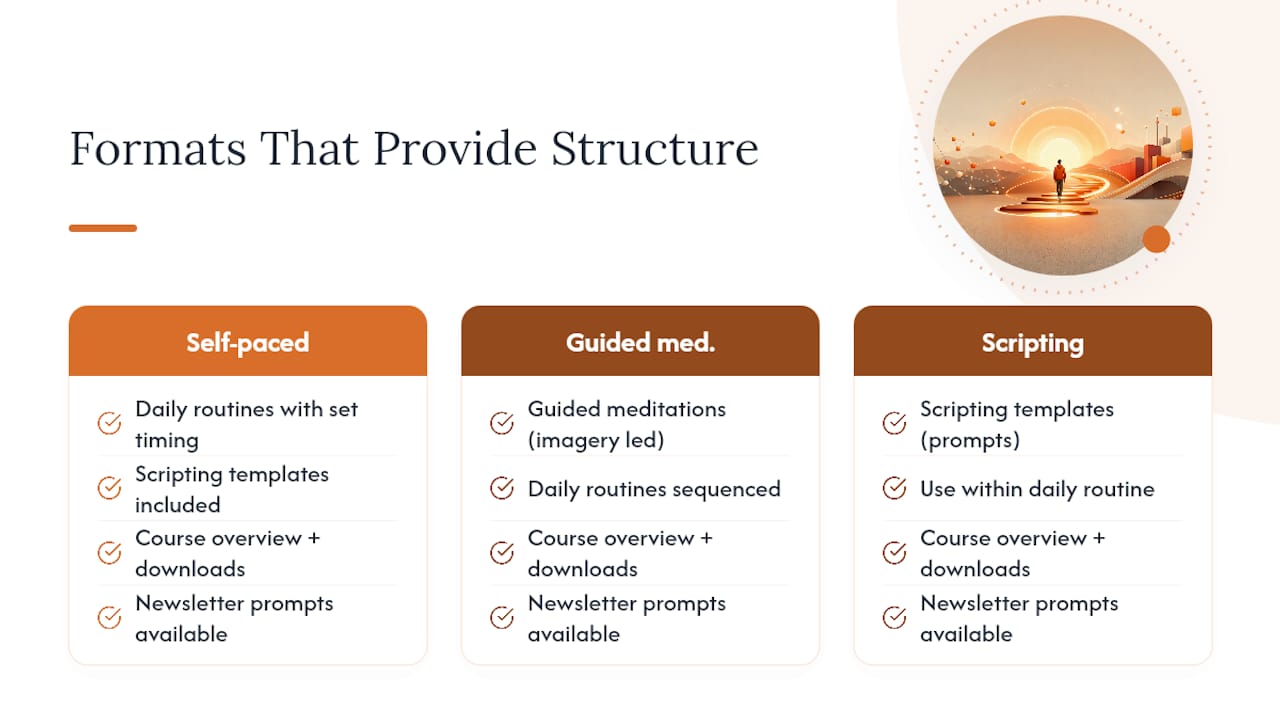
Clicking through gets you an overview of the current courses and downloadable resources, along with the option to join the newsletter for ongoing prompts and guided exercises. Start with the full course overview at Livethelifeofyourdreams and pick the format, self-paced course, guided meditation, or scripting template, that matches how you already like to work.
Sources
- Use visualization for success – MSU Extension
- Mental imagery and sport performance (review) – PMC
- 5 Visualization Techniques to Help You Reach Your Goals – BetterUp
- 17 Data Visualization Techniques All Professionals Should Know – HBS Online
FAQ
What Are Visualization Techniques?
Visualization techniques are structured ways of mentally rehearsing a goal, action, or calming scene using detailed sensory imagery, sight, sound, touch, and emotion, rather than a vague daydream.
Can You Teach Yourself to Visualize?
Yes. Most people build the skill through short, repeated practice, starting with simple exercises like the candle or apple technique before moving to full scene-building.
Is Visualization a CBT Technique?
Guided imagery and mental rehearsal overlap with methods used in cognitive behavioral therapy for anxiety and performance issues, though visualization as practiced for goal setting is broader than clinical CBT protocols.
How Do You Visualize for Manifestation?
Combine outcome visualization with process visualization and scripting, practice for a few minutes twice daily, and pair each session with one small real-world action so the imagined outcome connects to actual behavior.
Quick reference
| Key | Practice |
|---|---|
| Ergebnis-Visualisierung | Das Ziel bildlich sehen, 2 Minuten |
| Prozess-Visualisierung | Die nächsten Schritte durchgehen, 2 Minuten |
| Kleine Tat | Ein Mini-Schritt noch heute |
Frequently asked questions
How long should a visualization session be?
Two to five minutes, daily. Athletes rehearse in short vivid passes rather than long sessions, and the research on mental practice favors frequency over length.
Should I visualize the outcome or the process?
Both, in that order: feel the outcome for a minute, then mentally walk the next concrete steps. Outcome-only visualization feels good and changes nothing; process rehearsal changes what you do.
Why does visualization need a daily task attached?
Mental rehearsal primes attention and readiness, but the results arrive through behavior. The tiny task is the bridge, and it takes minutes.
Continue reading
- Habit Stacking: Quick Micro-Stacks That Actually Stick
- Synchronicity and Opportunities: A Practical Guide
- Self-Fulfilling Prophecy: What It Is and How to Change It
- Priming Psychology: A 4-Week Routine for Abundance
- Identity Shifting: How to Make Change Actually Stick
- Rewire Limiting Beliefs in 8 Micro Shifts With CBT and Neuroscience