
A self-fulfilling prophecy is an expectation that causes the very behavior that makes it come true. Expect to fail a job interview, and you’ll likely walk in tense, give short answers, and leave early, confirming exactly what you feared. The mechanism is not magic. It’s psychology: your belief shapes your behavior, your behavior shapes the outcome, and the outcome reinforces the belief. Here’s the practical takeaway you can use right now: pick one belief you hold about yourself, write it down, and for the next seven days, act as if the opposite were true. Track what changes.
- The core loop: Expectation → behavior → outcome → reinforced expectation
- Positive form: High expectations produce effort and opportunity (Pygmalion effect)
- Negative form: Low expectations produce withdrawal and failure (Golem/nocebo effect)
- The exit: Cognitive reappraisal plus deliberate behavior change, not wishful thinking alone
Key Takeaways
A self-fulfilling prophecy works through behavior, not magic: change the behavior, collect disconfirming evidence, and the belief updates on its own.
| Point | Details |
|---|---|
| Core mechanism | Expectation changes behavior, behavior changes outcomes, outcomes reinforce the expectation. |
| Historical roots | W. I. Thomas (1928) and Robert K. Merton (1948) established the theoretical and sociological foundations. |
| Evidence strength | Expectancy effects are well-documented in education and health; effect sizes vary by context and relationship authority. |
| Breaking the loop | Cognitive reappraisal plus deliberate behavior change is the most effective approach; thought alone is not enough. |
| Livethelifeofyourdreams | Offers structured, evidence-informed programs for readers who want guided help reprogramming limiting beliefs. |
Table of Contents
- Where the self-fulfilling prophecy comes from
- How a self-fulfilling prophecy actually works
- What the research actually shows
- Real-world examples across six domains
- Pygmalion vs. Golem: why the direction of expectation matters
- How to recognize and break a negative self-fulfilling prophecy
- What a self-fulfilling prophecy is not
- How self-fulfilling prophecies scale to institutions
- An evidence-informed approach to using expectations deliberately
- How literature uses self-fulfilling prophecies
- The belief you’ve been living inside
- What Livethelifeofyourdreams offers readers who want to go further
- Sources
Where the self-fulfilling prophecy comes from
The idea has two clear intellectual parents, separated by about twenty years.
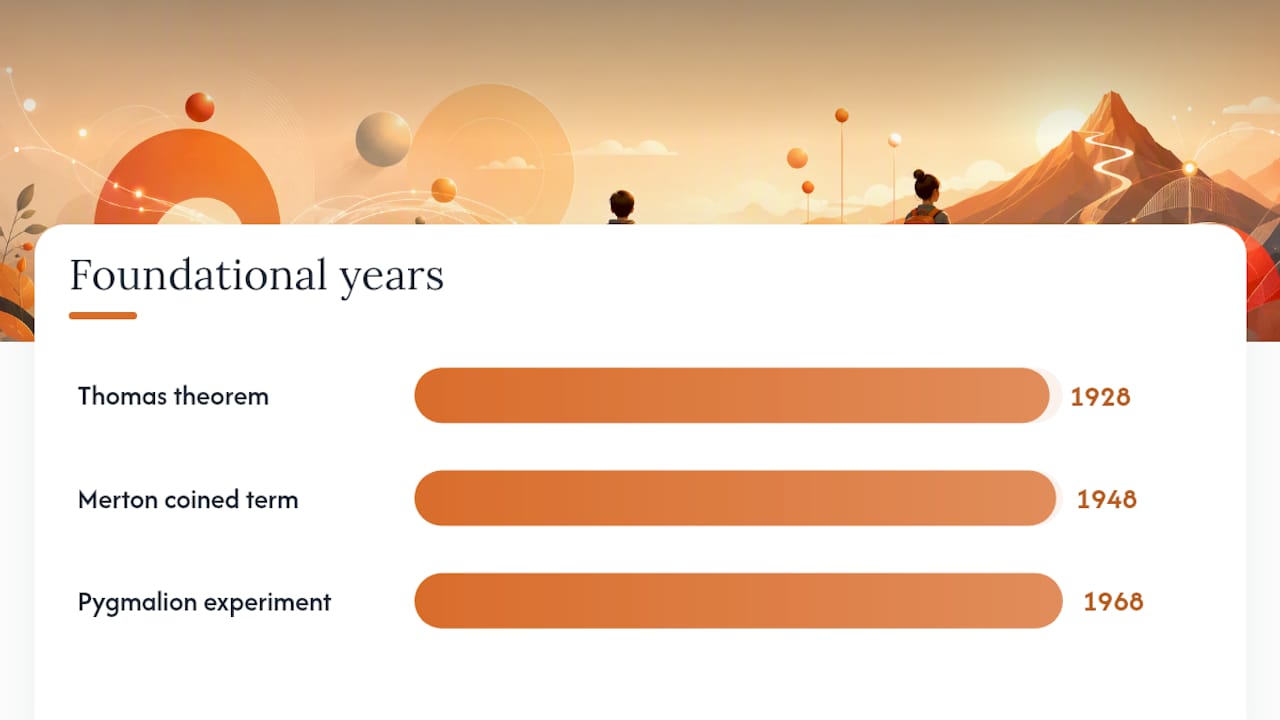
W. I. Thomas and the Thomas theorem (1928) came first. Sociologist W. I. Thomas and his wife Dorothy Swaine Thomas wrote that “if men define situations as real, they are real in their consequences.” That single sentence is the Thomas theorem, and it explains why a subjective belief, even a factually wrong one, can produce real-world effects. If you believe a neighborhood is dangerous, you avoid it, businesses close, property values fall, and the neighborhood becomes more dangerous. The belief created the outcome.
Robert K. Merton coined the phrase in 1948. Writing in The Antioch Review, Merton defined a self-fulfilling prophecy as “a false definition of the situation evoking a new behavior which makes the originally false conception come true.” His bank-run example is still the clearest illustration: a rumor spreads that a solvent bank is about to fail. Depositors panic and withdraw their money. The bank, now drained of cash, actually fails. The rumor was false, until enough people believed it.
Rosenthal and Jacobson (1968) brought the concept into the laboratory. Their Pygmalion experiment told elementary school teachers that certain students had been identified as “intellectual bloomers” likely to show dramatic gains. Those students were actually chosen at random. By the end of the year, the labeled students showed measurably higher IQ gains than their peers. The teachers’ expectations had changed how they taught, and that changed how the students learned.
| Year | Figure | Contribution |
|---|---|---|
| 1928 | W. I. Thomas | Thomas theorem: definitions shape consequences |
| 1948 | Robert K. Merton | Coined “self-fulfilling prophecy”; bank-run illustration |
| 1968 | Rosenthal & Jacobson | Pygmalion experiment: teacher expectations shift student IQ gains |
How a self-fulfilling prophecy actually works
The mechanism runs in a loop, and each stage feeds the next.
Stage 1: Belief formation. You form an expectation about yourself, another person, or a situation. It may be based on past experience, a stereotype, or something someone told you. The belief does not need to be accurate to be powerful.
Stage 2: Behavioral change. The belief alters what you do. This happens through both conscious and unconscious channels:
- Unconscious channels: tone of voice, eye contact, facial expression, how much time or attention you give someone, subtle warmth or coldness in body language. Nonverbal cues from expectation-holders reliably shape targets’ self-concepts and performance across many contexts.
- Conscious channels: the effort you put in, the opportunities you create or block, the plans you make or abandon.
Stage 3: Situational change. Your altered behavior produces a real change in the environment. The student who gets less teacher attention falls behind. The employee who is micromanaged stops taking initiative.
Stage 4: Feedback loop. The outcome appears to confirm the original belief. The teacher sees the student struggling and concludes the low expectation was right all along. The manager sees the passive employee and concludes the micromanagement was necessary. The loop closes and tightens.

A short example for each stage: Belief, “I’m bad at networking.” Behavior, You skip the conference happy hour. Outcome, You make no new contacts. Reinforcement, “See? Networking never works for me.”
What the research actually shows
The Pygmalion experiment is famous, but the research picture is more nuanced than the headline version suggests.
Classic findings. Rosenthal and Jacobson’s original study showed that teacher expectations produced measurable IQ gains in randomly labeled students. Teacher expectations can produce measurable improvements in student achievement, and low expectations tied to race, class, or gender can depress performance and reproduce inequality. That finding has been replicated in various forms across decades of education research.
Peer-reviewed scope. Expectancy effects appear across education, health, and social behavior, but they are highly context-dependent and can operate unconsciously through nonverbal channels. The effect is real; its size varies considerably by setting, relationship, and the target’s own self-efficacy.
Methodological cautions. Several limitations are worth knowing:
- The original Pygmalion study has faced criticism for small sample sizes in some grade levels and measurement inconsistencies.
- Effect sizes in expectancy research vary widely; some meta-analyses find modest average effects, others find stronger ones in high-authority relationships (teacher-student, doctor-patient).
- Context matters: an expectation that works in one environment may fail where the target has strong counter-evidence or high self-efficacy.
- Expectancy bias can affect researchers themselves, which is why blind study designs matter.
The bottom line: expectancy effects are real and well-documented in education and health contexts. Claims that extend to “any thought becomes reality” go well beyond what the evidence supports.
Real-world examples across six domains
Self-fulfilling prophecies show up everywhere once you know what to look for.
- Education. A teacher assumes a student from a low-income household will struggle. She calls on him less, gives shorter feedback, and seats him away from the front. He receives less instruction, falls behind, and by spring his grades confirm what she expected. The expectation created the gap it predicted.
- Workplace. A manager decides a new hire lacks leadership potential. She assigns the hire only routine tasks, excludes her from strategy meetings, and gives minimal mentoring. The hire never develops visible leadership skills. The manager concludes her initial read was correct.
- Relationships. Someone who expects rejection in romantic relationships tends to pull back emotionally before a partner has a chance to leave. The emotional distance frustrates the partner, who eventually does leave. The person concludes: “I knew this would happen.”
- Health: placebo and nocebo. Placebo and nocebo phenomena show how expectations influence health outcomes, though the underlying mechanisms and magnitudes vary by condition and study design. A patient told that a treatment is highly effective often experiences genuine symptom relief. A patient warned of severe side effects is more likely to report them, even from a sugar pill.
- Finance: bank runs. Merton’s original example still plays out. When depositors believe a bank is failing, they withdraw funds simultaneously. The bank, unable to cover mass withdrawals, actually fails. The belief was self-confirming.
- Fiction and myth. Oedipus’s parents, warned he would kill his father and marry his mother, abandon him, setting in motion the very chain of events the prophecy described. Macbeth, told he will be king, takes actions to secure that outcome and destroys himself in the process. Both stories turn on the same mechanism: the attempt to control a prophecy brings it about.
Pygmalion vs. Golem: why the direction of expectation matters
The same mechanism produces opposite outcomes depending on whether the expectation is high or low.
The Pygmalion effect is what happens when someone holds genuinely high expectations of another person and communicates them through behavior: more attention, richer feedback, harder challenges, and visible confidence. The target internalizes that belief, works harder, and often meets the higher bar.
The Golem effect is the mirror image. Low expectations, communicated through neglect, reduced opportunity, and subtle dismissal, produce lower performance. The name comes from the Jewish folklore figure of the Golem, a creature that becomes what its creator makes it.
Practical consequences for leaders and teachers:
- High expectations without real support are just pressure; they need to be paired with resources and feedback.
- Low expectations are often invisible to the person holding them, they show up in tone and task assignment, not explicit statements.
- Stereotypes about gender, race, or class are a common source of unconscious Golem-effect expectations.
- The Pygmalion effect works as an intentional leadership tool when combined with actual support and opportunity, not just verbal encouragement.
Mini action tip for leaders: Before assigning a task, ask yourself: “Am I giving this person this task because I believe they can grow into it, or because I’ve already decided they can’t handle more?” That one question surfaces a lot of hidden Golem-effect thinking.
How to recognize and break a negative self-fulfilling prophecy
The most effective way to interrupt a negative self-fulfilling prophecy is cognitive reappraisal combined with deliberate behavior change. Thinking differently is necessary but not sufficient on its own. You also have to act differently and collect evidence that the old belief was wrong.
Here is a five-step protocol you can run on any negative belief:
- Identify the belief. Write it out in one sentence: “I believe that ____.” Be specific. “I’m bad at public speaking” is workable. “I’m a failure” is too broad to test.
- Measure the behavior it produces. For one week, log every time the belief changes what you do. Avoid a presentation? Speak less in meetings? Write it down. You need a baseline.
- Replace one action. Choose the single behavior most directly driven by the belief and do the opposite once. Volunteer to speak at the next team meeting. Send the email you’ve been avoiding. One action, not a personality overhaul.
- Collect data. What actually happened? Did the feared outcome occur? Write the result next to the original belief. Repeated confirmation of negative expectations erodes self-efficacy, so a single disconfirming experience starts to loosen the loop.
- Iterate. After seven days, rewrite the belief based on what you observed. “I’m bad at public speaking” might become “I’m uncomfortable with public speaking but I did it and survived.” That’s a smaller, more accurate belief, and a weaker prophecy.
Example scripts:
- Teacher to student: “I noticed you got that last problem right. I’m going to give you a harder one because I think you can handle it.”
- Manager to report: “I want you to lead the client call next week. I’ll be there, but I want them hearing from you.”
- Partner to partner: “I’m going to assume you want to work this out, and I’m going to act like that’s true until I have evidence otherwise.”
Tracking template: Keep a simple three-column log: Date | Belief I acted on | What I actually did | What happened. Review it at the end of seven days.
Pro Tip: The most common mistake is trying to change the belief first and the behavior second. Reverse it. Change the behavior, collect the evidence, and let the belief update on its own. Beliefs follow evidence more reliably than they lead it.
What a self-fulfilling prophecy is not
A few common confusions are worth clearing up directly.
- It is not the law of attraction. The law of attraction claims that thoughts alone attract matching circumstances through some universal force. Self-fulfilling prophecies work through a documented causal chain: expectation → behavior → outcome. The behavior is the mechanism. Removing behavior from the equation removes the effect.
- It is not predestination or fate. The prophecy is not fixed. It exists only as long as the belief drives the behavior. Change the behavior and you interrupt the loop.
- It is not simplistic positive thinking. Telling yourself “I will succeed” without changing what you do produces nothing. The Pygmalion effect works because teachers changed their actions, not just their thoughts.
- Placebo vs. magical thinking. Placebo effects are measurable expectancy effects operating through known biological and psychological pathways, changes in neurotransmitter activity, pain-gate modulation, and behavioral compliance. They are not evidence that thought alone heals. The nocebo effect, where negative expectations worsen symptoms, follows the same logic.
The practical advice: use expectancy effects deliberately by pairing a changed belief with a changed behavior. Expecting a different outcome while doing the same things is not a self-fulfilling prophecy. It’s just hope.
How self-fulfilling prophecies scale to institutions
What happens between one teacher and one student also happens between institutions and entire populations.
When employers hold lower expectations of candidates from certain demographic groups, they offer fewer interviews, less mentorship, and smaller starting salaries. Those candidates accumulate less experience and fewer credentials over time. The employer later points to the credential gap as evidence the original judgment was correct. The expectation reproduced the disparity it claimed to observe.
The same dynamic appears in clinical settings, where clinician expectations about patient compliance or pain tolerance can shape treatment decisions, and in algorithmic systems, where training data encoding historical bias produces predictions that perpetuate it.
Institutional interventions that reduce other-imposed prophecies:
- Structured training for teachers and managers on expectancy bias and its behavioral channels
- Blind evaluation processes (anonymized applications, blind auditions) that remove demographic cues before judgment
- Accountability mechanisms that track outcomes by group and flag systematic gaps
- Algorithm audits that test whether automated systems reproduce historical disparities
Structured interventions like training, blind processes, and algorithm audits can reduce other-imposed self-fulfilling prophecies at institutional scale. One concrete example: the introduction of blind auditions in major American orchestras in the 1970s and 1980s, where musicians performed behind a screen, produced a measurable increase in the proportion of women hired. The expectation that women were less capable instrumentalists had been shaping audition outcomes; removing the cue interrupted the loop.
An evidence-informed approach to using expectations deliberately
Elvis D. Beuses, founder of Livethelifeofyourdreams and author of the international bestseller Cómo Vencer el Miedo, spent over two decades in the medical and pharmaceutical industry before applying the same evidence-based rigor to personal transformation. His work draws on peer-reviewed psychology, neuroscience, and ancient wisdom traditions to give readers tools that are both testable and grounded.
Two short exercises drawn from that framework:
Exercise 1: The 7-day micro-experiment
- Write one belief you hold about yourself that limits your behavior.
- Identify one specific action that belief prevents.
- Do that action once per day for seven days.
- At the end of day seven, write what you observed. Did the feared outcome happen? How often? What surprised you?
- Expected timeline: most people notice a shift in the belief’s emotional intensity within seven to ten days of consistent behavioral disconfirmation.
Exercise 2: The manager script (for leaders)
- Before your next one-on-one, write down your honest expectation of that person’s performance.
- Ask: “Is this expectation based on evidence, or on a pattern I assumed early on?”
- If it’s the latter, choose one stretch task to assign and one piece of specific positive feedback to give.
- Track whether their behavior changes over the next two weeks.
For readers working through identity and expectation-driven behavior in relationships, coaching-based approaches offer a structured way to surface the beliefs driving the loop before trying to change behavior.
Note: These exercises are educational tools, not medical or psychological treatment. Results vary by individual, context, and consistency of practice.
How literature uses self-fulfilling prophecies
Writers have understood the mechanism for millennia, long before psychologists named it.
- Oedipus Rex (Sophocles). King Laius receives a prophecy that his son will kill him. He orders the infant Oedipus abandoned. Oedipus survives, grows up not knowing his origins, and eventually kills a stranger on the road, his father, and marries the widowed queen, his mother. Every action taken to prevent the prophecy created the conditions for it.
- Macbeth (Shakespeare). The witches tell Macbeth he will be king. He takes that expectation and acts on it: murder, betrayal, paranoia. The prophecy did not force his hand; his belief that it was inevitable did. Shakespeare’s insight is that the prophecy gave Macbeth permission to want what he already wanted.
- Modern fiction. The Harry Potter series turns on the same device. Voldemort’s attempt to kill the infant Harry, triggered by a prophecy, is what creates the “chosen one” in the first place. J. K. Rowling uses the mechanism to ask whether prophecy reveals destiny or manufactures it.
What makes these stories endure as teaching tools is the dramatic irony: the audience sees the loop closing while the characters cannot. That gap between what the character believes and what the reader knows is exactly the gap that self-awareness creates in real life. Seeing the loop is the first step to stepping out of it.
The belief you’ve been living inside
When I look back at the years I spent building something from nothing, after job loss, after divorce, after the kind of near-deportation that makes you question whether the ground under your feet is real, what I see most clearly is not the hardship. It’s the beliefs I was running on without knowing it. The belief that people like me don’t get to build wealth. The belief that speaking up leads to rejection. Those beliefs were not facts. They were prophecies I was fulfilling every single day through the choices I made and the risks I didn’t take.

The moment I started treating those beliefs as hypotheses rather than truths, and testing them with actual behavior, the loop began to break. That’s what the exercises in this article are designed to do. If you want a more structured path through that process, the resources at Livethelifeofyourdreams are built for exactly this kind of work. Try the seven-day experiment. See what the evidence tells you.
What Livethelifeofyourdreams offers readers who want to go further
The psychology in this article is real and the steps are testable, but working through deeply held beliefs on your own is harder than it sounds. Livethelifeofyourdreams courses and downloadable programs are built for readers who want a structured, evidence-informed path through the process: subconscious reprogramming, expectation-setting tools grounded in neuroscience, and guided exercises that combine ancient wisdom traditions with peer-reviewed behavioral science.
The programs address the specific patterns this article covers: negative self-fulfilling prophecies, scarcity conditioning, self-sabotage, and the gap between what you believe and what you actually do. For readers who want practical coaching support alongside self-directed study, that combination tends to accelerate the timeline for change. Visit Livethelifeofyourdreams to see the current programs and find the one that fits where you are right now. Individual results vary; these are paid digital products, not clinical treatment.
Sources
- Self-Fulfilling Prophecy In Psychology: Definition & Examples
- Self-fulfilling prophecy: Meaning, examples, and impact
- Self-fulfilling prophecy | Definition & Examples | Britannica
- PMC article (peer-reviewed source on expectancy effects)
- What Is a Self-Fulfilling Prophecy? | Verywell Mind
- Self-fulfilling prophecy, Wikipedia
Frequently asked questions
What is a simple example of a self-fulfilling prophecy?
Expecting rejection makes you guarded; guardedness reads as coldness; the other person responds coolly, and your expectation arrives. The belief manufactured the evidence.
Can positive expectations backfire?
They can, when belief replaces preparation. The research-backed version is optimistic expectations plus honest effort, which is the combination this guide builds.
How do I find my own negative prophecies?
Finish the sentence: “things like that don’t happen to people like me.” Whatever fills the blank is a working prophecy, and step one of the plan is naming it.
More to explore
- 3 Tests to Stop Confirmation Bias in Goals, Backed by Neuroscience
- 94 Studies Show Implementation Intentions That Work in 7 Days
- Habit Stacking: Quick Micro-Stacks That Actually Stick
- Synchronicity and Opportunities: A Practical Guide
- Neuroplasticity and Habits: Rewire Your Brain in 4 Weeks
- Rewire Limiting Beliefs in 8 Micro Shifts With CBT and Neuroscience
- Angel Number 1155 Meaning: Change, Freedom, New Starts
- Glaubenssätze über Geld verändern lernen
- MEDITATION TO START THE YEAR