Implementation intentions are short “if-then” plans that link a specific cue to a specific action, and they close the gap between wanting to do something and actually doing it. A meta-analysis by Gollwitzer and Sheeran found a medium-to-large effect (d = .65) across 94 tests, which is a large effect for a technique that takes about thirty seconds to write. Once you have a goal, the next step is learning to write the plan correctly. That comes next.
TL;DR:
- Successful plans require selecting a reliable, unmissable cue and clearly specifying a single, observable behavior to automate responses effectively.
- The technique enhances goal pursuit during initiation, shielding from distractions, and disengagement, but only when attached to a genuine, already activated goal.
- Common failures stem from weak motivation, conflicting cues, cognitive overload, or unaddressed psychological resistance, which often need deeper work beyond planning.
- Practical implementation involves choosing a specific, consistent cue, creating a simple plan, rehearsing mentally, and adjusting cues if behavior does not improve after a week.
Table of Contents
- What Are Implementation Intentions and How Do They Work?
- What Does the Research Actually Show?
- How to Write an Implementation Intention That Actually Works
- Why Implementation Intentions Fail (and How to Fix Them)
- Implementation Intentions in Action: Real Examples
- Templates and a 7-Day Practice Plan
- Why Trust This Guide on Implementation Intentions
- Why Plans Alone Don’t Always Stick
- How Livethelifeofyourdreams Helps You Apply This
- Sources
- FAQ
What Are Implementation Intentions and How Do They Work?
An implementation intention takes the form “If [situation X occurs], then I will [perform behavior Y].” That’s the whole formula, coined by psychologist Peter M. Gollwitzer, whose research established the construct as a distinct mechanism separate from ordinary goal setting.
Most people confuse a goal intention with an implementation intention, and the mix-up is exactly why so many resolutions die by February, as explained in Professional Career Development: Steps for Long-Term Success. A goal intention says “I will exercise more.” That’s a destination, not a route. An implementation intention says “If it is 7 a.m. on a weekday, then I will put on my running shoes and walk for 15 minutes.” One states what you want. The other tells your brain exactly when, where, and how to act on it.
The mechanism behind this is what researchers call strategic automaticity. When you form an if-then plan, you mentally rehearse the link between a cue and a response before the moment arrives. This does two things at once: it raises the mental accessibility of the cue, so you notice it more readily, and it automates the response, so acting on it doesn’t require a fresh decision. A PMC review on self-regulation describes this as offloading part of the decision-making burden onto the environment itself, which is a fundamentally different approach than relying on willpower in the moment.
Cues generally fall into four detectable categories:
- Time cues: “If it’s 9 a.m., then I will write for 45 minutes before checking email.”
- Place cues: “If I walk into the kitchen, then I will drink a glass of water first.”
- Event cues: “If I finish a meeting, then I will send a follow-up email within 10 minutes.”
- Internal state cues: “If I feel the urge to check my phone during work, then I will take three deep breaths instead.”
Pro Tip: Pick a cue you cannot miss. A vague cue like “when I have time” gives your brain nothing to grab onto. A cue like “when I sit down at my desk” is unmissable, which is exactly the point.
What Does the Research Actually Show?
The evidence behind implementation intentions is unusually strong for a self-help technique, mostly because it wasn’t born in self-help. It came out of decades of controlled psychology research.
The foundational data point is the meta-analysis by Gollwitzer and Sheeran, which pooled 94 independent studies and found an effect size of d = .65 on goal attainment. In behavioral science, that’s considered medium to large, on par with or exceeding many clinical interventions studied with similar rigor. It means people who form if-then plans are substantially more likely to follow through than people with the same goal but no plan.
By the numbers: Across 94 independent tests, implementation intentions produced an effect size of d = .65 on goal attainment, a medium-to-large effect rarely seen from a single-sentence intervention.
That same review found the benefit isn’t limited to getting started. Implementation intentions appear to help across three distinct phases of goal pursuit:
- Initiation: acting promptly when the cue appears instead of delaying.
- Shielding: protecting the goal from distractions and competing temptations once you’ve started.
- Disengagement: helping people abandon a plan that isn’t working and switch to a better one.
That third function surprises people. Implementation intentions aren’t only about pushing forward. They also make it easier to notice when a strategy has failed and pivot, because the plan was specific enough to evaluate in the first place.
There’s a hard boundary condition worth knowing before you get too excited about the effect size. Forming an if-then plan only works when it’s attached to a real, activated goal intention. If you don’t actually want to floss more, writing “if I finish brushing my teeth, then I will floss” won’t manufacture motivation out of nothing. Research on goal intentions and attainment is explicit on this point: the plan amplifies existing commitment, it doesn’t create it. That’s the single most misunderstood part of the whole technique, and it’s why some people try it once, see no results, and give up.
How to Write an Implementation Intention That Actually Works
Writing an effective if-then plan is a five-step process, and skipping any one step is usually why a plan fails to change behavior.
- Confirm you have a genuine goal intention. Before writing any if-then statement, ask whether you actually want the outcome. If the honest answer is “not really,” fix the motivation problem first. No planning technique compensates for a goal you don’t care about.
- Choose exactly one cue. Pick a moment, location, event, or internal state that occurs reliably and that you’ll notice without effort. Multiple cues for the same behavior dilute the link, at least at first.
- Specify one observable behavior, not a goal. “Then I will feel more confident” isn’t observable. “Then I will say one thing I’m proud of out loud” is. If you can’t picture yourself doing the action on video, it’s too vague.
- Write the plan as a single sentence. “If [cue], then I will [behavior].” No qualifiers, no backup clauses, no “unless I’m too tired.” Complexity is the enemy of automaticity.
- Rehearse it once, mentally. Research on strategic automaticity suggests the act of forming the plan (not repeating it daily) does most of the work. Read it, picture the cue, picture yourself acting. That’s it.
Here are templates you can copy directly and adapt:
- If [specific time] arrives, then I will [specific action] for [duration].
- If I arrive at [specific place], then I will [specific action] before doing anything else.
- If [event] happens, then I will [specific action] within [timeframe].
- If I notice [internal state/urge], then I will [specific alternative action] instead.
Pro Tip: Write the “then” clause before the “if” clause. People default to vague behaviors (“exercise more”) and then bolt on a weak cue. Nail the exact action first, then find the cue that fits it best.
A short practice exercise: pick one goal you’ve stalled on for at least a month. Write a single if-then plan using the format above. Commit to it for seven days, no exceptions, no revisions mid-week. At the end of the week, check whether you followed the cue-response link and whether the cue itself was reliable enough to notice every day. Most first plans fail not because the person lacked willpower but because the cue was poorly chosen; that’s a design flaw, not a character flaw.
Why Implementation Intentions Fail (and How to Fix Them)
Even a well-written if-then plan can fall apart, and the failure modes are well documented enough that you can usually diagnose the problem in under a minute.
Weak or absent motivation is the most common culprit. If you’re using an implementation intention to force yourself into a goal you don’t actually value, the plan has almost nothing to work with. The fix isn’t a better cue. It’s addressing the underlying resistance before you plan anything, which often means confronting the belief or fear driving the avoidance in the first place.
Competing plans sharing the same cue cause real interference. If “when I sit at my desk” triggers both “check email” and “write for 45 minutes,” your brain has two competing responses attached to one trigger, and it will default to whichever is easier. The fix is to reassign one behavior to a different cue or sequence them explicitly: “If I sit at my desk, then I will write for 45 minutes before opening email.”
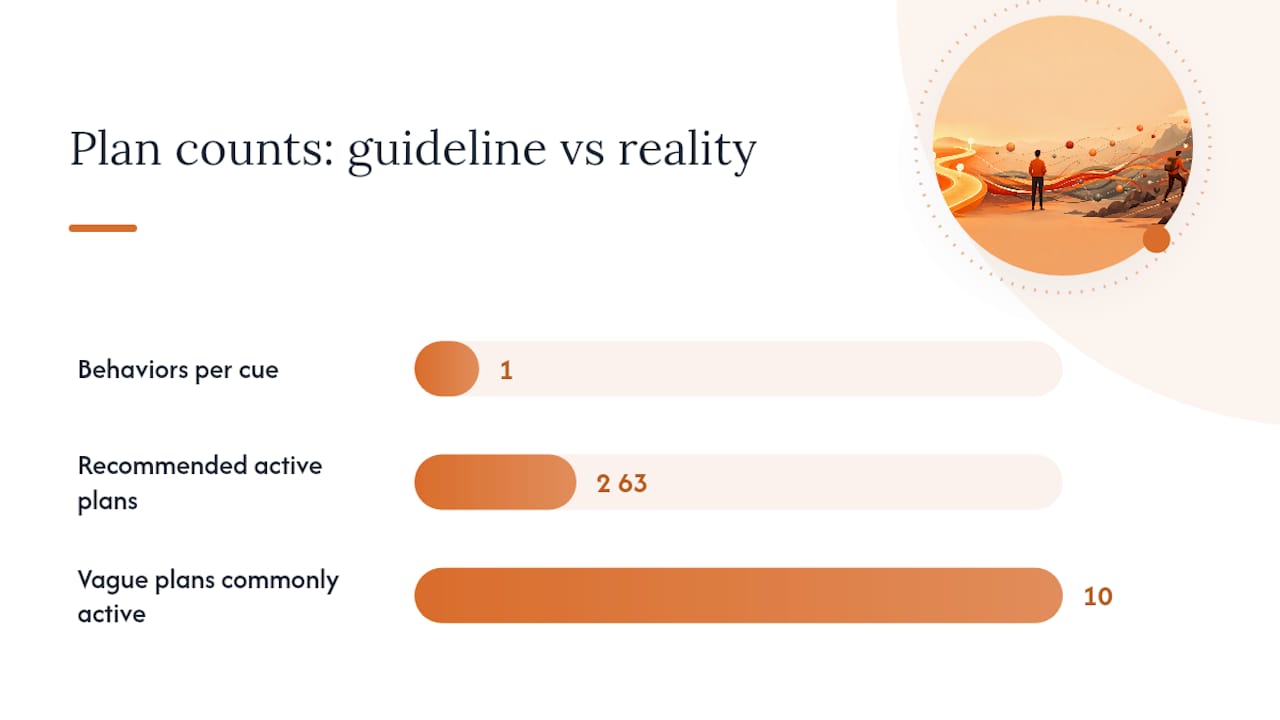
Cognitive overload and fatigue blunt the automaticity effect. Plans formed when you’re exhausted or juggling five other decisions don’t stick as well, because part of what makes them work is a clear mental rehearsal at formation. Simplify the plan and reduce the number of active if-then plans you’re running at once. Two or three well-formed plans beat ten vague ones.
Habit strength and social context also matter. An existing habit that conflicts with your new cue (grabbing your phone the second you sit down, for instance) will compete with a new plan until the new link gets reinforced. Social settings that don’t support the behavior (eating lunch with coworkers who order dessert every day) weaken the cue’s power too.
- Confirm motivation before writing a plan, not after it fails.
- Give each cue exactly one behavior.
- Cap active plans at two or three.
- Adjust cues that conflict with existing habits or social settings.
Pro Tip: If a plan fails for a full week, don’t just try harder. Change the cue. A cue you keep missing isn’t a discipline problem, it’s a design problem.
If the resistance runs deeper than a scheduling issue (something closer to self-sabotage or an unconscious ceiling on how much success feels safe) a plan alone won’t fix it. That’s usually a sign the block is psychological rather than logistical, and it’s worth addressing directly through work like breaking the upper limit problem rather than writing a fourth if-then plan for the same stuck goal.
Implementation Intentions in Action: Real Examples
The template adapts cleanly across very different goals, and the strongest examples share one trait: the cue is unmistakable and the behavior is a single visible action.
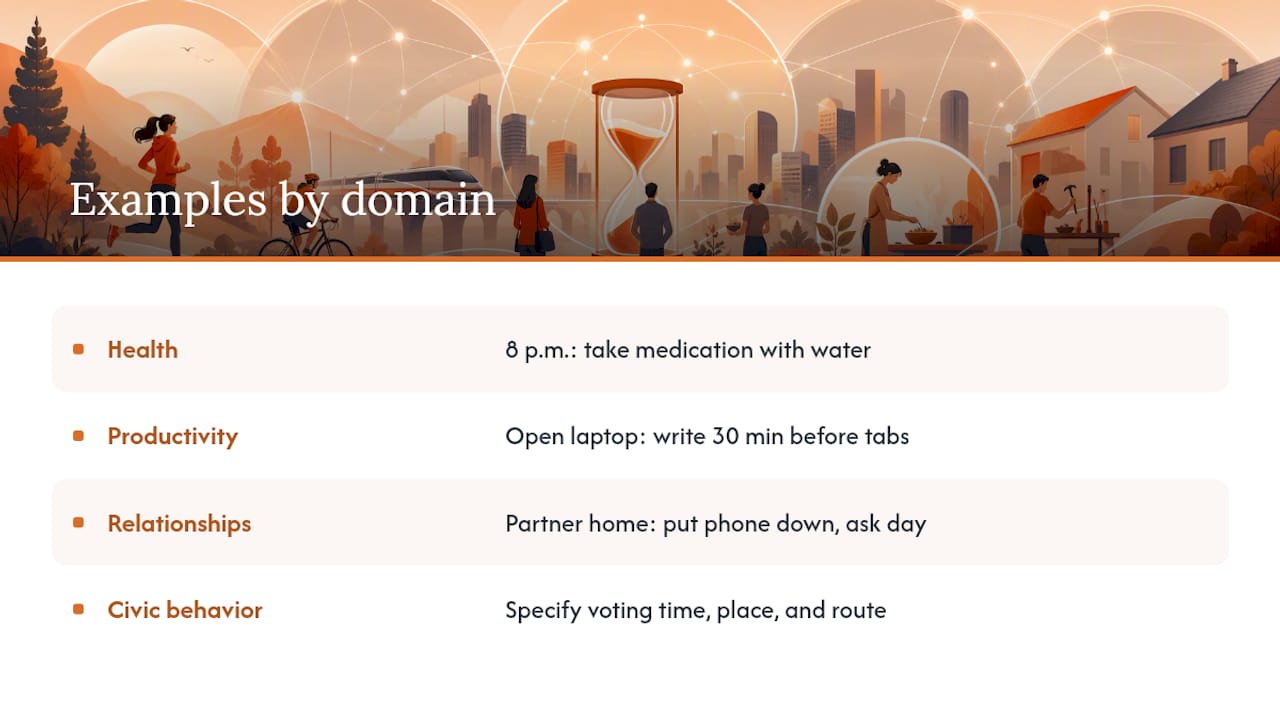
Health: “If it’s 8 p.m., then I will take my medication with my glass of water.” “If I get a calendar reminder for my appointment, then I will confirm it by text within the hour.” “If I finish my lunch, then I will take a 10 minute walk around the block.”
Productivity: “If I open my laptop in the morning, then I will write for 30 minutes before opening any tabs.” “If an email arrives that isn’t urgent, then I will move it to a folder and answer it at 4 p.m.” “If a meeting ends with an action item assigned to me, then I will add it to my task list before leaving the room.”
Relationships: “If it’s Sunday evening, then I will call my parents for 15 minutes.” “If my partner gets home from work, then I will put my phone down and ask about their day.” “If I notice I’m annoyed at a friend, then I will name the specific issue out loud instead of going quiet.”
Civic behavior: James Clear’s summary of the research points to voter turnout studies where simply asking people to specify what time they’d vote, from where, and by what route measurably increased follow-through. The same logic applies to flu shot appointments: naming the exact day and location closes the gap between intention and action.
Templates and a 7-Day Practice Plan
Copy one of these directly and fill in your own specifics:
- Time-based: “If it is [time], then I will [behavior] for [duration].”
- Place-based: “If I am at [location], then I will [behavior] before [competing activity].”
- Event-based: “If [event] happens, then I will [behavior] within [timeframe].”
- Internal-state-based: “If I feel [urge/emotion], then I will [alternative behavior] instead.”
For logging, keep it simple: note the date, whether the cue occurred, and whether you followed through. That’s three data points, nothing more. A University of Melbourne if-then planning resource recommends this kind of minimal tracking specifically because heavier logging systems tend to get abandoned within days.
A 7-day version to run right now:
- Day 1: Write one plan using a template above. Rehearse it mentally once.
- Days 2 to 4: Log whether the cue occurred and whether you acted on it.
- Day 5: If you missed the cue twice, swap it for a more reliable one.
- Days 6 to 7: Keep logging. Note whether the response is starting to feel automatic.
Why Trust This Guide on Implementation Intentions
This article was written by Elvis D. Beuses, who spent more than 20 years in medical and pharmaceutical work before building Livethelifeofyourdreams, and who wrote the international bestseller Cómo Vencer el Miedo alongside a YouTube channel reaching 240,000 subscribers focused on personal transformation.
That background shapes how this guide handles the science: peer-reviewed research from Gollwitzer’s original work and later meta-analyses sets the boundaries of what’s actually proven, while the practical templates and troubleshooting steps come from years of coaching people through the gap between knowing what to do and doing it.
- Clinical and pharmaceutical background informs the emphasis on precise, measurable behaviors over vague aspirations.
- Peer-reviewed sources anchor every claim about effect size and mechanism.
- Practical templates are built for people who’ve already tried journaling and affirmations without lasting change.
Why Plans Alone Don’t Always Stick
If-then plans work on the part of you that knows what to do and just needs a clear trigger. They don’t touch the part of you that quietly believes you don’t deserve the outcome, and that’s where a well-written plan can still collapse. I’ve seen people write a flawless implementation intention and break it within days, not because the cue was wrong, but because some belief underneath was pulling in the opposite direction.
That’s when if-then planning needs to sit alongside belief work, not replace it. Pair the plan with something that addresses the resistance directly, like rewiring the limiting belief driving the sabotage, and the plan finally has room to work the way the research says it should.
, Elvis
How Livethelifeofyourdreams Helps You Apply This
A well-written if-then plan solves the scheduling problem. It doesn’t solve the deeper one: the belief that quietly convinces you to skip the plan the moment it gets hard. That gap is exactly what Livethelifeofyourdreams’s programs are built to close, using the same evidence-based logic behind implementation intentions and pairing it with the belief work that makes plans actually stick.
Two programs focus on combining planning and belief change as one integrated system rather than two separate fixes.
If you’ve written implementation intentions before and watched them fail for no clear reason, the block probably isn’t the plan. Start with Rewire Limiting Beliefs in 8 Micro Shifts and see what’s actually running underneath it.
Sources
- Implementation Intentions and Goal Achievement: A Meta-analysis of Effects and Processes
- PMC review on self-regulation and planning (2015)
- PubMed entry on implementation intentions / Gollwitzer research
FAQ
What Are Implementation Intentions?
Implementation intentions are if-then plans that link a specific situational cue to a specific behavior, written as “If [cue], then I will [action].” They work by making the cue mentally accessible and automating the response, so you act without needing a fresh decision in the moment.
What Is Gollwitzer’s Implementation Intentions Theory?
Peter Gollwitzer’s theory holds that forming an if-then plan creates strategic automaticity, a deliberate pre-decision that hands control of a behavior over to an environmental cue. A meta-analysis of 94 studies found this produces a medium-to-large effect on goal attainment.
Can You Give an Example of the Intention-Behavior Gap?
Someone who intends to exercise regularly but never schedules a specific time or place is living inside the intention-behavior gap, wanting the outcome without a mechanism to trigger it. An implementation intention like “If it’s 7 a.m. on a weekday, then I will walk for 15 minutes” closes that gap by attaching the goal to a concrete, unmissable cue.
Do Implementation Intentions Work Without Motivation?
No. Research on goal intentions shows implementation intentions amplify an existing, activated goal; they don’t generate motivation from nothing. If motivation is the real problem, address that first, potentially with deeper belief work like rewiring limiting beliefs, before writing another plan.
How Many Implementation Intentions Should I Use at Once?
Two or three well-formed plans work better than a long list of vague ones, since cognitive overload weakens the automaticity effect that makes the technique work. Master one or two cue-behavior links before adding more.
Quick reference
| Key | Practice |
|---|---|
| Goal | If-then template |
| Save money | If payday lands, then I transfer the set amount first |
| Practice affirmations | If I pour coffee, then I say my three lines |
| Move daily | If it is 6 pm, then I walk ten minutes |
Frequently asked questions
What is an implementation intention?
An if-then plan: “If it is 6 pm, then I walk ten minutes.” You pre-decide the trigger and the response so behavior runs on cues instead of willpower.
Why does it work so well?
The research base covers nearly a hundred studies because it removes the deciding moment, where most goals die. The cue fires, the action follows, no debate.
How many if-then plans at once?
Two or three maximum. More than that and the cues compete; the method’s power comes from one clean link between anchor and action.
You might also like
- Self-Fulfilling Prophecy: What It Is and How to Change It
- Habit Stacking: Quick Micro-Stacks That Actually Stick
- Synchronicity and Opportunities: A Practical Guide
- Beliefs and the Placebo Effect: What Actually Changes Behavior
- Identity Shifting: How to Make Change Actually Stick
- Top 7 I Am Words Of Affirmation To Transform Your Reality