
Yes, your beliefs and the mental images you rehearse can change what you do, and that changes the outcomes you get. But not by magic. Expectation works by redirecting attention, sharpening motivation, and biasing which actions your brain selects in a given moment. It is a behavioral lever, not a wish.
That comes with a hard caveat: belief only moves outcomes when it is tied to a specific, repeatable action you can measure. “I believe I’ll get healthier” changes nothing. “If it’s 7 a.m. and I’ve made coffee, then I do 10 pushups” changes plenty, because it gives your expectation somewhere to land.
- Belief shifts behavior mainly through attention, motivation, and action selection, not through direct causation on the world.
- Vague hope rarely moves outcomes. Belief paired with a concrete cue and action reliably does.
- The rest of this piece breaks down the mechanism, the research, and a protocol you can start using today.
Key Takeaways
Belief changes outcomes only when it’s converted into a specific, cued action tracked over a measurable period like three and twelve weeks.
| Point | Details |
|---|---|
| Belief works through behavior | Expectation shifts attention, motivation, and action selection, not external events directly. |
| Pair belief with a cue | Implementation intentions (“if X, then Y”) turn vague hope into a repeatable trigger. |
| Visualize with sensory detail | Identity-specific, sensory-rich imagery outperforms generic goal images in guiding action. |
| Track two checkpoints | Review habit strength at 3 weeks and again later for realistic progress signals. |
| Watch for overconfidence | Manifestation belief can correlate with risky financial choices without behavioral grounding. |
| Use a structured method | Livethelifeofyourdreams pairs this exact protocol with Kabbalah and Law of Attraction framing for readers ready to commit. |
Table of Contents
- How Beliefs and Expectation Change Behavior
- What Do the Key Studies Actually Show?
- A Practical Protocol for Turning Belief Into Habit
- Where Belief Falls Short and How to Stay Grounded
- Ethical Considerations and Controversies
- Why Some People Respond to Belief Work More Than Others
- An Editorial Take on Doing This Honestly
- Get Livethelifeofyourdreams’s Guided Protocol for Your Habit
- Sources
How Beliefs and Expectation Change Behavior
The clearest demonstration of belief shaping outcomes isn’t mystical. It’s the Pygmalion effect, the finding that when someone (a teacher, manager, or coach) expects more from a person, that expectation changes how they treat that person, which changes the person’s actual performance. Expect more from a student, and a teacher unconsciously gives more eye contact, more time, more encouragement. The student responds to that treatment, not to the expectation itself. Belief works through behavior, and behavior works through other people’s responses.
The same loop runs inside your own head. When you genuinely expect to follow through on a habit, three things shift at once:
- Attention narrows toward opportunities that fit the expected outcome (you notice the gym on your commute you’d ignored for years).
- Motivation gets a measurable boost from your brain’s reward circuitry before you’ve done anything.
- Action selection tilts toward behaviors consistent with the identity you’re expecting to inhabit.
That third point runs deeper than most manifestation content admits. Research on decision-making shows that identity-specific, sensory-rich expectations engage the lateral orbitofrontal cortex, which works with the nucleus accumbens to amplify motivation for a very particular goal rather than a generic one. A PLOS Biology study on this circuit found that vague wanting doesn’t move the needle nearly as much as a detailed, sensory version of the outcome. Picturing “success” barely registers. Picturing the exact feeling of closing your laptop after a finished project does.
There’s also direct neural evidence that belief can override raw sensory input. A model-based fMRI study on smokers found that what people believed about receiving nicotine changed their striatal learning signals and their choices, independent of what they actually received. Expectation didn’t just color perception. It rewired what the brain treated as a reward.
What Do the Key Studies Actually Show?
Strip away the hype and three findings carry the practical weight here.
- The Pygmalion effect generalizes beyond classrooms. Expectancy effects show up in workplace performance reviews, athletic coaching, and therapy outcomes, wherever one person’s belief about another shapes the interaction enough to nudge results in that direction.
- Belief measurably alters reward processing in the brain. The nicotine study above isn’t a footnote. It shows belief changing dopamine-linked learning signals in real time, which is about as close to “belief changes biology” as neuroscience currently gets, without drifting into unsupported claims about curing disease through thought alone.
- Combining a mental rehearsal with a concrete trigger beats either alone. A controlled intervention that paired implementation intentions with mental imagery found stronger habit strength after three weeks, with gains still holding at the twelve-week mark. Imagery alone fades. A plan alone feels dry. Together, they stick.
The imagery didn’t just make people feel more motivated. It made the link between the cue and the action easier for the brain to retrieve automatically, which is the actual definition of a habit.
The limitations matter as much as the findings. Effect sizes in these studies are moderate, not dramatic. Motivation acts as a moderator, meaning the technique amplifies existing drive rather than manufacturing it from nothing. Most of this research tracks relatively short-term periods, so claims about permanent identity change from a single visualization session outrun the evidence. Treat these techniques as a strong lever on a real system, not a switch that flips your life once and stays flipped.
A Practical Protocol for Turning Belief Into Habit
Here’s a compact version of what the research above actually supports. Run this for one habit at a time.
- Choose one specific behavior and a concrete cue. Not “exercise more.” Something like “after I pour my morning coffee.” Time, place, or a preceding action all work as cues; vague intentions don’t.
- Write the implementation intention as an if-then statement. “If it’s after coffee, then I put on my running shoes.” This single sentence format has decades of behavioral research behind it because it removes the moment of decision, you’ve already decided.
- Rehearse a sensory-rich visualization for one to five minutes. Don’t picture the goal in the abstract. Picture the cue, the exact physical motion of the action, and the specific feeling of the reward, tying it to the identity you want (“a person who runs before checking their phone”). This maps closely onto the identity-specific circuitry described earlier and gives your brain a more retrievable template than a generic goal image does.
- Add an immediate micro-reward and track it. A checkmark, a two-minute favorite song, anything that lands right after the action. Log it daily for at least three weeks, then review at the twelve-week mark, the same checkpoints used in the imagery research cited above.
- Diagnose failures honestly. If you skip days, ask which link broke: was the cue unreliable (you don’t always have coffee at the same time), was the visualization too vague, or was motivation simply low that week? Each has a different fix.
Pro Tip: Keep your visualization under two minutes for the first week. Longer sessions feel productive but often drift into daydreaming about the outcome instead of rehearsing the specific cue-to-action sequence, which is the part actually doing the work.
Expect early wins around three weeks in, with the habit feeling more automatic by twelve. Some habits take longer to settle, and that’s normal, not a sign the method failed.
Where Belief Falls Short and How to Stay Grounded
Belief is a lever on behavior, not a substitute for expertise. If you’re managing a real medical condition, a legal dispute, or a financial decision, pair conviction with a qualified professional. Confidence doesn’t diagnose illness or read a contract.
There are cognitive traps worth naming directly:
- Confirmation bias makes you notice hits and forget misses, inflating how well a technique “worked.”
- False attribution credits belief for outcomes actually driven by unrelated factors, like a market shift or someone else’s decision.
- Overconfidence is the most documented risk. Research using a Manifestation Scale across three studies found that higher manifestation belief correlated with riskier investment choices and financial harm, not just optimism.
- Structural blindness turns systemic barriers, discrimination, lack of access, into personal failures (“I just didn’t believe hard enough”).
Keep a measurable log. If your tracked behavior isn’t moving after several weeks, that’s data, not a character flaw.
Ethical Considerations and Controversies
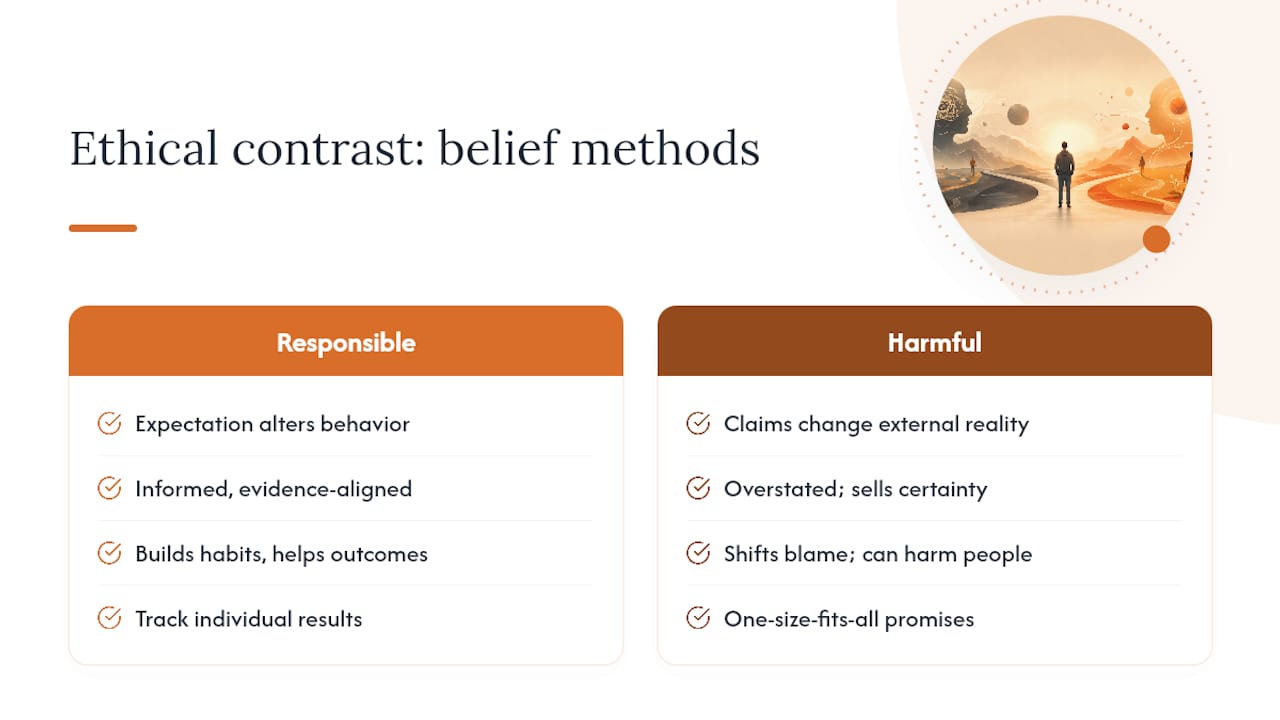
The core controversy around belief-based methods isn’t whether expectation affects behavior. That part is well established. It’s how these ideas get marketed. Watered-down manifestation content routinely blurs the line between “belief changes your behavior, which changes some outcomes” and “belief directly changes external reality,” and that second claim has no credible backing.
The ethical line sits at informed framing. Teaching someone to use implementation intentions and vivid mental rehearsal to build a habit is defensible, evidence-aligned coaching. Telling someone their unemployment, illness, or financial hardship results from insufficiently positive thinking is a different act entirely, and a harmful one. It shifts blame for structural and biological realities onto an individual’s mindset.
There’s a subtler issue too: expectancy effects like the Pygmalion effect cut both ways. A teacher’s low expectations can suppress a student’s performance just as reliably as high expectations lift it. That means belief-based frameworks carry real power to help or harm depending on how they’re applied, especially by anyone coaching or advising others. Responsible use means pairing belief work with honesty about its limits, not selling certainty where the evidence only supports probability.
Genetics and psychology research on treatment response (a separate field from manifestation work) has also found that individual variation in expectancy sensitivity is real. Some people respond more strongly to expectation-based interventions than others, which argues against one-size-fits-all promises and for tracking your own results rather than assuming a technique will work identically for everyone.
Why Some People Respond to Belief Work More Than Others
Not everyone gets the same return from visualization and implementation intentions, and that variation is worth naming instead of glossing over. Personality traits linked to optimism and self-efficacy tend to correlate with stronger responsiveness to expectation-based techniques, likely because people who already expect competent outcomes engage more fully with the rehearsal itself rather than doubting it mid-exercise.

Baseline motivation matters just as much as personality. Motivation acts as a moderator, meaning the same protocol produces different results depending on how much drive someone brings into it. Two people can run an identical if-then plan and get different outcomes because one wanted the change more urgently going in.
Cognitive style plays a role too. People who naturally think in vivid, sensory detail tend to generate more effective visualizations, since the identity-specific neural circuitry involved responds more to specific, textured imagery than to abstract goal statements. If your mental images come easily and in detail, expect a faster response. If they don’t, that’s not a failure. It just means the “sensory anchors” step in the protocol deserves more deliberate practice, using actual sounds, smells, and physical sensations rather than a vague mental snapshot.
None of this means the technique only works for a lucky few. It means results scale with how specifically you apply it, and tracking your own three-week and twelve-week checkpoints tells you more about your personal responsiveness than any general claim can.
An Editorial Take on Doing This Honestly
I spent over twenty years in medical and pharmaceutical work before I built Livethelifeofyourdreams, and that background left me allergic to manifestation content that skips the mechanism and jumps straight to the promise. Kabbalah and Law of Attraction principles talk about belief shaping reality in spiritual language. Neuroscience describes the same territory in terms of reward circuits and learning signals. I don’t think you have to pick one framework over the other. I think you have to demand that whichever one you use actually changes your behavior, measurably, on a timeline you can track.
The people who come to me having already tried journaling and affirmations without lasting results usually made one mistake: they rehearsed the outcome and skipped the cue. Belief without an if-then plan is a daydream. Add the plan, and it becomes a habit.
Get Livethelifeofyourdreams’s Guided Protocol for Your Habit
Livethelifeofyourdreams turns the exact protocol above into a structured, guided course, so you’re not reverse-engineering implementation intentions and visualization scripts from research papers on your own.

The digital courses walk you through choosing your cue, writing your if-then statement, and building a sensory-rich visualization matched to your specific goal, whether that’s a financial habit, a health routine, or breaking a pattern of self-sabotage rooted in scarcity thinking, as explained in Habits, not hacks: how to train like you intend to last. Each program blends the neuroscience covered here with Kabbalah and Law of Attraction framing, drawing on frameworks from Napoleon Hill and Andrew Carnegie’s wealth psychology, so you get structure instead of a vague affirmation list. If you’ve tried the watered-down version of manifestation and stalled out, this is built for the next attempt. Start with the manifestation courses at Livethelifeofyourdreams and set your first three-week checkpoint this week.
Sources
- Belief about nicotine modulates neural learning signals, PMC
- Simplypsychology
- Wanting this, not that: The neural circuit that turns specific expectations into actions, PLOS Biology
Frequently asked questions
Does the placebo effect mean beliefs cure disease?
No, and this guide is blunt about it. Placebo effects are real for symptom perception and some outcomes, but they do not shrink tumors or replace treatment. The honest use is expectation where it works: effort, persistence, and recovery.
What is the nocebo effect?
The dark twin: expecting side effects or failure produces them at higher rates. It is one more reason the sentences you repeat about your goals and your body deserve editing.
How do I use expectation honestly?
Believe in the process you control. Expect your effort to change outcomes because it changes behavior, and let the placebo research encourage the ritual without lying to you about its limits.
Keep exploring
- 3 Tests to Stop Confirmation Bias in Goals, Backed by Neuroscience
- Stop Costly Outbursts in 8 Weeks: Emotional Regulation for Success
- 94 Studies Show Implementation Intentions That Work in 7 Days
- Neuroplasticity and Habits: Rewire Your Brain in 4 Weeks
- Improve Nervous System Regulation in 4 Weeks, Backed by Science
- Rewire Limiting Beliefs in 8 Micro Shifts With CBT and Neuroscience