Yes, developing emotional regulation for success is backed by real data: people who can regulate emotion well report greater well-being and, in one landmark study, higher disposable income. A recommended fast start is a simple technique you can do at your desk: take a double inhale through your nose, exhale slowly through your mouth, then silently name what you’re feeling in one word. That’s it. That’s the whole first step.
TL;DR:
- Strong emotional regulation is linked to higher well-being, income, and socioeconomic status, with skills that protect cognitive clarity, energy, and social standing.
- Techniques like labeling emotions, breathing exercises, and reinterpreting situations are supported by research as effective, adaptable, and situationally specific.
- Managing emotional arousal with physiological methods before cognitive strategies increases success, especially during high-intensity reactions.
- Building regulation skills through structured, gradual practice over weeks improves automaticity and resilience more than casual or one-off efforts.
- Suppression and surface acting impair cognition and drain resources, making genuine regulation skills far more valuable for ongoing success.
Table of Contents
- What Does Emotional Regulation Have to Do With Success?
- Which Emotional Regulation Techniques Actually Work?
- How Do You Pick the Right Strategy in the Moment?
- What’s the Fastest Way to Calm Down When You’re Overwhelmed?
- How Do You Build Lasting Emotional Regulation Skills?
- What Are the Biggest Mistakes People Make With Emotional Regulation?
- Why the Founder’s Background Shapes This Approach
- Does Emotional Regulation Change How People See You?
- Can You Combine Emotional Regulation With Goal-Setting?
- What Do People Get Wrong About Emotional Regulation?
- Do Regulation Styles Differ Across People and Cultures?
- The Gap Between Popular Advice and What Actually Works
- Build Regulation Skills With Structure Instead of Guesswork
- Sources
- FAQ
What Does Emotional Regulation Have to Do With Success?
The connection isn’t theoretical. A study published in PMC found that people who could reliably amplify or suppress their emotional expression on demand, a lab measure of regulatory skill, reported higher life satisfaction. In one study, that same group was associated with higher disposable income and socioeconomic status compared to others tested. That’s not a correlation you’d expect from a “soft skill.”
The mechanism isn’t mysterious once you break it down. Emotional regulation skills protect three things that success actually depends on: cognitive clarity, physiological resources, and social standing.
Start with cognitive clarity. When you’re flooded with anger, panic, or shame, your prefrontal cortex, the part of your brain responsible for planning and weighing tradeoffs, loses bandwidth to the amygdala’s threat response. Decisions made in that state tend to be short-sighted. People who can regulate their emotional state keep more of their thinking capacity online during the moments that matter most, like a tense negotiation or a bad quarterly review.
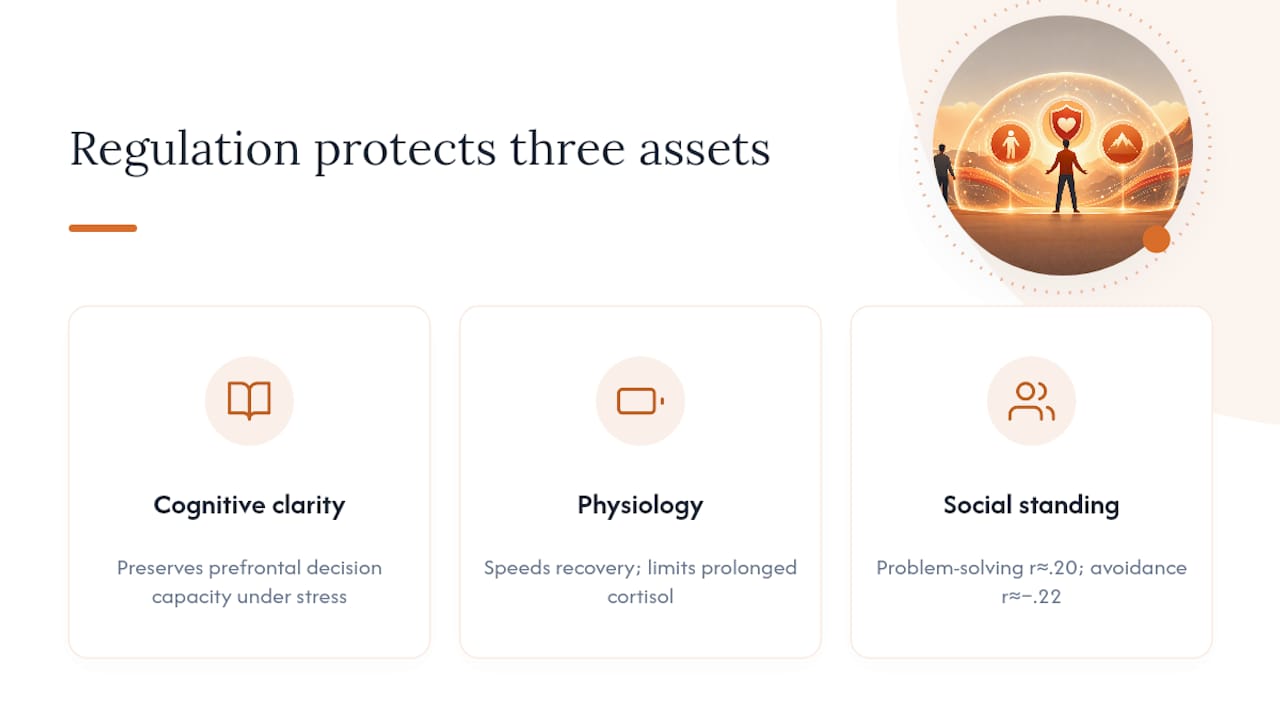
Then there’s physiological load. Chronic emotional dysregulation keeps cortisol and adrenaline elevated longer than they need to be. That drains energy you’d otherwise spend on sustained, high-quality work. Regulation isn’t about feeling less. It’s about recovering faster, so the cost of a bad moment doesn’t compound into a bad week.
The third piece is social and leadership advantage. Maladaptive strategies showed negative correlations with outcomes, including avoidance and self-blame. Those aren’t massive effect sizes on their own, but they’re consistent across large samples, and they compound over a career. Someone who defaults to problem-solving instead of avoidance during a setback is playing a different long game than someone who doesn’t.
The core statistic: People with strong lab-tested emotion regulation skills reported higher well-being and, in one study, the highest disposable income and socioeconomic status among all participants tested. Problem-solving as a regulation strategy correlates with academic achievement at r ≈ .20; avoidance correlates negatively at r ≈ .22.
None of this means emotion suppression is the answer. Suppression and reappraisal are both regulation strategies, but they work in opposite directions, one costs you cognitive resources, the other frees them up. That distinction drives everything in the next section.
Which Emotional Regulation Techniques Actually Work?
Five techniques have the strongest evidence behind them: cognitive reappraisal, affect labeling, mindfulness, breathing exercises, and physical exercise. Each works through a different mechanism, and knowing which lever to pull in a given moment is most of the skill.
Cognitive reappraisal means reinterpreting a situation to change its emotional impact, not denying what happened, but reframing what it means. If a client cancels a deal, “I failed” and “this client wasn’t the right fit and I have better data now” are both true readings of the same event. Reappraisal is consistently supported by research as an adaptive strategy that reduces emotional intensity while preserving cognitive function. That last part matters more than it sounds: suppression, by contrast, can actually impair memory and carries a measurable physiological cost, your heart rate and blood pressure stay elevated even as your face goes neutral.
Affect labeling is deceptively simple: put a specific word on what you’re feeling. Not “stressed,” but “humiliated.” Not “annoyed,” but “dismissed.” Specificity is the whole point. Naming an emotion with precision reduces amygdala activation and engages the prefrontal regions that support regulation, a phenomenon sometimes called emotional granularity. Vague labels barely move the needle; precise ones do measurably more work.
Mindfulness builds the muscle that makes the other techniques possible: noticing an emotional shift before it hijacks your behavior. Regular practice increases emotion differentiation over time and appears to reduce amygdala reactivity, according to evidence-based reviews of daily regulation practice. You don’t need 40 minutes on a cushion. Three minutes of noticing your breath before a difficult call does real work.
Breathing techniques hit fast, physiologically, before your thinking brain even gets involved. The physiological sigh, a double inhale followed by one long exhale, can reduce acute anxiety faster than several minutes of general meditation, according to applied research summaries. It’s the closest thing to an emotional reset button that doesn’t require privacy or time.
Physical exercise functions as a frontline regulation strategy, not an afterthought. It discharges accumulated stress hormones and shifts neurotransmitter activity in ways that lower baseline reactivity. Treat a daily walk or a lifting session as part of your regulation toolkit, not a separate wellness goal sitting next to it.
Here’s how to choose among them in practice:
- Use reappraisal when you have a few minutes to think and the trigger is interpretive (a comment, an email, a decision you’re second-guessing).
- Use labeling the instant you notice a strong reaction, before you decide what to do about it.
- Use mindfulness as daily maintenance, not just crisis response.
- Use breathing when your body is activated and your mind is racing too fast to reason with.
- Use exercise as a standing practice that lowers your baseline reactivity across the board.
Pro Tip: Rehearse these techniques while you’re calm, so they exist when you’re in crisis. Naming an emotion out loud during a low-stakes moment, like sitting in traffic, builds the neural pathway so it fires automatically when the stakes are actually high.
The strategies aren’t interchangeable. They’re a toolkit that has to be matched to the moment, and that match is a skill of its own.
How Do You Pick the Right Strategy in the Moment?
Match the strategy to your arousal level, not to what worked last time. Under very high arousal, cognitive strategies like reappraisal become nearly inaccessible, your brain is too flooded to reason its way out. That’s not a willpower failure. It’s documented in research on strategy sequencing: physiological techniques come first at high intensity, cognitive techniques work once you’ve calmed the body down.
Think of it as three tiers:
Low intensity (mild irritation, a nagging worry): reappraisal and problem-solving work well here. You have enough cognitive bandwidth to reframe or plan.
Moderate intensity (visible frustration, pre-meeting nerves): affect labeling and brief mindfulness check-ins are the sweet spot. Name it, notice it, don’t try to out-think it yet.
High intensity (rage, panic, a flooded nervous system): go physiological first. Paced breathing, a cold splash of water on your face, or a short burst of movement. Cognitive work waits until your body settles.
This maps onto what’s sometimes called a skill ladder: awareness, then attention, then interpretation, then action, then recovery. You notice a shift (awareness), you decide where to focus (attention), you reframe what it means (interpretation), you choose a response (action), and afterward you process what happened (recovery). Skipping steps is where most people get stuck, jumping straight to “action” before they’ve even noticed they’re activated.
Here’s a checklist you can run through before, during, and after high-stakes moments:
- Before: Check your baseline. Are you already carrying stress from earlier in the day? If so, do a physiological reset before you walk in.
- During, at first sign of activation: Label the emotion in one specific word.
- During, if intensity climbs: Switch to breathing or a brief physical reset (unclench your jaw, drop your shoulders, exhale longer than you inhale).
- During, once you feel more settled: Reappraise. Ask what else this situation could mean.
- After: Spend two minutes reviewing what triggered you and which strategy actually worked, so the next round is faster.
The point isn’t to eliminate emotional reactions. It’s to shorten the gap between reaction and intentional response, especially in professional settings where a ten-second delay is often the difference between a costly outburst and a measured reply.
What’s the Fastest Way to Calm Down When You’re Overwhelmed?
Use the Stop, Breathe, Reflect, Choose sequence: it’s a four-step framework built for exactly this moment, and it takes under two minutes.
Stop. Physically pause whatever you’re doing. If you’re typing an email in anger, stop typing. If you’re mid-sentence in a heated conversation, stop talking. This step alone interrupts the momentum of a reaction before it becomes an action.
Breathe. This is where the physiological sigh earns its place: double inhale through the nose, one long exhale through the mouth. Repeat two or three times. Your heart rate will measurably drop within seconds.
Reflect. Ask yourself one question: “What do I actually want to happen here?” Not what you want to say in the heat of the moment, what outcome you actually want six months from now.
Choose. Pick a response deliberately, rather than letting the first impulse run the show. This is the entire framework recommended by Harvard Health’s guidance on adult self-regulation, and its power is in the sequencing, not any single step.
A few other rapid regulators worth keeping in your back pocket:
- Cold-face technique: Splash cold water on your face or hold an ice pack to your cheeks for 15 seconds. It triggers the mammalian dive reflex, which slows your heart rate.
- A 10-minute walk: Movement discharges stress hormones faster than sitting with them does.
- Affect labeling out loud: Saying “I’m feeling defensive right now” to yourself, even silently, activates the same prefrontal regulation circuits that reappraisal does.
Pro Tip: Practice Stop, Breathe, Reflect, Choose during a mildly annoying moment, like a slow checkout line, before you ever need it in a real crisis. Skills fire faster under pressure when they’re already grooved into habit.
How Do You Build Lasting Emotional Regulation Skills?
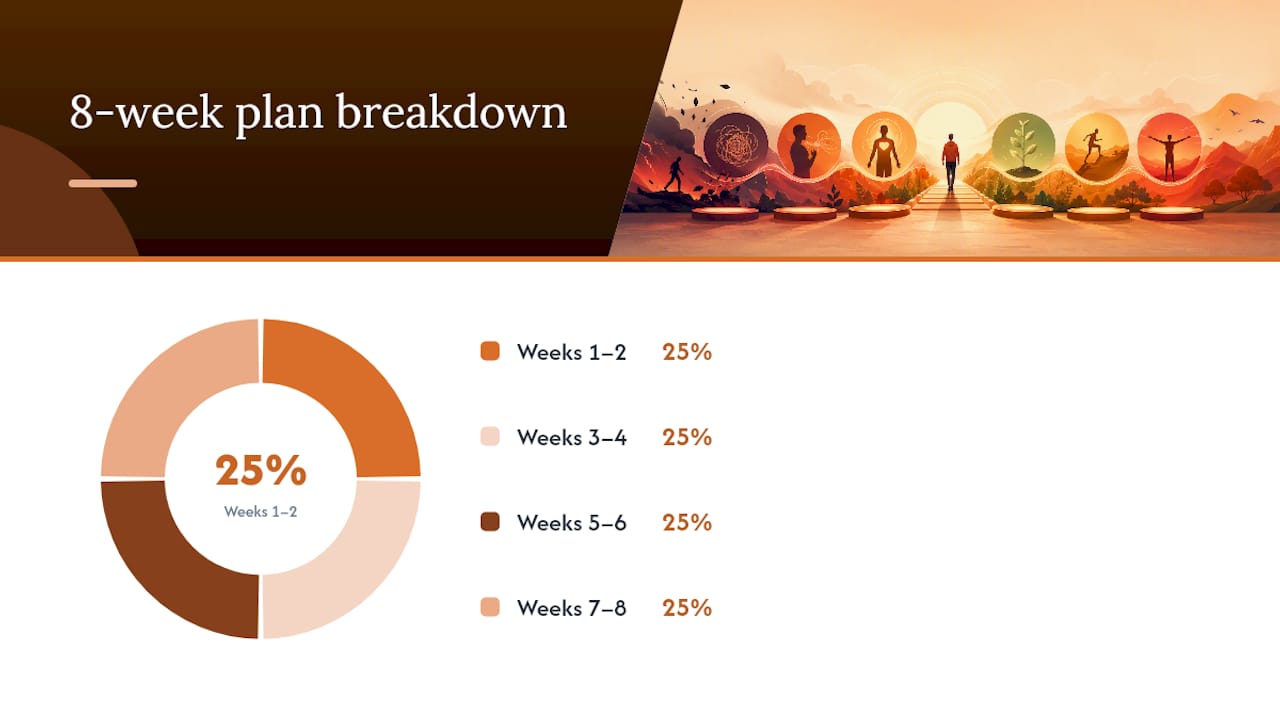
An 8-week plan works better than a single insight, because regulation is a trained skill, not a personality trait you either have or don’t. Scaffold it: start with awareness, then move to reappraisal, then to value-based action, rather than jumping straight to advanced techniques you haven’t practiced.
Here’s a realistic progression:
- Weeks 1 to 2, awareness. Practice affect labeling three times a day. Set a phone reminder if you need to. The goal isn’t to fix anything yet, just to notice and name.
- Weeks 3 to 4, breathing and physiological control. Add a daily physiological sigh practice, two minutes each morning, plus one on-demand use during an actual stressful moment.
- Weeks 5 to 6, reappraisal. Each evening, pick one frustrating moment from the day and write down a single alternative interpretation of it. This builds the reframing habit deliberately, rather than hoping it shows up under pressure.
- Weeks 7 to 8, integration. Combine labeling, breathing, and reappraisal in real time during one deliberately chosen high-stakes situation each week, a hard conversation, a presentation, a negotiation.
Habit stacking makes this stick. Attach the physiological sigh to something you already do daily, brushing your teeth or your morning coffee, so it doesn’t rely on willpower to remember. Attach the evening reappraisal note to your existing wind-down routine.
Track three simple metrics in a notebook or a phone app: your general mood on a 1 to 5 scale, the number of “incidents” where you felt hijacked by an emotion, and one decision you made that day you’re proud of versus one you regret. You don’t need anything sophisticated. The CBT-based micro-shift approach that pairs small daily reframes with tracking tends to outperform sporadic, high-effort attempts at “fixing” your emotional life all at once.
Don’t overlook the basics that make all of this easier. Sleep deprivation lowers your threshold for emotional reactivity almost as much as an actual stressor does. Regular exercise lowers your baseline arousal so smaller triggers stay small. Nutrition, especially avoiding the blood sugar swings from skipped meals and excess caffeine, affects your emotional bandwidth more than most people give it credit for.
Measure the effect on performance, not just mood. Are your decisions holding up better under review a week later? Are you recovering faster after a setback? Those are the success metrics that actually matter, and they lag behind the daily practice by two or three weeks before you’ll notice a real shift.
What Are the Biggest Mistakes People Make With Emotional Regulation?
Suppression is the most common mistake, and it’s costly in a way most people don’t realize. Pushing an emotion down without processing it doesn’t make it disappear, it just delays the cost and raises the interest rate. Suppression can impair memory formation and keeps your body in a state of physiological arousal even while your face looks calm, according to research comparing reappraisal and suppression.
Surface acting, performing a calm or positive emotion you don’t actually feel, is a close cousin and just as draining. Customer service workers and managers who surface-act through difficult interactions all day report higher burnout than those who use genuine reappraisal, because faking an emotion takes ongoing cognitive effort with no payoff in actual regulation.
There’s also a pattern worth naming: functional dysregulation in high performers. Some of the most successful people you’ll meet are quietly dysregulated, they channel anxiety into overwork, or anger into perfectionism, and it looks like drive from the outside. The corrective isn’t to slow down. It’s to add the same labeling and reappraisal practices, just aimed at recognizing when “drive” is actually unprocessed fear.
Leadership makes all of this contagious, a dynamic explored in depth by Jay Scott Coaching’s articles on workplace emotional management. Practitioner commentary on workplace regulation notes that leaders’ unregulated stress spreads through teams faster than almost anything else a manager does, faster than a bad quarterly number, faster than a missed deadline. A visibly rattled leader after a stressful event, a lost client, a layoff round, sets the emotional tone for everyone below them.
A few tactics worth building into your management routine:
- Prepare a short delay script in advance: “I want to think about this properly, let’s pause for 10 minutes,” and use it out loud, publicly, so your team sees regulation modeled rather than assumed.
- After a stressful event, name the collective mood in the room before moving to logistics. Skipping straight to “next steps” while everyone’s still rattled backfires.
- Schedule a brief team check-in the day after a hard event rather than pretending it didn’t happen. Silence reads as unresolved tension, not composure.
Why the Founder’s Background Shapes This Approach
The framework was developed drawing on experience in medical and pharmaceutical work combined with personal experiences of upheaval, offering insight into how emotional dysregulation compounds crises rather than resolving them. This combination informed a respect for evidence-based techniques that withstand high-pressure situations.
This approach integrates neuroscience, CBT-based micro-shifts, and select spiritual framings such as Kabbalah’s emphasis on intentional response and the Law of Attraction’s focus on internal state before external action. These frameworks complement research-based techniques to help make daily practice more meaningful rather than mechanical, supporting habit formation beyond the early stages.
The through-line across Elvis’s bestseller and his 240,000-subscriber audience is consistent: regulation skill, not raw motivation, is what determines whether someone follows through on a goal once the initial excitement fades.
Does Emotional Regulation Change How People See You?
It changes almost everything about how people read you in a room. Regulated people are perceived as more trustworthy, more competent, and more promotable, not because they feel less, but because their reactions are proportional and predictable. Unpredictability is exhausting to be around, and colleagues, clients, and partners unconsciously route around people they can’t predict.
Networking depends on this more than people admit. A tense exchange at a conference, a partner missing a deadline, a client pushing back hard in a negotiation, these are the moments that actually determine whether a relationship survives long enough to become valuable. Someone who can label their frustration, breathe through it, and respond with a measured question instead of a defensive reaction builds trust in exactly the moments that matter most.
There’s a reciprocal effect too. Being around someone who regulates well tends to calm your own nervous system, a phenomenon close to emotional contagion working in reverse. That’s part of why some people are simply easier to be around under pressure. It’s not charisma in the usual sense. It’s a nervous system that doesn’t spike the room’s temperature every time something goes sideways.
If you’re building a network for career or business purposes, this is worth treating as a skill investment, not a personality trait. The people who get repeat introductions, second meetings, and long-term partnerships tend to be the ones whose emotional responses don’t require everyone else to manage them.
Can You Combine Emotional Regulation With Goal-Setting?
Regulation and goal-setting work best together, because most goals fail from emotional interference, not from a bad plan. You don’t abandon a fitness goal because the plan was wrong. You abandon it because a bad day triggered shame, and shame triggered avoidance, and avoidance became a pattern.
Build regulation checkpoints directly into your goal structure. When you set a target, also decide in advance how you’ll handle the emotional dip that follows an inevitable setback. That’s not pessimism, it’s the same principle behind a fire drill: you rehearse the response before you need it.
Motivation, contrary to popular advice, isn’t a prerequisite for action. It’s often a byproduct of small wins, and small wins require you to stay in the game after a bad week instead of quitting in a moment of frustration. Reappraisal is the tool that does this work: reframing a missed target as data instead of failure keeps you moving instead of spiraling.
Pair this with the 8-week structured approach to overcoming self-sabotage, where the win itself becomes the trigger for regulation work, because subconscious resistance to success is a documented pattern in people who’ve hit their ceiling repeatedly. Goal-setting frameworks that ignore the emotional volatility of pursuing a goal are incomplete frameworks.
What Do People Get Wrong About Emotional Regulation?
The biggest myth is that regulation means suppressing or eliminating emotion. It doesn’t. Regulation means changing the intensity, timing, or expression of an emotion, not removing it. Someone who’s furious and channels that fury into a calm, direct conversation is regulating, not repressing.
A second myth: that regulated people don’t feel as much. Often the opposite is true. Emotional granularity, naming feelings with precision, actually requires feeling things clearly enough to distinguish “disappointed” from “betrayed.” Numbness isn’t regulation. It’s usually a sign of the dysregulation that suppression eventually produces.
A third myth is that regulation is a fixed trait you’re born with. It’s a trained skill, closer to a muscle than a personality type. People who seem naturally calm under pressure have almost always built that capacity through repetition, often without labeling it as practice.
A fourth misconception: that positivity equals regulation. Forcing yourself to feel or perform positive emotions you don’t actually have, surface acting, is not regulation. It’s a drain on the same resources regulation is supposed to protect. Genuine reappraisal, arriving at a real, different interpretation of events, is not the same as painting over a real one.
Do Regulation Styles Differ Across People and Cultures?
Individual and cultural differences in emotional expression are real, and treating one style as universally “correct” misses the point. Some cultural contexts emphasize emotional restraint in public settings as a mark of maturity; others treat open expression as a sign of authenticity and trust. Neither approach is inherently more successful, what matters is whether the style someone uses matches the demands of the situation they’re in.
Individual temperament matters too. Some people are naturally higher in trait neuroticism, meaning they experience emotional triggers more intensely and more often. That’s not a character flaw, it’s a starting point that changes how much regulation practice is needed, not whether it’s worth doing. Someone with a higher baseline reactivity who builds strong regulation skills often ends up more resilient than someone who started calmer and never had to build the muscle.
The practical takeaway is to treat regulation style as adaptable rather than fixed by identity or upbringing. A leader raised in a culture that discourages visible emotion may need to practice expressing enough emotion to build trust with a team that reads stoicism as coldness. Someone raised in a highly expressive environment may need to practice the pause before reacting, the “Stop” in Stop, Breathe, Reflect, Choose, when working in a context that reads intensity as instability. The goal isn’t conformity to one style. It’s flexibility, the ability to shift your regulation approach to fit the room you’re actually in.
The Gap Between Popular Advice and What Actually Works
Most advice on managing emotions at work tells people to “stay positive” or “don’t let it get to you.” Both instructions are close to useless, and the research bears that out: suppression, which is what “don’t let it get to you” actually means in practice, costs cognitive function and leaves your body activated regardless of what your face is doing.
What the evidence actually supports is narrower and less inspirational sounding: label precisely, breathe before you think, reappraise once you’re calm enough to reappraise honestly, and rehearse all of it when the stakes are low so it’s available when they’re high. That’s it. It’s not glamorous, and it doesn’t fit neatly into a motivational quote.
The people who treat this as a training program instead of a mood management trick are the ones who see it show up in their income, their relationships, and their decision quality over time, not because emotion disappears, but because the gap between trigger and response gets shorter and more deliberate. Start with the labeling. Everything else builds on that one habit.
, Elvis
Build Regulation Skills With Structure Instead of Guesswork
Reading about reappraisal and breathing techniques gets you the concept. Turning them into an automatic response under real pressure is a different project, and that’s where a structured program earns its place over piecing techniques together on your own.

Livethelifeofyourdreams offers two programs built for exactly this gap. Rewire Limiting Beliefs in 8 Micro Shifts pairs CBT-based reframing techniques with the neuroscience behind why old patterns feel so automatic, useful if your main struggle is catching and reinterpreting a reaction before it runs the show. If your pattern is closer to self-sabotage after a real win, a promotion, a big client, a financial breakthrough, the 8-week plan to beat the upper limit problem addresses the specific subconscious resistance that shows up right when things start going well.
DIY practice works for plenty of people, but a structured 8-week arc with built-in accountability tends to close the gap faster for anyone who’s tried journaling or affirmations before without lasting change. Start with whichever program matches the pattern you recognize most in yourself, and work through it at your own pace.
Sources
- The ability to regulate emotion is associated with greater well-being, income, and socioeconomic status
- Self-regulation for adults: Strategies for getting a handle on emotions and behavior
- Emotion regulation strategies: How to choose what works
- How to Master Your Emotions
FAQ
How does ADHD affect emotional regulation?
ADHD is strongly associated with emotional dysregulation because the same executive function networks that manage attention also govern impulse control and emotional response, so reactions can feel faster and harder to interrupt. The core techniques here, labeling, physiological breathing, and the Stop, Breathe, Reflect, Choose sequence, still apply, though people with ADHD often need more repetition to make the pause automatic.
What are the five R’s of emotional regulation?
Definitions vary across sources, but a common version covers recognize, reflect, regulate, respond, and reset, a sequence that closely mirrors the awareness to recovery skill ladder covered earlier in this guide.
What should you do when you feel emotionally dysregulated?
Run the Stop, Breathe, Reflect, Choose sequence: physically stop what you’re doing, use a physiological sigh to calm your body, ask what outcome you actually want, then choose a deliberate response instead of the first impulse.
What are the symptoms of emotional dysregulation?
Common signs include disproportionate reactions to minor triggers, difficulty calming down after being upset, impulsive decisions made in the heat of the moment, and physical symptoms like a racing heart or shallow breathing that persist well after the triggering event has passed.
Quick reference
| Key | Practice |
|---|---|
| Week 1-2 | Name the emotion before reacting, ten times a week |
| Week 3-4 | The 90 second pause at every trigger |
| Week 5-6 | Repair conversations within 24 hours |
| Week 7-8 | Pre-commitments for your three biggest triggers |
You might also like
- Habit Stacking: Quick Micro-Stacks That Actually Stick
- Synchronicity and Opportunities: A Practical Guide
- Beliefs and the Placebo Effect: What Actually Changes Behavior
- Self-Fulfilling Prophecy: What It Is and How to Change It
- Identity Shifting: How to Make Change Actually Stick
- Top 7 Love Affirmations To Attract Specific Person