
Habit stacking means attaching a new behavior to something you already do automatically. The formula is simple: After [CURRENT HABIT], I will [NEW HABIT]. Want to try one right now? After you pour your morning coffee or tea, you will write down one thing you’re grateful for. That’s it. One sentence, one new habit, zero willpower required.
Here’s what makes it work:
- The existing habit (pouring your drink) acts as the trigger
- The new behavior rides on an established neural pathway
- You don’t need motivation, the cue fires automatically
This approach, popularized by James Clear and rooted in behavioral science, is one of the most reliable habit formation techniques available.
Key Takeaways
Habit stacking works because it attaches new behaviors to existing automatic routines, removing the need for willpower or memory to initiate change.
| Point | Details |
|---|---|
| The core formula | Write “After [anchor], I will [new behavior]” and keep the anchor specific and daily. |
| Start smaller than you think | New behaviors should take under two minutes; expand only after the stack feels automatic. |
| Expect 66 days on average | UCL research found a median of 66 days to automaticity, with a range of 18–254 days. |
| One miss won’t break it | Missing a single day has minimal impact; consecutive misses are the real risk. |
| Livethelifeofyourdreams | Offers structured habit templates, tracking tools, and evidence-based courses to support lasting change. |
Table of Contents
- What habit stacking is and why it works
- How to build your first habit stack, step by step
- Copyable habit-stacking examples you can use today
- Common habit-stacking mistakes and how to fix them
- Does habit stacking actually work? What the evidence says
- How to habit stack if you have ADHD
- Habit stacking and manifestation: why the smallest actions carry the most weight
- Guided support for building habits that last
- Sources
What habit stacking is and why it works
Every habit follows a loop: cue, routine, reward. Habit stacking hijacks the cue stage by using a behavior you already do as the trigger for a new one. The existing habit is called the anchor. Because your brain has already automated the anchor, it fires reliably without conscious effort. Attaching a new behavior to that moment borrows the established neural pathway rather than building one from scratch.
The neuroscience backs this up. Research on synaptic pruning and context-dependent memory shows that repeated actions in a stable context become encoded more efficiently over time. The more consistent the cue, the faster the new behavior becomes automatic.
The single most important rule: your anchor must be specific, daily, and observable. “After breakfast” is too vague. “After I place my mug on the kitchen counter” is a real cue.
James Clear’s framework, drawn from BJ Fogg’s Tiny Habits research, makes the same point: the anchor must be a discrete, completed action, not a fuzzy time window. HabitBox’s science-backed guide notes that a median of 66 days is needed to reach automaticity, which means anchor reliability matters from day one.
The reward piece is subtler. When the new behavior is small enough to feel easy, completing it produces a small win. That win is the reward. No external incentive needed.
- Anchor: a specific, completed action you do every day
- New behavior: something tiny enough to do in under two minutes
- Reward: the satisfaction of completing the stack (no bribery required)
How to build your first habit stack, step by step
The method works best when you treat the first two weeks as a design experiment, not a commitment. Here’s the process:
- Choose your anchor. Pick one habit you do every single day without thinking: brushing your teeth, making tea, sitting down at your desk, plugging your phone in at night. It must be daily and specific.
- Make the new behavior tiny. Not “exercise more”, “do two squats.” Not “meditate”, “take three slow breaths.” If it feels almost embarrassingly small, you’ve got it right.
- Write your ‘After/Then’ script. Put it in writing, literally. “After I brush my teeth at night, I will floss one tooth.” “After I sit at my desk, I will write one sentence in my journal.” Writing it down increases follow-through.
- Run it for two weeks before adding anything. Resist the urge to stack three new habits at once. One link in the chain first.
- Track it simply. A checkbox in a notebook or a free app like Habitica or Streaks works fine. You’re looking for consistency, not perfection.
- Expand gradually. Once the stack feels automatic, you do it without thinking, you can extend the behavior or add a second link.
Copyable ‘After/Then’ scripts for common goals:
- Focus: “After I open my laptop, I will close all browser tabs except one.”
- Health: “After I boil the kettle, I will drink a full glass of water.”
- Sleep: “After I plug my phone in to charge, I will put it face-down and pick up my book.”
- Mindset: “After I sit down with my morning drink, I will read one paragraph of something inspiring.”
Pro Tip: The two-minute rule, as James Clear describes it, isn’t a permanent constraint, it’s a starting constraint. Once the behavior is automatic, extend it naturally. Two squats become five. One breath becomes a two-minute breathing practice. The goal is to make starting frictionless, not to stay tiny forever.
Copyable habit-stacking examples you can use today
These are grouped by context so you can find what fits your day. At least one stack per group is drawn from typical UK daily life.
Morning
- After I turn off my alarm, I will open the curtains immediately (light exposure resets your circadian rhythm)
- After I put the kettle on, I will do five minutes of stretching while it boils
- After I pour my tea, I will write three intentions for the day
- After I finish breakfast, I will take my vitamins
Commute (UK-specific)
- After I tap my Oyster card or contactless on the Tube, I will put on a podcast or audiobook rather than scrolling
- After I sit down on the train, I will spend five minutes reviewing my to-do list
- After I arrive at my stop, I will walk the last five minutes rather than taking the bus
Work and focus
- After I sit at my desk, I will write tomorrow’s single most important task on a sticky note
- After I send my first email of the day, I will set a 25-minute Pomodoro timer
- After I finish a meeting, I will write one action item before opening anything else
Health
- After I wash my hands before lunch, I will do ten shoulder rolls
- After I eat, I will walk for five minutes, even just around the office or flat
- The American Heart Association recommends layering short physical behaviors into existing routines exactly this way
Evening and sleep
- After I finish washing up after dinner, I will prepare tomorrow’s bag or outfit
- After I sit on the sofa, I will spend two minutes writing what went well today
- After I plug my phone in, I will do a 60-second body scan before reading
Digital wellbeing
- After I open Instagram, I will set a 10-minute timer before I start scrolling
- After I close my laptop for the day, I will write one thing I accomplished
Extending a micro-stack: once your single-link stack feels automatic, add one more link. “After I pour my tea, I write three intentions” becomes “After I pour my tea, I write three intentions, then I read one page.” Build the chain slowly. Emphasis confirms that testing one stack at a time, then layering, produces far better results than building a long chain from day one.
Common habit-stacking mistakes and how to fix them
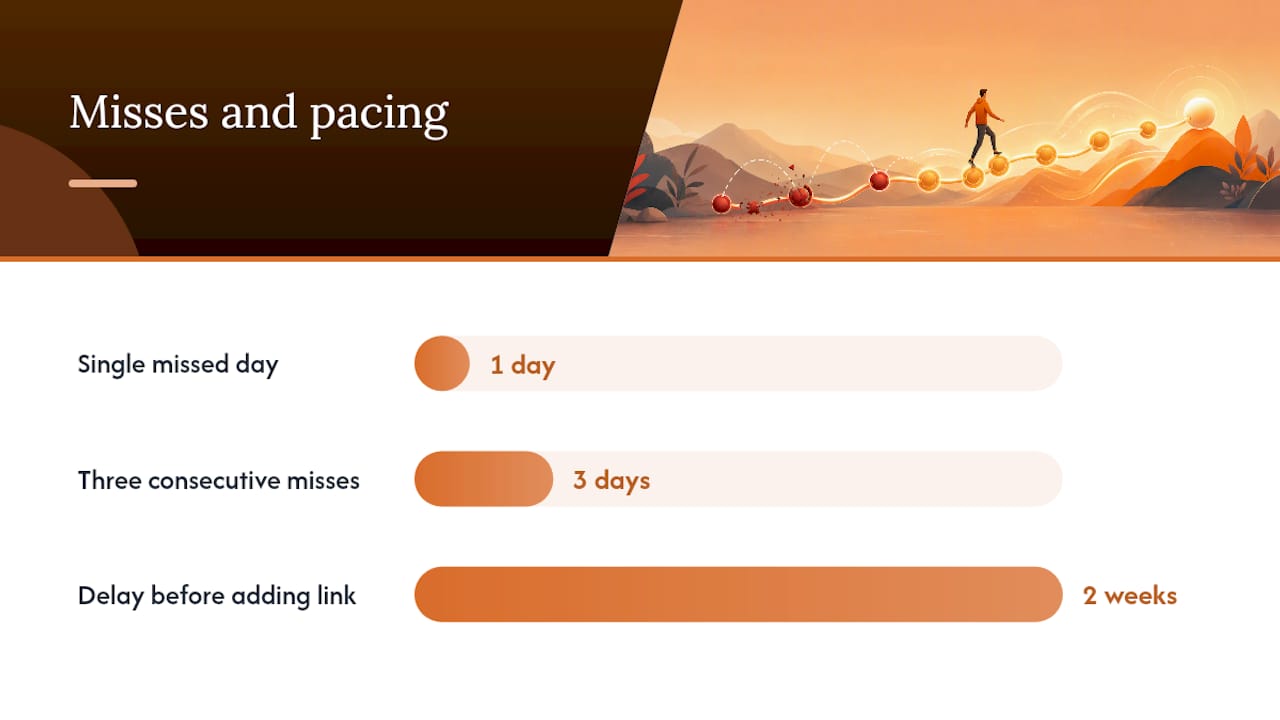
Most stacks fail for one of three reasons. Here’s how to spot them and recover fast.
Common failure modes:
- Vague anchor: “After I finish work” fails because “finishing work” happens at different times, in different ways, on different days. Fix: anchor to a physical action instead, “After I close my laptop lid.”
- Too-big new behavior: “After I brush my teeth, I will meditate for 20 minutes” is too large a leap. The activation energy kills it. Fix: shrink to two minutes or less.
- Overstacking too soon: building a five-step chain before any link is automatic means the whole chain collapses when one step is missed. Fix: one link for two weeks, then add.
- Wrong time of day: stacking a high-focus task onto a low-energy anchor (like “after dinner, I will write my business plan”) sets you up to skip it. Fix: match the cognitive demand of the new behavior to your energy at that time.
- Context change: your stack worked at home, then you went on holiday or changed jobs and the anchor disappeared. Fix: identify the nearest equivalent anchor in the new context and rewrite the script.
Cleveland Clinic’s guidance is clear that habit stacking requires repetition and realistic steps, it’s not effortless by design. When a stack keeps failing, two practical fixes work: shrink the behavior further, or swap the anchor for a more consistent one.
Recovery after a missed day:
- Don’t treat a miss as a failure. Missing one day doesn’t break a habit.
- Ask: was the anchor reliable? Was the behavior too large?
- Restart the next day with the same stack, no penalty.
- If you miss three days in a row, that’s a design problem, not a willpower problem, redesign the stack.
Pro Tip: All-or-nothing thinking is the fastest way to abandon a good stack. One missed day is data, not defeat. The UCL study found that missing a single day had no meaningful impact on long-term habit formation, consecutive misses are what slow progress. One skip is fine. Just don’t skip twice.
Does habit stacking actually work? What the evidence says
The short answer: yes, with caveats. The mechanism is solid; the timeline varies more than most guides admit.
The most-cited figure comes from a longitudinal UCL study by Lally et al., which tracked participants forming simple daily habits. The median time to automaticity was 66 days, but the range ran from 18 to 254 days. That spread matters. A habit that takes you three weeks might take someone else eight months, and both are normal.
Key finding: missing one day did not significantly disrupt habit formation. Consecutive misses did.
Good Housekeeping’s behavioral science coverage reinforces that cue specificity is the single biggest predictor of success. Cues can be location-based, time-based, or action-based. Habit stacking uses action-based cues specifically, and warns against vague anchors like “after breakfast”, the action must be discrete and observable.
Evidence-based best-practice rules:
- Start with a behavior that takes under two minutes
- Anchor to a daily, fixed, observable action
- Write the stack as a specific “After/Then” sentence
- Celebrate small completions (a fist pump, a smile) to reinforce the reward loop
- Expect 66 days on average before it feels truly automatic
| Metric | Finding | Source |
|---|---|---|
| Median days to automaticity | 66 days | Lally et al., UCL |
| Range across participants | 18–254 days | Lally et al., UCL |
| Impact of missing one day | Minimal | Lally et al., UCL |
| Recommended starting duration | Under 2 minutes | James Clear / BJ Fogg |
Balanced verdict: habit stacking works reliably when the anchor is specific and the new behavior is genuinely small. It is not a shortcut to instant change. Think of it as a scaffolding technique, it gives new behaviors a place to attach, but the building still takes time.
How to habit stack if you have ADHD
For people with ADHD, habit stacking offers something particularly useful: an external cue that replaces the internal executive-function prompt that often misfires. Instead of relying on remembering to do something, the anchor does the remembering for you.
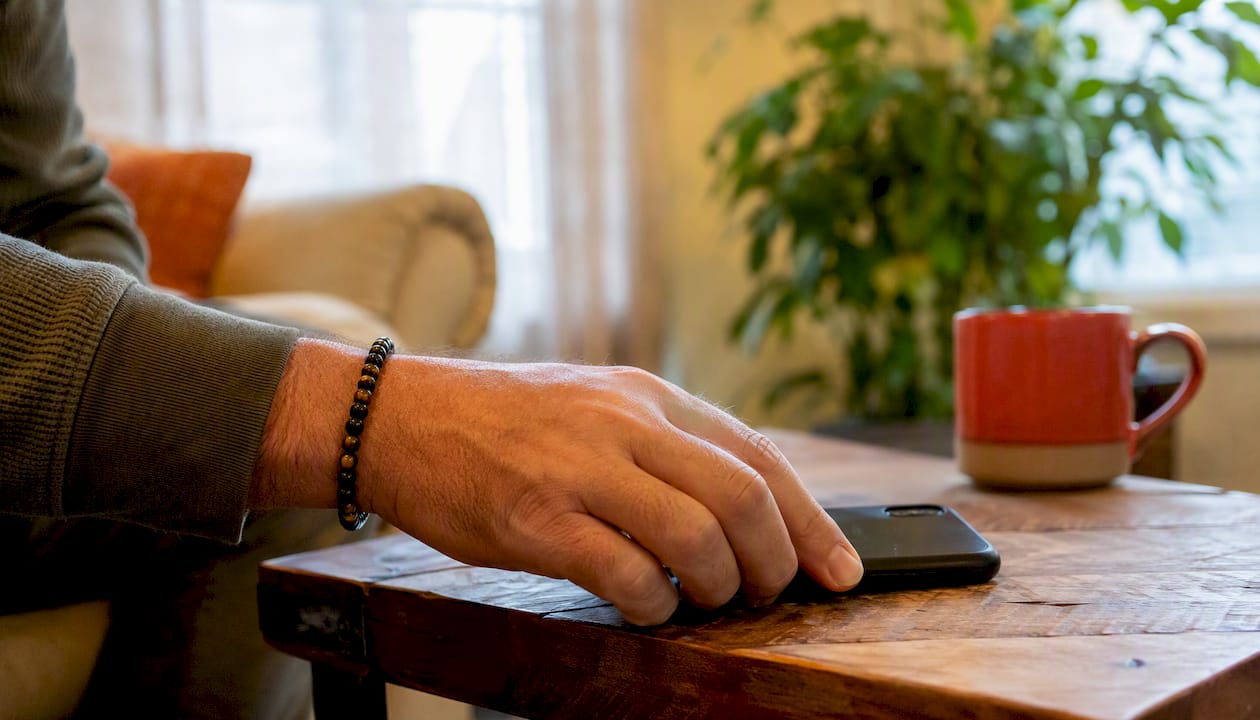
Verywell Mind’s ADHD-focused coverage notes that concrete external cues reduce the cognitive load of habit initiation, which is exactly where ADHD tends to create friction.
That said, ADHD introduces specific challenges: routines vary more, mornings can be chaotic, and a stack that works on a structured day may collapse on a bad one. The fix is to build stacks that are shorter, more visual, and more forgiving.
Practical adjustments for ADHD:
- Use visual reminders. Place a physical object at the anchor point, a sticky note on the kettle, a journal on the pillow, a vitamin bottle next to the toothbrush. The object is the cue, not just the habit.
- Keep stacks to one or two links. A three-step chain is too much to hold in working memory. One link, mastered, then add.
- Use temptation bundling. Pair the new habit with something you genuinely enjoy. “After I sit on the exercise bike, I will watch one episode of my favorite show.” The enjoyable activity is contingent on the new behavior.
- Choose the most consistent anchor in your day. For many people with ADHD, that’s a physical routine: brushing teeth, making a drink, getting into bed. These tend to survive chaotic days better than work-based anchors.
- Forgive variability. An ADHD-friendly stack is designed to be restarted easily, not to be perfect.
ADHD-adapted micro-stacks:
- After I brush my teeth, I will take my medication
- After I sit on the sofa with my evening drink, I will write one thing that went well today
- After I plug my phone in at night, I will set tomorrow’s alarm and check my calendar for 60 seconds
- After I put my shoes on to leave the house, I will check my bag for my keys, wallet, and phone
Note: this is general behavioral guidance, not medical advice. If you’re managing ADHD and finding habit formation particularly difficult, a conversation with your GP or a behavioral coach is a worthwhile step.
Habit stacking and manifestation: why the smallest actions carry the most weight
Here’s something most productivity guides miss entirely. Habit stacking isn’t just a behavioral trick, it’s an identity-building practice. Every time you complete a stack, you cast a vote for the person you’re becoming. That’s not motivational language; it’s how identity change actually works at the behavioral level.
The manifestation practices I’ve worked with for over two decades, gratitude rituals, affirmations, visualization, don’t float in the air. They need a container. A habit stack gives them one. After I make my morning tea, I sit for two minutes and write what I’m grateful for. Not because I’m disciplined. Because the kettle is the cue, and the cue is reliable.
What I’ve seen, both personally and through the work I do with readers and course participants, is that people who struggle with affirmations or visualization often struggle because those practices have no anchor. They try to do them “when I feel like it”, which is a vague window, not a cue. Attach a gratitude practice to making your tea, or a visualization to your commute, and it stops being something you have to remember. It becomes part of who you are.
That shift, from “I’m trying to be more positive” to “I’m someone who reflects every morning”, is where real transformation begins. Tiny, repeatable actions build identity faster than grand gestures.
Guided support for building habits that last
The stacks in this article give you a starting point. But if you’ve tried building habits before and found yourself back at square one after a few weeks, the issue usually isn’t motivation, it’s structure.

At Livethelifeofyourdreams, the courses and downloadable resources are built specifically for people who want more than a tip list. The approach blends behavioral science with the kind of identity-level work that makes habits stick beyond the first month. Here’s what you get access to:
- Ready-to-use habit templates tied to manifestation and personal growth goals
- Stepwise plans that start with one micro-stack and build progressively
- Tracking sheets designed to keep you honest without making you feel guilty
- Evidence-informed guidance grounded in neuroscience and psychology, not just motivation
If you’re ready to move from knowing what to do to actually doing it consistently, visit Livethelifeofyourdreams and explore the current course offerings.
Sources
- Habit Stacking: How to Build New Habits by Taking Advantage of Old Ones
- Habit Stacking: A Science-Backed Guide (2026) | HabitBox Blog
- Habit stacking: Everything you need to know, Cleveland Clinic
- How are habits formed? (Lally et al., UCL), PubMed Central
Frequently asked questions
What is the habit stacking formula?
After I [existing anchor], I will [new two-minute habit]. The existing habit supplies the trigger so the new one does not compete for memory or willpower.
Why do my habit stacks keep failing?
Almost always one of three things: the anchor was vague, the new habit was too big, or the stack had more than two links. The troubleshooting section fixes each.
How long before a stack runs on autopilot?
Usually several weeks of daily reps. The test is simple: when you do the new habit before remembering you planned to, the stack has installed.
You might also like
- 3 Tests to Stop Confirmation Bias in Goals, Backed by Neuroscience
- Stop Costly Outbursts in 8 Weeks: Emotional Regulation for Success
- 94 Studies Show Implementation Intentions That Work in 7 Days
- Improve Nervous System Regulation in 4 Weeks, Backed by Science
- Identity Shifting: How to Make Change Actually Stick
- Rewire Limiting Beliefs in 8 Micro Shifts With CBT and Neuroscience