Confirmation bias makes you notice, trust, and remember evidence that supports the goal you already chose, while filtering out signs you picked the wrong target or the wrong method. The immediate risk: you keep funding a plan that isn’t working, ignore a better alternative sitting in plain sight, and mistake stubbornness for commitment. The good news is that the same research explaining why this happens also points to specific, testable fixes covered below.
TL;DR:
- Committing to a goal creates a reference point that biases attention toward confirming evidence and dismisses signs of better alternatives.
- Early partial progress often falsely signals success, leading to reluctance in changing strategies and escalating investment in underperforming plans.
- Introducing goal conflict or explicitly considering opposing evidence significantly reduces confirmation bias and improves decision accuracy.
- Pre-specifying disconfirmation criteria and using neutral framing before making commitments help prevent defensive reasoning and selective evidence gathering.
- Regular outside checks and structured mid-course reviews are critical for maintaining objectivity and avoiding deep-rooted self-sabotage patterns.
Table of Contents
- What Is Confirmation Bias in the Context of Goals?
- Why Confirmation Bias Matters for Setting and Pursuing Goals
- What the Research Shows About Bias and Decision Dynamics
- How to Recognize and Reduce Confirmation Bias While Pursuing Goals
- Three Exercises to Test Your Goals Before You Over-Commit
- A Practitioner’s View on Turning Research Into Habit Change
- Key Takeaways for Setting Goals Without the Blind Spots
- The Overlooked Piece of the Confirmation Bias Conversation
- Sources
- FAQ
What Is Confirmation Bias in the Context of Goals?
Confirmation bias is the tendency to search for, interpret, and recall information in a way that supports what you already believe or have already chosen. Applied to goals, it means that once you commit to a target, a method, or a timeline, your brain quietly starts stacking the deck in favor of that choice.
The mechanism behind this isn’t just a bad habit. Researchers Talluri and colleagues found that the act of choosing itself changes how your brain processes new information, a phenomenon they call choice-dependent gain modulation. Once you commit to an answer, option, or plan, your attention and sensitivity shift to favor evidence consistent with that choice. This isn’t limited to opinions you argue about at dinner. It shows up in simple perceptual tasks, numerical judgments, and, by extension, everyday decisions about how to spend your time and effort.
Here’s what that looks like in practice, tied to actual goal decisions people make:
- Hiring: A manager decides a candidate is “the one” in the first ten minutes, then spends the rest of the interview unconsciously steering questions toward answers that confirm that first impression.
- Fitness goals: Someone commits to a specific diet plan, then reads every fatigue spell as “detox” and every plateau as “muscle building,” while dismissing headaches or mood swings as unrelated.
- Career pivots: A person decides to switch industries, then only searches for success stories from others who made the same leap, skipping the far more common stories of people who struggled or reversed course.
- Personal projects: A side business owner picks a marketing channel early, sees a small early win, and keeps pouring budget into it for months past the point where the numbers stopped justifying it.
None of this requires bad faith or low intelligence. It’s a default setting. Once you pick a direction, your mind starts working as a lawyer for that decision rather than a judge of it. That single shift, from evaluating to defending, is the root of most of the goal-related damage confirmation bias causes.
Why Confirmation Bias Matters for Setting and Pursuing Goals
The damage isn’t abstract. It shows up as wasted time, money, and motivation, and it gets worse the longer you’ve invested in a goal.
Research on goal-setting behavior shows that once people commit to a specific goal and start making progress using an initial method, they tend to become less likely to switch to alternative methods, even if those alternatives might work better. The research on goal-driven switching found that the goal itself creates a reference point. Hitting even part of that number starts to feel like proof the current method is working, which crowds out any real comparison against better options.
This creates a specific, repeatable pattern of harm:
- Goal inertia sets in early. The moment you have a number to chase, whether it’s a revenue target, a weight goal, or a savings figure, you stop asking “is this the right approach” and start asking “am I closer to the number.”
- Progress gets misread as validation. Partial progress toward a numeric goal feels like confirmation the whole plan is sound, even when the progress is marginal or coincidental.
- Switching costs get inflated in your head. Because you’ve already logged some progress, abandoning the current method feels like throwing away sunk effort, even though the effort is already spent regardless of what you do next.
- Escalation of commitment follows. You double down, extend deadlines, or increase the budget for the current approach rather than testing whether an alternative might close the gap faster.
- Better alternatives go unexamined. The mental bandwidth spent defending the current plan is bandwidth not spent scouting other options, so the better path often stays invisible until the damage is done.
The paradox here is worth sitting with: setting a specific, numeric goal is standard advice for effective goal setting, and for good reason, it creates clarity and accountability. But that same specificity is what creates the reference point that locks you in. A vague goal (“get healthier”) gives you room to pivot. A precise one (“lose 20 pounds by June”) gives your brain a scoreboard to defend, and defending a scoreboard is exactly the kind of task confirmation bias is built for.
What the Research Shows About Bias and Decision Dynamics
The strongest evidence on this topic comes from three separate lines of research, each attacking the problem from a different angle. Together they explain both the mechanism and the fix.
The neural mechanism. Talluri et al.’s 2018 study on choice-consistent evidence weighting used perceptual and numerical decision tasks to show that confirmation bias isn’t a conscious failure of willpower. It’s a measurable shift in how the brain weights incoming information after a choice is made. The bias appears within moments of commitment, before there’s even been time to gather new “confirming” evidence deliberately. This tells you the bias is not something you can simply try harder to avoid. It requires structural countermeasures, not willpower.
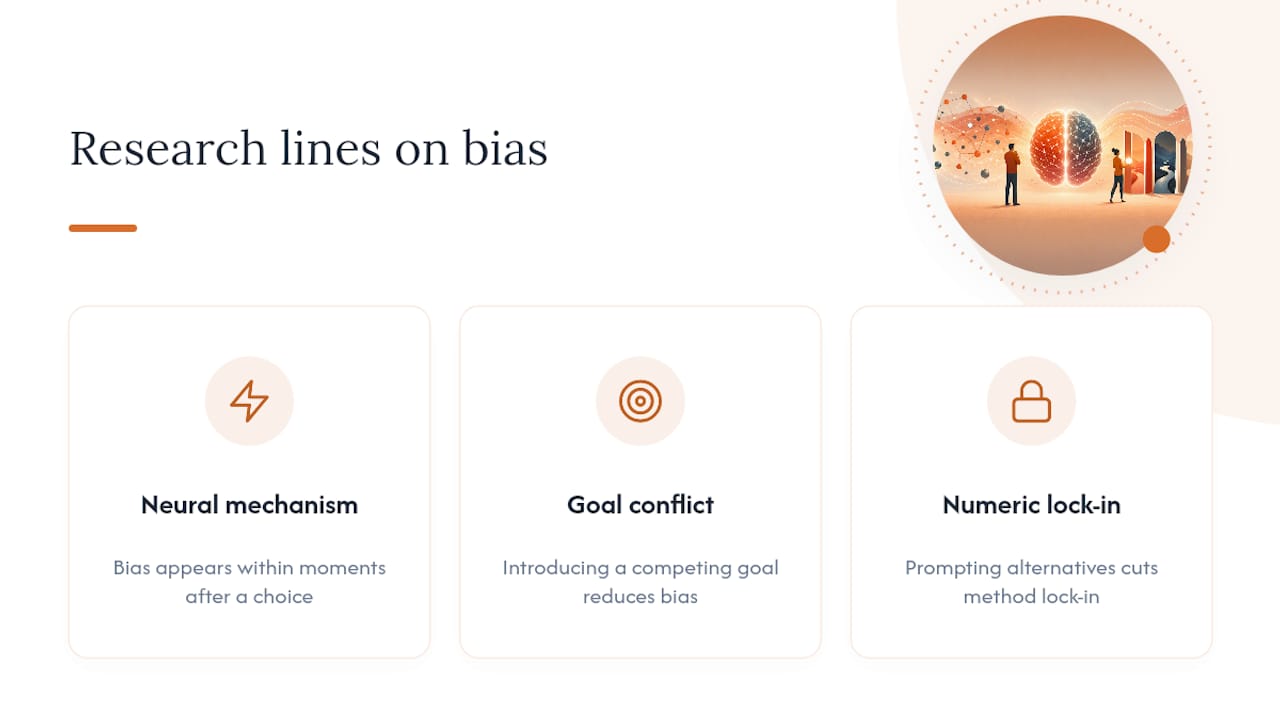
The goal-conflict effect. A separate body of work found something almost counterintuitive: priming people with a competing, conflicting goal reduces confirmation bias compared to pursuing a single goal in isolation. The research on goal conflict found that when people hold two goals that pull in different directions, they naturally start weighing both sides of incoming evidence instead of filtering for the goal they favor. Conflict, in other words, forces balance. A single, unopposed goal invites tunnel vision.
The numeric lock-in effect. As covered above, the study on goal-driven switching is the clearest real-world demonstration of how these lab findings play out in ordinary decision-making. It found that prompting people to explicitly consider the advantages of alternative methods, not just weaknesses of the current one, reduced the lock-in effect meaningfully.
A pattern across the research: Confirmation bias intensifies specifically after commitment, whether that commitment is a lab choice, a numeric target, or a chosen method, and it eases when a second, competing consideration is deliberately introduced.
One caveat matters here. Most of these findings come from controlled lab tasks: perceptual judgments, simple numeric choices, short-term decisions. Real-world goals unfold over months or years, with more noise, more emotion, and more sunk cost involved. The direction of the effect holds up well outside the lab, but the size of it in a messy, high-stakes personal goal is likely larger, not smaller, than what a lab study captures.
How to Recognize and Reduce Confirmation Bias While Pursuing Goals
Fixing this isn’t about trying to be more objective through sheer effort. Objectivity isn’t a personality trait you can summon. It’s a set of structures you build into your decision process before bias has a chance to take hold.
Pre-specify what would count as disconfirming evidence. Before you commit to a goal or a method, write down, in advance, exactly what result would tell you it isn’t working. Do this before you start, not after three months in when you’re already emotionally invested. The guidance on pre-committing to disconfirming evidence is specific on this point: identifying your falsification criteria ahead of time short-circuits the defensive reasoning that kicks in once you’re already committed.
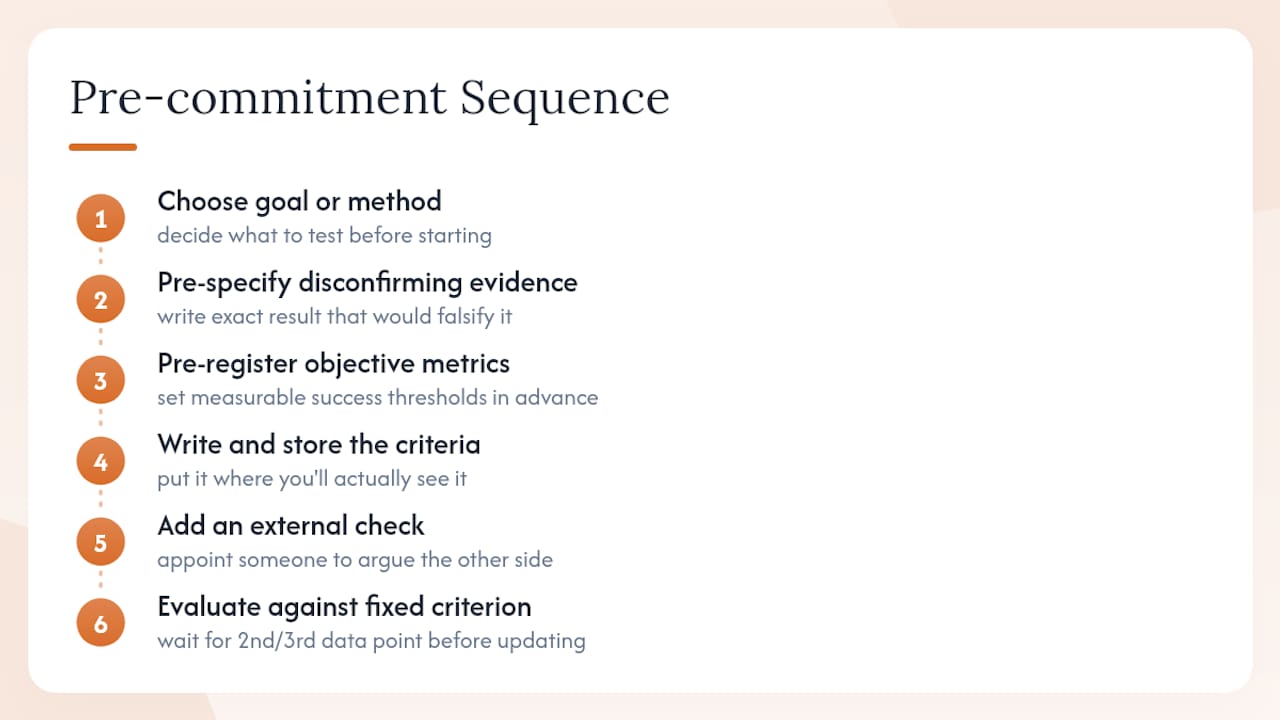
Manufacture goal conflict on purpose. Since goal conflict measurably reduces bias, build a competing consideration into your plan deliberately.
Slow the decision down and use neutral framing. Reframe your self-check questions to remove the answer you’re hoping for. Instead of asking “is this working?” ask “what would someone with no stake in this outcome conclude from these numbers?” That small shift in framing removes the built-in bias toward a “yes.”
Bring in an outside check. Management research on reducing organizational bias consistently recommends inviting disagreement and appointing someone specifically to argue the other side. You don’t need a formal team to do this. A colleague, mentor, or accountability partner who has no investment in your plan succeeding can spot what you can’t.
Use objective, pre-registered metrics instead of vibes. Decide your success thresholds before you start tracking, and write them down somewhere you can’t quietly revise later. Methodological research on cognitive bias in analysis points to blinding and separating your exploratory thinking from your confirmatory checks as effective safeguards, borrowed from experimental science but just as useful for a personal fitness log or a business dashboard.
Don’t treat early progress as proof of long-term fit. Early wins are often the result of enthusiasm, novelty, or easy low-hanging fruit, not evidence the method itself is sound. Wait for a second or third data point before updating your confidence.
Pro Tip: Write your disconfirming-evidence criteria on paper, not in your head, and store it somewhere you’ll actually see it again, like the top of a project document or the first page of a journal. A rule you can’t remember is a rule you’ll rationalize away.
Three Exercises to Test Your Goals Before You Over-Commit
These three tools translate the research above into something you can use in fifteen minutes, either alone or with a team.
1. The “What Would Convince Me I’m Wrong” template. Before starting any goal, write answers to these four questions and sign your name under them:
- What specific result, seen over what timeframe, would tell me this plan isn’t working?
- What would I expect to see if a competing approach were actually better?
- Who would I trust to tell me the truth about this, even if it’s unwelcome?
- What’s the smallest amount of contrary evidence I’d need to at least pause and reconsider?
Sign and date it, then revisit it at your first checkpoint. Prioritizing strong disconfirming evidence over trivial counterexamples matters more than collecting a long list of weak objections, so keep the questions sharp and specific rather than broad.
2. Goal-conflict priming exercise. Take your primary goal and write a genuinely competing sub-goal next to it, one that pulls in a meaningfully different direction. If your goal is “hit a savings target by cutting expenses,” your competing sub-goal might be “find one investment or income change that could hit the same number faster.” Spend ten minutes listing pros and cons for each path side by side. The act of holding two live options, rather than one goal and its absence, forces broader evidence gathering.
3. Mid-course decision checklist. At every checkpoint (weekly, monthly, or quarterly depending on your goal’s timeline), answer these before deciding to continue:
- Am I judging this by the metric I pre-registered, or a new one that’s more flattering?
- Has an outside person reviewed this progress in the last 30 days?
- Would a neutral observer call this progress meaningful, or within normal noise?
- Is there a specific, named alternative I haven’t seriously tested?
- If I were starting today with zero sunk cost, would I still choose this path?
A “no” on the last question, especially, is the single strongest signal that inertia, not evidence, is driving the decision to continue.
A Practitioner’s View on Turning Research Into Habit Change
Elvis D. Beuses has spent more than two decades in medical and pharmaceutical work, a field built on distinguishing real signal from noise in evidence, before applying that same discipline to personal transformation and manifestation work. That background shapes a specific stance: the biggest obstacle to reaching a goal usually isn’t lack of belief. It’s an unexamined, unfalsifiable version of the goal that quietly resists any evidence it’s wrong.
In practice, that means treating a goal less like a fixed destination and reframing it as a testable hypothesis: something you’re willing to revise the moment the evidence says so. A person working through limiting beliefs around money, for example, might set a goal to double their income within a year. Framed as a hypothesis rather than an identity, the question becomes “what would prove this approach isn’t the right one,” not “how do I defend this number no matter what happens.”
Self-directed tools work for readers who can hold themselves accountable to the checklists above. Readers who notice they keep defending the same stalled plan, or who suspect a deeper pattern of self-sabotage is driving the resistance to change course, tend to benefit from a more structured program that builds in outside accountability by design.
Key Takeaways for Setting Goals Without the Blind Spots
Confirmation bias isn’t a flaw you eliminate once. It’s a standing risk you manage every time you commit to a new goal. A short list of priorities, applied consistently, does most of the work:
- Write your disconfirming-evidence criteria before you start, not after you’re invested.
- Build in a competing consideration or goal-conflict check at the outset.
- Treat early progress as a data point, not proof.
- Get a genuinely neutral outside opinion at every major checkpoint.
- Revisit your criteria on a schedule, not just when things start feeling wrong.
If you notice the same self-protective patterns showing up across multiple goals, whether financial, physical, or relational, that’s usually a sign of a deeper belief system doing the defending, not just a single bad plan. Rewire Limiting Beliefs in 8 Micro Shifts walks through CBT and neuroscience-based exercises designed specifically for that pattern, and it’s worth exploring if the checklist above feels like it’s describing a habit rather than a one-time mistake. For readers whose self-sabotage shows up specifically around success, income, or visibility, the 8 week Upper Limit Problem program targets that particular flavor of resistance directly.
The Overlooked Piece of the Confirmation Bias Conversation
Most advice on confirmation bias stops at “seek out opposing views,” which is true but incomplete, and honestly a little useless without a mechanism to act on. The research that matters more, in my view, is the finding that a single competing goal does more to correct your evidence gathering than a stack of good intentions ever will. Conflict, not willpower, is what forces balance.
The conventional wisdom on goal setting oversells specificity without warning you about its cost. A precise numeric goal is a double-edged tool: it focuses effort and it manufactures a reference point your brain will defend past the point of usefulness. Nobody selling goal-setting frameworks wants to mention that second part.
If you take one thing from this article, take the falsification habit. Decide what would prove you wrong before you’re invested enough to argue with the answer. Everything else, the outside checks, the goal-conflict exercises, the metrics, exists to support that one discipline.
, Elvis
Sources
The core mechanism explained here comes from Talluri et al.’s 2018 study on choice-consistent evidence weighting, the clearest experimental demonstration of how commitment changes evidence processing. The Psychology Today piece on goal conflict explains why competing goals reduce bias. The study on goal-driven switching behavior documents the numeric lock-in effect central to this article. HBS Online’s guide to organizational confirmation bias and the Logically Fallacious explainer on avoiding bias both offer practical, field-tested mitigation tactics referenced throughout.
- Confirmation Bias through Selective Overweighting of Choice-Consistent Evidence, Talluri et al. (2018)
- Goal Conflict Helps You See Both Sides of an Issue | Psychology Today
- The (Better) Road Not Taken: Setting a Goal Reduces Switching to More Effective Alternatives
- Confirmation bias: how it affects your organization and how to overcome it, HBS Online
- Avoid confirmation bias in everyday arguments, Logically Fallacious
FAQ
What Is a Good Example of Confirmation Bias?
A classic example is someone who believes a particular diet works, then notices and remembers every day they felt good on it while dismissing bad days as unrelated causes. In goal pursuit, it shows up as continuing to fund a marketing channel because of one early win, while ignoring months of weak returns after that.
What Are the “Big Three” Cognitive Biases?
There’s no single official list, but confirmation bias is consistently named alongside anchoring bias (over-relying on the first piece of information you receive) and the sunk cost fallacy (continuing a plan because of what you’ve already invested, not what it’s likely to return) as three of the most common biases affecting everyday decisions.
What Are Some Confirmation Bias Exercises I Can Try?
Two effective ones are the “what would convince me I’m wrong” template, where you write your falsification criteria before starting a goal, and goal-conflict priming, where you deliberately hold a competing sub-goal to force balanced evidence gathering, both detailed earlier in this article.
Why Does Confirmation Bias Matter for Achieving Goals?
It matters because confirmation bias causes people to misread partial progress as proof a method works, which leads to goal inertia, escalated commitment to underperforming plans, and missed opportunities to switch to genuinely better alternatives, as research on goal-driven switching demonstrates directly.
Can Confirmation Bias Be Fully Eliminated?
No single technique removes it completely, since the bias operates below conscious awareness through mechanisms like choice-dependent gain modulation. Structured countermeasures like pre-committing to disconfirming evidence and inviting outside review reduce its impact meaningfully, even though they don’t erase the underlying tendency.
Quick reference
| Key | Practice |
|---|---|
| Test 1 | Write the disconfirming evidence before deciding |
| Test 2 | Ask one person to argue the other side |
| Test 3 | Set the kill criteria before you start |
Frequently asked questions
What is confirmation bias in goal setting?
Collecting only the evidence that says you are on track while filtering out the data that says otherwise. It feels like optimism and functions like blindfold.
Why does it matter for manifesting goals?
Because visualization amplifies it: the more you rehearse success, the more you need disconfirming checks to stay honest. The three tests in this guide are that check.
How often should I run the three tests?
Weekly on any goal that matters, and always before big commitments of money or time. The tests take minutes and save quarters.
You might also like
- 94 Studies Show Implementation Intentions That Work in 7 Days
- Turn Visualization Techniques Into Action With One Tiny Daily Task
- Improve Nervous System Regulation in 4 Weeks, Backed by Science
- Neuroplasticity and Habits: Rewire Your Brain in 4 Weeks
- Priming Psychology: A 4-Week Routine for Abundance
- Top 7 Affirmations For Manifesting A Job