
Synchronicity is what Carl Jung called a meaningful coincidence, an event that lines up with your inner state without any traceable cause and effect. Turning that into real opportunity takes three moves: set a clear intention, hold soft awareness through your day, and act fast when something lines up. Treat it as a signal worth testing, not a guarantee, and it starts working like a tool instead of a mystery.
That distinction matters for how you use the rest of this guide. Synchronicity does not hand you a job offer or a soulmate. It hands you a nudge, and what you do in the next ten minutes decides whether the nudge becomes anything at all.
Key Takeaways
Synchronicity becomes useful the moment you pair a clear intention with fast, small action on the coincidences you actually notice.
| Point | Details |
|---|---|
| Definition matters | Synchronicity means a meaningful coincidence with no clear cause, distinct from random luck or traceable serendipity. |
| Use the three-part model | Trigger, connect the dots, act, this is the repeatable sequence behind every real opportunity. |
| Preparation multiplies noticing | Clearing schedule space and reducing clutter measurably increases how often you catch a hook. |
| Watch for cognitive traps | Confirmation bias and apophenia can turn a helpful practice into obsessive overinterpretation. |
| Journal and review weekly | Writing down hooks and revisiting them weekly reveals patterns you’d otherwise miss in the moment. |
| Structured support helps | Livethelifeofyourdreams offers a guided program for readers who want this practice built into a daily system. |
Table of Contents
- What Is Synchronicity, and How Does It Differ From Luck?
- How Does Synchronicity Actually Create Opportunities?
- What Is the Best Method for Turning Signals Into Action?
- Which Daily Habits Increase Your Odds of Noticing Opportunities?
- When Does Synchronicity Turn Into a Cognitive Trap?
- What Do Real Synchronicity-Driven Opportunities Look Like?
- A Seven-Day Checklist for Building Synchronicity Into Your Week
- Why I Think Synchronicity Deserves a Skeptical, Practical Approach
- A Structured Way to Practice This With Support
- Frequently Asked Questions
- Sources
What Is Synchronicity, and How Does It Differ From Luck?
Jung introduced the term in the mid-20th century to describe coincidences that felt psychologically loaded, events connected by meaning rather than cause. He developed the idea partly through correspondence with physicist Wolfgang Pauli, who took the concept seriously enough to treat it as a hypothetical acausal principle worth exploring alongside physics. That collaboration is one reason synchronicity survived outside pure mysticism. It had a scientist willing to sit with the idea, even as mainstream science stayed skeptical of it as a testable phenomenon.
Merriam-Webster keeps the definition tight: synchronicity is “the coincidental occurrence of events that seem related but are not obviously caused one by the other.” That is different from plain coincidence, which carries no emotional charge, and different from serendipity, which usually describes a lucky outcome you can trace to a specific action you took. Synchronicity sits in between: it feels significant, but the mechanism stays hidden.
Here is where it gets interesting for people trying to use this practically.
- Surveys of therapists have found that many have encountered clients describing synchronistic experiences during therapy, often around grief, career upheaval, or major decisions.
- Clinical writing from the same period treats these events cautiously, noting that meaning-making around coincidence can support insight in therapy but can also tip into overinterpretation if unchecked.
- Mainstream psychology does not treat synchronicity as a causal force. It treats the experience of noticing it as real and worth studying.
That gap, between the experience being real and the mechanism being unproven, is the whole reason this guide focuses on behavior instead of belief. You do not need to settle the metaphysics to use the pattern.
How Does Synchronicity Actually Create Opportunities?
The mechanism is less mysterious than it feels in the moment. Serendipity researchers describe a three-part sequence: a trigger, connecting the dots, and follow-through. The Psyche guide on serendipity calls this “smart luck,” and the key word is smart. Luck without preparation just passes by. Luck with preparation gets noticed and used.
- Trigger, An unexpected encounter, comment, or piece of information crosses your path.
- Connect the dots, Your brain links that trigger to something you already care about or are working toward.
- Act, You follow up within a short window, before the moment cools off.
Preparation is what makes step two possible. A cluttered schedule and a cluttered mind both reduce your ability to notice a trigger even when it is right in front of you. Research on active participation points to intention setting and reduced mental noise as the two levers that increase how often people register these moments. Clear ten minutes of white space in your day and you are statistically more likely to catch the thing your brain would otherwise filter out.
There is also a timing pattern worth knowing. Meaningful coincidences tend to cluster during major life transitions, career changes, breakups, moves, grief. Psychology Today’s coverage of this clustering effect explains it as a byproduct of loosened routines. When your systems (social, professional, emotional) are already in flux, you are more sensitive to pattern and more open to unfamiliar input. That is not magic. It is a nervous system paying closer attention because the old script stopped working.
- Transitions lower your resistance to new input.
- Lowered resistance means more triggers get noticed.
- More noticed triggers means more chances to act.
What Is the Best Method for Turning Signals Into Action?
Here is a sequence you can start tomorrow morning.
- Set a specific intention, Not “I want good things to happen.” Something like “I’m looking for a collaborator on this project” or “I want a clear next step on my career.”
- Hold soft awareness through the day, Do not hunt for signs. Stay open enough to notice when something rhymes with your intention.
- Flag the hook when it appears, A name comes up twice. A stranger mentions the exact book you needed. Write it down immediately, even one line.
- Respond within 24 to 48 hours, Send the message, make the call, show up. The window closes faster than people expect.
- Review weekly, Look back at what you flagged and what you acted on. Patterns show up in hindsight that you missed in the moment.
A short journal makes step three and step five actually work. Executive coaches recommend keeping a running log of daily events specifically because patterns get lost in the noise without a written record.
Your entries do not need to be long:
What happened. Who was involved. What it connected to. What I did about it (if anything).
The three ingredients work together, but they are not interchangeable.
| Element | What it does | Where it can fail |
|---|---|---|
| Intention | Gives your attention a target to filter for | Too vague to notice a match against |
| Soft awareness | Keeps you receptive without forcing outcomes | Tips into obsessive sign-watching if overdone |
| Action | Converts a noticed pattern into a real result | Skipped out of doubt or waiting for more proof |
Pro Tip:
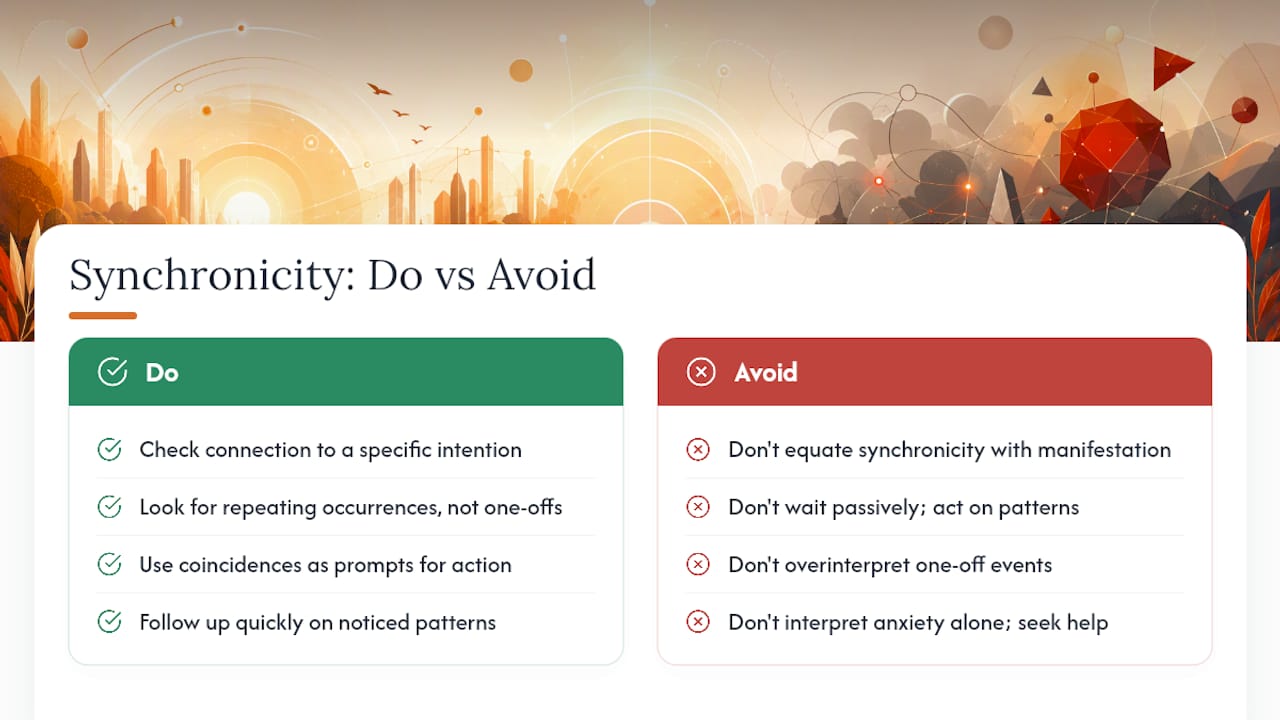
Set a response threshold before you start. Decide in advance that you’ll act on a signal only if it connects clearly to your stated intention and shows up more than once. That single rule stops you from chasing every coincidence and burning out on the practice within a week.
Which Daily Habits Increase Your Odds of Noticing Opportunities?
Small, repeatable practices do more here than any single big ritual.
- Morning intention (2 minutes), Name one thing you’re open to that day, out loud or on paper.
- Midday awareness break (5 minutes), Step away from screens, breathe, and notice what’s around you without judging it.
- Micro-journaling (3 minutes, end of day), Log anything that felt like a hook, even a small one.
- Movement or creative time (20 to 30 minutes), Walking, drawing, or music loosens the same mental grip that overthinking tightens.
Meeting new people is where a lot of opportunities actually hatch, and a short script helps more than winging it:
- “I’m working on [specific project] right now, curious if you’ve run into anything like that.”
- “I’ve been thinking a lot about [topic], has that come up for you lately?”
- “What are you excited about these days?” followed by genuine follow-up questions.
None of this works if your calendar is packed edge to edge. Block at least one unstructured hour a week, no meetings, no errands, just open space. Guidance on manifesting opportunities makes the same point from a different angle: visibility and responsiveness require room to exist in the first place. A full calendar produces zero hooks, not because the universe stopped sending them, but because you stopped being able to see them.
When Does Synchronicity Turn Into a Cognitive Trap?
Pattern-seeking is a double-edged skill. The same brain wiring that lets you spot a real opportunity also lets you manufacture false ones.
- Watch for confirmation bias, You’ll remember the ten times a “sign” led somewhere and forget the two hundred times it didn’t.
- Know the term apophenia, This is the tendency to perceive meaningful connections in random data. It’s the technical name for seeing a face in a cloud, or a message in a license plate.
- Run a quick check before acting on any “big” sign, Does this connect to a specific stated intention, or am I retrofitting meaning after the fact?
- Recognize when it’s not about opportunity anymore, If coincidences are causing distress, disrupting sleep, or feeding a broader sense of everything being connected to you personally, that can point toward something clinical rather than developmental. Persistent, distressing overinterpretation of unrelated events shows up in conditions from OCD to psychosis, and a licensed therapist should be the next call, not another journal entry.
- For therapists working with clients on this material, Synchronistic experiences can be a legitimate entry point into meaning-making in therapy, as long as the frame stays exploratory rather than deterministic. The goal is insight, not prophecy.
What Do Real Synchronicity-Driven Opportunities Look Like?
Career: A former colleague’s name comes up twice in one week, once in an unrelated email thread, once in conversation with a friend. Instead of shrugging it off, you send a two-line message: “Your name keeps coming up, how’s everything going?” That reconnect turns into a referral three weeks later. The copyable move: treat a repeated name as a hook worth a low-stakes message, not a sign to overanalyze.

Relationship:
You notice the same theme surfacing in conversations with three different friends, that you keep undervaluing your own time. Rather than dismissing it as a fluke, you test it: you say no to one request that week that you’d normally accept. The relationship that shifts because of that boundary tells you the pattern was real. The copyable move: when a theme repeats across unrelated sources, run a small experiment instead of a big life overhaul.
Creative work:
You post about a stalled project publicly instead of privately stewing over it, small act of visibility. A stranger comments with an idea you hadn’t considered, and that exchange becomes a working collaboration. The copyable move: visibility plus a genuine ask creates more hooks than staying quiet ever will.
A Seven-Day Checklist for Building Synchronicity Into Your Week
- Set one specific intention for the week. Two minutes, Monday morning.
- Block one hour of unstructured time on your calendar. Do this once, at the start of the week.
- Reach out to one person you haven’t spoken to in a while. Ten minutes, any day.
- Do one visible action tied to your intention (post, ask, share). Fifteen minutes, midweek.
- Micro-journal every evening. Three minutes a day, seven days total.
- Practice one soft-listening conversation where you ask more than you talk. Any single conversation this week.
- Set your response plan for if a hook shows up: who you’ll message, how fast, what you’ll say. Five minutes, done once, used as needed.
Why I Think Synchronicity Deserves a Skeptical, Practical Approach
People tend to fall into one of two camps on this. Either synchronicity is treated as proof of some cosmic plan, or it’s dismissed entirely as confirmation bias with better branding. Both camps miss the more useful middle ground, which is that the experience of noticing meaningful coincidence is real, common, and worth building a practice around, even if you never resolve the debate about why it happens.
What convinces me this is worth teaching as a skill rather than a belief is how consistently the mechanism traces back to ordinary psychology: attention, preparation, and the willingness to act on a small signal before overthinking kills it. That is not a claim about the universe. It is a claim about what happens when you clear space in your calendar and your head. The evidence and the guardrails in this guide reflect that stance, not blind faith and not blanket dismissal.
Test the seven-day checklist. Keep the journal for two weeks before deciding whether any of this works for you. That is a fair trial, and it costs you nothing but a few minutes a day.
A Structured Way to Practice This With Support
Reading about synchronicity gets you halfway. Building the habit, intention setting, journaling, response discipline, is where most people stall out on their own, especially when the transition they’re in feels overwhelming to navigate solo. That’s the gap Livethelifeofyourdreams was built to close: a program that pairs the psychological groundwork in this guide with structured daily practice, rather than leaving you to improvise a routine from a blog post.

The course suits three kinds of readers in particular:
- Anyone mid-transition (career change, breakup, relocation) who wants a structured way to use the increased sensitivity that comes with that period.
- People who’ve tried journaling or affirmations before without a clear system for turning insight into action.
- Readers who want the spiritual framing grounded in psychology rather than presented as pure mysticism.
Learners get a full framework for intention setting, guided journaling prompts, and daily practices built around the same evidence-informed approach outlined here, developed from Elvis D. Beuses’s own transformation after divorce, job loss, and near-deportation, and refined across a bestselling book and a 240,000-subscriber audience. If you want to see the approach before committing to anything, visit the Live The Life Of Your Dreams homepage and check the current course details and entry point.
Frequently Asked Questions
Is synchronicity the same thing as manifestation?
Not exactly. Manifestation usually implies you’re generating an outcome through belief or focus alone. Synchronicity, in Jung’s original sense, describes a meaningful coincidence you notice and respond to, it’s more about recognition and action than pure attraction.
How do I know if a coincidence is meaningful or just random?
Check whether it connects clearly to a specific intention you’d already set, and whether it repeats rather than showing up once. A one-off event with no link to anything you’re working toward is more likely noise than signal.
Can synchronicity actually help my career or relationships?
Yes, when you treat it as a prompt for action rather than a passive sign. The referral, the reconnection, the collaboration, these come from following up on a noticed pattern quickly, not from waiting for the universe to finish the job.
Should I worry if I’m noticing coincidences constantly?
Occasional clustering, especially during a life transition, is normal and well documented. If the coincidences are causing anxiety, disrupting sleep, or feeding a sense that everything revolves around you personally, talk to a licensed therapist rather than trying to interpret your way out of it alone.
Sources
- PMC article on active participation and noticing (source supplied)
- How to open up to serendipity and create your own luck, Psyche Guides
- Why meaningful coincidences cluster during life changes, Psychology Today
- Merriam-Webster, synchronicity
More to explore
- Self-Fulfilling Prophecy: What It Is and How to Change It
- Beliefs and the Placebo Effect: What Actually Changes Behavior
- Turn Visualization Techniques Into Action With One Tiny Daily Task
- Priming Psychology: A 4-Week Routine for Abundance
- Identity Shifting: How to Make Change Actually Stick
- Rewire Limiting Beliefs in 8 Micro Shifts With CBT and Neuroscience