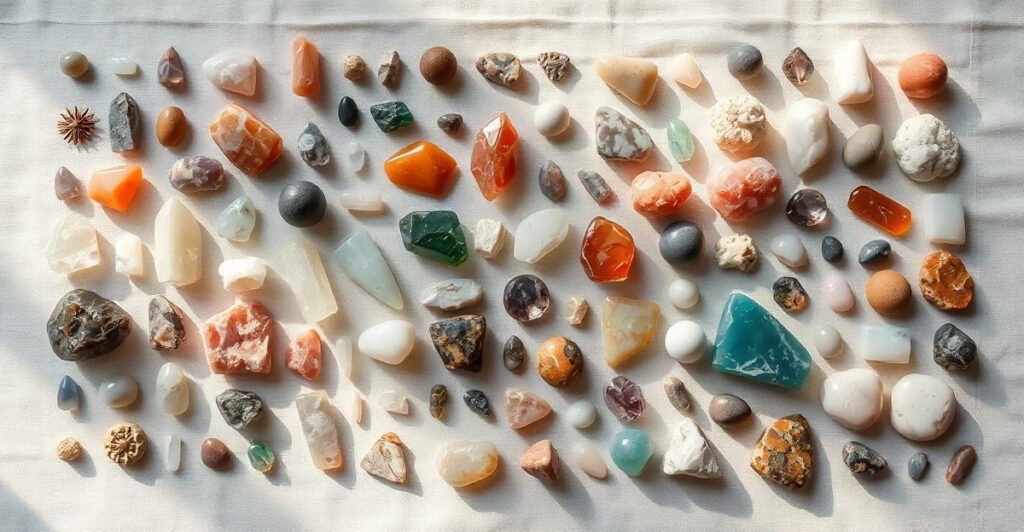
Crystals are sorted in four useful ways: by their internal structure (7 crystal systems), by mineral family (quartz, feldspar, beryl, and more), by physical shape (points, clusters, spheres, tumbled stones), and by color. Knowing all four makes it easy to pick the right stone and spot a mislabeled one.
This guide walks through each sorting method, lists the 20 most popular crystals, explains the “12 crystals” and “top 7” questions, and shows how to choose a type for your goal.
What are the different types of crystals?
The word “types” is used four different ways in crystal practice: scientific systems, mineral families, formation shapes, and colors. Each answers a different question.
- Crystal systems: the geometry of the atomic lattice, which is why stones grow in the shapes they do. There are 7.
- Mineral families: groups of related minerals, such as the quartz family or the feldspar family, that share chemistry.
- Formations and shapes: how a stone is grown or cut, such as a point, a cluster, a geode, a sphere, or a tumbled stone.
- Colors: a quick, practical grouping many practitioners use to match a stone to an intention.
For what crystals are and how they are used overall, start with our main guide to crystals and their meanings.
What are the 7 main types of crystals?
The 7 main types of crystals are the 7 crystal systems, defined by the symmetry and axis lengths of the repeating lattice. This is the answer geologists give.
| System | Shape tendency | Common stones |
|---|---|---|
| Cubic | Cubes, octahedrons | Pyrite, fluorite, garnet, diamond |
| Tetragonal | Four-sided prisms, longer on one axis | Zircon, apophyllite, rutile |
| Hexagonal | Six-sided prisms | Beryl, aquamarine, emerald |
| Trigonal | Three-fold symmetry, often six-sided points | Quartz, amethyst, calcite, tourmaline |
| Orthorhombic | Blocky, diamond-shaped cross sections | Topaz, peridot, celestite, aragonite |
| Monoclinic | Slanted prisms, blades | Selenite, gypsum, malachite, jade, moonstone |
| Triclinic | Irregular, no right angles | Labradorite, amazonite, turquoise, kyanite |
Trigonal is sometimes folded into hexagonal, which is why you may see “6 crystal systems” elsewhere. Both counts describe the same minerals.
Why this matters in practice: the system explains the shape you are holding. When you pick up a clear quartz point and see six flat faces meeting in a pyramid tip, that is the trigonal lattice showing on the outside. A cube of pyrite looks machine-cut because the cubic lattice really does stack at right angles. Fluorite grows natural octahedrons, eight-sided diamonds, for the same reason. Once you know the system, a “too perfect” shape stops looking suspicious, because some minerals genuinely grow that clean.
It also helps with identification. If a seller calls a bladed, slightly bendy white crystal “clear quartz,” the shape is wrong: quartz does not grow in flat blades. Selenite does, because it is monoclinic. Small structural tells like this catch a lot of mislabeled stones before you even test hardness.
What are the main crystal mineral families?
Most popular crystals belong to a handful of large mineral families, and stones in the same family often share a look and a hardness.
| Family | Members | Notes |
|---|---|---|
| Quartz (macrocrystalline) | Clear quartz, amethyst, citrine, rose quartz, smoky quartz | Mohs 7, very common, durable |
| Chalcedony (microcrystalline quartz) | Agate, jasper, carnelian, onyx, chrysoprase | Banded or solid, takes a high polish |
| Feldspar | Moonstone, labradorite, amazonite, sunstone | Often shows flash or sheen |
| Beryl | Emerald, aquamarine, morganite, heliodor | Mohs 7.5 to 8, gem quality common |
| Corundum | Ruby, sapphire | Mohs 9, second only to diamond |
| Tourmaline | Black tourmaline, pink and green tourmaline, watermelon | Strong grounding reputation |
| Garnet | Almandine, pyrope, grossular | Deep reds to greens, Mohs 7 to 7.5 |
| Carbonates | Calcite, malachite, azurite, rhodochrosite | Softer, Mohs 3 to 4, often water-sensitive |
| Mica group | Lepidolite, muscovite | Flaky, soft, calming reputation |
Knowing the family helps you predict care needs. Carbonate stones like malachite are soft and should stay dry, while quartz-family stones tolerate handling and a quick rinse.
Families also explain why some stones that look unrelated behave the same way. Amethyst, citrine, rose quartz, and smoky quartz are all just quartz with different trace elements or natural irradiation, so they share a hardness of 7, a similar feel, and the same easy care. Agate, carnelian, and jasper are also quartz, only with crystals too small to see, which is why they polish so smoothly and come in solid or banded colors rather than points. When you learn that “chalcedony” simply means microcrystalline quartz, a whole shelf of stones suddenly makes sense as one group.
The feldspar family is worth singling out because it is behind most of the stones people buy for their “flash”: moonstone’s floating glow, labradorite’s blue and gold sheen, sunstone’s glitter. That optical effect comes from light bouncing off internal layers in the feldspar structure, not from any coating, so a genuine piece shows the flash shift as you tilt it rather than sitting on the surface.
What are the types of crystal formations and shapes?
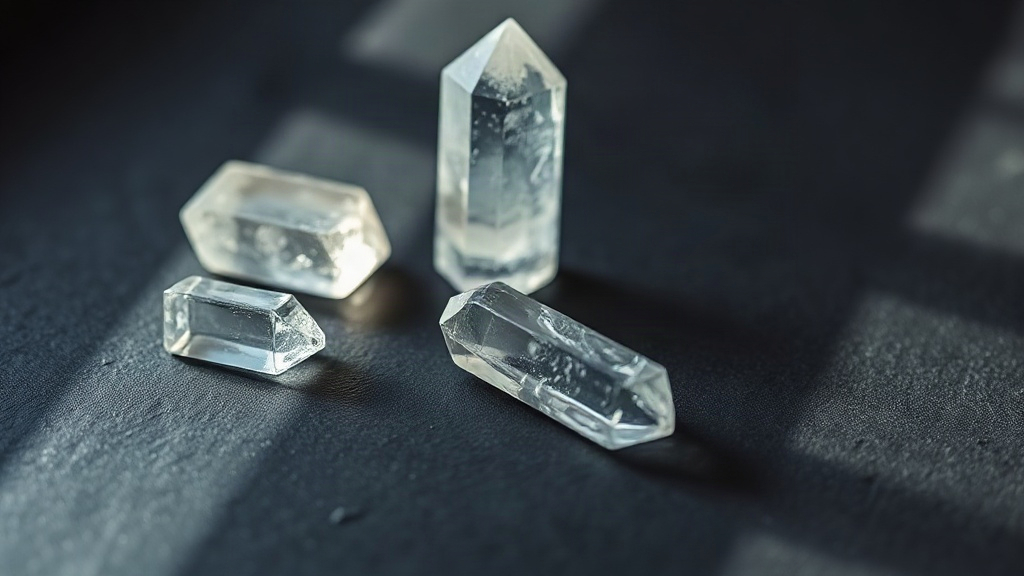
Crystals come in natural formations and cut shapes, and practitioners often choose a shape for how it directs attention or fits the hand, not for any different power.
| Form | What it is | Often used for |
|---|---|---|
| Point or generator | Single terminated crystal | Focusing an intention in one direction |
| Cluster | Many points on one base | A room stone, charging other crystals |
| Geode or cathedral | Hollow rock lined with crystals | A centerpiece, calm ambiance |
| Tumbled stone | Small, polished, rounded | Carrying, pocket work, grids |
| Sphere | Polished ball | Meditation, even energy in all directions |
| Tower or obelisk | Tall, faceted, pointed top | Altar focus, grid centers |
| Pyramid | Four-sided cut point | Anchoring a space, grid work |
| Palm or worry stone | Flat, thumb-sized | Stress relief, a touch cue through the day |
| Raw or rough | Uncut natural piece | A natural look, display |
| Double-terminated | Points on both ends | Two-way flow, pairing ideas |
Special natural features include druzy (a sugar-like crust of tiny crystals), phantom (a ghost outline of an earlier growth stage), and self-healed (a broken face regrown with small points). These are collector details, not upgrades.
A note on the marketing around shapes: towers, pyramids, and spheres are cut and polished from larger rough, and a sphere is not “more powerful” than the chunk it came from. What shapes actually change is how you interact with the stone. A palm stone invites you to hold it, so you use it more often. A tall tower on a shelf is a visual anchor you notice every time you pass. A sphere rolls evenly in the hand during meditation. Choose the shape that fits the habit you want to build, and do not pay a premium for a form that promises special properties.
One shape worth understanding is the cluster. Because it has many points facing outward in all directions, people treat it as a “whole room” stone rather than a directed one, and often use a small cluster as a resting place to refresh their other stones. A single point, by contrast, has one termination, so it gets used when someone wants to aim an intention at a specific goal or direction.
What are the 20 most popular crystals?
The 20 most popular crystals cover the common intentions of calm, love, protection, focus, energy, and abundance. This is a practical “most collections include these” list.
- Clear quartz: clarity, amplification.
- Amethyst: calm, sleep, intuition.
- Rose quartz: love, self-compassion.
- Citrine: confidence, abundance.
- Black tourmaline: protection, grounding.
- Selenite: clearing, peace.
- Carnelian: courage, drive.
- Labradorite: transformation, imagination.
- Tiger’s eye: confidence, balance.
- Green aventurine: luck, opportunity.
- Hematite: grounding, focus.
- Fluorite: mental clarity, study.
- Lapis lazuli: truth, expression.
- Moonstone: cycles, intuition, new starts.
- Sodalite: logic, calm communication.
- Smoky quartz: releasing stress, grounding.
- Amazonite: soothing, boundaries.
- Malachite: change, protection (keep dry).
- Obsidian: truth, shadow work.
- Pyrite: willpower, abundance (handle dry).
What are the types of crystals by color, and what do they mean?
Grouping crystals by color is the fastest way to match a stone to an intention, since color themes are fairly consistent across traditions.
| Color | Common theme | Examples |
|---|---|---|
| Clear or white | Clarity, clearing, fresh starts | Clear quartz, selenite, moonstone |
| Black | Protection, grounding, boundaries | Black tourmaline, obsidian, hematite |
| Pink | Love, gentleness, emotional healing | Rose quartz, rhodonite, morganite |
| Green | Growth, luck, heart, money | Aventurine, jade, malachite, emerald |
| Blue | Calm, truth, communication | Sodalite, lapis lazuli, aquamarine, celestite |
| Purple | Intuition, peace, spirituality | Amethyst, lepidolite, charoite |
| Yellow or gold | Confidence, energy, abundance | Citrine, pyrite, yellow calcite |
| Red or orange | Drive, courage, vitality | Carnelian, red jasper, garnet, sunstone |
| Brown | Stability, grounding, home | Smoky quartz, tiger’s eye, petrified wood |
When you cannot remember a stone’s traditional meaning, its color will usually get you close.
Color grouping has a real basis in how people respond. Cool blues and greens are calming to look at, so blue and green stones on a desk genuinely help some people settle. Warm reds and oranges are stimulating, which is why carnelian and red jasper get chosen for energy and courage. This is closer to color psychology than to any special property of the mineral, but it still works as a cue. The one caution is that a single color can mean different things depending on the stone: green malachite is used for change and protection, green aventurine for luck and calm, and green jade for steadiness. Use color to narrow the field, then check the specific stone.
What are the “12 crystals” people ask about?
The “12 crystals” usually refers to the 12 traditional birthstones, one per calendar month, though some people mean a 12-stone zodiac set or a 12-piece starter collection.
- January: garnet. February: amethyst. March: aquamarine.
- April: diamond or clear quartz. May: emerald. June: moonstone or pearl.
- July: ruby or carnelian. August: peridot. September: sapphire or lapis lazuli.
- October: opal or tourmaline. November: citrine or topaz. December: turquoise or tanzanite.
A 12-stone starter set often looks like the birthstone list swapped for cheaper equivalents: garnet, amethyst, aquamarine, clear quartz, aventurine, moonstone, carnelian, tiger’s eye, lapis, black tourmaline, citrine, and sodalite. That covers a full year of intentions on a small budget.
The zodiac version assigns a stone to each sun sign rather than each month, and the lists vary by author. A common one pairs Aries with carnelian, Taurus with rose quartz, Gemini with agate, Cancer with moonstone, Leo with tiger’s eye, Virgo with amazonite, Libra with lapis lazuli, Scorpio with obsidian, Sagittarius with turquoise, Capricorn with garnet, Aquarius with amethyst, and Pisces with aquamarine. Because these lists are not standardized, treat a zodiac stone as a nice starting suggestion, not a rule, and switch it for any stone whose theme fits your actual goal better.
What are the top 7 healing crystals?
The top 7 healing crystals for a starter kit are clear quartz, amethyst, rose quartz, citrine, black tourmaline, selenite, and carnelian. Together they cover focus, calm, love, confidence, protection, clearing, and drive.
If you only buy one, make it clear quartz, since it is the most flexible and pairs well with any intention. Build from there as specific goals come up. Our main crystals guide has the full breakdown of each.
A common question is whether “healing crystals” is a separate type from other crystals. It is not. The same clear quartz sits in a lab as a piezoelectric component, in a jeweler’s tray as a gemstone, and on a nightstand as a focus object. “Healing crystal” describes a use, not a category. That matters when shopping, because a stone marketed with a wellness label often costs more than the identical mineral sold as a specimen. If you are comparing prices, search the plain mineral name too.
How do you choose which type of crystal to use?
Choose a crystal type by matching three things: your goal to a stone’s theme or color, the format to how you will use it, and the price to a common, genuine option rather than a rare one.
- Name one goal. Calm, confidence, focus, love, protection.
- Pick a stone or color that matches, using the tables above.
- Choose a form. A tumbled stone or palm stone to carry, a cluster or tower for a room, a sphere for meditation.
- Check the family for care needs. Quartz family is low-maintenance; carbonates and selenite must stay dry.
- Buy the common version. Amethyst, quartz, and aventurine are cheap and real. Skip “rare” bargains.
How can you tell crystal types apart from fakes?
You tell real crystal types from fakes by checking the name against the look: dyed stones are too evenly colored, glass has bubbles and no internal flaws, and invented names like “cherry quartz” signal dyed glass.
- Dyed: color concentrated in cracks, unnaturally uniform, common in “turquoise” howlite and bright agate.
- Glass: air bubbles, perfect clarity in a large cheap piece, warms quickly in the hand.
- Misnamed: heat-treated amethyst sold as natural citrine, quartzite sold as jade.
- Assembled: doublets and triplets glued from thin slices, seen in opal and ametrine.
For a full buying and fake-spotting walkthrough, see our guide to where to buy crystals.
Frequently asked questions
What are the 7 main types of crystals?
The 7 crystal systems, grouped by lattice geometry: cubic, tetragonal, hexagonal, trigonal, orthorhombic, monoclinic, and triclinic. Quartz and amethyst are trigonal, pyrite and fluorite are cubic, and selenite is monoclinic.
What are the 20 most popular crystals?
Clear quartz, amethyst, rose quartz, citrine, black tourmaline, selenite, carnelian, labradorite, tiger’s eye, green aventurine, hematite, fluorite, lapis lazuli, moonstone, sodalite, smoky quartz, amazonite, malachite, obsidian, and pyrite.
What are the 12 crystals?
Most often the 12 birthstones, one per month, from garnet in January through turquoise in December. Some people mean a 12-stone zodiac set or a 12-piece starter collection covering a full range of intentions.
What are the top 7 healing crystals?
Clear quartz for focus, amethyst for calm, rose quartz for self-kindness, citrine for confidence, black tourmaline for grounding, selenite for clearing, and carnelian for drive. This set covers most everyday intentions.
How are crystals classified?
Four ways: by crystal system (lattice geometry, 7 of them), by mineral family (quartz, feldspar, beryl, and so on), by formation or cut shape (point, cluster, sphere, tumbled), and by color. Each grouping answers a different question.
Pick one type and start
Choose a single goal, match it to one stone by theme or color, pick a form you will actually use, and put it to work in a daily habit. Add types only as new intentions come up.
For a gentle daily prompt while you build the practice, join our free message from the universe and abundance meditation.