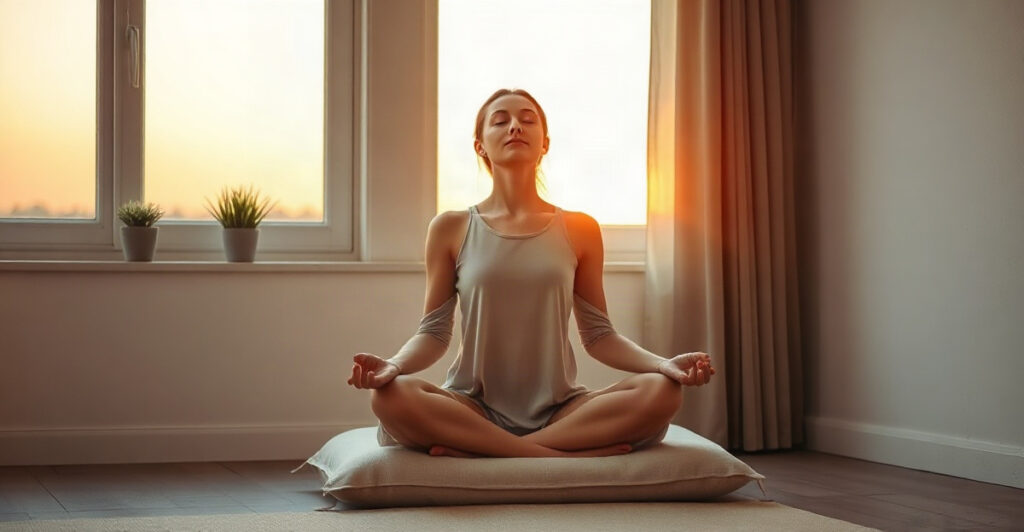
Mindfulness meditation for anxiety is the practice of paying calm, nonjudgmental attention to the present moment so anxious thoughts lose their grip. Practiced 5 to 10 minutes a day, it takes the edge off worry for most people, often within 2 to 4 weeks.
Anxiety has a favorite trick: it drags you out of the present and into an imagined future, a 3 a.m. replay of conversations and a highlight reel of disasters that haven’t happened. Mindfulness brings you back to now, and now is almost always more bearable than what your mind was painting. This guide shows you how. You’ll find the research in plain words, a 5-minute script you can use tonight, the 3-3-3 rule for sudden spikes, and an honest week-by-week picture of what to expect.
What is mindfulness meditation for anxiety?
Mindfulness meditation for anxiety is a mental practice in which you observe your breath, body, and thoughts on purpose, without judging them or fighting them. The goal is a changed relationship with worry, and an empty mind is not part of the deal.
Anxiety feeds on 2 things: resistance and rehearsal. You resist a racing heart, which makes it louder, and you rehearse feared futures, which makes them feel real. Mindfulness interrupts both. When you notice a thought and quietly call it “worry,” it stops running the show.
Picture a Monday morning. Your chest tightens before a meeting. The old pattern goes, “Something is wrong, fix it,” followed by 40 minutes of rumination. The mindful pattern goes, “There’s the tightness. That’s anxiety trying to protect me,” followed by 6 slow breaths. The sensation is identical. Your relationship to it is different, and that difference is the whole practice.
Start smaller than feels impressive. 2 minutes counts. 1 minute counts.
Is mindfulness meditation good for anxiety?
Yes. Mindfulness meditation carries moderate, well-replicated evidence for easing anxiety, and it works as a skill you build rather than a pill that acts on you.
The landmark study is a 2014 Johns Hopkins review of 47 clinical trials with 3,515 participants, published in JAMA Internal Medicine. It found mindfulness meditation programs produced small to moderate improvements in anxiety, and the authors judged that evidence stronger than the evidence behind most alternatives they compared. Harvard Health’s summary of the research reaches the same conclusion: meditation helps people watch anxious thoughts arise and pass without being swept away by them.
Be honest with yourself about the limits. The effects are moderate, not miraculous, and study quality varies across the field. In one trial led by Dr. Elizabeth Hoge with people diagnosed with generalized anxiety disorder, an 8-week mindfulness course reduced anxiety symptoms more than general stress-management classes did, though both groups improved. Mindfulness helps most people on most days. It is also not a substitute for professional care when anxiety is severe.

How does mindfulness meditation calm an anxious brain?
Mindfulness calms the anxious brain by training the amygdala, your brain’s smoke alarm, to stop treating every worry like a fire. Each time you notice an anxious thought and return your attention to the breath, you complete 1 repetition for the prefrontal cortex, the part of the brain that regulates the alarm.
This is neuroplasticity at work, the same mechanism behind how habits rewire the brain. A research team led by Dr. Britta Hölzel at Harvard-affiliated Massachusetts General Hospital found that 8 weeks of mindfulness practice came with measurable gray matter density changes, including increases in regions tied to emotion and memory (Psychiatry Research: Neuroimaging, 2011).
The everyday version looks like this. The first 100 times you catch a worry, it takes 30 seconds to notice you’ve been swept away. After a few weeks of practice, you catch it in 3. The alarm still rings. You get faster at walking over and turning it down.
How do you do a 5-minute mindfulness meditation for anxiety?
A 5-minute mindfulness meditation for anxiety comes down to 6 small steps, and you can do the whole sequence tonight at your kitchen table. This is the exact script I would hand a friend on day 1.
- Set a timer for 5 minutes. A short timer removes the “am I done yet?” question and makes it easy to say yes to the practice.
- Sit and settle. Feet flat, hands loose in your lap, eyes closed or lowered. Let your spine be tall but not stiff.
- Take 3 long exhales. Breathe in through the nose for about 4 counts and out through the mouth for about 6. A longer exhale nudges your nervous system toward calm.
- Count the breath from 1 to 10. One full breath per number. When you reach 10, start again at 1. This gives a busy mind a job to do.
- Label and return. When a worry pulls you away, and it will, silently say “thinking” and walk your attention back to the count. Every return is 1 rep, never a failure.
- Close gently. When the timer sounds, notice 1 place in your body that feels softer than when you started. Then stand up and carry on with your day.
The most common objection is “my mind won’t stop, so I’m bad at this.” You are doing it right. Noticing that the mind wandered is the exercise. A session with 20 wanderings and 20 returns is a working set, the way 20 reps at the gym is a real workout.
Once the practice feels steady, you can aim it at something bigger than calming down. Our pillar guide to meditation for manifestation shows how the same attention skill gets used deliberately on the life you want.
Which technique should you use in an anxious moment?
Different tools fit different moments, so match the technique to the situation instead of forcing 1 practice everywhere.
| Technique | Best for | Time | How to do it |
|---|---|---|---|
| 5-minute breath count | A daily baseline practice | 5 minutes | Count breaths 1 to 10, restart, return when you drift |
| 3-3-3 grounding | A sudden anxiety spike | Under 2 minutes | Name 3 things you see, 3 you hear, move 3 body parts |
| Body scan | Anxiety that lives in the body | 10 minutes | Move attention from toes to head, softening each area |
| Labeling thoughts | Overthinking and rumination | Anytime | Say “worry” or “planning,” then return to the breath |
| Guided meditation | Evenings when focus is gone | 10 to 20 minutes | Follow a recorded voice so attention has somewhere to rest |
If racing thoughts dominate your evenings, pair this table with our guided meditation to reduce anxiety and stress, and keep the 5-minute script for mornings.
What is the 3-3-3 rule of anxiety?
The 3-3-3 rule is a fast grounding technique: name 3 things you can see, identify 3 sounds you can hear, and move 3 parts of your body. It works because anxiety lives in imagined futures while your senses can only report on the present.
Use it as first aid. Sitting in a dentist’s waiting room with your jaw clenched, you look around: the poster, the fern, the light on the floor. Then 3 sounds: the hum of the vent, a muffled voice, your own breathing. Then move: roll your ankles, shrug your shoulders, open and close your hands. The spike usually eases within a few minutes, because your attention has a room to stand in again instead of a catastrophe.
Think of the 3-3-3 rule as the emergency kit and your daily meditation as the training that makes the kit work faster. The calmer your baseline, the less fuel any single spike has.

How long does mindfulness meditation take to ease anxiety?
Most people feel a small shift within the first week and a real change in their baseline within 2 to 4 weeks of daily practice. Eight weeks is where the stronger research results, including the brain changes described above, tend to show up.
- Days 1 to 3: Expect frustration. Your mind wanders 30 times, and you’ll wonder whether you’re doing it wrong. You aren’t.
- Week 1: Calm shows up in the minutes right after a session, and you catch yourself mid-worry once or twice during the day.
- Weeks 2 to 4: The gap between trigger and reaction widens. A study at the University of Waterloo found 10 minutes of mindfulness practice improved focus and attention in anxious participants compared with a control group, which is exactly this stage doing its work.
- Week 8: The practiced response starts replacing the default one. Worry still visits, but it stays shorter and lands softer.
If you’ve “tried meditation before and it didn’t work,” look at the dose before you judge the medicine. 3 sporadic sessions spread across a month is not a trial. Anchor the 5 minutes to something you already do, like your first coffee, the way we suggest in our morning routine for abundance, and let consistency do the heavy lifting.
When is meditation not enough for anxiety?
Meditation alone is not enough when anxiety regularly interferes with your sleep, your work, your relationships, or your health. That pattern deserves professional support, and reaching for it is wisdom, not defeat.
Two clinical programs are worth knowing by name: MBSR (mindfulness-based stress reduction) and MBCT (mindfulness-based cognitive therapy). Both are structured 8-week courses developed by clinicians, and both carry decades of trials behind them, including the studies cited above. Ask a doctor or therapist whether one fits your situation.
Roughly 19% of U.S. adults experience an anxiety disorder in any given year, according to the National Institute of Mental Health, so if this is you, you’re in large company, and effective help is routine. On hard weeks, give yourself permission to keep the practice small: eyes open, 2 minutes, or mindful walking instead of sitting.
Frequently asked questions
What is the best meditation for anxiety?
There is no single best meditation, but mindfulness of the breath is the most studied and the easiest place to start. If racing thoughts dominate, a guided meditation of 10 to 20 minutes often works better in the beginning because a voice gives your attention somewhere to rest.
How can I calm my anxiety quickly?
Use the 3-3-3 rule: name 3 things you can see, 3 sounds you can hear, and move 3 parts of your body. Then take 3 slow breaths with a longer exhale than inhale. Most people feel the physical surge begin to ease within a few minutes.
Is 5 minutes of meditation a day enough for anxiety?
Yes. 5 minutes a day is enough to start, and a modest practice you keep beats an ambitious one you abandon. The University of Waterloo research used 10 minutes, and many beginners grow from 5 to 10 within a few weeks.
Can mindfulness meditation make anxiety worse?
For most people, no, though sitting quietly with worry can feel uncomfortable at first, and a small number of people feel more distressed during long or intense sessions. If a session leaves you shaken, shorten it, keep your eyes open, or practice with a guide, and speak with a professional if anxiety interferes with daily life.
Should I use a guided meditation for anxiety and overthinking?
Yes, guided meditations are the easiest starting point for an overthinking mind because a voice keeps your attention anchored. Start with 10 to 20 minutes in the evening, and keep your 5-minute silent practice for the morning.
What is the difference between mindfulness and relaxing?
Relaxation tries to change how you feel, while mindfulness changes how you relate to what you feel. You can be mindful of anxiety without making it disappear, and that shift drains much of the tension around it.
One more thing before you go. If this kind of steady, practical guidance speaks to you, we send a free daily “message from the universe” with a short abundance meditation to everyone on our list. It takes 30 seconds to read each morning, and it keeps this calm, deliberate state of mind in front of you all day. Get today’s message at livethelifeofyourdreams.org and let tomorrow start with it.