
The most effective morning routine for abundance takes a variable amount of time and follows one sequence: hydrate, get sunlight, move your body, write your intentions, visualize and affirm, then name your single priority. That order is not arbitrary. Physical activation first, then mental preparation, then focused work. Research consistently shows this sequence uses your peak willpower window and prevents decision fatigue from hijacking the rest of your day.
The short version:
- Micro (5–10 min): 16 oz water + 5 min sunlight + 3 affirmations + one written priority
- Core (20–30 min): Hydrate + sunlight + 10 min movement + 5 min journaling + 3–5 min visualization/affirmations + one priority
- Full (60–90 min): All of the above + extended movement + gratitude practice + 5-min visualization script + deep intention-setting
Verdict: Practiced consistently, this routine shifts your default mental state from scarcity to abundance within weeks, not months. The habits are simple. The sequencing is what most people miss.
Pro Tip: Lay out your water glass, journal, and running shoes the night before. Removing that 30 seconds of friction is the single fastest way to make the first week stick.
Table of Contents
- What does a morning routine for abundance actually look like?
- How each habit works and exactly how long it takes
- How do you build a personalized abundance routine that sticks?
- Why do these habits actually work?
- What should you actually say? Mantras, prompts, and a visualization script
- Gratitude practices that go beyond journaling
- Evening habits that make your morning routine easier
- Key Takeaways
- The gap between ritual and result
- What Livethelifeofyourdreams offers beyond this guide
- Primary sources and further reading
What does a morning routine for abundance actually look like?
Three templates. Pick the one that fits your life right now, not the one that sounds most impressive.
Template comparison: Micro, Core, and Full
| Time Block | Micro (5–10 min) | Core (20–30 min) | Full (60–90 min) |
|---|---|---|---|
| Hydration | 16–20 oz water (1 min) | 16–20 oz water (1 min) | 16–20 oz water (1 min) |
| Sunlight/Air | Step outside (2–3 min) | Step outside (5 min) | Step outside (5–10 min) |
| Movement | Skip or 2 min stretch | 10 min walk or yoga (10 min) | 20–30 min workout |
| Journaling | One sentence intention (1 min) | Expressive writing prompts (5 min) | Full expressive writing (10 min) |
| Visualization/Affirmations | 3 affirmations aloud (2 min) | Guided visualization (5 min) | 5-min script + mantras (10 min) |
| Gratitude | Woven into affirmations | 2–3 spoken gratitudes (2 min) | Dedicated gratitude practice (5 min) |
| Single Priority | Name it aloud (1 min) | Write it down (2 min) | Write it + first action step (5 min) |
| Total | ~8 min | ~30 min | , |
| Primary benefit | Breaks phone-first habit | Builds consistent mindset shift | Full circadian and mindset reset |
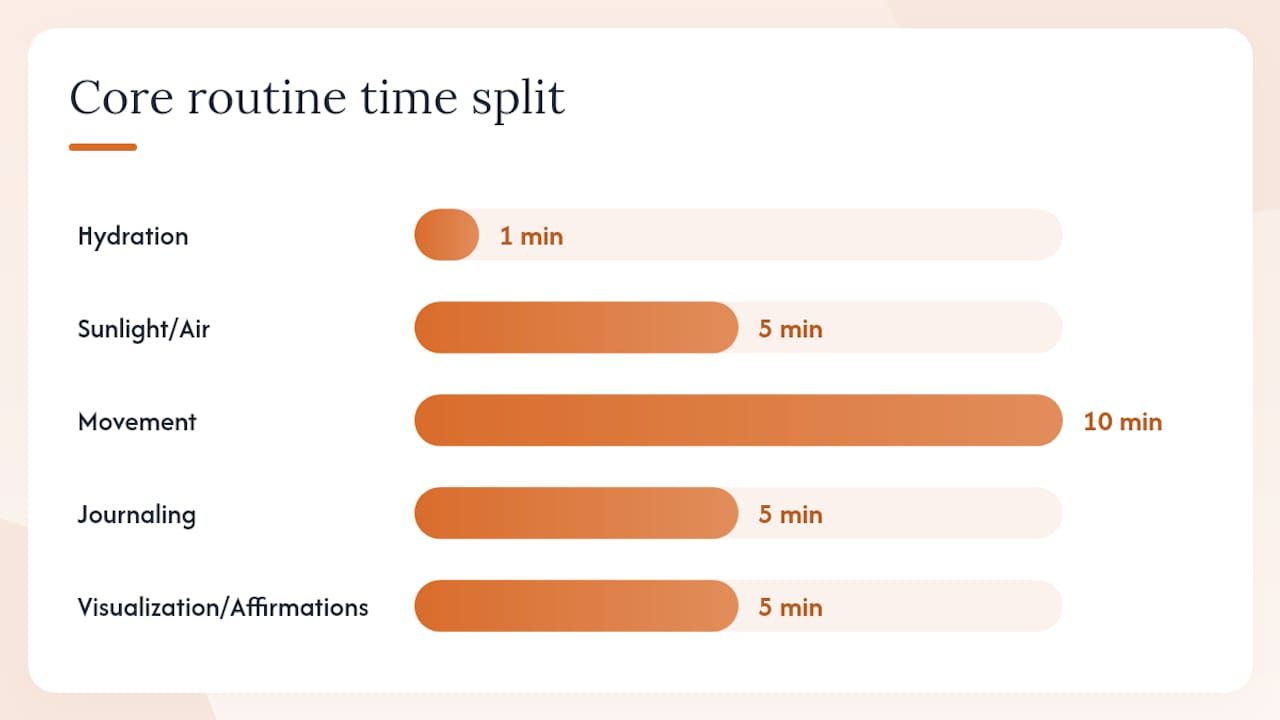
The Micro template exists for one reason: to give you a win on the hardest days. A parent with a newborn, a shift worker finishing a night rotation, anyone whose morning is genuinely compressed. Eight minutes beats zero every single time.
The Core template is where most people find their groove. Thirty minutes covers every high-leverage habit without requiring you to wake up at 4 AM.
The Full template is for days when you have the space, or for weekends when you want to go deeper. Think of it as the version you build toward, not the one you start with.
Pro Tip: Start with the Micro template for the first two weeks. Once it feels automatic, add one block from the Core template. Stacking habits gradually is far more effective than attempting the Full routine on day one and burning out by day four.
How each habit works and exactly how long it takes
Sunlight: your circadian reset button
Step outside within 30 minutes of waking. Five to ten minutes of direct morning light helps reset your circadian rhythm, supports serotonin production, and improves sleep quality that same night, according to evidence summarized by Bulletproof. You do not need bright sunshine. Overcast outdoor light still delivers far more lux than indoor lighting. Leave your phone inside. This is not a scroll break with fresh air; it is a biological signal to your brain that the day has started.
Hydration before caffeine
Drink water before anything else. Your body loses water overnight through breathing and perspiration, and even mild dehydration blunts cognitive performance. Delay your first coffee by 60–90 minutes after waking. This timing matters because your cortisol awakening response, a natural morning spike in alertness, peaks in the first 30–45 minutes. Caffeine taken during that window can blunt the response and contribute to the mid-morning crash many people blame on their coffee. Let the cortisol do its job first.
Movement: the minimum effective dose
Ten minutes of physical activity shortly after waking improves alertness and cognitive performance for the next 2–3 hours. You do not need a gym. A brisk walk around the block, ten minutes of yoga, or a short body weight circuit all qualify. The goal is to reduce sleep inertia, the grogginess that lingers when your brain has not fully transitioned from sleep to wakefulness. Movement accelerates that transition faster than any amount of scrolling or snoozing.

Expressive writing and journaling
This is where the abundance mindset work gets concrete. Psychologist James Pennebaker’s research, summarized by SUCCESS, shows that expressive writing for as little as three minutes delivers measurable reductions in stress and improvements in cognitive function. The mechanism is simple: writing externalizes mental noise, which frees up working memory for intentional thought.
A 3-minute journaling template:
- What am I grateful for right now? (one specific thing, not a list)
- What would make today feel like a win?
- What belief or fear is in my way, and what is the truth about it?
Write by hand. Paper reduces cognitive load compared to typing on a device, and it keeps you off screens during the first hour.
Visualization and affirmations
Three to five minutes is enough. The goal is not to daydream; it is to rehearse the feeling of abundance so your nervous system starts treating it as familiar rather than foreign. Speak affirmations aloud in the present tense. Saying “I am open to receiving abundance” while feeling it in your body is categorically different from reading a list of positive phrases without engagement. The embodiment is the practice.
Protecting the first hour: the no-screens rule
No phone, no email, no news for the first 60 minutes after waking. This is the single habit that most people resist and most people need. Every notification you check in that window is a decision that costs willpower before you have spent any on yourself. The research on morning sequencing is clear: the first 90 minutes of the day are your highest-value cognitive window. Spend them on your own priorities, not someone else’s inbox.
How do you build a personalized abundance routine that sticks?
Adjustments for real-life constraints
Parents with young children: Do the Micro template before the household wakes up. Even 10 minutes of quiet before the morning chaos is enough to set your mental state. If that is impossible, attach two or three affirmations to an existing task, like saying them while you make breakfast.
Shift workers: Your “morning” is whenever you wake up before your shift. The sequence stays the same; the clock time does not matter. What matters is protecting the first hour of your waking day from screens and reactive tasks.
Genuinely time-crunched mornings: Collapse the routine to its two non-negotiables: water and one written intention. Two minutes. That is the floor, and it is enough to maintain the habit identity even on the hardest days.
- Keep a backup version of the Micro template written on a sticky note inside your journal cover.
- If you miss a morning, do not try to compensate by doubling up the next day. Just restart.
- Consistency across 30 days matters more than perfection on any single morning.
Why do these habits actually work?
The habits in this routine are not arbitrary wellness trends. Each one maps to a specific mechanism that researchers have studied.
The evidence behind the practice
| Habit | Mechanism | Practical takeaway |
|---|---|---|
| Morning sunlight | Circadian rhythm reset, serotonin support | 5–10 min outdoors within 30 min of waking |
| Hydration | Cognitive performance, dehydration reversal | 16–20 oz water before caffeine |
| Delayed caffeine | Cortisol awakening response protection | Wait 60–90 min before first coffee |
| Movement | Sleep inertia reduction, 2–3 hr cognitive boost | 10–20 min minimum |
| Expressive writing | Stress reduction, working memory freed | 3–5 min by hand |
| Consistent wake time | Sleep quality, habit automaticity | 7–9 hours of sleep supports this |
“Expressive writing for as little as three minutes reduces psychological stress and improves cognitive clarity, not because it solves problems, but because it externalizes them. The page holds what the mind no longer has to.”, James Pennebaker’s research, as summarized by SUCCESS
The founder’s approach: Elvis D. Beuses
Elvis D. Beuses, founder of Livethelifeofyourdreams, brings more than 20 years of experience in medical and pharmaceutical fields alongside his own story of rebuilding after divorce, job loss, and near-deportation. His platform’s core premise is that spiritual practices and neuroscience are not in conflict. They explain each other. The morning rituals in this guide are built on that same premise: ancient wisdom traditions have always known that how you begin your day shapes everything that follows. Now the research confirms why.
His 240K-subscriber YouTube channel and international bestseller Cómo Vencer el Miedo reflect the reach of an approach that takes manifestation seriously without abandoning rigor.
The cortisol awakening response is one of the most underused pieces of morning science. Your cortisol naturally spikes 50–100% above baseline in the first 30–45 minutes after waking. That spike is your body’s built-in alertness mechanism. Protecting it, with sunlight, water, and movement instead of screens and caffeine, means you are working with your biology rather than against it.
What should you actually say? Mantras, prompts, and a visualization script
High-impact abundance affirmations
Speak these aloud, slowly, with your hand on your chest if it helps you feel them rather than just recite them:
- “I am worthy of financial abundance and I receive it with ease.”
- “Opportunities find me because I show up prepared and open.”
- “My mind is clear, my energy is high, and I attract what I need today.”
- “I release scarcity thinking and choose to see possibility.”
- “Abundance flows to me in expected and unexpected ways.”
These are phrased in the present tense and oriented toward feeling, not just declaration. That distinction matters for embodiment. Sacred ritual practices that emphasize the felt sense of abundance, rather than rote repetition, tend to produce more consistent mindset shifts over time.
Journaling prompts for abundance and action
- What is one thing I already have that I sometimes take for granted?
- What would I do today if I knew I could not fail?
- What limiting belief showed up yesterday, and what is the more accurate story?
- What is one concrete action I can take today that moves me toward financial or personal abundance?
A 5-minute visualization script
Sit comfortably. Close your eyes. Take three slow breaths.
Picture yourself at the end of a day that went exactly as you hoped. Where are you? What does the room look like? What can you smell or hear?
Notice how your body feels. Relaxed? Energized? Proud? Stay with that feeling for 30 seconds.
Now see one specific thing you accomplished today. Not a vague success, but a concrete one. A conversation that went well. A decision you made with confidence. A number in your account that reflects your work.
Feel gratitude for it as if it has already happened.
Take one more breath. Open your eyes. Write down the one action that will make that vision real today.
Pro Tip: You can search YouTube for “Attract Abundance, Prosperity, Wealth (Listen Daily!)” and play it softly in the background during your affirmation block. Spoken mantras from an external source can help anchor the practice when your own inner voice is still skeptical.
Fixing limiting beliefs in the morning
When a voice in your head says “this won’t work for me,” that is scarcity conditioning speaking, not reality. You do not need to argue with it. Write it down in your journal, then write one sentence that challenges it with evidence. “This won’t work” becomes “I have changed habits before. I can do it again.” That is the entire practice. You are not trying to silence doubt; you are training your brain to respond to it differently.
Pro Tip: If you miss three or more days in a row, do not restart with the Full template to “make up for it.” Return to the Micro template for three days, rebuild the identity, then scale back up.
Gratitude practices that go beyond journaling
Journaling and gratitude are related but not the same thing. Journaling is a cognitive practice. Gratitude, done separately, is a somatic one. The difference is where you feel it.
Three ways to build a distinct gratitude practice into your morning:
Spoken gratitude. Before you get out of bed, say three specific things you are grateful for out loud. Not “my family” but “the conversation I had with my sister on Tuesday.” Specificity activates genuine feeling rather than rote acknowledgment.
Gratitude walk. During your sunlight block, name one thing you appreciate for every minute you are outside. This combines the circadian benefit of morning light with the mindset benefit of directed attention. Five minutes outside becomes five genuine moments of appreciation.
Object anchoring. Keep one physical object, a stone, a ring, a small token, near your water glass. Each morning when you pick it up, let it trigger one moment of felt gratitude before you do anything else. This is a form of conditioned response that takes about two weeks to become automatic.
The distinction between these practices and journaling is intentional. Writing processes thought. Spoken and embodied gratitude practices train your nervous system to recognize abundance as a present-tense reality rather than a future goal.
Evening habits that make your morning routine easier
Your morning routine starts the night before. That is not a metaphor.
Adults need 7–9 hours of sleep for the consistent wake times that make morning routines sustainable. A 10 PM bedtime with a 6 AM alarm gives you exactly 8 hours. That math is obvious, but most people treat sleep as the variable they compress when life gets busy, then wonder why their morning feels impossible.
Four evening habits that directly support a strong morning:
Set tomorrow’s single priority tonight. Before you close your laptop, write one sentence: “Tomorrow, the most important thing I will do is ___.” This eliminates the decision from your morning and lets your subconscious work on it overnight.
Prepare your morning environment. Water glass on the counter. Journal open to a fresh page. Workout clothes laid out. Phone charging in another room. Two minutes of preparation removes the friction that kills routines.
Wind down screens 30–60 minutes before bed. Blue light exposure in the evening delays melatonin production and makes it harder to fall asleep at your target time. A book, light stretching, or a brief meditation replaces the scroll.
Do a brief evening reflection. Three questions: What went well today? What would I do differently? What am I looking forward to tomorrow? This closes the mental loop on the day and primes your brain for a more intentional morning.
Key Takeaways
A consistent morning routine for abundance works because it sequences physical activation, mental preparation, and intention-setting in the order that best uses your brain’s natural morning alertness window.
| Point | Details |
|---|---|
| Sequence is the strategy | Physical activation first, then journaling and affirmations, then your single priority, this order protects willpower. |
| Start with the Micro template | Eight minutes of water, sunlight, affirmations, and one written priority beats any routine you abandon by day five. |
| Expressive writing is the anchor | Three minutes of handwritten journaling, based on Pennebaker’s research, reduces stress and frees working memory for intentional thought. |
| Evening prep enables morning success | Laying out your environment and setting tomorrow’s priority the night before removes the friction that kills new routines. |
| Livethelifeofyourdreams | Offers evidence-informed scripts, guided meditations, and structured programs that pair these habits with deeper manifestation work. |
The gap between ritual and result
Most abundance content gives you one of two things: a spiritual framework with no practical structure, or a productivity checklist with no soul. The morning routine described in this guide is neither.
What I have seen, working at the intersection of behavioral science and ancient wisdom traditions, is that the people who get lasting results are the ones who stop treating these practices as separate. Visualization is not mysticism. It is mental rehearsal, the same technique elite athletes use before competition. Affirmations are not wishful thinking. They are deliberate interruptions of a default mental narrative that was written by fear, scarcity, and other people’s expectations.
The neuroscience of the cortisol awakening response, Pennebaker’s expressive writing findings, the circadian evidence on morning light, these do not replace the spiritual dimension of a morning practice. They explain it. They give you the confidence to take it seriously.
The mistake most people make is waiting until they believe it will work before they start. That is backwards. You build belief through repetition, not the other way around. Start with eight minutes. Do it for 14 days. The evidence will show up in your mood, your focus, and eventually your results.
What Livethelifeofyourdreams offers beyond this guide
If this guide gave you the framework, the Livethelifeofyourdreams programs give you the depth. The platform was built specifically for people who have tried journaling, affirmations, and visualization on their own and hit a ceiling, not because the practices are wrong, but because the subconscious blocks underneath them were never addressed.

The guided programs combine the evidence-informed morning habits in this article with structured work on scarcity conditioning, self-sabotage patterns, and wealth psychology drawn from Kabbalah, Law of Attraction principles, and behavioral neuroscience. You get downloadable ritual scripts, guided meditations, and a clear progression from beginner practices to advanced reprogramming work. This is not a motivational course. It is a system.
If you are ready to move from reading about abundance to building it as a daily practice, visit Livethelifeofyourdreams and explore the current programs.
Primary sources and further reading
The research and resources that informed this guide:
- Best Morning Routine for High Performers, Backed by Science | SUCCESS, Covers James Pennebaker’s expressive writing research, sequencing principles, and the cognitive case for protecting your first 90 minutes. Start here if you want the behavioral science behind the habits.
- Morning Routine for Success: 7 Research-Backed Steps | ClickUp, Practical template structure with research on movement, hydration, priority-setting, and habit formation. Useful for building the Core and Full templates.
- Morning Routine for Success: 8 Habits Backed by Science | Bulletproof, Detailed guidance on morning sunlight timing, caffeine delay, and the cortisol awakening response. The most specific source on biological sequencing.
- How Much Sleep Do I Need? | CDC, Authoritative sleep-duration recommendations. The foundation for consistent wake times and everything that depends on them.
- 5 Sacred Morning Rituals That Transformed My Abundance | Soul Signal, Covers embodied gratitude, affirmation practice, and ritualized intention-setting. Useful for the mantras and visualization sections.
- Livethelifeofyourdreams.org, Elvis D. Beuses’s platform for evidence-informed manifestation courses, guided meditations, and downloadable abundance resources. The practical next step after this guide.
Recommended
Frequently asked questions
How long should an abundance morning routine be?
Start with five minutes: gratitude, one affirmation, one intention. The templates in this guide scale to thirty or sixty minutes only after the five minute version has survived two weeks.
What if I am not a morning person?
Anchor the routine to something you already do, the first coffee or the shower, and shrink it until it is impossible to skip. Consistency beats ambition here.
Which script should I start with?
The gratitude-and-intention script in the templates section. It is the one every longer routine is built from, so nothing is wasted if you later expand.
You might also like
- Manifest Money: Practical Rituals and an Action Plan
- Abundance Mindset: Practical Steps to Think Bigger
- 15 Money Mindset Shifts That Turned Broke Beginners Into Abundance Magnets
- New Law of Attraction Books You Must Read to Attract Abundance
- How To Attract Money + Abundance Into Your Life: The Complete Scientific & Spiritual Guide That Actually Works
- Money Meditation: 3-Minute Practice + Full Guided Script
- binaural beats soothing relaxation music
- music for yoga and meditation with sounds of nature
- Unterbewusstsein positiv programmieren mit Übungen