
An abundance mindset is the belief that there is enough, enough opportunity, enough resources, enough success, for you and everyone around you. The opposite, a scarcity mindset, treats life as a zero-sum game where someone else’s win is automatically your loss. You can start shifting right now with three actions: name one thing you already have that you often overlook, spend 60 seconds listing what went right today (not what went wrong), and ask yourself “What else is possible here?” the next time you feel stuck.
Start today:
- Notice one overlooked resource in your life (a skill, a relationship, a piece of knowledge)
- Name three small wins from the past 24 hours out loud or in writing
- Replace “I can’t afford that” with “How could I make that possible?” just once today
Key Takeaways
An abundance mindset is a trainable skill built through small, consistent daily practices, not a feeling you wait for.
| Point | Details |
|---|---|
| Definition matters | Abundance thinking is emotional stability under uncertainty, not naive optimism or denial of real problems. |
| Start with behavior | Act generously and ask curiosity questions before the feeling of abundance arrives, behavior leads, feeling follows. |
| Daily practices drive change | Gratitude journaling, the win log, and the noticing exercise build attentional priming over 2–4 weeks of consistent use. |
| Financial stress doesn’t block it | A resource inventory and micro-generosity shift the scarcity lens even when cash is tight. |
| Livethelifeofyourdreams | Offers structured digital courses and guided meditations for readers who want a supported path beyond the free 30-day plan. |
Table of Contents
- What does an abundance mindset actually mean?
- Why shifting to abundance thinking pays off
- Ten practices to build an abundance mindset
- How to feel abundant when money is tight
- Why these practices work: the neuroscience and psychology
- Common obstacles and how to get past them
- A 30-day plan to shift your mindset
- A perspective on what actually changes
- Guided support from Livethelifeofyourdreams
- Sources
What does an abundance mindset actually mean?
Most people hear “abundance mindset” and picture someone chanting affirmations in a mirror. That’s not it. The real distinction is about the invisible filter your brain applies to every situation.
A scarcity mindset assumes there is a fixed, limited supply of good things, money, recognition, love, opportunity. That assumption narrows attention. When you’re running on scarcity, you protect what you have, you hesitate to share credit, and you interpret other people’s success as a threat. An abundance mindset flips the assumption: resources and opportunities can grow, and someone else thriving doesn’t shrink your share.
The difference shows up in small, daily decisions. A scarcity thinker hears about a colleague’s promotion and feels a knot in their stomach. An abundance thinker hears the same news and thinks, “What did they do that I can learn from?” One person leaves the conversation deflated; the other leaves with a lead.
Abundance thinking is not naive optimism or denial of real problems. It doesn’t mean pretending money stress isn’t real or that every situation has a silver lining. It means staying emotionally stable enough under pressure to keep looking for options, instead of locking down and reacting from fear.
Why shifting to abundance thinking pays off
The benefits of an abundance mindset aren’t abstract. They show up in measurable behavior changes across four areas.
Creativity and problem-solving. Fear narrows attention. When your brain is in threat mode, it filters out information that doesn’t feel immediately relevant to survival. Abundance reduces that threat signal, which expands cognitive flexibility and creativity, you literally notice more options in the same situation.
Relationships. Scarcity breeds competition and withholding. Abundance makes generosity feel safe. People who operate from abundance share connections, credit, and knowledge more freely, which tends to build stronger professional and personal networks over time.
Mental health and resilience. Gratitude practices linked to abundance thinking are associated with improved mental well-being, higher self-esteem, and stronger relationship bonds. The mechanism is straightforward: when you train attention toward what’s working, you interrupt the rumination loop that feeds anxiety.
Decision-making under uncertainty. This one is underappreciated. Scarcity-driven decisions are often reactive and short-term. Abundance allows you to stay committed to a direction without being emotionally destroyed when the path shifts, what practitioners call being “committed but unattached” to a specific outcome.
Research consistently links gratitude and abundance-oriented practices to reduced anxiety, better sleep quality, and stronger social connection, outcomes that compound over weeks and months of consistent practice.
Ten practices to build an abundance mindset
These aren’t aspirational suggestions. Each one has a specific mechanism and a way to do it today.
-
Morning gratitude journaling. Write three specific things you’re grateful for before checking your phone. Specificity matters: “I’m grateful for my health” is weaker than “I’m grateful my knee didn’t hurt on my walk this morning.” Daily gratitude journaling is linked to improved well-being and is one of the most replicated findings in positive psychology.
-
The curiosity question. When you hit a wall, ask: “What am I not seeing here?” or “What would someone with more options do?” This is the core of abundant thinking as a trainable skill, you’re deliberately recovering information your scarcity filter blocked.
-
Cognitive reappraisal. Catch a scarcity thought (“There’s no way I can do this”) and restate it as a question (“What would I need to make this possible?”). This isn’t positive spin, it’s a recognized psychological technique that supports a shift from fixed, scarcity-based assumptions to a growth orientation.
-
Visualization with a plan. Spend five minutes imagining a specific goal as already achieved. Then immediately write one concrete action you can take this week toward it. Visualization works best when paired with real steps, fantasy alone doesn’t move the needle.
-
Strategic generosity. Share one piece of useful knowledge, a contact, or a resource with someone today with no expectation of return. This trains the brain that giving doesn’t deplete you, the opposite of scarcity logic.
-
Micro-risk experiments. Pick one small thing you’ve been avoiding out of fear of failure or judgment. Do it this week. The goal isn’t success; it’s proving to yourself that the risk was survivable.
-
Affirmation with evidence. Generic affirmations often backfire. Tie yours to something real: “I’ve solved hard problems before, and I can figure this out.” The evidence anchor makes it believable rather than hollow.
-
Environment audit. Spend 30 minutes this week identifying three people in your life who consistently operate from scarcity (chronic complainers, zero-sum competitors) and three who don’t. Deliberately increase time with the second group.
-
The 24-hour win log. At the end of each day, write down one thing that went better than expected. Small counts. Over 30 days, this log becomes hard evidence against the scarcity story that “nothing ever works out.”
-
Noticing practice. Once a day, pause for 60 seconds and name five things in your immediate environment you usually ignore. This trains the “director’s chair” perspective, the ability to observe your situation rather than just react to it.
Three journaling prompts you can use tonight:
- “What resources do I already have that I’m not fully using?”
- “Where am I assuming there’s not enough, and what evidence actually supports that?”
- “What would I try if I knew I couldn’t fail?”
A simple daily routine:
- Morning (5 min): Gratitude journal + one curiosity question
- Midday (2 min): Catch one scarcity thought and reframe it
- Evening (3 min): Win log entry + one affirmation with evidence
How to feel abundant when money is tight
Financial stress is real, and no mindset shift erases a negative bank balance. But scarcity thinking and financial scarcity are not the same thing. One is a circumstance; the other is a lens. You can be broke and still train the lens.
Start with a resource inventory. Write down every non-financial asset you have: skills, relationships, knowledge, time, physical health, tools you own. Most people are genuinely surprised by the length of this list. Naming available resources and tracking small wins are practical ways to interrupt scarcity thinking even when cash is short.
Practice micro-generosity. Buy a stranger’s coffee. Share a useful article. Offer 20 minutes of your expertise to someone who needs it. These acts cost almost nothing but send a powerful signal to your nervous system: “I have enough to give.” That signal is the opposite of survival mode.

Reframe income language. Instead of “I can’t afford that,” try “That’s not where I’m choosing to put money right now.” The first statement positions you as a victim of your circumstances. The second positions you as someone making decisions, which is true, and which keeps agency intact.
Pro Tip: When scarcity feels physically overwhelming, tight chest, racing thoughts, the sense that everything is urgent, try this 60-second reset: name five things you can see, four you can touch, three you can hear. This interrupts the survival-physiology loop and gives your prefrontal cortex enough room to think again.
Why these practices work: the neuroscience and psychology
The practices above target specific psychological mechanisms.
Gratitude and attention training. Gratitude journaling trains the brain to scan for positive information, shifting attention from threat-detection to opportunity-detection.
Cognitive reappraisal. Reframing a scarcity thought as a question activates cognitive regions that reduce emotional reactivity.
Noticing as a trainable skill. Executive coach Verresen describes abundant thinking as a skill you exercise by asking neutral, open-ended questions, the kind that recover information your brain filtered out under scarcity. This is sometimes called “beginner’s mind”: approaching a familiar situation as if you don’t already know the answer.
Habit formation and priming. Consistent small practices build priming effects that shift automatic perception over time. The brain doesn’t change through insight alone; it changes through repeated behavior. That’s why the 30-day plan below matters more than a single good day.
| Mechanism | Practice that targets it | Expected timeline |
|---|---|---|
| Attentional priming | Gratitude journaling, win log | 2–4 weeks of daily practice |
| Cognitive reappraisal | Curiosity questions, reframing | Noticeable within days; deepens over weeks |
| Habit formation | Daily routine, micro-risk experiments | 4–8 weeks for automatic behavior |
| Emotional regulation | Noticing practice, grounding routine | Immediate relief; sustained shift in 30+ days |
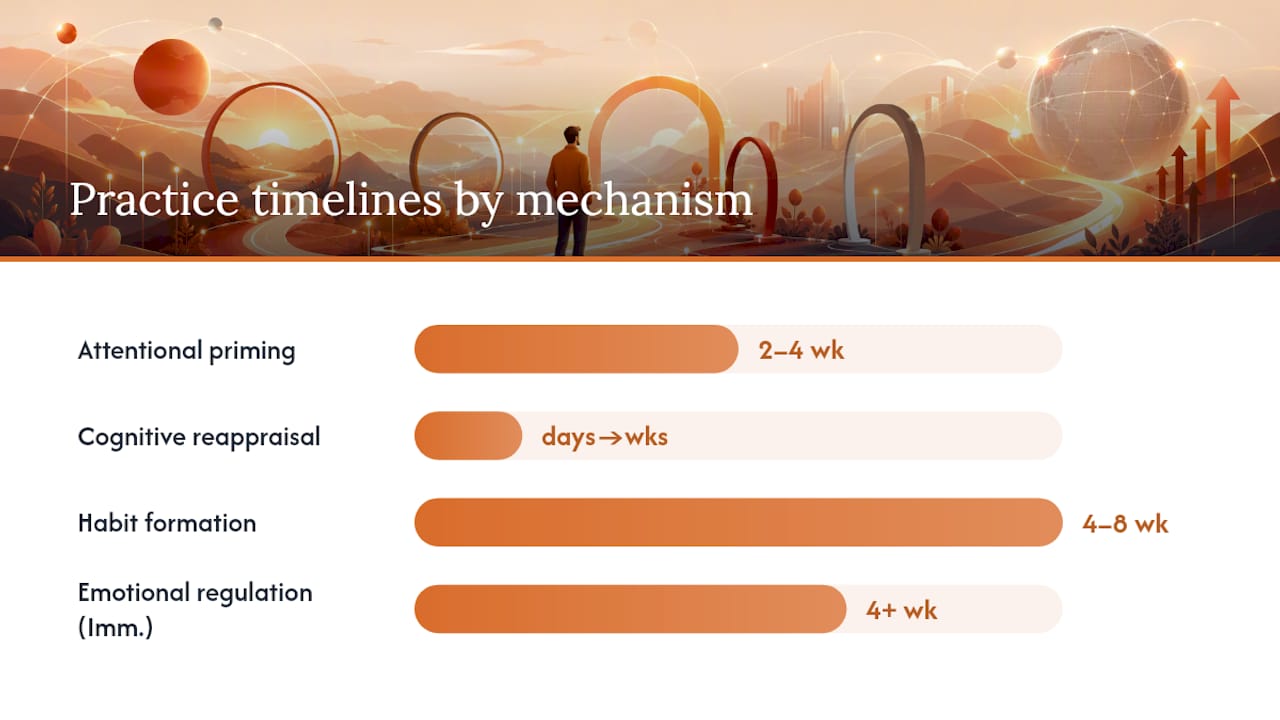
Effect sizes vary by person and consistency. These are directional estimates based on the psychological literature, not guarantees.
Common obstacles and how to get past them
Shifting from scarcity to abundance is not linear. Here are the most common places people stall, and what to do about each.
-
Survival physiology takes over. When stress is acute, a job loss, a health scare, a relationship crisis, the nervous system defaults to threat mode and the practices feel impossible. This isn’t failure; it’s biology. The fix is the 60-second grounding routine from the section above, used as a circuit breaker before attempting any reframe.
-
Your social environment reinforces scarcity. If everyone around you operates from a zero-sum worldview, abundance thinking feels delusional. You don’t need to lecture anyone. Just reduce exposure and increase time with people who demonstrate the mindset you’re building.
-
Comparison collapses progress. Social media comparison is a scarcity machine. Someone else’s highlight reel triggers the “not enough” script almost automatically. The counter-move: when you notice comparison happening, ask “What does their success tell me is possible?” instead of “Why not me?”
-
Ingrained limiting beliefs resist reframing. Some scarcity patterns run deep, childhood poverty, repeated professional failure, chronic rejection. These don’t dissolve in a week. They need patient, repeated exposure to counter-evidence. The win log is specifically designed for this: 30 days of small wins builds a factual case against the belief that things never work out.
-
Toxic positivity masquerades as abundance. Forcing yourself to feel grateful when you’re genuinely struggling doesn’t work and often backfires. An abundance mindset is not naive optimism, it’s emotional stability under uncertainty, not the performance of happiness. If a practice feels hollow, scale it back to something smaller and more honest.
Pro Tip: Momentum and relapse look similar from the inside. If you miss three days of journaling and feel like you’ve “lost it,” check your win log. If there’s evidence of small shifts over the past two weeks, you haven’t relapsed, you’ve just had a rough patch. Re-anchor by doing the simplest practice you have (the 60-second noticing exercise) and build back from there.
A 30-day plan to shift your mindset
Change is gradual and trackable. This schedule turns the practices above into a daily structure with weekly milestones. Behavioral change research supports small, consistent practices with regular reflection as the most reliable path to lasting mindset shifts.
| Week | Primary focus | Daily micro-practice |
|---|---|---|
| Week 1 | Noticing | 60-second noticing exercise + one curiosity question |
| Week 2 | Reframing | Catch one scarcity thought daily and restate it as a question |
| Week 3 | Building practices | Full morning routine (gratitude journal + affirmation with evidence) |
| Week 4 | Generosity and scale | One act of micro-generosity daily + weekly resource inventory review |
Week-by-week checklist:
- Week 1, Notice: Do the 60-second noticing exercise every morning. Write down one thing you usually overlook. No journaling required yet, just observation.
- Week 2, Reframe: Add the scarcity-thought catch. Every time you hear yourself say “I can’t” or “there’s not enough,” write the thought down and restate it as a question.
- Week 3, Build: Add the full morning routine (five minutes: gratitude journal, curiosity question, affirmation with evidence). Start the 24-hour win log each evening.
- Week 4, Scale: Add one daily act of micro-generosity. Review your win log at the end of the week and identify three patterns of progress.
Weekly reflection questions:
- What scarcity thought came up most this week?
- What did I notice that I would have missed a week ago?
- Where did I act from abundance, even briefly?
A perspective on what actually changes
Most people approach mindset work looking for a feeling, they want to feel abundant. That’s the wrong target. What actually shifts first is behavior, not feeling. You start asking different questions before you start feeling different. You act generously before generosity feels natural. The feeling follows the behavior, usually by several weeks.
The research on cognitive reappraisal and habit formation supports this sequence. You don’t wait until you believe something to act on it; you act on it until the belief catches up. That’s why the practices in this article are behavioral first, journaling, noticing, asking questions, doing micro-risk experiments, rather than purely attitudinal.
The other thing most abundance content gets wrong: it treats scarcity as a character flaw. It isn’t. Scarcity thinking is a survival adaptation. It kept your ancestors alive. The goal isn’t to shame yourself out of it; it’s to build a parallel track that your brain can choose when the situation doesn’t actually require survival mode. That track gets stronger every time you use it.
Twenty years of working at the intersection of psychology, personal transformation, and the principles that figures like Napoleon Hill spent lifetimes documenting has made one thing clear: the people who sustain abundance thinking long-term are not the ones who feel the most motivated. They’re the ones who built the smallest, most consistent daily practices and kept them running through the hard weeks.
Guided support from Livethelifeofyourdreams
The free practices in this article work. But structured, guided support accelerates the process significantly, especially for readers who’ve tried journaling and affirmations before without lasting results.

Livethelifeofyourdreams offers digital courses and downloadable resources that go beyond what a single article can provide: guided meditations designed to interrupt scarcity conditioning at the subconscious level, downloadable journaling programs with daily prompts built around the 30-day framework above, and a structured curriculum that blends Kabbalah and Law of Attraction principles with peer-reviewed psychology. The courses are built specifically for people who want evidence-informed methods, not generic motivation. If you’re ready for a structured path rather than a self-directed one, start with the full program at Livethelifeofyourdreams and see which resource fits where you are right now.
Sources
- Abundance Mindset: 5 Ways to Develop an Abundance Mindset – 2026 – MasterClass
- The remarkable advantage of abundant thinking
- Scarcity vs. Abundance Mindset: The Apple IPO Lesson | SUCCESS
- How To Develop An Abundance Mindset And Break Free From Scarcity – BetterUp
- How to develop an abundance mindset: 8 tips to help you thrive, Calm Blog
Frequently asked questions
What is an abundance mindset in simple terms?
The working assumption that possibilities outnumber obstacles: other people’s wins do not shrink your share, skills can grow, and enough is achievable. It changes decisions long before it changes bank balances.
Is an abundance mindset just positive thinking?
No, and this guide is clear about the difference. Positivity ignores problems; abundance thinking sees problems clearly while assuming resources and options exist to meet them.
How long does the shift take?
Weeks of daily practice for the first reliable changes. Gratitude, generosity, and evidence-logging are the three steps that do the heaviest lifting.
Keep exploring
- Manifest Money: Practical Rituals and an Action Plan
- Andrew Carnegie’s Wealth Secrets for an Abundance Mindset
- Wealth Psychology: The Evidence-Based Manifester’s Guide
- Gratitude and Abundance: The Evidence Behind the Practice
- Stop Sabotaging Wins: An 8 Week Plan to Beat the Upper Limit Problem
- How To Attract Money + Abundance Into Your Life: The Complete Scientific & Spiritual Guide That Actually Works