Gratitude reliably shifts what you pay attention to and how you behave, and that shift is what actually produces “abundance.” Not a check in the mail, not a stranger handing you a windfall: a documented change in perception and habit that makes you more likely to notice opportunities, act on them, and feel better while you do. “Attracting” abundance, in the version grounded in research, means training your attention and your behavior, not casting a wish into the universe.
Here’s where to start today:
- Pick one gratitude practice (journaling or a spoken thank-you) and do it for five minutes.
- Skip to the 30-day starter plan below if you want the full sequence.
Key Takeaways
Gratitude practiced consistently trains attention and behavior toward existing resources and opportunities, producing modest but real, measurable gains in well-being rather than guaranteed material outcomes.
| Point | Details |
|---|---|
| Evidence is real but modest | Gratitude interventions produce small-to-moderate gains in life satisfaction and reductions in anxiety and depression symptoms. |
| Expression beats introspection | Telling someone you’re grateful produces stronger benefits than private journaling alone. |
| Language shapes mindset | Swapping “I have to” for “I get to” reduces scarcity framing and increases a sense of agency. |
| Culture and background matter | Practice type and effect size vary by country and by prior experience of financial scarcity. |
| Livethelifeofyourdreams builds the habit | Its courses turn these research-backed practices into a structured daily sequence, blending Kabbalah and Law of Attraction with neuroscience findings. |
Table of Contents
- What Does the Research Say About Gratitude and Abundance?
- What Gratitude Practices Actually Work?
- How Does Gratitude Actually Build an Abundance Mindset?
- A 30-Day Plan to Build Gratitude Into an Abundance Habit
- Who’s Behind This Guide?
- Does Where You Grow Up Change How Abundance Feels?
- What Happens If You Keep This Up for Years, Not Weeks?
- Have Real People Built Abundance This Way?
- What Actually Moves the Needle Here
- Where Livethelifeofyourdreams Fits Into This
- Sources
- FAQ
What Does the Research Say About Gratitude and Abundance?
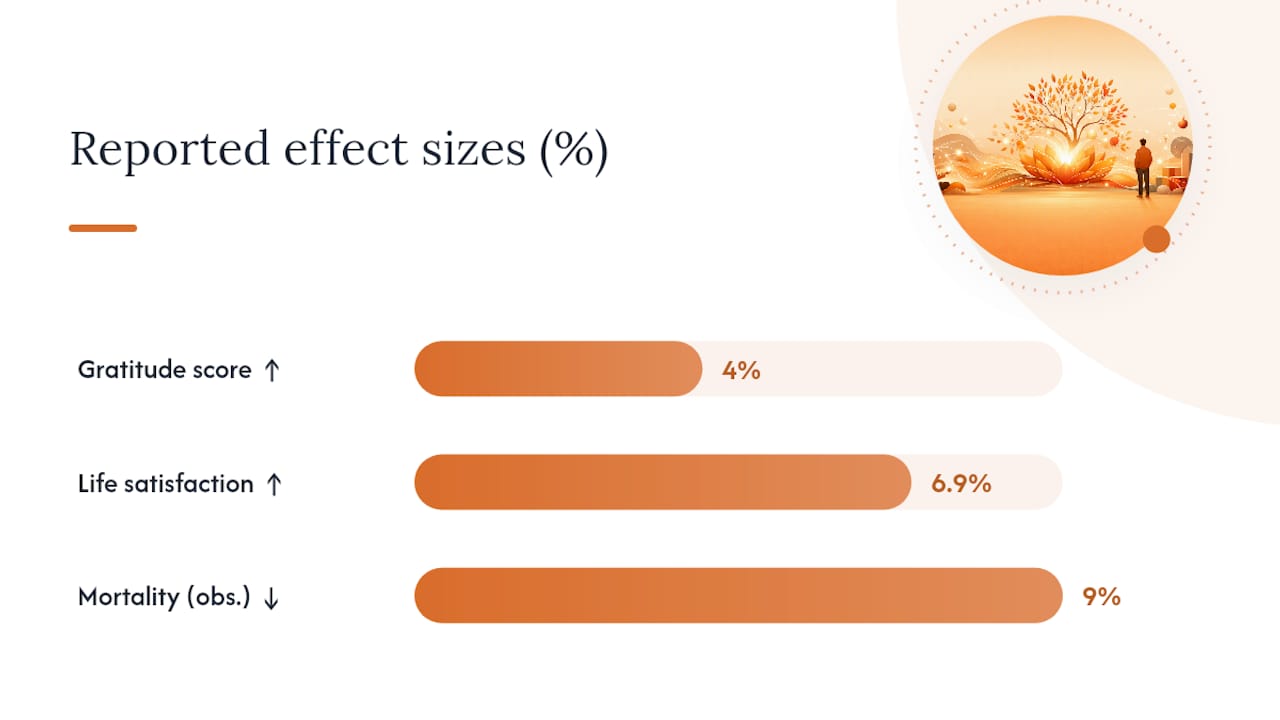
The strongest evidence comes from a meta-analysis of 64 randomized controlled trials, which found gratitude interventions produced roughly 4% higher gratitude scores and about 6.9% higher life satisfaction, alongside measurable reductions in anxiety and depression symptoms. The certainty behind some of those outcomes was rated low to very low, which matters. Gratitude journaling is not a substitute for therapy or medication. It is a real, replicated, but modest effect.
The core finding: small, consistent gains, not dramatic transformation. That is the honest headline, and it’s a better foundation for a lasting practice than an inflated one.
A few other data points worth knowing:
- The Nurses’ Health Study found that people in the highest third of gratitude scores had roughly a 9% lower mortality risk over four years than those scoring lowest. This is observational data, so it shows association, not proof that gratitude itself extends life.
- Grateful people in that study also reported more physical activity and better sleep, which likely explains part of the mortality link.
- A neuroscience study on amygdala-putamen connectivity found that this specific brain pathway partly mediates the relationship between trait gratitude and positive affect, giving the “gratitude changes your brain” claim an actual mechanism instead of a slogan.
Put together, the evidence supports gratitude as a low-cost complement to other well-being strategies, not a stand-alone cure. That framing matters more than any single statistic here.
What Gratitude Practices Actually Work?
Four practices show up again and again in the research, and each one takes minutes, not hours.
- Daily gratitude journaling. Write three things you’re grateful for each morning or night. Keep it specific: “my neighbor drove me to the airport” beats “my friends.” A one-line version works fine if five minutes feels like too much some days.
- Expressed gratitude. Write a letter, send a text, or say thanks out loud to someone who helped you. Research on expressed versus internal gratitude found that telling someone produces stronger psychological benefits than simply feeling grateful privately. This is the practice most people skip, and it’s probably the one doing the most work.
- Savoring. Pause on a good moment, an unusually good coffee, a compliment, sunlight through a window, and stay with it for ten seconds instead of moving straight to the next task. Savoring trains the same attentional muscle as journaling, just in real time.
- Language reframing. Swap “I have to” for “I get to.” “I get to go to work” instead of “I have to go to work” sounds small, but it changes the frame from obligation to choice, and that shift chips away at scarcity conditioning, the background belief that there’s never enough time, money, or opportunity.
Pro Tip: Pair a gratitude practice with an existing habit, like brushing your teeth or brewing coffee. Habit stacking is why some people journal for years and others quit after a week; the cue does the remembering so you don’t have to.
None of these need to happen in isolation. Journaling about a moment you savored, then telling the person involved, compounds the benefit and creates a small feedback loop: you notice something good, you name it, someone else feels good, and you’re more inclined to notice the next good thing. That loop is the mechanical core of what people mean when they talk about gratitude and abundance working together.

How Does Gratitude Actually Build an Abundance Mindset?
Gratitude works on three levers: attention, motivation, and behavior. Attention comes first. Practicing gratitude trains you to scan for what’s already working instead of defaulting to what’s missing, which is the literal opposite of scarcity thinking. That’s not a metaphor; it’s a shift in what your brain treats as noteworthy.
Motivation follows attention. People who score higher on gratitude measures tend to report more health-promoting behaviors, better sleep, more physical activity, more follow-through on goals, according to the same Nurses’ Health Study data referenced above. Feeling like you already have something worth protecting or building on tends to motivate action more than fixating on a deficit does.
Language does the connecting work between the two. Replacing “I have to” with “I get to” is a small edit with an outsized effect, because it reduces the subconscious framing of scarcity and reframes daily tasks as access rather than burden.
Three traps to watch for:
- Toxic positivity. Gratitude is not a demand to feel fine about a genuinely bad situation. Naming a real problem and being grateful for something unrelated can coexist.
- Comparison traps. Gratitude aimed at “at least I’m better off than X” curdles into resentment or guilt fast. Keep it about your own experience.
- Spiritual bypassing. Using gratitude language to avoid addressing a fixable problem, a bad job, a toxic relationship, isn’t gratitude. It’s avoidance wearing gratitude’s clothes.
A 30-Day Plan to Build Gratitude Into an Abundance Habit
Four weeks, one new layer each week, building instead of replacing.
- Week 1: Notice. Journal three specific things you’re grateful for each day, five minutes, morning or night.
- Week 2: Express. Keep journaling, and add one gratitude letter plus two spoken thank-yous during the week. Say it out loud, don’t just think it.
- Week 3: Savor and reframe. Add a daily ten-second savoring pause, and swap “I have to” for “I get to” at least three times a day, out loud or in your head.
- Week 4: Act and review. Pair one gratitude moment each day with a small step toward a goal you care about. On the weekend, spend ten minutes reviewing what shifted, mood, sleep, how you talked to yourself, what you noticed that you’d have missed a month ago.
| Week | Focus | Time Commitment |
|---|---|---|
| 1 | Daily journaling | five minutes |
| 2 | Expressed gratitude | five minutes + 3 expressions/week |
| 3 | Savoring and language reframe | five minutes + ongoing reframes |
| 4 | Action pairing and review | five minutes + 10-minute weekend review |
Who’s Behind This Guide?
Elvis D. Beuses spent more than 20 years in the medical and pharmaceutical field before rebuilding his life after divorce, job loss, and a near-deportation, an experience that shaped his interest in the psychology of scarcity and reinvention.
- He wrote the international bestseller Cómo Vencer el Miedo, addressing fear and subconscious reprogramming directly.
- His work reaches a 240,000-subscriber YouTube audience built on personal testimonials rather than abstract theory.
- Livethelifeofyourdreams’s approach deliberately pairs Kabbalah and Law of Attraction principles with peer-reviewed psychology and neuroscience research, rather than treating either tradition as sufficient on its own.
Does Where You Grow Up Change How Abundance Feels?
Culture and income shape which gratitude practices land and how “abundance” gets defined in the first place. A 34-country study of gratitude interventions found that gratitude practices reliably increased positive affect and life satisfaction across cultures, but effect sizes varied substantially. Writing a full gratitude letter produced bigger shifts than simply listing blessings in some countries, and the reverse was true elsewhere.
Socioeconomic background plays a similar role. Someone who grew up watching every dollar stretched thin is likely to hear “practice abundance” differently than someone raised without that pressure, and that’s not a flaw in the practice, it’s a reason to adapt it. Scarcity conditioning, the deep, often unconscious belief that resources are perpetually insufficient, tends to run stronger in people who experienced real material scarcity, and gratitude work aimed at that group needs to acknowledge the real constraint rather than talk past it.
This is also where “abundance” as a word gets misread. It doesn’t mean pretending your bank balance is fine when it isn’t. It means noticing the resources, relationships, and options that already exist alongside the real limits, and making decisions from that fuller picture instead of a scarcity-only one. Practically, that means the version of gratitude journaling useful to a reader managing genuine financial stress will look different from the version useful to someone comfortable but chronically dissatisfied, more focused on agency and specific wins, less on generic positivity.
What Happens If You Keep This Up for Years, Not Weeks?
The clearest long-term signal is the mortality data: people in the highest gratitude tertile in the Nurses’ Health Study had roughly a 9% lower risk of dying over the four-year follow-up period than those in the lowest tertile, tracking with better sleep and more physical activity. Correlation, not causation, but a durable one across a large sample.
On the mental health side, the meta-analysis of gratitude interventions found sustained reductions in anxiety and depression symptoms across studies, not just an immediate mood bump that fades. That distinction, temporary boost versus lasting shift, is exactly what separates a gratitude practice from a placebo.
The behavioral compounding matters just as much as the biological data. A grateful disposition correlates with a measurable neural pathway tied to positive affect, meaning the reward circuitry itself appears to shift with sustained practice. In plain terms: things that used to feel neutral start to feel rewarding, a morning walk, a conversation, finishing a task, and that changed reward sensitivity is arguably the real mechanism behind people who describe “attracting” more good things into their life. They’re not attracting more events. They’re registering more of the ones already happening, and that registration changes what they do next.
None of this happens on a two-week timeline. The effect sizes in the research are modest by design, small-to-moderate gains repeated consistently. The payoff is in the compounding, not the spike.
Have Real People Built Abundance This Way?
The British Psychological Society’s coverage of gratitude research points to gratitude interventions supporting a wide range of health-promoting behaviors across different populations, not a narrow demographic. That breadth matters, because it means the practice isn’t just useful for people already inclined toward journaling and self-reflection.
The clearest pattern across the research is behavioral, not anecdotal: people who pair gratitude with a specific cue and a small, repeatable action show far higher adherence than those told to simply “have a grateful mindset.” A cue-practice-reward loop, gratitude tied to your morning coffee, to a Sunday phone call, to closing your laptop for the day, sticks in a way that vague intention never does. That’s consistent with what the multinational study across 34 countries found: structured practices with a clear format, a letter, a specific list, a savoring pause, outperformed loose, undefined “be more grateful” advice.
Groups that build gratitude into shared rituals tend to see it stick longest. Families that share one good thing from the day at dinner, teams that open meetings with a quick round of acknowledgment, communities with a regular thank-you tradition: the mechanism is the same cue-practice-reward loop, just distributed across more people reinforcing each other. The individual practice works. The shared version tends to survive longer.
What Actually Moves the Needle Here
Most gratitude content treats it as a mood fix: feel bad, list three things, feel slightly better, repeat. That’s not wrong, but it undersells what the research actually shows. The meta-analysis, the amygdala-putamen findings, and the 34-country study all point toward gratitude as an attention and behavior lever, not a feelings exercise.
The conventional advice fails in one specific way: it treats gratitude as universal, one journal format, applied identically to everyone, forever. The evidence says the opposite. Expressed gratitude beats private gratitude for most people. Some cultures respond better to letters, others to simple lists. Someone carrying real financial scarcity needs a different entry point than someone who is comfortable but restless.
If I had to pick the one thing readers should prioritize first, it’s expression over introspection. Telling someone you’re grateful, out loud, in writing, does more measurable work than another private list ever will. Start there, then build the rest of the habit around it.
Where Livethelifeofyourdreams Fits Into This
Reading about gratitude interventions is one thing. Building a daily practice that actually reprograms scarcity conditioning over months, not days, is another. Livethelifeofyourdreams was built for that gap: structured courses and downloadable tools, guided meditations, affirmation sets, ritual frameworks, that translate the research above into a daily sequence instead of leaving you to design one from scratch.

What makes this approach different from a generic affirmations app is the blend behind it: Kabbalah and Law of Attraction principles paired with the same evidence base covered in this guide, not mysticism offered on its own terms. If you’ve tried journaling or visualization before and felt like it fizzled out after a week, that’s usually a structure problem, not a you problem, and it’s exactly what a cue-practice-reward framework is built to fix. Visit the Livethelifeofyourdreams homepage to see the current course lineup and find the starting point that matches where your gratitude practice stands today.
Sources
- The effects of gratitude interventions: a systematic review and meta-analysis – PMC
- Gratitude enhances health, brings happiness – and may even lengthen lives – Harvard Health
- Amygdala-putamen connectivity links gratitude to greater well-being – PMC
- A multinational megastudy of the effects of gratitude practices on subjective well-being
FAQ
What Is Gratitude and Abundance?
Gratitude and abundance describes the practice of noticing what you already have as a way to shift attention and behavior toward opportunity, rather than a promise that gratitude alone produces wealth or material gain.
Does Gratitude Actually Attract Abundance?
Gratitude doesn’t attract events by itself, but it reliably changes what you notice and how you act, which the meta-analysis of gratitude interventions links to measurable gains in life satisfaction and reduced anxiety and depression symptoms.
What’s the Core Principle Behind Gratitude Practice?
The consistent theme across the research is that expressed gratitude, telling someone rather than just feeling it privately, produces stronger benefits, and that pairing a specific cue with a small daily practice builds a habit that sticks.
What Did Marcus Aurelius Say About Gratitude?
Marcus Aurelius wrote in Meditations about waking each day grateful for the ability to think, work, and act, framing gratitude as a discipline for facing difficulty rather than a reaction to good fortune. That Stoic framing lines up with the modern research: gratitude as a trainable habit, not a dependent emotion.
How Long Does It Take to See Results From a Gratitude Practice?
Studies included in the meta-analysis show measurable shifts within weeks of consistent practice, though effect sizes are modest and tend to build with sustained repetition rather than a single session.
More to explore
- 15 Money Mindset Shifts That Turned Broke Beginners Into Abundance Magnets
- New Law of Attraction Books You Must Read to Attract Abundance
- How To Attract Money + Abundance Into Your Life: The Complete Scientific & Spiritual Guide That Actually Works
- Morning Routine for Abundance: Templates and Scripts
- Money Meditation: 3-Minute Practice + Full Guided Script
- How To Reframe Limiting Beliefs from Scarcity to Abundance