
A money meditation is a short, focused practice that uses breath, visualization, and affirmations to redirect your attention away from scarcity and toward financial possibility. It doesn’t conjure cash from thin air. What it does is train your mind to notice opportunities, loosen the grip of fear-based money habits, and make intentional choices rather than reactive ones. Meditation can make unconscious financial habits conscious and put you back in the driver’s seat.
Start here: your 3-minute money meditation
Sit comfortably, close your eyes, and take three slow breaths. On each exhale, let your shoulders drop. Now picture your bank account showing a number that genuinely excites you. Hold that image for 30 seconds. Feel what it’s like in your body: the ease, the relief, the quiet confidence. Silently repeat: “Money flows to me naturally and consistently.” Stay with that feeling for another 60 seconds. Take one more deep breath, open your eyes, and write down one financial action you’ll take today, however small.
Do this every morning for seven days. The full 8–12 minute guided script later in this article deepens the same practice.
Pro Tip: Set a recurring 7 AM phone alarm labeled “3-min money practice.” The label itself becomes a cue that primes your mindset before the day’s noise takes over.
Key Takeaways
A daily money meditation practice produces lasting mindset shifts only when paired with consistent, concrete financial action.
| Point | Details |
|---|---|
| Start with 3–5 minutes daily | A short morning session builds the habit faster than infrequent long sessions; as your habit strengthens, add two 10–15 minute sessions per week and one 20–30 minute monthly session to review financial goals. |
| Pair every session with action | Write one financial task after each practice to tie intention to behavior. |
| Affirmations need to feel true | Soften resistance by moving from bold claims to open, possibility-based phrasing. |
| Realistic timeline | Mindset shifts typically emerge in weeks 3–8; material results follow behavioral change. |
| Livethelifeofyourdreams | Offers guided meditations and courses that blend spiritual tradition with neuroscience for lasting results. |
Table of Contents
- How do you practice money meditation step by step?
- Full sample guided money meditation script (8–12 minutes)
- What are the most effective money affirmations and how do you use them?
- Which manifesting methods actually work, and how do you use them?
- How often should you practice, and when will you see results?
- What mindset traps undermine a money meditation practice?
- Why does money meditation change habits? The science and the people behind it
- Why this approach to money meditation is the one that actually sticks
- Deepen your practice with Livethelifeofyourdreams
- Sources
How do you practice money meditation step by step?
The setup matters more than most guides admit. A distracted environment produces a distracted practice. Get the conditions right once, and the habit builds itself.
- Choose your time. Morning, before checking your phone, is the most effective window. Your brain is in a lighter, more receptive state right after waking, and you haven’t yet loaded it with the day’s problems.
- Set your space. Sit upright in a chair or cross-legged on the floor. Lying down works if you’re confident you won’t fall asleep. Dim the lights or face a window. Silence notifications.
- Anchor with breath. Inhale for a count of four, hold for four, exhale for six. Repeat this four times. The extended exhale activates your parasympathetic nervous system, which is the state where visualization lands deepest.
- Choose a visual anchor. A close, mindful look at a single dollar bill can reveal surprising emotional and cultural associations you carry about money. Try holding one in your hands before closing your eyes. Notice any tension, any story that surfaces.
- Move into visualization. Picture a specific, vivid scene: you at a desk reviewing a bank statement that reflects your goal, or handing a check to a cause you care about because you can. Specificity is what makes the image feel real rather than abstract.
- Add an affirmation. Choose one short phrase and repeat it silently five times while holding the image. Examples: “I am financially free,” or “I attract income from multiple sources.”
- Close and act. Before you stand up, write one concrete financial action in a notebook. Pay one bill. Send one email. Move $10 to savings. The action anchors the intention.
Practice schedule: Daily micro-sessions of 3–5 minutes build the habit. Once the habit is solid, extend two sessions per week to 10–15 minutes for deeper work. One longer session per month, 20–30 minutes, is useful for reviewing your financial goals and resetting your visualization targets.
Pro Tip: Pair the closing journaling step with a specific financial task you’ve been avoiding. The calm state from meditation lowers the emotional charge around money tasks, making it easier to actually open the bill or make the call.
Full sample guided money meditation script (8–12 minutes)
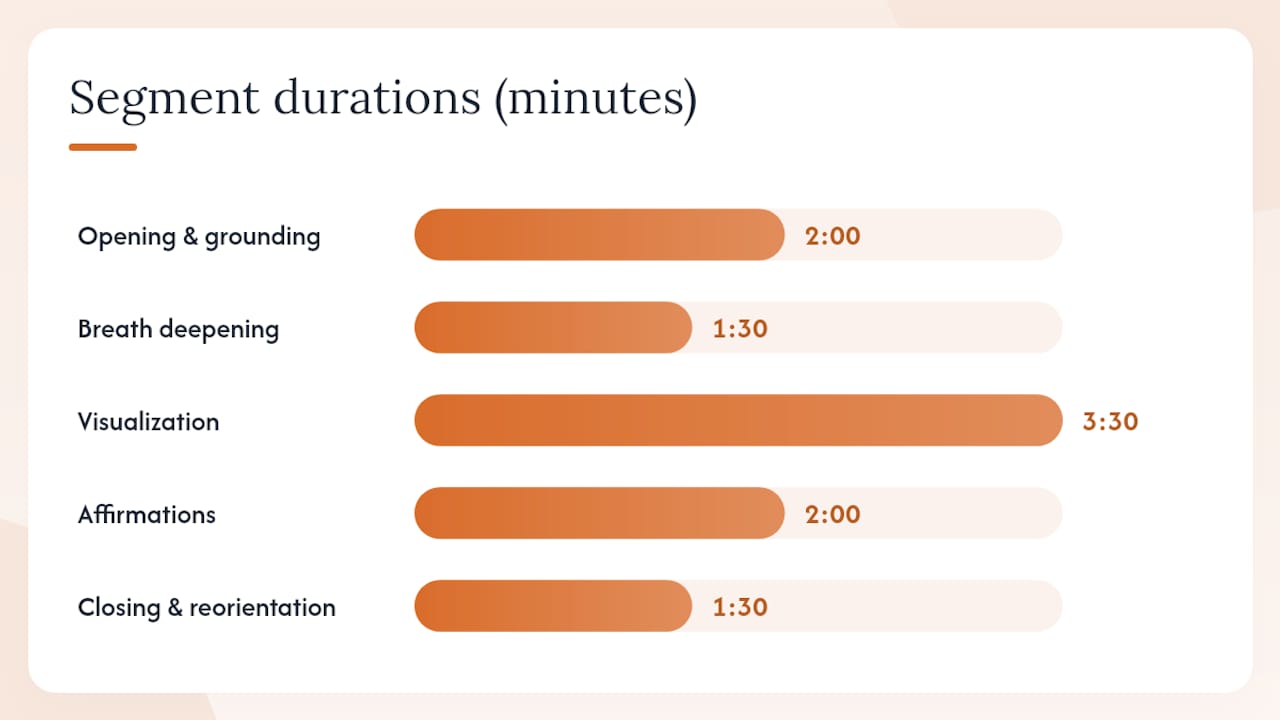
Record this at a slow, deliberate pace. Leave two to three seconds of silence after each ellipsis. A soft instrumental background (binaural beats in the theta range, or simple piano) helps, but silence works too. The full read at a calm pace runs roughly 10 minutes.
Opening and grounding (0:00–2:00)
- Find a comfortable position and gently close your eyes.
- Take a deep breath in through your nose… and release slowly through your mouth.
- Again: breathe in… and out. Let your body settle into the surface beneath you.
- Feel the weight of your hands on your legs. Feel your feet on the floor.
- With each exhale, release any tension you’ve been carrying today.
Breath deepening (2:00–3:30)
- Inhale for four counts: one, two, three, four.
- Hold for four: one, two, three, four.
- Exhale for six: one, two, three, four, five, six.
- Repeat this cycle three more times at your own pace.
- You are safe. You are present. You are open.
Visualization: your abundant future (3:30–7:00)
- Imagine yourself one year from now, in a version of your life where money is no longer a source of stress.
- Picture the room you’re in. What does it look like? What do you see out the window?
- You open your laptop and check your accounts. The numbers reflect your work, your worth, your choices.
- Feel the ease in your chest. Not arrogance. Just quiet confidence.
- Money comes to you through your skills, your creativity, your relationships. It flows in regularly and consistently.
- See yourself giving generously: to your family, to causes you believe in, to your own growth.
- Stay in this scene. Breathe it in. Let it feel real, because your mind doesn’t fully distinguish between a vivid image and lived experience.
Guided imagery used this way makes a future possibility feel real, which is exactly why it motivates behavior change rather than just pleasant daydreaming.
Affirmations (7:00–9:00)
Repeat each phrase silently or aloud, slowly:
- I am worthy of financial abundance.
- Money flows to me easily and often.
- I make wise decisions with my finances.
- I am open to new and unexpected income.
- I am grateful for everything I have and everything that is coming.
Closing and reorientation (9:00–10:30)
- Take one more deep breath in… and release.
- Begin to bring gentle awareness back to the room around you.
- Wiggle your fingers and toes.
- When you’re ready, open your eyes slowly.
- Before you move, write down one word that captures how you feel right now. Then write one financial action you’ll take before noon.
What are the most effective money affirmations and how do you use them?
Abundance meditations that combine visualization with short, specific affirmations and daily repetition consistently show up as the most practical format for shifting mindset over time. The affirmations below are written in the present tense and kept short so they’re easy to hold in mind during practice.
30 money and abundance affirmations:
- I am financially free.
- Money is a tool I use with intention.
- I attract wealth through my skills and creativity.
- I deserve to be well compensated for my work.
- My income grows steadily every month.
- I am open to receiving money from unexpected sources.
- I release all fear around money.
- I manage my finances with clarity and confidence.
- Abundance is my natural state.
- I am grateful for every dollar I earn and spend.
- I make smart, calm decisions about money.
- My relationship with money is healthy and positive.
- I attract opportunities that create financial growth.
- I am worthy of a life of financial ease.
- Money comes to me in increasing amounts.
- I give and receive money freely and joyfully.
- I trust myself to build lasting wealth.
- Financial security is available to me.
- I notice and act on income opportunities.
- My mindset around money is expanding every day.
- I am becoming more financially confident.
- I have more than enough.
- Wealth flows to me from multiple directions.
- I am aligned with the energy of abundance.
- I choose prosperity over scarcity.
- I am a good steward of money.
- Every day I move closer to my financial goals.
- I am open to new income streams.
- I release inherited beliefs about money that no longer serve me.
- I am building a financially free future, one decision at a time.
How to use them effectively:
If “I am wealthy” creates internal resistance (a quiet voice saying “No you’re not”), soften the phrasing. Move from “I am wealthy” to “I am open to new income opportunities.” That small shift reduces the gap between where you are and where you’re going, which makes the affirmation land rather than bounce off.
Three practical formats work best: repeating five affirmations aloud during your morning practice, writing three in a journal each evening, and recording yourself saying ten of them and playing the audio during a commute or walk.
Pro Tip: After stating an affirmation, take one tiny financial action that matches it. Said “I notice income opportunities”? Spend two minutes brainstorming one new service you could offer or one person you could follow up with. The action makes the affirmation a rehearsal, not just a wish.
Which manifesting methods actually work, and how do you use them?
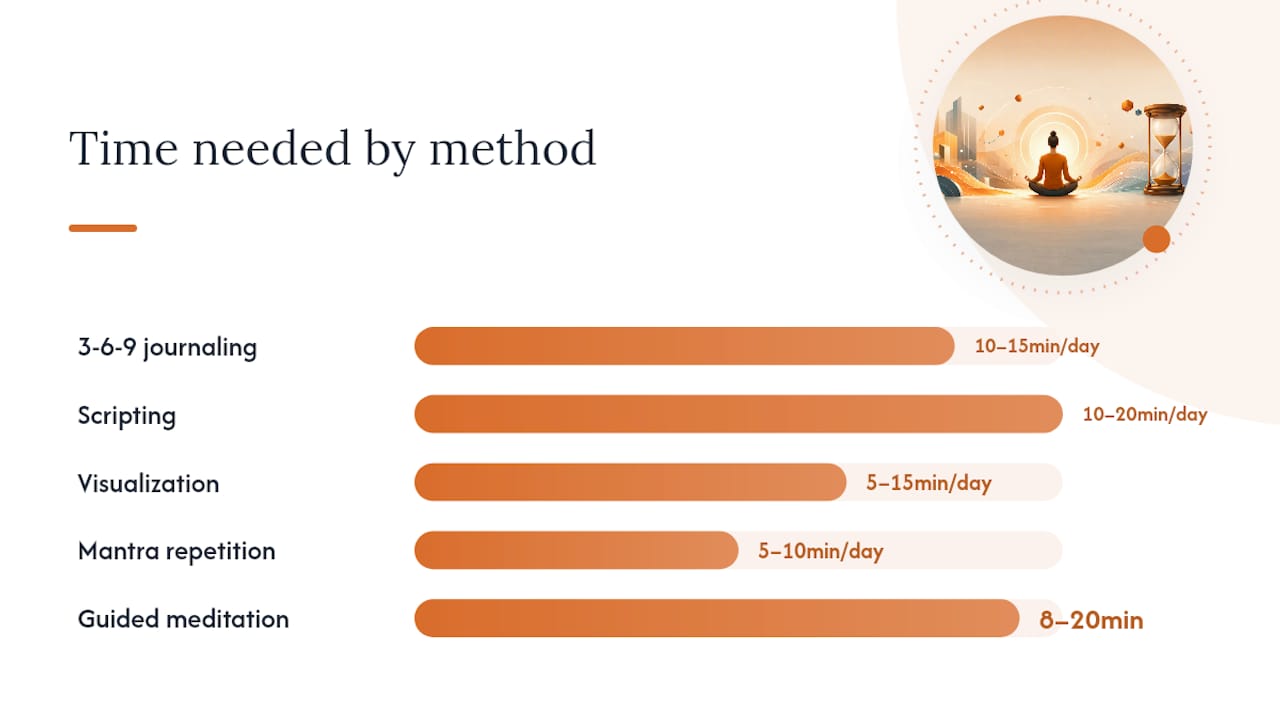
Several popular methods circulate in the manifesting space. Here’s what each one is, how to use it, and where the evidence gets thin.
The 3-6-9 method: Write your financial intention three times in the morning, six times in the afternoon, and nine times at night. The repetition builds focus and keeps your goal present throughout the day. It’s a journaling practice, not a ritual with mystical numerical power. The value is in the daily written reinforcement, not the specific counts. If the counting becomes obsessive or stressful, drop it and just write your intention once a day.
Scripting: Write a journal entry as if you’re living your desired financial reality right now. “Today I received a call about a new consulting project…” Write in past or present tense, with sensory detail. This is a structured form of guided imagery that makes future possibilities feel real and primes your attention to notice relevant opportunities.
Visualization: The core of most prosperity meditation practices. You hold a vivid mental image of your financial goal and feel the associated emotions. Abundance meditation techniques combine breath, visualization, mantras, and gratitude to shift attention and mindset. The key is specificity: a vague “more money” image is far less effective than a clear scene with sensory detail.
Mantra practice: Repeating a short phrase or traditional sound during meditation. Mantra-based abundance practices like the Shreem mantra come from Vedic tradition and are used to cultivate a felt sense of abundance through repetition. Many guided abundance meditations on mainstream platforms use “Shreem” and recommend daily repetition for integration. You don’t need to adopt a Sanskrit mantra; a simple English phrase like “I receive” works the same way mechanically.
On frequency claims: You’ll see references to specific sound frequencies (528 Hz, 432 Hz) that supposedly attract money or reprogram the subconscious. The honest framing: these are audio environments that some people find conducive to relaxed focus. There’s no peer-reviewed evidence that a specific Hz value attracts wealth. Use them if the sound helps you relax and concentrate. Don’t rely on them as the mechanism.
| Method | Time needed | Focus style | Best for |
|---|---|---|---|
| 3-6-9 journaling | 10–15 min/day | Verbal, written | People who think through writing |
| Scripting | 10–20 min/day | Verbal, narrative | Creative thinkers, detail-oriented |
| Visualization | 5–15 min/day | Visual, sensory | Those who think in images |
| Mantra repetition | 5–10 min/day | Auditory, body | People who respond to rhythm and sound |
| Guided meditation | 8–20 min/session | Mixed (audio-led) | Beginners and those who need structure |
How often should you practice, and when will you see results?
Realistic expectations matter here.
, and while some people notice a mindset shift quickly, material financial results take longer and require action alongside practice.
- Beginners (weeks 1–2): One 3–5 minute session daily. Focus on consistency over depth. The goal is building the habit, not achieving a breakthrough.
- Steady practice (weeks 3–8): Two longer sessions per week, 10–15 minutes each, alongside daily micro-sessions. Most people notice a shift in how they think and talk about money within this window. Anxiety around financial topics tends to soften.
- Deeper cycles (month 3 onward): One monthly 20–30 minute session to review goals and reset visualizations. Continue daily micro-sessions. Material results, meaning actual changes in income or savings, typically emerge here because the mindset shift has had time to influence behavior.
Simple financial actions to pair with practice:
- Review your budget for 10 minutes after your morning session.
- Send one professional follow-up email or pitch per week.
- Move a fixed small amount to savings the same day you meditate.
- Read one article about personal finance or investing each week.
Red flags that practice has become avoidance: You’re meditating daily but haven’t opened your bank app in two weeks. You’re scripting about wealth but haven’t applied for a single opportunity. You feel calm about money but your actual financial situation is worsening and you’re not addressing it. Meditation should lower the emotional charge around financial tasks, not replace them.
What mindset traps undermine a money meditation practice?
The practice itself is neutral. What you bring to it determines whether it helps or becomes another form of avoidance.
Ethical guidelines to keep in mind:
- Avoid framing your practice around taking from others or “attracting” outcomes that require someone else to lose.
- Be careful with language about deserving. “I deserve unlimited wealth” can slide into entitlement thinking that bypasses the work required. Prefer “I am building wealth through consistent effort and openness.”
- Respect others’ autonomy. Manifesting practices are personal. Don’t pressure others to adopt your beliefs about money or abundance.
Common mindset traps:
- Scarcity looping: You meditate, feel good, then immediately check social media and compare your finances to someone else’s highlight reel. The loop undoes the session. Protect the 10 minutes after practice from comparison triggers.
- Spiritual bypassing: Using meditation as a reason not to address real financial problems. If you owe money, have no emergency fund, or are avoiding a difficult financial conversation, meditation is a complement to addressing those things, not a substitute.
- Magical thinking: Believing that visualization alone will produce results without behavioral change. Combining visualization with a small, concrete financial action is what ties attention to behavior and produces real outcomes.
- Obsessive ritual: If missing a day of the 3-6-9 method creates significant anxiety, the practice has become a compulsion. Scale back to a simpler format.
When to seek professional support: A financial therapist or certified financial planner can address the structural and behavioral dimensions of money that meditation alone can’t reach. A therapist is appropriate if money anxiety is severe, persistent, or linked to trauma. These professionals complement the practice; they don’t replace it.
Why does money meditation change habits? The science and the people behind it
Visualization and repetition work because of how the brain allocates attention. When you repeatedly imagine a specific financial outcome with emotional engagement, you’re training your reticular activating system (RAS), the brain’s attention filter, to flag relevant opportunities and information in your environment. You don’t create money by thinking about it. You do start noticing pathways you were previously filtering out.
Habit formation research supports the cue-routine-reward loop: a consistent morning practice becomes a cue, the meditation is the routine, and the calm and clarity you feel afterward is the reward. Over time, the loop becomes automatic.
“Contemplative exercises on money help people notice bodily sensations and habitual responses to spending, enabling intentional change.” The practice makes the unconscious visible, which is the first step toward changing it.
This is the foundation of what Elvis D. Beuses built into the Livethelifeofyourdreams approach. With more than 20 years in medical and pharmaceutical fields, Elvis brings a research-grounded lens to practices that other guides treat as purely mystical. His international bestseller Cómo Vencer el Miedo and a YouTube channel with 240,000 subscribers reflect a community that responds to exactly this blend: spiritual tradition made credible by evidence. The Livethelifeofyourdreams courses and guided resources are built on the same principle: ancient tools like visualization and mantra, explained through the psychology and neuroscience of attention and habit.
Why this approach to money meditation is the one that actually sticks
Most money meditation guides give you a script and leave you there. What they skip is the part that makes the practice durable: pairing the internal shift with an external action, and understanding why the practice works so you don’t abandon it the first week nothing dramatic happens.
The blend of spiritual technique and evidence-informed rationale isn’t a marketing angle. It’s the reason the practice holds up under pressure. When you know that visualization trains your attention filter, you don’t need to believe in magic to keep showing up. And when you pair each session with one concrete financial step, you close the loop between intention and result.
Try the 3-minute practice from the opening of this article right now. Then come back and tell us what you noticed. The conversation in the comments is where the real learning happens.
Deepen your practice with Livethelifeofyourdreams
If the scripts and affirmations here resonated, the next step is a structured program that holds the practice together over weeks, not just a single session.

Livethelifeofyourdreams offers guided money meditations, downloadable affirmation libraries, and full digital courses that blend Kabbalah, Law of Attraction principles, and peer-reviewed psychology into a single, coherent system. The courses are built for people who’ve tried journaling and visualization before without lasting results, and who want a framework that explains why the practice works, not just what to do. Elvis D. Beuses’s rags-to-riches story, his medical background, and the community of practitioners behind the brand make this a credible next step rather than another generic program. Visit Livethelifeofyourdreams to explore the full course library and find the resource that fits where you are right now.
Sources
- Meditation on Money
- Meditation on Money, The Mindfulness Bell
- Youaligned
- Lakshmi Abundance Meditation & Mantra – Ally Boothroyd
- Abundance Guided Meditation for Joy, Good Health, Wealth & Prosperity – Golden Lotus Mala
- Abundance | Devi Brown
-
Recommended
Article generated by BabyLoveGrowth
Frequently asked questions
Does meditating on money actually help finances?
Indirectly but measurably: research on scarcity shows money worry consumes working memory, which causes worse financial decisions. Three minutes of calming practice returns some of that bandwidth.
When should I do the money meditation?
Before you look at your accounts, before a money conversation, or any time bill dread spikes. It is a before-tool, not an afterthought.
I fell asleep. Did it still work?
The relaxation still counts. For the visualization part, sit up next time and shorten the session rather than chasing a long one.
More to explore
- Think and Grow Rich Summary: 13 Principles Explained
- Andrew Carnegie’s Wealth Secrets for an Abundance Mindset
- Wealth Psychology: The Evidence-Based Manifester’s Guide
- Gratitude and Abundance: The Evidence Behind the Practice
- Scarcity Mindset: Why It Happens and How to Shift It
- Clear Money Blocks in 5 Steps, Evidence Based Not Just Affirmations
- 848 Angel Number Meaning: Love, Money & Twin Flame
- Manifestieren trotz innerer Zweifel gelingt so
- Neuroplastizität und persönliche Veränderung