
Wealth psychology, as used here, is the practice of combining subconscious reprogramming, scarcity-to-abundance mindset work, and neuroscience-aligned spiritual rituals to change how your brain perceives and pursues financial opportunity. Two actions you can start today: a 5-minute parasympathetic activation (slow diaphragmatic breathing or a body-scan meditation) and a short sufficiency journal entry noting three things you already have. James Doty’s neuroscience work at Stanford explains why these two steps matter: relaxation plus repetition is the mechanism that embeds new intentions into the subconscious. The APA’s coverage of scarcity research adds a practical reason to start there, building even a small buffer of time or calm reduces the “bandwidth tax” that keeps scarcity-conditioned brains locked in short-term survival mode. Elvis D. Beuses, founder of Livethelifeofyourdreams, built his entire curriculum around this pairing of evidence and practice.
Key Takeaways
Wealth psychology works when parasympathetic activation, repeated intention-setting, and identity reconstruction are practiced together consistently over 8–12 weeks.
| Point | Details |
|---|---|
| Start with two daily habits | A 5-minute breathing practice and a sufficiency journal entry are the highest-leverage entry points. |
| Scarcity impairs decisions neurally | Reduced dlPFC activity under scarcity drives short-term choices; building slack reverses this. |
| Belief alone is not enough | Manifestation belief predicts perceived success, not objective outcomes, pair it with measurable experiments. |
| Track slack first | If your time or financial buffer is growing, the bandwidth tax is lifting and better decisions follow. |
| Livethelifeofyourdreams | Offers a structured, evidence-aligned curriculum combining neuroscience, Kabbalah, and Law of Attraction for guided implementation. |
Table of Contents
- What does the neuroscience say about wealth psychology?
- Foundational principles of evidence-informed wealth psychology
- Your daily and weekly routine for the first 8–12 weeks
- How to reprogram scarcity conditioning step by step
- Common pitfalls and safety flags to watch for
- How to measure progress and track results
- When to get coaching or join a structured course
- Why blending science and spiritual practice works
- What Livethelifeofyourdreams offers readers ready to go deeper
- Sources
What does the neuroscience say about wealth psychology?
The core claim is straightforward: the brain can change, and deliberate practice is what changes it. Neuroplasticity, the brain’s ability to form new neural pathways through repeated experience, is the biological mechanism behind every manifestation protocol worth taking seriously. Doty’s work at Stanford describes a specific sequence: shift from sympathetic (stress) activation to parasympathetic (rest) activation, then introduce a clear intention repeatedly. That pairing is what allows the intention to move from conscious thought into the subconscious circuits that shape attention and behavior.
Parasympathetic activation does more than feel calming. It restores activity in the dorsolateral prefrontal cortex (dlPFC), the region responsible for goal-directed decision-making. An fMRI study on induced scarcity found that a scarcity mindset decreases dlPFC activity and increases orbitofrontal cortex (OFC) activity during financial choices, pushing the brain toward reactive, short-term decisions. That neural shift is the mechanism behind why people under financial stress make choices that deepen their financial stress.
Sabina Brennan and related reporting in New Scientist argue that visualization combined with disciplined action primes task-relevant brain networks, increasing the probability of noticing and acting on real opportunities. The word “disciplined” matters. A three-study series developing a Manifestation Scale A three-study series developing a Manifestation Scale found that manifestation belief correlates with higher perceived likelihood of success but shows little direct relationship with objective outcomes like income or education level. Belief alone is not enough. It can also tip into overconfidence and risky financial decisions when left unmanaged.
The practical read: manifestation practices work through attention, habit, and decision quality, not through the universe delivering results. That distinction protects you from the traps covered later in this guide.
Foundational principles of evidence-informed wealth psychology
Six principles organize the practices that follow. They are not a philosophy, they are operating rules.
1. Parasympathetic first. Every practice session starts with nervous system regulation. Without it, you are running affirmations through a stressed brain, which filters them as threats rather than possibilities.
2. Repetition builds pathways. A single visualization session does nothing lasting. The same intention, revisited daily for weeks, begins to bias your attention toward relevant opportunities, the same way a new word you learn suddenly appears everywhere.
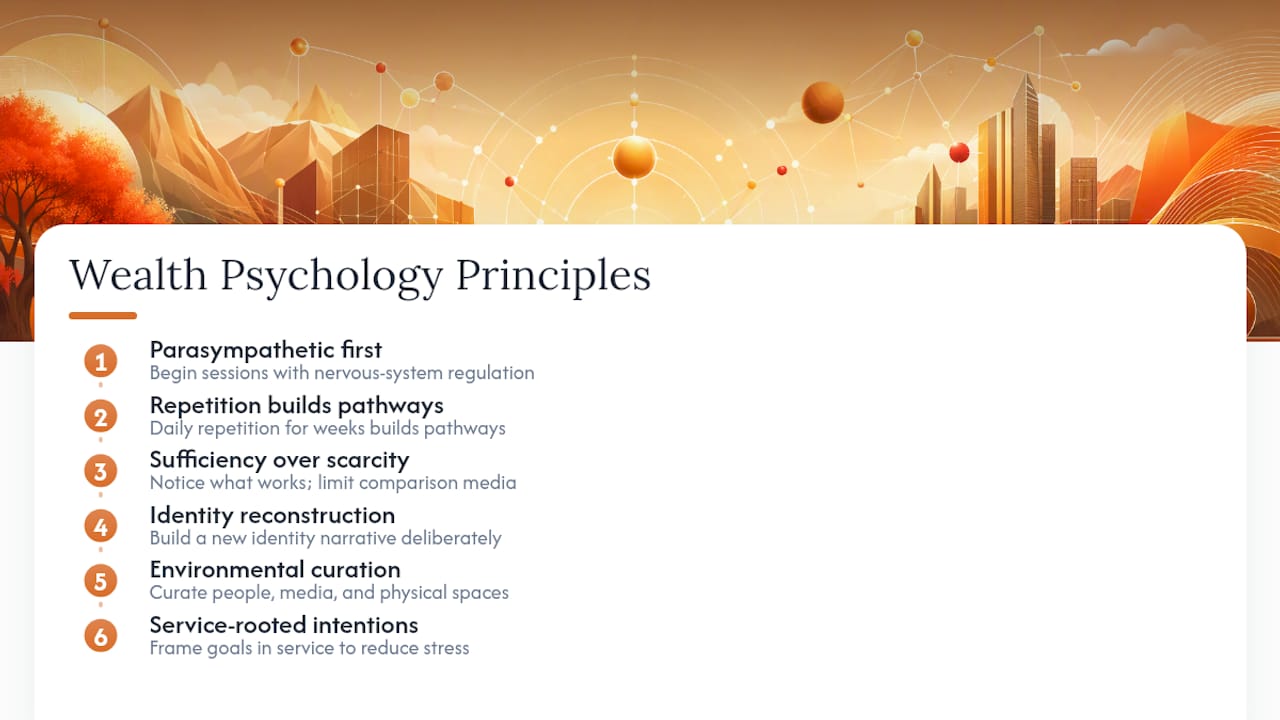
3. Sufficiency framing over scarcity framing. Scarcity framing narrows attention to what is missing. Sufficiency framing, noticing what is already working, widens it. Psychology Today’s coverage of scarcity research recommends sufficiency journaling and limiting comparison-fueling media as two of the most practical entry points.

4. Identity reconstruction. Behavior follows identity. If you believe you are “someone who struggles with money,” no amount of visualization overrides that self-concept. Wealth psychology requires deliberately building a new identity narrative through language, environment, and social exposure.
5. Environmental curation. Your environment shapes your defaults. The people you spend time with, the media you consume, and the physical spaces you inhabit all prime your nervous system and your reference points for what is normal.
6. Service-rooted intentions. Doty’s Stanford research notes that intentions grounded in compassion and service reduce attachment-driven stress and increase cognitive flexibility. An intention framed as “I want to earn more so I can give more” activates a different neural profile than “I need more money or I’ll fail.”
Pro Tip: Frame your written intentions as “I am becoming someone who…” rather than “I want…”, the present-progressive framing signals identity change to the subconscious rather than a gap between now and a desired future.
Your daily and weekly routine for the first 8–12 weeks
The routine below is designed to be stacked onto existing habits, not added as a separate block of time you have to find.
Morning (10–15 minutes total)
- Box breathing or 4-7-8 breath for 5 minutes immediately after waking, before checking your phone.
- Read your written intention aloud once, slowly.
- Two-minute visualization: see yourself making one specific decision today from an abundance mindset.
Evening (5–10 minutes total)
- Sufficiency journal: three sentences on what worked, what you already have, and one financial decision you made well today.
- One-line commitment for tomorrow: a small, concrete action aligned with your wealth intention.
Weekly (30 minutes, same day each week)
- Review the week’s journal entries for patterns in scarcity vs. sufficiency language.
- Celebrate one financial win, however small.
- Run one “money-flow experiment” (see Section 5).
- Adjust one environmental input: unfollow one comparison-triggering account, or add one sufficiency-aligned input.
| Practice | Time required | Primary cognitive effect |
|---|---|---|
| Box breathing / 4-7-8 breath | 5 minutes | Parasympathetic activation; restores dlPFC function |
| Intention reading + visualization | 5 minutes | Attention priming; intention embedding via repetition |
| Sufficiency journaling | 5 minutes | Scarcity-framing reduction; sufficiency schema reinforcement |
| Weekly review and experiment | 30 minutes | Pattern recognition; behavioral experiment iteration |
Weeks 1–3 focus on consistency over depth. Weeks 4–6 add the weekly experiments. Weeks 7–12 scale visualization specificity and begin identity-reconstruction language work.
How to reprogram scarcity conditioning step by step
Step 1: Surface your triggers
Write down the last three financial decisions you regret. For each one, note: what was the emotional state beforehand, what was the time pressure, and what did you tell yourself about money in that moment? This surfaces your personal scarcity triggers and the self-talk patterns attached to them.
Step 2: Run structured experiments
Three experiment templates that work:
- Small financial risk experiment. Commit a modest, pre-decided amount to something growth-oriented (a course, a tool, a small investment). Hypothesis: “I can make a considered financial decision without panic.” Measure: your emotional state before, during, and 48 hours after.
- Mental-accounting swap. For one week, track every purchase against your stated values rather than against a fear of running out. Measure: how many purchases align with your wealth intention vs. how many are reactive.
- Social exposure experiment. Spend time with one person whose financial mindset you want to model. Measure: what specific beliefs or behaviors you notice and want to adopt.
Step 3: Build slack
The APA’s scarcity research is direct on this: without a buffer of time or money, the bandwidth tax of scarcity keeps reasserting itself. Even a small emergency fund or a 30-minute daily unscheduled block reduces the cognitive load that drives short-term decisions. Build slack before scaling experiments.
Step 4: Reconstruct identity and curate environment
Replace scarcity-coded language in your self-talk (“I can’t afford that” → “That’s not my priority right now”). Audit your media diet monthly. Research on scarcity mindset shifts specifically names celebrating others’ financial wins as a practice that reduces comparison-driven scarcity framing.
Common pitfalls and safety flags to watch for
The practices above are grounded in evidence, but they carry real risks when misapplied.
Frequent mistakes:
- Treating visualization as a substitute for action rather than a primer for it.
- Ignoring actual financial risk because a manifestation belief creates overconfidence, a documented pattern in the Manifestation Scale research.
- Confirmation bias: attributing every positive event to the practice and every setback to external factors.
- Social-comparison traps: following “wealth lifestyle” content that triggers scarcity rather than sufficiency.
Safety flags that require you to pause and reassess:
- You are making repeated financial bets you cannot afford to lose, justified by belief in the process.
- Your debt is increasing while you maintain that the practice is “working.”
- You cannot build any slack, time or financial, after 8 weeks of trying.
- The practice is increasing anxiety rather than reducing it.
Pro Tip: Run a monthly “reality audit”: list your three most significant financial decisions from the past 30 days and ask whether each one would look reasonable to a financially stable friend who had never heard of manifestation. If the answer is no for more than one, the practice needs recalibrating.
How to measure progress and track results
Neural habit formation typically takes 2–12 weeks for behavioral patterns to stabilize; material financial outcomes take 3–12 months to show measurably. Expecting income changes in week two sets you up to abandon a practice that is actually working.
| Weekly marker | How to measure | Green signal | Red signal |
|---|---|---|---|
| Parasympathetic practice consistency | Days completed out of 7 | 5+ days | Fewer than 3 days |
| Scarcity vs. sufficiency language ratio | Journal word count review | Sufficiency language increasing | Scarcity language dominant |
| Slack built | Time or money buffer added | Any increase | No change or decrease |
| Impulsive financial decisions | Self-reported count | Declining week-over-week | Flat or increasing |
| Stress baseline | 1–10 self-rating, same time daily | Trending down | Flat or rising |
The single metric to watch first is slack. If you are building even a small buffer, the bandwidth tax is lifting, and better decisions follow naturally.
When to get coaching or join a structured course
DIY is enough when you are consistent, your stress baseline is dropping, and your experiments are generating useful data. Coaching or a structured course makes sense when:
- Progress has stalled for more than 6 weeks despite consistent practice.
- Financial risk is escalating and you need external accountability.
- You want a structured curriculum rather than self-directed experimentation.
- You are unsure whether your practices are evidence-aligned or drifting into magical thinking.
What a credible program shows:
- Explicit grounding in neuroscience or peer-reviewed psychology, not just testimonials.
- A stepwise curriculum with measurable milestones.
- Practitioner credentials and a clear methodology.
- A refund policy or trial module.
Livethelifeofyourdreams meets these criteria: the curriculum blends Kabbalah and Law of Attraction principles with neuroscience and psychology research, includes downloadable meditations, affirmations, and journaling templates, and is built around Elvis D. Beuses’s 20+ years of medical and pharmaceutical background alongside his own documented experience of financial rebuilding after job loss and personal crisis.
Why blending science and spiritual practice works
Most manifestation content picks a lane: either pure neuroscience (which loses the motivational and meaning-making power of spiritual framing) or pure spirituality (which loses the credibility and practical structure that evidence provides). Neither alone produces lasting change for most people.
Elvis D. Beuses built Livethelifeofyourdreams specifically to hold both. His international bestseller Cómo Vencer el Miedo and his YouTube channel, which has grown to 240,000 subscribers, reflect a consistent position: spiritual practices are most effective when they are grounded in a mechanism you can understand and measure. That is not a compromise between two worldviews. It is what the neuroscience actually supports.
What Livethelifeofyourdreams offers readers ready to go deeper
The practices in this guide work. They work faster with structure, accountability, and materials designed around the evidence.

Livethelifeofyourdreams courses give you a complete, sequenced program: guided meditations for parasympathetic activation, sufficiency journaling templates, visualization scripts, and a progress-tracking framework built around the same 8–12 week timeline described here. The curriculum draws on neuroscience, Kabbalah, and Law of Attraction principles, not as competing frameworks, but as complementary tools for the same goal. Elvis’s 20+ year background in medicine and pharma means the evidence is read carefully, not cherry-picked. Visit Livethelifeofyourdreams to explore the course offerings and find the program that fits where you are right now.
Sources
- James Doty on the neuroscience of manifestation | Stanford Report
- The psychology of scarcity | APA Monitor
- Neural mechanisms of scarcity mindset (PMCID: PMC6575633)
- 6 ways to shift out of a scarcity mindset | Psychology Today Singapore
- Can imagining a better future really make it come true? | New Scientist
Frequently asked questions
What is wealth psychology?
The study of how people think, feel, and decide about money, and why identical incomes produce different outcomes. This guide translates the research into practices a manifester can actually use.
What is the single most useful finding?
Scarcity consumes bandwidth: money worry itself taxes the thinking you need to solve money problems. Calming the fear is not soft, it is the first practical step of every plan.
How do I apply this alongside manifestation?
Use manifestation tools to steady attention and belief, and use the behavioral findings, automation, defaults, reviews, to carry the results. The guide is organized as exactly that pairing.
Keep exploring
- Think and Grow Rich Summary: 13 Principles Explained
- Andrew Carnegie’s Wealth Secrets for an Abundance Mindset
- Manifest Money: Practical Rituals and an Action Plan
- Abundance Mindset: Practical Steps to Think Bigger
- Gratitude and Abundance: The Evidence Behind the Practice
- Scarcity Mindset: Why It Happens and How to Shift It