
Think and Grow Rich teaches one central idea: a specific, sustained mental framework built around 13 principles can convert a burning desire into wealth, success, or any defined goal. Napoleon Hill spent roughly two decades studying successful people and distilled what he found into a system anyone can follow.
- The book: Think and Grow Rich by Napoleon Hill, first published in 1937, remains one of the most widely read personal development books in history.
- The promise: Hill claimed that by studying the habits and thinking patterns of high achievers, he could give readers a repeatable mental blueprint for success, not luck or inheritance.
The 13 principles, chapter-by-chapter breakdowns, the six basic fears, and a practical daily routine are all covered below.
Key Takeaways
Think and Grow Rich is most useful when its 13 principles are treated as a daily practice system rather than a philosophy to agree with.
| Point | Details |
|---|---|
| Define your chief aim precisely | Write one specific sentence with a goal, a date, and what you will give in return. |
| Use autosuggestion daily | Read your written statement aloud twice a day with genuine emotional engagement, not flat repetition. |
| Build a Mastermind group | Find two to five accountability partners and meet weekly; peer accountability drives follow-through. |
| Persist and measure | Track one weekly persistence metric to distinguish active practice from passive belief. |
| Pair mindset with practical tools | Hill’s framework addresses psychology; supplement it with real financial literacy and a written budget. |
Table of Contents
- Why Napoleon Hill wrote this book and why it still matters
- The 13 principles at a glance
- A chapter-by-chapter map of the book
- The six basic fears Hill identifies and how to counter them
- How to apply Think and Grow Rich today
- What the book gets wrong and how to read it productively
- What Think and Grow Rich means for evidence-informed manifestation work
- Sources
Why Napoleon Hill wrote this book and why it still matters
Andrew Carnegie planted the seed. Hill accepted, and the result was a body of work that culminated in Think and Grow Rich, first published in 1937.
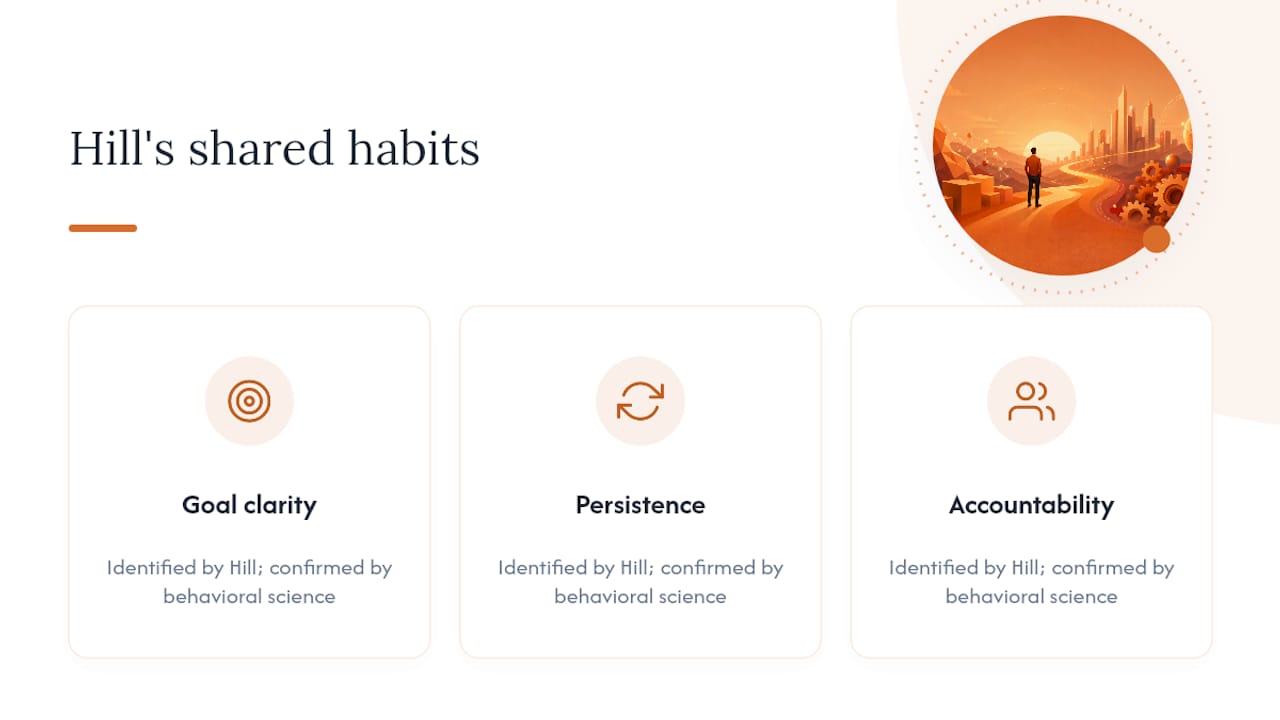
The research method was observational and anecdotal. Hill interviewed industrialists, inventors, and political leaders, looking for shared mental habits rather than running controlled experiments. That distinction matters when you read the book: the claims are pattern-based, not laboratory-proven. Still, the patterns Hill identified, including goal clarity, persistence, and social accountability, align closely with what behavioral science has confirmed in the decades since.
The book’s reach grew steadily through the 20th century and has never really stopped. Its influence on the self-help genre, on entrepreneurship culture, and on the language of personal development is hard to overstate.
The 13 principles at a glance
Four Minute Books notes that Hill distilled 13 recurring habits from studying more than 500 successful individuals. Here they are, each with a one-line definition and the practical reason to care:
- Desire: A burning, specific want, not a vague wish. Without it, every other principle stalls.
- Faith: Belief that your goal is achievable. Hill treats faith as a mental state you can build deliberately, not one you either have or don’t.
- Autosuggestion: Feeding your subconscious through repeated, emotionally charged affirmations. The mechanism Hill describes maps onto what modern psychology calls self-talk and mental rehearsal.
- Specialized knowledge: Targeted expertise in your chosen field. General knowledge, Hill argues, is nearly worthless without a plan to apply it.
- Imagination: Both synthetic (recombining existing ideas) and creative (generating genuinely new ones). Hill sees imagination as the workshop where desire gets shaped into a plan.
- Organized planning: Translating desire into a written, step-by-step strategy. This is where most readers stall, and Hill spends considerable time here.
- Decision: The habit of reaching decisions quickly and changing them slowly. Hill observed that successful people rarely dithered; unsuccessful ones rarely committed.
- Persistence: Sustained effort against resistance. Hill calls it the sustained effort necessary to induce faith, and he pairs it directly with desire.
- Power of the Master Mind: A coordinated alliance of two or more people working toward a shared goal. Modern coaching circles recognize this as a direct precursor to peer accountability groups.
- Sex transmutation: Redirecting intense emotional energy toward creative and professional output. Controversial today, but Hill’s underlying point, that emotional intensity fuels achievement, has real behavioral backing.
- The subconscious mind: The bridge between conscious thought and action. Hill believed you could program it through repetition and emotion.
- The brain as a broadcasting and receiving station: Hill’s most metaphysical claim, that minds can transmit and receive thought vibrations. Read it as a metaphor for attentiveness and openness to ideas rather than literal telepathy.
- The sixth sense: Hill’s term for intuition sharpened through practice of the other 12 principles. He presents it as the capstone, accessible only after the earlier steps are internalized.
Pro Tip: Combine Mastermind, Autosuggestion, and Organized Planning as a weekly trio: meet your accountability partner once a week, review your written plan together, then spend five minutes each morning repeating your chief aim aloud. The three principles reinforce each other in a way that none of them does alone.
A chapter-by-chapter map of the book
The book’s structure follows the 13 principles roughly in order, though Hill weaves themes together rather than treating each chapter as a sealed unit.
- Introduction / The Secret: Hill teases a “secret” throughout the book without stating it outright. Most readers conclude it is the idea that thoughts, when backed by desire and faith, become reality. He uses Edwin Barnes, who arrived at Thomas Edison’s office with nothing but a burning desire to become Edison’s business partner, as his opening illustration.
- Chapter 1 (Desire): The Six-Step Success Formula appears here. Practical guides consistently extract these six steps as the book’s most actionable sequence: fix an exact amount of money (or specific goal), decide what you will give in return, set a definite date, create a written plan, write a clear statement, and read it aloud twice daily.
- Chapter 2 (Faith): Hill introduces the Self-Confidence Formula, a written affirmation readers are instructed to memorize and repeat. He argues faith is built through repetition, not inspiration.
- Chapter 3 (Autosuggestion): Short but central. Hill explains that the subconscious accepts only emotionally charged instructions. Flat, mechanical repetition does little; repetition combined with feeling does a great deal.
- Chapter 4 (Specialized Knowledge): Hill uses Henry Ford’s famous “ignorant idealist” trial as an example, where Ford was cross-examined about general history and responded that he could summon any expert he needed. The lesson: know your field deeply and build a team for the rest.
- Chapter 5 (Imagination): Hill distinguishes synthetic imagination (rearranging existing concepts) from creative imagination (receiving new ideas). He credits both to successful inventors and entrepreneurs.
- Chapter 6 (Organized Planning): The longest chapter. Hill outlines how to form a Mastermind group, how to present yourself as a leader, and how to recover from temporary defeat. He lists 28 causes of failure here, a checklist worth reading slowly.
- Chapter 7 (Decision): Hill cites the Founding Fathers’ decision to sign the Declaration of Independence as an example of irreversible commitment producing extraordinary results. The chapter is brief but pointed.
- Chapter 8 (Persistence): Hill gives a four-step method for building persistence: a definite purpose, a burning desire, a definite plan, and a closed mind against negative influence. He uses the “three feet from gold” story, a miner who quit just before striking a vein, as the chapter’s anchor.
- Chapter 9 (Power of the Master Mind): Hill explains the concept through Carnegie’s own steel empire, arguing Carnegie’s real asset was not capital but the coordinated intelligence of his inner circle.
- Chapter 10 (Sex Transmutation): Dated in its framing and worth reading with historical context. The core idea, that intense emotional energy can be redirected toward creative output, is the part worth extracting.
- Chapter 11 (The Subconscious Mind): Hill describes seven positive emotions (desire, faith, love, sex, enthusiasm, romance, hope) and seven negative ones (fear, jealousy, hatred, revenge, greed, superstition, anger) and argues the subconscious acts on whichever set dominates.
- Chapter 12 (The Brain): The most speculative chapter. Hill’s “broadcasting” metaphor is best read as a description of heightened receptivity and creative openness rather than literal neuroscience.
- Chapter 13 (The Sixth Sense): Hill presents this as the reward for mastering the preceding 12 principles: a reliable intuition that guides decisions. He frames it as the apex of the system, not a shortcut to it.
The six basic fears Hill identifies and how to counter them
Hill argues that fear, not lack of talent or opportunity, is the primary obstacle to success. He names six specific fears and ties each to a practical counter.
- Fear of poverty: Shows up as over-caution, procrastination, and excuse-making. Hill’s counter: definiteness of purpose. A clear, written goal leaves less mental space for scarcity thinking.
- Fear of criticism: Produces conformity, lack of initiative, and the habit of making excuses. Counter: build self-confidence through the Self-Confidence Formula and reduce exposure to chronic critics.
- Fear of ill health: Leads to hypochondria and negative self-suggestion. Counter: autosuggestion focused on health and vitality rather than disease.
- Fear of loss of love: Drives jealousy and possessiveness. Counter: replace the fear-based thought pattern with a definite focus on contribution and self-worth independent of others’ approval.
- Fear of old age: Produces apology for age and slowing of initiative. Counter: reframe experience as an asset and maintain a definite chief aim that keeps attention forward-facing.
- Fear of death: Often manifests as religious anxiety or paralysis. Hill’s counter is philosophical: occupy the mind with a purpose large enough to make the question of death secondary.
Pro Tip: Autosuggestion is Hill’s most direct tool against fear-based inertia. Write a single sentence that states the opposite of your dominant fear (“I am building financial security through deliberate daily action”), read it aloud with genuine feeling each morning, and track whether the fear-driven behavior, procrastination, avoidance, excuse-making, decreases over 30 days. The Blinkist summary of the book highlights this daily repetition practice as one of Hill’s most consistently recommended exercises.
How to apply Think and Grow Rich today
The book’s mental exercises are more useful when they are tied to measurable habits rather than left as abstract intentions. Here is a modernized routine built directly from Hill’s own instructions.
The Six-Step Success Formula as a weekly practice:
- Write your chief aim as a single, specific sentence. Include a number, a date, and what you will give in return (a skill, a service, a commitment of time).
- Read it aloud twice daily, morning and evening, with genuine emotional engagement, not a flat recitation.
- Identify one person or a small group (two to five people) who can serve as your Mastermind. Meet weekly, even briefly. Accountability is the mechanism, not the meeting itself.
- Build a written plan with at least three milestones and a date for each. Revise it when circumstances change, but never abandon the chief aim itself.
- Track one persistence metric each week: how many times did you act toward your goal despite resistance? A simple tally in a notebook works.
- Audit your mental diet. Hill’s seven negative emotions are not abstract; they show up as specific thought loops. Notice which ones dominate your internal monologue and replace them deliberately.
Contemporary reviewers recommend pairing this mindset work with practical financial tools, budgeting systems, investment education, and measurable savings targets, so that belief is backed by a real plan rather than substituting for one.
Modern behavior-change research supports several of Hill’s mechanics. Written goals outperform unwritten ones in studies on implementation intentions. Visualization combined with planning (what researchers call mental contrasting) is more effective than visualization alone. Peer accountability, the Mastermind in practice, consistently improves follow-through across domains from fitness to entrepreneurship.
Pro Tip: Pick one metric to track for 30 days: the number of times you read your written chief aim aloud. Nothing else. Measurement creates accountability without adding complexity, and it quickly reveals whether you are practicing the principle or just believing in it.

What the book gets wrong and how to read it productively
Think and Grow Rich has real limitations, and pretending otherwise does readers a disservice.
- The method is anecdotal. Hill observed successful people and identified patterns. He did not run controlled studies, and confirmation bias almost certainly shaped what he noticed. The 13 principles are a coherent synthesis, not a proven causal framework.
- Some examples are historically dated. References to gender, race, and social dynamics reflect early 20th-century America. High-visibility summaries consistently flag this, advising readers to extract the timeless mechanics and set aside the period-specific framing.
- The “secret” is deliberately vague. Hill never states it plainly, which creates interpretive flexibility but also allows readers to project almost anything onto the book’s central claim.
- Sex transmutation and the sixth sense are unverifiable. They are the book’s most speculative chapters. The underlying ideas, emotional energy as fuel, intuition as a trained skill, are defensible. The specific framing is not.
- Mindset is not a financial plan. Desire and faith do not replace budgeting, investing, and financial literacy. The book is a psychology of achievement, not a substitute for practical money management.
What Hill gets right is substantial: goal clarity, written plans, persistence in the face of setbacks, and social accountability are among the most replicated findings in performance psychology. The book’s value is in those mechanics. Pair it with a real financial education resource and the combination is genuinely powerful.
What Think and Grow Rich means for evidence-informed manifestation work
Hill’s framework is foundational for anyone serious about mindset work, but it is a starting point, not a complete system. The principles that hold up best under scrutiny, desire, faith, autosuggestion, organized planning, persistence, and the Mastermind, map directly onto what neuroscience and behavioral psychology now describe as goal representation, self-efficacy, mental rehearsal, implementation planning, grit, and social accountability. That convergence is not coincidental. Hill was observing real psychological mechanisms decades before the research vocabulary existed to name them.
Where the book requires supplementation is in the gap between belief and execution. Hill’s system is strongest at the level of internal state: it is exceptionally good at helping you clarify what you want, build conviction, and sustain effort. It is weaker on the external mechanics of how money actually works, how markets behave, and how to build financial resilience. That is not a flaw in Hill’s intention; it is simply outside the book’s scope.
At Livethelifeofyourdreams, the approach is to take Hill’s core mechanics seriously while grounding them in modern behavioral science and practical application. The subconscious reprogramming work, the fear-clearing exercises, and the goal-setting frameworks in our courses draw directly on Hill’s principles, but they are paired with the kind of measurable, structured practice that turns intention into a trackable result. If you want to explore that combination, start here.
Sources
These sources are worth bookmarking if you want to go deeper on Hill’s ideas or read a critical perspective:
- Think and Grow Rich, Wikipedia
- Think And Grow Rich Summary – Four Minute Books
- Think And Grow Rich Review: Still Worth It in 2026? – Try It Randomly
- Think and Grow Rich Summary: Key Lessons, Quotes & Review
- Think and Grow Rich summary of key ideas and review, Blinkist
Frequently asked questions
Is Think and Grow Rich still worth reading?
Yes, with context: Hill’s claims about his research are dubious, but the thirteen principles survive because they describe real mechanisms, desire, planning, persistence, and the mastermind effect among them, that modern books still repackage.
What is the most important of the 13 principles?
Start with Desire and Organized Planning. The book’s own logic is that burning desire without a written plan is wishing, and the summary shows how the middle principles connect the two.
Which practice should I start with this week?
The definiteness of purpose exercise: one written sentence, the exact amount, the deadline, and what you will give for it. Every other principle in the book assumes you have done this.
More to explore
- How To Reframe Limiting Beliefs from Scarcity to Abundance
- Wealth Psychology: The Evidence-Based Manifester’s Guide
- Gratitude and Abundance: The Evidence Behind the Practice
- Scarcity Mindset: Why It Happens and How to Shift It
- Clear Money Blocks in 5 Steps, Evidence Based Not Just Affirmations
- Make Subliminals for Wealth Actually Move Your Money in 8 Weeks