
Subliminals for wealth can sharpen focus, interrupt scarcity thinking, and build the daily habits that lead to better financial decisions, but no credible research shows they generate money on their own. The most useful move is starting a simple nightly listening routine paired with a short journaling habit, then tracking real financial actions alongside it. Treat the audio as a mindset tool, not a mechanism, and pair it with concrete steps like budgeting or debt paydown.
TL;DR:
- Subliminals for wealth primarily support establishing daily habits and emotional stability but lack credible evidence of directly increasing income.
- Effective subliminal tracks should feature smooth looping, specific scripting, clear guidance, and offer samples or previews before purchase.
- Research shows that subliminals are more likely to improve focus and reduce money-related anxiety than to produce tangible financial gains.
- Pair subliminal sessions with concrete actions like budgeting or debt repayment, and track real financial metrics over weeks to measure progress.
- Avoid products with exaggerated promises or guarantees, and use subliminals only as part of a broader, structured wealth-building strategy.
Table of Contents
- What Subliminals for Wealth Are and How the Audio Formats Work
- Does the Evidence Actually Support Subliminal Messages for Success?
- How to Use Subliminals for Wealth: A Daily Protocol
- Sample Wealth Affirmations and Script Ideas Worth Adapting
- Safety, Red Flags, and Keeping Expectations Real
- How Live The Life Of Your Dreams Approaches Subliminals Inside a Bigger System
- The Real Problem With How Most People Use Subliminals
- A Structured Alternative to DIY Subliminal Tracks
- Sources
- FAQ
What Subliminals for Wealth Are and How the Audio Formats Work
A money subliminal is a recorded set of affirmations, usually first-person and present-tense (“I attract wealth easily,” “money flows to me”), delivered in one of three ways: spoken aloud at normal volume, masked beneath music or nature sounds so the words sit below conscious hearing, or embedded silently in a track with no audible speech at all. The theory behind masking is that the subconscious picks up the message even when the conscious mind cannot parse it. Whether that actually happens is a separate question, covered in the next section.
Most commercial tracks layer affirmations over binaural beats or isochronic tones, two different methods for producing a “brainwave entrainment” effect. Binaural beats play a slightly different frequency in each ear; isochronic tones pulse a single frequency on and off. Sellers commonly pair these with theta (4 to 8 Hz) or delta (0.5 to 4 Hz) ranges, the frequency bands associated with drowsiness and deep sleep, and market the result as “sleep programming” or “deep reprogramming.” That framing is popular across the subliminal market, though it remains a marketing claim rather than a clinically established effect.
A few practical signals separate a well-made track from a lazy one:
- Loop-safe editing. No audible click, pop, or silence gap where the track restarts, since a bad loop point can jolt you awake mid session.
- Clear, specific scripting. Vague lines (“I am wealthy”) do less work than specific ones tied to real goals (“I handle unexpected expenses calmly”).
- Listening guidance included. Reputable creators tell you the intended volume, session length, and whether the track is meant for active or passive listening.
- A free or preview sample. Most trustworthy sellers let you hear (or at least sample a silent version of) the track before you buy, which is a recommended consumer safeguard.
That last point matters more than shoppers realize. Google Play listings for manifestation apps commonly include preview or “silent version” options specifically so buyers can test comfort and quality before committing. If a seller doesn’t offer that, treat it as a minor red flag.
Does the Evidence Actually Support Subliminal Messages for Success?
Here’s the honest answer: subliminals are popular, widely used, and largely untested for financial outcomes. WIRED’s reporting on the subliminal boom found many TikTok and YouTube users convinced the tracks changed their appearance, mood, or luck, but the coverage leans almost entirely on personal testimony rather than controlled measurement. That gap between belief and proof is the single most important thing to understand before you buy a track marketed as a wealth shortcut.
Formal trial data on subliminals specifically for money outcomes is scarce. Databases that track randomized controlled trials, including PubMed’s ongoing RCT mapping work, show a field where reporting standards for trials in general keep improving, but well-designed studies isolating subliminal audio as the cause of a financial change simply aren’t there in meaningful numbers. Compare that to cognitive behavioral therapy, where rigorous trial processes like the GAP CBT study demonstrate a much stronger evidence base for changing beliefs and behavior. If you want the research-backed approach to rewiring money habits, CBT-style methods currently outperform subliminal audio on every measure researchers can actually test.
Experts who study behavior change generally frame subliminal audio’s real value differently than sellers do: it’s a support tool for consistent focus and emotional alignment, the habit scaffolding that can lead to better financial action, not a direct switch that manufactures money.
So why do so many people swear by them? A few plausible mechanisms, none mutually exclusive:
Placebo and expectation effects are well documented across psychology, and a listener who expects to feel calmer or more confident about money often does, regardless of the audio’s specific mechanism. Increased focus happens simply because a daily ritual, any ritual, creates a checkpoint that reminds you to think about your goal. Emotional alignment matters too: affirmations spoken in the right tone can lower anxiety around money, and calmer people make fewer panicked financial decisions. And cueing for action is real. A track that ends with “I take smart financial steps today” can nudge you toward actually opening that budgeting app.
None of that adds up to “subliminals make you rich.” It adds up to “subliminals can support the habits that make you better with money,” which is a meaningfully different and more honest claim. Set your success criteria around consistency, mood, and follow-through on real financial tasks, not around passive outcomes.
How to Use Subliminals for Wealth: A Daily Protocol
Consistency beats intensity with this kind of practice. A haphazard listen here and there does far less than a fixed daily slot, even a short one.
- Pick your primary listening window. Morning sessions (10 to 20 minutes, active listening, ideally with a journal open) work best for people who want to set intention before the day starts. Night sessions (30 to 60 minutes, passive, played as you fall asleep) suit the theta/delta sleep-programming approach and require zero willpower since you’re asleep for most of it.
- Choose headphones for binaural content. Binaural beats need separate left and right channels to work as designed, so speakers defeat the purpose. Isochronic tones and straightforward affirmation tracks work fine through speakers if headphones feel uncomfortable overnight.
- Set volume below distraction threshold. Loud enough to register, quiet enough that it doesn’t keep you awake or pull focus from your journaling. For sleep tracks, err quieter.
- Loop it and forget it. Use a properly loop-safe file (see the quality checklist above) so a bad edit doesn’t wake you at 2 a.m.
- Pair every session with one micro-action. This is the step people skip and the one that actually matters. After your morning listen, write one sentence about a real financial decision you’ll make that day. After a night session, review the next morning what you did differently.
- Journal three lines, not three pages. What you listened to, one thought that came up, one action you took. Brevity keeps the habit alive past week two, when most self-improvement routines quietly die.
- Track a monthly metric, not a daily feeling. Savings rate, a debt number going down, invoices sent, whatever ties to your actual goal. Subjective mood swings day to day; a number doesn’t lie to you.
Pro Tip: Stack your listening session onto an existing habit, like your commute or your usual bedtime scroll, instead of trying to create a brand-new time slot. Habit stacking is why gym-goers who tie workouts to “right after coffee” stick with it longer than people who just plan to “find time later.”
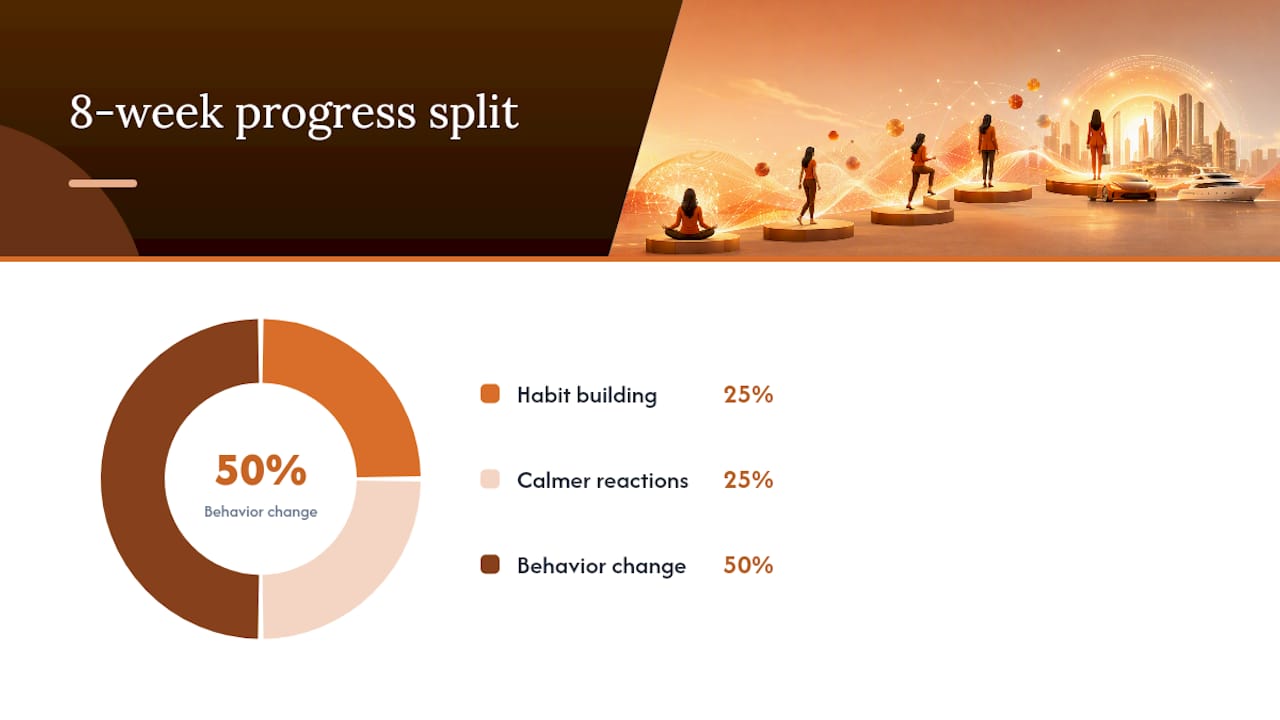
A realistic eight-week arc looks like this: weeks one and two are pure habit-building, and you likely won’t feel much. Weeks three and four are where most people report calmer reactions to money stress, mainly because the daily ritual has started doing its quiet work on attention and mood. By weeks five through eight, the real shift should show up in your micro-actions, not your feelings. More invoices sent. A budget actually followed. A negotiation you didn’t chicken out of. If nothing has changed behaviorally by week eight, the subliminal isn’t the missing piece, your action plan is.
This is also the point where CBT-style micro-shifts earn their reputation. Reframing a single limiting thought (“I’m bad with money”) into a testable belief (“I’ve made three good financial decisions this month”) does more measurable work than another month of passive listening alone. If you want a structured way to work through that kind of reframe, changing your relationship with money beliefs is worth exploring as a next layer.
Sample Wealth Affirmations and Script Ideas Worth Adapting
Vague scripts produce vague results. “I am wealthy” means nothing to your brain because it can’t be measured or acted on.
Try adapting these instead of copying generic templates:
- “I make calm, informed decisions about money.”
- “I handle unexpected expenses without panic.”
- “I notice new opportunities to earn and act on them.”
- “I track my spending because I respect my own progress.”
- “I negotiate for what my work is worth.”
- “Money that comes to me, I manage wisely.”
Repetition density matters more than most buyers realize. A script of eight to twelve short lines, looped for the full track length, tends to work better than a sprawling forty-line monologue, since the subconscious benefit (real or perceived) comes from consistent exposure to a small set of ideas, not novelty. Keep sentences under ten words where possible.
When layering scripts with music or brainwave tones, keep the affirmation volume just under the music bed, never fighting for attention with it, and avoid stacking multiple competing tracks in one session (one wealth script plus one confidence script simultaneously just muddies both).
A few do’s and don’ts worth memorizing:
- Do tie every affirmation to a believable near-term outcome, not a fantasy. “I attract new clients this month” beats “I attract a million dollars.”
- Do write in your own natural phrasing rather than copying a stranger’s script verbatim; the words should sound like you, not a stock affirmation generator.
- Don’t script promises of instant riches, debt disappearing overnight, or guaranteed windfalls. Those claims aren’t just unrealistic, they set you up to quit the habit the moment reality doesn’t match the fantasy.
- Don’t phrase anything around taking from or beating others financially. Scarcity-framed competition language tends to reinforce the exact mindset you’re trying to leave behind.
Safety, Red Flags, and Keeping Expectations Real
Some corners of the subliminal market lean hard into promises that don’t hold up. Product pages advertising instant debt elimination or guaranteed windfalls are marketing copy, not evidence, and a legitimate seller will never claim a specific dollar outcome from listening alone.
Watch for a few consistent red flags before buying anything:
- Guarantees of a specific income or timeline (“$10,000 in 30 days”).
- No sample or preview track offered anywhere on the page.
- Pressure tactics like countdown timers or “limited spots” on a digital download.
- Testimonials with no other detail, no context, no verification.
The bigger risk isn’t a wasted $20 purchase. It’s letting a passive audio habit become a substitute for actual financial planning, a mild but real form of avoidance where listening feels like progress while the budget still isn’t made and the debt still isn’t tracked. Keep the fundamentals running in parallel: a real budget, a real savings plan, and when the numbers get complicated, a real financial planner, the kind of structured guidance offered through services like Amber Wealth’s financial planning. If money anxiety starts feeling unmanageable rather than motivating, that’s a signal to talk to a mental-health professional, not to add another hour of listening.
How Live The Life Of Your Dreams Approaches Subliminals Inside a Bigger System
Elvis D. Beuses built this perspective after two decades in medical and pharmaceutical work, followed by his own collapse and rebuild through divorce, job loss, and a near-deportation, a story detailed in his bestseller Cómo Vencer el Miedo and shared across his 240,000-subscriber YouTube channel. That background shapes the brand’s stance: subliminals earn a place in a wealth practice only when paired with Kabbalah and Law of Attraction principles grounded in something testable, namely CBT-style micro-shifts, structured journaling, and accountability check-ins that turn belief work into measurable financial behavior.
The Real Problem With How Most People Use Subliminals
The conventional advice on subliminals for wealth almost always stops at “listen daily and trust the process.” That’s incomplete, and frankly a little irresponsible given how much money the manifestation industry makes off passive hope. The evidence supports subliminals as an attention and mood tool, not a wealth mechanism, and treating them as the latter is exactly why so many people cycle through track after track without their bank balance ever moving.
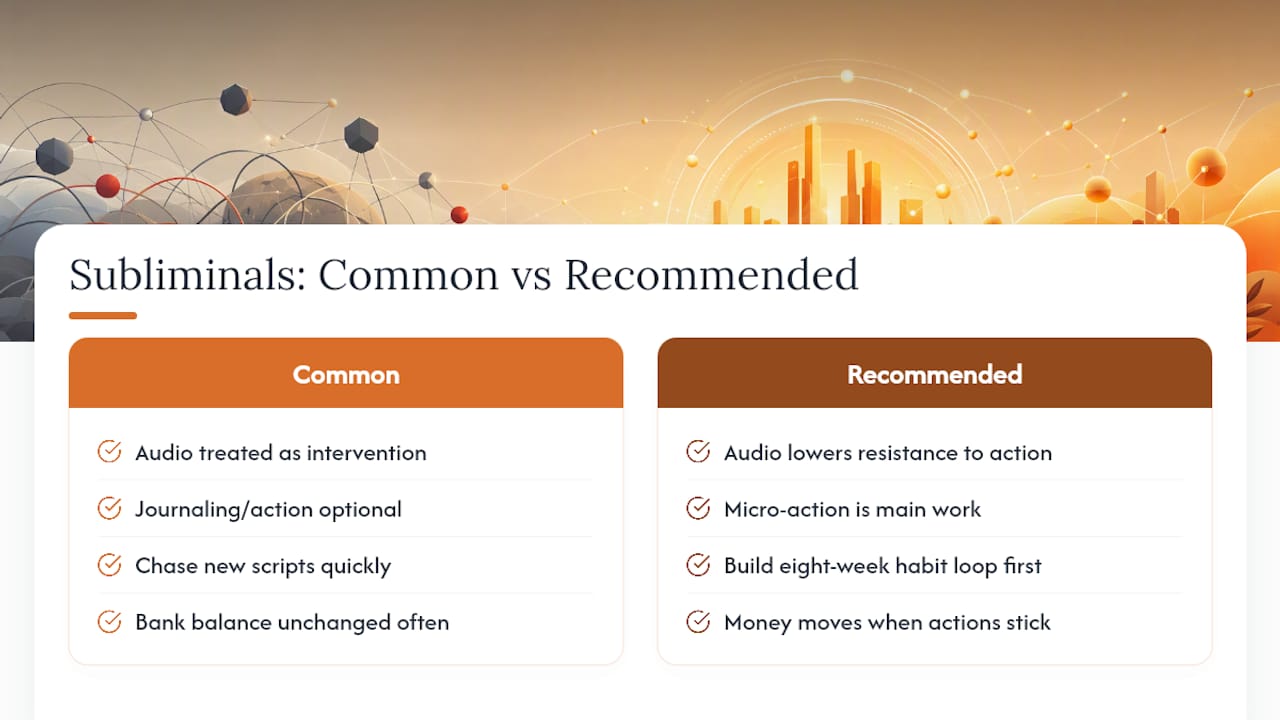
Where most guides get it backwards: they treat the audio as the intervention and the journaling or action step as optional garnish. Flip that. The micro-action after each listening session, the one sentence in your journal, the actual budget line you adjust, is doing more of the real work than the track itself. The subliminal’s job is to lower resistance to doing that work consistently, nothing more.
Prioritize this first: build the eight-week habit loop before you buy a second track. Most people chase a “better” script when their actual problem is that they stopped listening after day nine.
, Elvis
A Structured Alternative to DIY Subliminal Tracks
DIY subliminals can build a habit, but they can’t hand you a system for catching the moment you self-sabotage, which is usually the real reason progress stalls. Rewire Limiting Beliefs in 8 Micro Shifts goes further than a looped audio track by combining CBT-based micro-shifts with structured accountability, walking you through the exact belief patterns that keep money at arm’s length instead of leaving you to guess which affirmation might work.
This fits best if you’ve already tried journaling, affirmations, or a stack of subliminal playlists and felt the same ceiling every time your income or savings started to grow. That pattern, often called the upper limit problem, usually needs more than a nightly track to break. The eight-step structure gives you a defined sequence instead of an open-ended listening habit with no clear endpoint.
If you recognize that pattern in your own finances, start with the 8 micro-shift program and work through the first shift this week.
Sources
- Can Listening to ‘Subliminals’ Make You Beautiful? Plenty of Women Believe It | WIRED
- The GAP CBT study, HRA research summaries
- PubMed, CONSORT 2025 RCT mapping dataset
FAQ
What affirmations attract money?
Specific, present-tense, first-person lines tied to real behavior work best, such as “I make calm, informed decisions about money” or “I notice new opportunities to earn.” Vague lines like “I am rich” give your brain nothing concrete to act on.
Which frequency attracts money?
There’s no verified frequency that attracts money. Sellers pair affirmations with theta (4 to 8 Hz) or delta (0.5 to 4 Hz) tones marketed for sleep and deep receptivity, but that’s a market convention, not a clinically proven effect.
Does a money subliminal work?
Money subliminals show no direct evidence of generating income, but they can support focus, calm, and consistent habits that lead to better financial decisions when paired with real action. The gap between anecdotal belief and controlled proof is wide, as WIRED’s reporting on the broader subliminal trend makes clear.
What is the most powerful subliminal?
No single track outperforms others in controlled testing, since no rigorous studies compare subliminal scripts head-to-head for financial results. The strongest results tend to come from short, specific scripts listened to consistently and paired with a micro-action, not from any particular seller’s frequency claims.
Are subliminals safe to listen to daily?
Daily listening is generally considered safe for most people when volume stays moderate and sessions stay under an hour, though it becomes a problem if it replaces actual budgeting, planning, or professional financial advice.
Quick reference
| Key | Practice |
|---|---|
| Week 1-2 | Daily listening while doing money admin |
| Week 3-4 | Add one earning experiment |
| Week 5-6 | Track what changed in what you attempt |
| Week 7-8 | Keep what worked, drop the rest |
Related reading
- Money Meditation: 3-Minute Practice + Full Guided Script
- Manifest Money: Practical Rituals and an Action Plan
- Abundance Mindset: Practical Steps to Think Bigger
- Think and Grow Rich Summary: 13 Principles Explained
- Stop Sabotaging Wins: An 8 Week Plan to Beat the Upper Limit Problem
- 15 Money Mindset Shifts That Turned Broke Beginners Into Abundance Magnets