The upper limit problem is a self-imposed ceiling on how much success, love, or happiness you’ll let yourself keep before you unconsciously sabotage it. Psychologist Gay Hendricks named the pattern in his book The Big Leap, and it explains why a raise, a great relationship, or a big win so often gets followed by a fight, an illness, or a sudden crash in mood. It’s known to occur frequently, is not a character flaw, and it responds to specific, learnable practices.
TL;DR:
- Most people carry an internal happiness or success threshold that, when crossed, triggers stress, self-doubt, or sabotage behaviors such as procrastination or conflict.
- Patterns like illness, fights, overspending, or hiding achievements often occur within 72 hours after a positive event, indicating a self-sabotage response.
- Limiting beliefs stem from early family agreements and social conditioning, reinforced by the brain’s threat detection system, which perceives positive change as unfamiliar danger.
- Gradual, small experiments over several weeks, such as tracking triggers and practicing savoring wins, can expand your tolerance for success and reduce self-sabotage.
- The upper limit problem typically overlaps with but is distinct from impostor syndrome and general self-sabotage, responding best to incremental behavior changes rather than dramatic shifts.
Table of Contents
- What the Upper Limit Problem Looks Like Day to Day
- Why Your Brain Sabotages Its Own Success
- Gay Hendricks’ Four Hidden Barriers to Success
- How to Raise Your Upper Limit, Step by Step
- Why You Can Trust This Framework
- Does the Science Actually Support the Upper Limit Problem?
- What Actually Changes When People Work Through This
- Upper Limit Problem vs. Self-Sabotage vs. Impostor Syndrome
- A Founder’s Note on Watching This Pattern Play Out
- A Guided Path if You Want Structure Around This Work
- Sources
- FAQ
What the Upper Limit Problem Looks Like Day to Day
You’ll usually recognize it in hindsight: things were going great, then you did something to make them stop. Most people carry an internal threshold for how much happiness or success they’ll tolerate, and crossing it triggers stress, worry, or an urge to retreat. The behaviors are strangely predictable once you know what you’re looking for.
- A dark or catastrophic thought right after good news (“this won’t last,” “something bad is coming”)
- Getting sick or injured within days of a promotion, launch, or milestone
- Picking a fight with a partner right after a genuinely good week together
- Procrastinating on the next step of a project the moment it starts succeeding
- Overspending or giving away money shortly after a financial win
- Downplaying or hiding an achievement instead of letting people celebrate it
- Feeling unexplained anxiety, guilt, or restlessness during a calm, happy stretch
These patterns, including psychosomatic illness and conflict timed to peak wins, show up often enough that they’re considered hallmark signs of the upper limit problem. Two quick checks: did something good happen in the last 72 hours, and did you follow it with a thought or action that undercut it?
Why Your Brain Sabotages Its Own Success
Hendricks traces the pattern back to limiting beliefs formed early in life, often through what he calls family “agreements.” If your household treated ambition as arrogance, or love as something you had to earn quietly, you absorbed a rule about how much good you’re allowed to have. Social conditioning reinforces the same ceiling. Unspoken family or peer rules can quietly enforce a narrow band of acceptable success, so stepping outside it feels like betrayal rather than growth.
There’s a biological layer too. Your amygdala, the brain’s threat detector, doesn’t distinguish well between danger and unfamiliar change. Rapid positive change registers as a variable it hasn’t modeled yet, so it fires a mild alarm. That alarm feels like anxiety or dread, even though nothing is actually wrong. Combine that wiring with scarcity conditioning, the belief that good things are limited and you’ll eventually be found undeserving, and the self-sabotage stops looking irrational. It’s a protective system running an outdated script.

Gay Hendricks’ Four Hidden Barriers to Success
The Big Leap organizes the upper limit problem into four specific barriers Hendricks identified through decades of coaching, each with its own signature behavior.
- Feeling fundamentally flawed, a core belief that you’re broken or unworthy, which drives you to hide real achievements so no one looks too closely.
- Disloyalty and guilt, the sense that surpassing family or friends betrays them, which shows up as shrinking your ambitions to stay “safe” among people you love.
- Believing more success brings more burden, the assumption that bigger wins mean bigger problems, which leads you to quietly cap your own growth before it gets “too big.”
- The crime of outshining, fear of making others feel small, which pushes you to downplay wins or give credit away that’s rightfully yours.
Hendricks argues the belief of being fundamentally flawed sits underneath the other three, which is why surface-level willpower rarely fixes the pattern on its own.
How to Raise Your Upper Limit, Step by Step
You don’t fix this with one dramatic breakthrough. Practitioners generally recommend small, measurable experiments over sudden leaps, because your nervous system adapts to gradual exposure far better than to a jolt. Here’s a sequence that works.
- Notice the pattern first. For one week, just track it. Any time something good happens, write down the very next thought or action. You’re building a map of your specific triggers, not fixing anything yet.
- Apply the 5% rule. Pick one life area, work, money, or a relationship, and stretch your comfort with success by a small, repeatable margin instead of an overwhelming one. Say yes to a slightly bigger project, or let a compliment land for five extra seconds before you deflect it.
- Reframe the discomfort. Anxiety after a win can be read as a “reality check,” a signal that you’ve moved into unfamiliar territory rather than a warning to retreat. That reframe alone defuses a lot of the panic.
- Practice savoring and receiving. When you get a genuine compliment, respond with “thank you” and nothing else. No qualifier, no joke to deflect it. This single habit does more to retrain the flawed belief than most people expect.
- Use your body, not just your thoughts. A minute of slow, extended exhales tells the amygdala the threat has passed. Do this the moment you notice the anxious spike after good news, before you act on it.
- Make success public in small doses. Tell one person about a win instead of hiding it. Outshining fear loses power the more often you practice being seen.
An 8-week arc gives this structure. Weeks 1 and 2 are pure awareness: track triggers, don’t intervene. Weeks 3 and 4 introduce the small experiments, one new stretch per week, in a single life area. Weeks 5 through 8 consolidate: repeat what worked, add a second life area, and start noticing that the anxious spike after good news is smaller and shorter than it was in week 1.
Pro Tip: Keep a running list titled “Evidence I’m Safe at This Level.” Every time you sit with a win without sabotaging it, add one line. Reading that list during a wobble does more than willpower ever will.
Why You Can Trust This Framework
This guide blends Gay Hendricks’ original upper limit theory with basic neuroscience and specific behavioral steps, rather than treating either lens as sufficient on its own. Elvis D. Beuses, founder of Livethelifeofyourdreams, built his approach after two decades in the medical and pharmaceutical field combined with his own experience of divorce, job loss, and near deportation, forcing him to test which practices actually shift entrenched patterns versus which ones just sound good. His book Cómo Vencer el Miedo and his 240,000-subscriber YouTube channel apply that same blend of practical psychology and lived experience.
One caveat matters: the upper limit problem describes a pattern of self-sabotage, not clinical depression, trauma, or panic disorder. If the anxiety after good news is severe, persistent, or paired with hopelessness, talk to a therapist or your doctor rather than relying on self-guided exercises alone.
Does the Science Actually Support the Upper Limit Problem?
Hendricks’ framework isn’t a peer-reviewed clinical model. It’s a coaching theory built from decades of client work, and psychologists have offered adjacent but more rigorously tested explanations for the same behavior. Self-handicapping research describes how people sabotage their own performance to protect their ego from a future failure. Fear-of-success literature, dating back to research in the 1970s, documents a similar pattern in high-achieving women navigating social expectations. Cognitive behavioral therapy explains the “reframe the discomfort” step through exposure and habituation, the well-documented process by which repeated, gradual contact with a feared situation reduces the fear response over time.
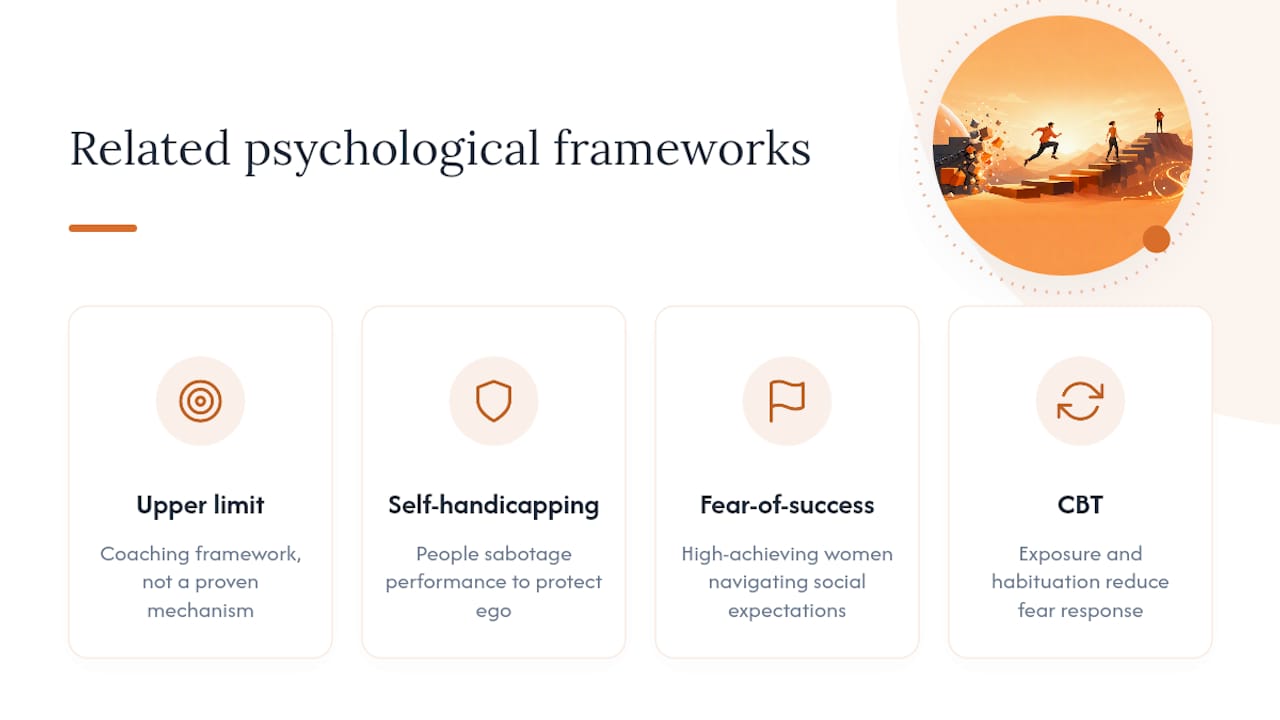
None of that contradicts Hendricks. It’s more accurate to say the upper limit problem is a useful, memorable label for a cluster of behaviors that several other schools of psychology also study, just with different vocabulary. The amygdala-threat framing holds up reasonably well as a simplified explanation, but it’s a shorthand for a much more complicated stress response system, not a complete neuroscience account. Where the model is thinner is falsifiability. It’s hard to design an experiment that proves or disproves a “happiness thermostat” exists as a discrete internal mechanism. Treat it as a practical framework that organizes real, observable behavior, useful for changing your patterns, less useful as a settled scientific fact.
What Actually Changes When People Work Through This
The pattern rarely disappears after one insight. It fades with repetition, and the people who make it stick tend to describe the same arc: a rough two or three months of noticing triggers followed by a slow lengthening of the stretches where good things stay good.

One illustrative case, drawn from coaching accounts built on Hendricks’ framework, follows a mid-career professional who kept getting close to a promotion and then missing a deadline or clashing with a manager right before the decision. Within a few months, the pattern of last-minute self-defeat stopped repeating, and the promotion followed. The outcome wasn’t a personality overhaul. It was a narrower, more specific fix: one trigger, tracked and interrupted enough times that the brain stopped treating success as a threat.
That’s the realistic long-term picture. Not a permanent cure, but a wider tolerance band that keeps expanding as long as you keep doing the small experiments.
Upper Limit Problem vs. Self-Sabotage vs. Impostor Syndrome
These three overlap enough to get confused constantly, but they’re not the same thing.
| Concept | Core mechanism | Typical trigger |
|---|---|---|
| Upper limit problem | Internal ceiling on tolerated happiness/success | Positive events (wins, love, money) |
| Self-sabotage | Broad umbrella term for any self-defeating behavior | Can occur with or without prior success |
| Impostor syndrome | Belief you don’t deserve your position despite evidence | Ongoing, tied to identity and competence, not a single event |
Self-sabotage is the umbrella category. The upper limit problem is a specific, named variety of it that Hendricks tied directly to a spike in something good happening. Impostor syndrome is narrower still and usually chronic: it’s less about a single trigger event and more about a standing belief that you’re fooling everyone. They frequently travel together. Someone with impostor syndrome often has an upper limit problem too, because the underlying belief (“I’m fundamentally flawed” or “I don’t belong here”) feeds both patterns.
A Founder’s Note on Watching This Pattern Play Out
I’ve spent enough time around people rebuilding their lives after loss to notice a consistent tell: the moment things start improving is often when people quietly pull back, not push forward. It matches my own experience of clawing back from divorce, job loss, and near deportation. The setbacks weren’t the hardest part. Staying steady once things started working again was.
One case that stuck with me involved someone who kept quitting new ventures within weeks of their first real sign of traction, a pattern she’d repeated three times before she named it. The intervention wasn’t dramatic: she tracked her triggers for two weeks, then practiced sitting with unqualified praise instead of deflecting it. Eight months later, the venture she’d almost abandoned twice was still running, and she said the anxious spike after a win had shrunk from days to minutes.
, Elvis
A Guided Path if You Want Structure Around This Work
Reading about the upper limit problem gets you halfway there. The harder part is running the actual experiments week after week without losing momentum, especially in the early stretch when the amygdala’s alarm is loudest and quitting feels easiest. Livethelifeofyourdreams built its program specifically for that gap: structured digital courses that pair Hendricks-style behavioral exercises with breathwork, meditations, and neuroscience explanations, so you’re not guessing what to do next or relying on willpower alone.

It’s built for people who’ve already tried journaling or affirmations and found them too vague to stick, and who want something more sequenced than a single inspirational book. The time commitment is modest, a short daily practice rather than an hour-long ritual, which is part of why it holds up past week two. If you want a real starting point rather than another article to bookmark, explore the guided program at Livethelifeofyourdreams and see which track matches where you’re stuck right now.
Sources
- Hitting Your ‘Upper Limit’? How To Overcome This Common Psychological Hiccup, Forbes
- Solving the Upper Limit Problem with Gay Hendricks, Podcast (Apple Podcasts)
FAQ
What Is the Upper Limit Problem?
It’s a self-imposed ceiling on how much happiness, success, or love you’ll allow yourself before you unconsciously self-sabotage, a term coined by Gay Hendricks in The Big Leap.
What Does “Upper Limit” Mean in This Context?
It refers to an internal threshold for tolerated positive experience. Cross it, and stress, guilt, or self-sabotaging behavior tends to follow, even when nothing external has gone wrong.
What Is the Upper Limit Problem in The Big Leap?
Hendricks frames it as an internal “happiness thermostat” that keeps you within a narrow, familiar range and identifies four hidden barriers, including the belief of being fundamentally flawed, that maintain the ceiling.
Is the Upper Limit Problem the Same as Impostor Syndrome?
No. Impostor syndrome is a chronic belief that you don’t deserve your position, while the upper limit problem is triggered specifically by a positive event and tends to respond well to graduated, experiment-based practice.
Frequently asked questions
What is the upper limit problem?
The pattern where good things get quietly sabotaged once they exceed your internal thermostat for how much good you tolerate, described by Gay Hendricks. The win creates anxiety, the anxiety manufactures a problem.
How do I know my upper limit is the issue?
The tell is the timing: sabotage appears right after wins, not before attempts. Arguments, sudden illness, or dropped balls that arrive on schedule with success point at a ceiling, not bad luck.
Can the ceiling actually move?
Yes. The eight week plan raises it gradually: notice the sabotage early, expand in tolerable doses, and keep the win while feeling the discomfort until the new level feels normal.
Keep exploring
- How To Reframe Limiting Beliefs from Scarcity to Abundance
- Manifest Money: Practical Rituals and an Action Plan
- Abundance Mindset: Practical Steps to Think Bigger
- Think and Grow Rich Summary: 13 Principles Explained
- Andrew Carnegie’s Wealth Secrets for an Abundance Mindset
- Wealth Psychology: The Evidence-Based Manifester’s Guide