
A money block is a subconscious belief or emotional pattern that limits how you earn, keep, or ask for money. It usually formed before you could argue with it, which is why willpower alone rarely dissolves it… The good news: money blocks are common, they follow recognizable patterns, and you can start shifting one this week just by naming a recurring money reaction and testing it against reality.
TL;DR:
- Most money blocks stem from early emotional patterns and beliefs absorbed in childhood, which activate automatically in response to money decisions.
- Recognizing specific scripts like avoidance, worship, status, or vigilance helps target the underlying reflexes that drive unhelpful financial behaviors.
- Effective change combines nervous-system regulation techniques with small, evidence-backed experiments, rather than relying on affirmations alone.
- External structural proof, such as paid invoices or contracts, is crucial to shifting feelings and beliefs more permanently than just mental repetition.
- Ongoing vigilance and gradual recalibration are necessary because money blocks tend to resurface at new income levels or relationship changes.
Table of Contents
- What Is a Money Block, Really?
- What Do Money Blocks Actually Look Like?
- Where Do Money Blocks Come From?
- How Do You Know If You Have Money Blocks?
- How to Clear Money Blocks: A Step-by-Step Process
- What the Research Says About Why This Works
- How Money Blocks Shape Everyday Financial Behavior
- Money Blocks Rarely Stay in Your Bank Account
- The Psychology Behind Money Blocks
- Myths That Keep Money Blocks in Place
- Our Take: Why Half-Measures Don’t Clear Money Blocks
- Ready to Rewire the Belief, Not Just the Mindset?
- Sources
- FAQ
What Is a Money Block, Really?
A money block is not a character flaw. It’s a learned association, wired into the nervous system, that tells you money is dangerous, shameful, or something you don’t deserve. That belief then drives concrete behavior: undercharging, avoiding your bank app, or quietly sabotaging a raise you asked for.
Psychologist Brad Klontz built a useful framework for sorting these patterns into what he calls “money scripts.” He identifies four core beliefs that shape most people’s financial behavior, and recognizing which one fits you is often the fastest route to change:
- Money Avoidance, the belief that money is bad or that wealthy people are corrupt, which leads to underearning and financial self-neglect.
- Money Worship, the belief that more money will finally fix your problems, which fuels overspending and chronic dissatisfaction even as income rises.
- Money Status, tying self-worth directly to net worth, which produces spending aimed at appearances rather than security.
- Money Vigilance, a hyper-alert, scarcity-driven watchfulness that can tip into anxiety and an inability to enjoy money even when it’s plentiful.
Here’s the part most people skip: these scripts run below conscious awareness. You don’t decide to undercharge a client. Your body flags the invoice as a threat, your heart rate ticks up, and you hit “send” with a lower number before you’ve thought it through. That’s the nervous system protecting you from an old danger that no longer exists. Understanding a money block means understanding that it’s less a thought and more a reflex.
What Do Money Blocks Actually Look Like?
Money blocks rarely announce themselves as beliefs. They show up as habits you’ve stopped questioning, the kind that look like personality quirks until you trace them back to a pattern.
- The invoice you “forget” to send. You did the work, you’re owed the money, and somehow three weeks pass. This is classic Money Avoidance: the paperwork itself feels like an unwanted confrontation.
- The raise you talk yourself out of asking for. You rehearse the conversation, build the case, then decide “now isn’t the right time” for the fourth quarter in a row. Underneath is usually a fear that wanting more makes you greedy.
- The bonus that disappears in a weekend. A windfall arrives and within days it’s spent on things you can’t quite remember buying. This is Money Worship colliding with a scarcity script: money doesn’t feel real until it’s gone.
- The business that stalls right before its best month. A missed deadline, a canceled launch, a client you suddenly can’t return calls from. This is the self-sabotage pattern tied to what coaches sometimes call the upper-limit problem: growth outpaces your internal sense of what you deserve, and something breaks to restore the old equilibrium.
- The refusal to look at the bank balance. Not because you’re careless, but because looking feels dangerous. Vigilance types check obsessively; avoidance types check almost never.
- The discount you offer before anyone asks. You quote a price, then immediately undercut it out of guilt. The block isn’t about the client’s budget. It’s about your own comfort with being paid well.
Pro Tip: For one week, keep a one-line note every time you feel a jolt of anxiety, guilt, or relief around a money decision. Don’t analyze it yet. Just log the trigger and the feeling. Patterns jump out fast once they’re written down instead of just felt.
Where Do Money Blocks Come From?
Most money blocks trace back to what’s sometimes called a “money blueprint,” the set of beliefs a child absorbs from watching adults react to money long before they understand what money even is. A parent’s clenched jaw at the mail, a hushed argument about bills, a grandparent’s Depression-era hoarding of leftovers and cash alike. None of it needs to be explained for a child to learn the lesson.
Annie Wright, a therapist who writes about money as a relational issue, points out that money carries lessons about power, safety, dependence, and belonging that get absorbed long before a person earns their first paycheck. The feelings you have about a bank statement today are often echoes of much older relational stories: who had control in your household, who felt safe, who belonged and who didn’t.
Common early messages that harden into adult blocks include:
- “Money doesn’t grow on trees” (scarcity as a permanent state, not a temporary condition)
- “We don’t talk about money” (shame and secrecy around finances)
- “Rich people are greedy” (moral suspicion of wealth)
- “Be grateful for what you have” (guilt attached to wanting more)
- “Your father works himself to death for this family” (money equals sacrifice and exhaustion)
These aren’t just ideas you were told. They were absorbed alongside a felt emotional state, tension in the room, a parent’s fear, a sense of instability, which is why the belief lives in the body as much as the mind. That combination of thought and physiological reaction is what makes a block so sticky, and so hard to argue away with logic alone.
How Do You Know If You Have Money Blocks?
Some signs are obvious once you’re looking for them: chronic underearning despite real skill, anxiety that spikes at the sight of a bank app, a pattern of sabotage right when things start going well. Others are quieter, like a persistent vague dread you’ve never traced to its source.
A short self-assessment can surface more than a week of casual self-reflection ever will. Set aside a notebook and answer these seven questions daily for one week, ideally covering both a slow day and a day when money actually moves through your hands.
- What did I feel the last time I checked my bank balance?
- Did I avoid a money task today (an invoice, a budget review, a financial conversation)? If so, what feeling came right before the avoidance?
- Did I undercharge, overspend, or give something away today that I meant to be paid for?
- What did my parents or caregivers say about money when I was a child, and did I hear an echo of it today?
- When did I last feel proud of a financial decision, and what made that moment different?
- Is there a financial goal I keep setting and quietly abandoning?
- What would change in my life if I earned twice as much this year, and does that thought feel exciting or unsafe?
Track your answers across at least one full pay cycle, not just one week in isolation. Blocks often intensify right after a win, a raise, a big sale, a client landing, which is exactly when the old blueprint feels most threatened and works hardest to restore familiar territory.
How to Clear Money Blocks: A Step-by-Step Process
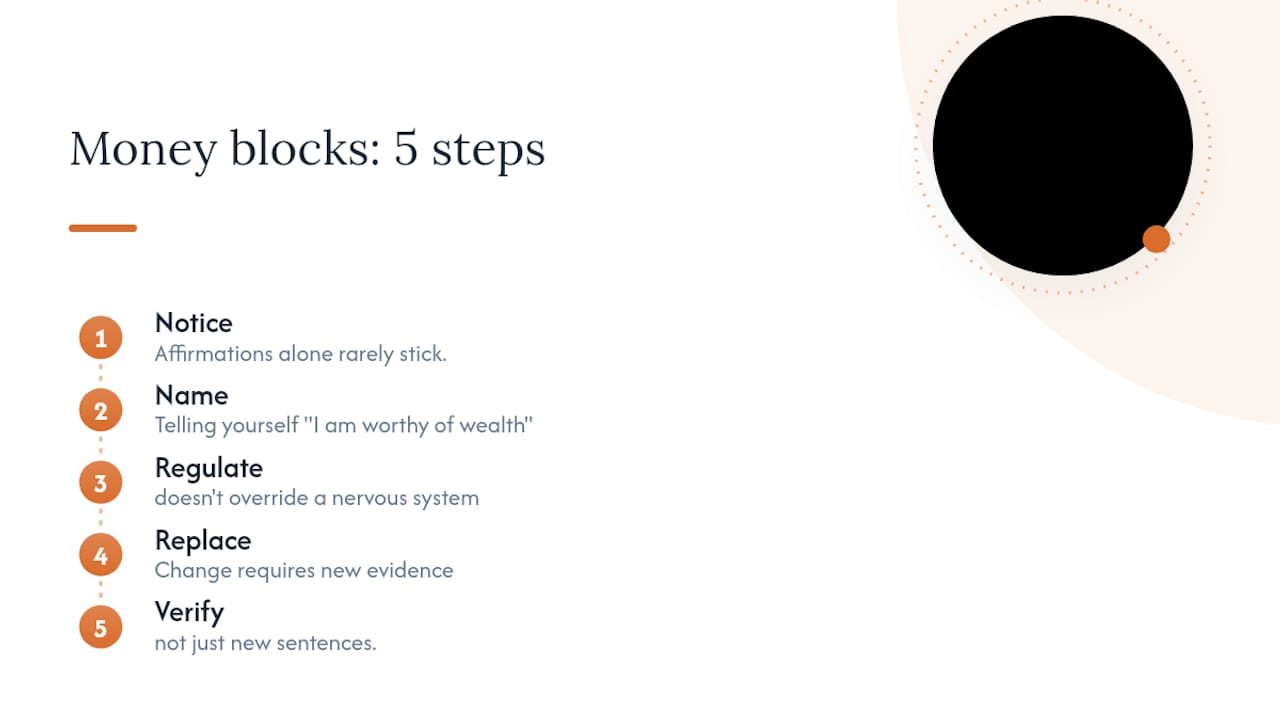
Affirmations alone rarely stick, and there’s a reason for that. Telling yourself “I am worthy of wealth” in the mirror doesn’t override a nervous system that’s spent decades treating money as dangerous. Change requires new evidence, not just new sentences. The process below moves through five stages: Notice, Name, Regulate, Replace, Verify.
Step 1: Notice the trigger
You can’t interrupt a pattern you can’t see. Use the self-assessment questions above, or simply keep a running note every time a money decision produces a disproportionate emotional reaction, guilt over a fair price, dread before opening a bill, euphoria that spends itself away within days.
Step 2: Name the source
Once you’ve caught a trigger, ask where it came from. Is this Money Avoidance whispering that wanting more makes you a bad person? Is it a Vigilance script insisting that spending anything is reckless? Naming the script, out loud or on paper, moves the reaction from an automatic reflex into something you can examine.
This step also means being honest about “financial scar tissue,” beliefs that formed after a real betrayal, a business partner who cheated you, a family member who borrowed and never repaid, a divorce that gutted your savings. Those aren’t irrational fears. They’re a nervous system that learned a real lesson and hasn’t yet been shown it’s safe to update.
Step 3: Regulate before you reframe
Trying to think your way out of a triggered nervous system rarely works, because the thinking brain goes partially offline under stress. Before you attempt any cognitive reframe, calm the body first.
A simple option: inhale for four counts, hold for four, exhale for six, and repeat for one minute before you open that invoice or check that balance. This isn’t a mystical step. It’s a practical way to bring your heart rate down enough that your prefrontal cortex, the part capable of reasoning through a new belief, can actually participate. Somatic regulation techniques like breathwork and grounding reduce nervous-system reactivity to money triggers, which is precisely what makes the next step possible.

Step 4: Replace the belief with a small experiment
This is where most self-help advice stops short, and where it needs to keep going. A new belief doesn’t take root because you repeated it. It takes root because you tested it and it held.
Try a 10% pricing experiment: raise your rate on the next quote by 10% and send it without apologizing or over-explaining. Notice what actually happens versus what your block predicted would happen. If a client says yes, you’ve just generated real evidence against the belief that you’re not worth more. If a client says no, you’ve learned information about that specific client, not proof that the old belief was correct all along, an important distinction most people skip.
Journaling prompts that support this step:
- What did I predict would happen before I sent that price/invoice/ask?
- What actually happened?
- What does the gap between prediction and reality tell me about the original belief?
Step 5: Verify with structural evidence
Feelings shift fastest when they’re backed by proof you can hold in your hand: a signed contract, a paid invoice, a bank transfer that actually cleared. This is why the financial thermostat concept matters. Income tends to snap back to a familiar level until your internal setting changes, and that setting shifts through repeated, verified proof rather than a single good week.
If past betrayal is part of your story, add real structural safeguards, contracts, clear payment terms, a second signature on major decisions, so your nervous system has external proof of safety to lean on while it recalibrates. This matters just as much as the emotional work; a body that’s been burned once needs more than a pep talk to trust again.
Pro Tip: Pick one belief this week and one very small, low-stakes action to test it. Don’t try to overhaul your entire financial life at once. Overcorrecting can trigger the exact protective sabotage you’re trying to clear.
A one-day micro-workflow you can try right now
Morning: write down one money task you’ve been avoiding and the feeling attached to it. Midday: do a two-minute breathing regulation before tackling that task. Afternoon: complete the task (send the invoice, ask the question, check the balance) and write down what actually happened versus what you predicted. Evening: log one piece of disconfirming evidence, however small, in a running list you can return to on harder days.
What the Research Says About Why This Works
None of this is guesswork stitched together from wishful thinking. Klontz’s money-script research gives the taxonomy: four repeatable patterns that explain a huge share of the financial behavior people can’t otherwise account for. Once you know which script is running, the specific behaviors, the undercharging, the avoidance, the compulsive spending, stop looking random and start looking like symptoms of a single root cause.
The nervous-system piece matters just as much. Regulation practices calm the physiological reactivity that hijacks decision-making before a cognitive reframe can land, which is why breathing before a hard money conversation isn’t a soft add-on. It’s the mechanism that makes the rest of the work possible.
Founder Elvis D. Beuses built Livethelifeofyourdreams’s approach around this same combination after two decades in medical and pharmaceutical work, followed by his own experience of divorce, job loss, and a near-deportation that forced him to rebuild his finances from close to nothing. That rebuild is the spine of his international bestseller, and it’s the same material he covers with his YouTube audience, where describe applying these steps to their own sabotage patterns.
A few things worth holding onto from this research:
- Money scripts are a taxonomy, not a diagnosis. You’ll likely see pieces of more than one in yourself.
- Regulation isn’t optional; it’s the step that makes cognitive change actually stick.
- Structural evidence (contracts, paid invoices, verified deposits) does work that affirmations can’t.
How Money Blocks Shape Everyday Financial Behavior
A money block doesn’t just sit quietly in the background. It actively steers decisions you’d otherwise call “practical.” You tell yourself you’re being cautious when you decline a good opportunity, or realistic when you undercharge for skilled work. The block disguises itself as reasonable judgment.
Over time this produces a gap between what someone is capable of earning and what they actually earn, a gap that has nothing to do with skill or market demand. Someone with Money Avoidance patterns might turn down promotions that would raise their visibility. Someone running a Vigilance script might hoard cash so tightly that they miss investments that would have compounded for years. Someone with a Money Worship pattern might chase every raise and bonus without ever feeling like enough has arrived.
The emotional cost compounds the financial one. Chronic money anxiety keeps the body in a low-grade stress state, which affects sleep, decision-making, and even the ability to negotiate calmly. Chronic avoidance breeds shame, since every unopened bill and unsent invoice becomes one more piece of evidence for the belief that you’re bad with money. The behavior and the belief feed each other in a loop that tightens with each repetition, until a small financial stumble feels like proof of a permanent character flaw rather than a single bad week.

Money Blocks Rarely Stay in Your Bank Account
Money blocks bleed into places that have nothing to do with your paycheck. A partner who grew up with Money Avoidance messaging might flinch every time their spouse wants to discuss a joint budget, not because they don’t care, but because the conversation itself feels like danger. That flinch gets read as disinterest or evasiveness, and the relationship absorbs a strain that actually started decades earlier in someone else’s childhood living room.
Self-worth takes a similar hit. When your sense of value gets fused with a Money Status script, every dip in income can feel like a dip in who you are, not just what you have. That’s a heavy thing to carry into a job interview, a first date, or a conversation with your own kids about allowance and chores.
Friendships and family dynamics shift too. Someone running a Vigilance pattern may quietly resent relatives who spend freely, while someone with Money Worship beliefs might overspend on gifts and gatherings trying to buy a sense of belonging they never fully feel they’ve earned. None of this is really about the money on the table. It’s about the older story the money is standing in for, which is exactly why clearing a block often improves relationships that never seemed financial in the first place.
The Psychology Behind Money Blocks
Several overlapping frameworks explain why money blocks form and why they’re so persistent. Klontz’s money-script model treats these patterns as learned financial identities, absorbed early and reinforced through repetition, similar to how any deeply conditioned habit gets wired into automatic behavior.
Attachment-style thinking adds another layer. If early relationships taught you that dependence was unsafe or that asking for help meant risking abandonment, those same fears often resurface around money, since money is fundamentally about interdependence: earning from others, asking to be paid, trusting a partner with shared finances. The “financial thermostat” concept borrows from the same logic that governs weight regulation and other homeostatic systems in the body: change the setting gradually and consistently, and the system recalibrates. Try to force it in one giant leap and it usually snaps back.
None of these frameworks require mysticism to make sense. They describe learned associations, physiological stress responses, and behavioral reinforcement loops, the same building blocks that explain phobias, habits, and plenty of other conditioned patterns. What makes money blocks distinct is simply how early they form and how quietly they operate, since almost nobody sits down and consciously decides their belief about money. It arrives secondhand, absorbed rather than chosen.
Myths That Keep Money Blocks in Place
The biggest myth is that clearing a money block is a one-time event, like flipping a switch. In practice, it works more like fitness: you get better at noticing and resolving the pattern faster, but the underlying tendency doesn’t vanish forever. Expecting permanent elimination sets people up to feel like a failure the first time an old reaction resurfaces.
A second myth: affirmations alone will fix it. Repeating “I am wealthy” without any behavioral evidence to back it up rarely convinces a nervous system that’s been running the opposite program for thirty years. The belief needs proof, not just repetition.
A third myth: money blocks only affect people who are bad with money or lack discipline. Plenty of highly disciplined, financially literate people carry serious blocks; the block doesn’t show up as ignorance, it shows up as a ceiling that discipline alone can’t break through.
A fourth myth: wanting more money is inherently shallow or greedy. This belief is itself a common money script (Money Avoidance in disguise), and it quietly keeps people underearning while calling it humility.
Our Take: Why Half-Measures Don’t Clear Money Blocks
Most manifestation advice treats money blocks like a vibe problem: raise your frequency, say the right affirmation, visualize the number, and the universe handles the rest. That advice isn’t entirely wrong, mindset genuinely matters, but it skips the part that actually does the work: proof. A belief formed by lived experience only changes when it meets new lived experience, not when it meets a nicer sentence.
At Livethelifeofyourdreams, our approach blends with CBT-style reframing and nervous-system regulation, because ancient wisdom asks the right questions about identity and worth, while the psychology and physiology explain why the answers need to be tested, not just believed. This isn’t a fast fix. Expect ongoing vigilance rather than a finish line: money blocks resurface at new income levels, new relationships, and new risks, and the goal is catching them faster each time, not eliminating them once and moving on.
Readers who’ve gone through tend to report the same thing: the shift wasn’t a single breakthrough moment. It was a string of small experiments that, stacked over weeks, finally gave their nervous system enough evidence to stop bracing for the old story.
, Elvis
Ready to Rewire the Belief, Not Just the Mindset?
You’ve read the framework: notice the trigger, name the script, regulate the body, run the experiment, verify with real evidence. Livethelifeofyourdreams built two structured programs around exactly that sequence, so you’re not left rebuilding it from scratch on your own.

Rewire Limiting Beliefs in 8 Micro Shifts walks you through the Notice, Name, Regulate, Replace, Verify sequence using CBT-style reframing paired with neuroscience explanations, in eight small, manageable shifts rather than one overwhelming overhaul. It’s built for anyone who read the self-assessment above and recognized more than one pattern in themselves.
If your block shows up specifically as sabotage right when things start going well. Canceled launches, stalled deals, disappearing momentum, Stop Sabotaging Wins is an 8-week plan built around that exact upper-limit pattern, with weekly structure instead of a single course you work through alone.
Both programs give you the small-experiment framework this article describes, plus the accountability structure that makes people actually run the experiment instead of just reading about it. Start with whichever one matches the pattern you caught in your own journaling this week, and expect steady, incremental movement rather than an overnight fix.
Sources
- Financial psychologist: Americans’ core money beliefs
- Money’s a therapeutic issue, so what are your beliefs?, Annie Wright
- How to Overcome Limiting Beliefs About Money (The Income Ceiling Nobody Talks About) – Work With David Wood
FAQ
What is a money block?
A money block is a subconscious belief or emotional pattern, usually formed in childhood, that limits how much you earn, keep, or feel comfortable asking for. It shows up as automatic behavior like undercharging or avoiding invoices rather than as a conscious decision.
What are the four numbers to attract money?
There’s no verified psychological or financial basis for a specific “four numbers” formula for attracting money; this idea circulates in numerology and manifestation communities without scientific backing. The evidence-based approach in this article, naming your money script and testing it with real experiments, has far more support than any numeric formula.
How can I manifest money quickly?
There’s no shortcut that bypasses evidence entirely, but the fastest real movement comes from combining a brief nervous-system regulation practice with one immediate small experiment, like sending an overdue invoice or quoting a slightly higher price. The 10% pricing experiment in the step-by-step clearing process is designed for exactly this.
What is a powerful mantra to remove money blocks?
A single mantra rarely works alone, but pairing a short phrase like “I am safe to receive more than I currently have” with a regulation breath and a real behavioral test tends to work better than repetition by itself. The phrase matters far less than whether you follow it with proof.
How do I know which money script I have?
Track your emotional reactions to money decisions for one week using the seven-question screener in this article, then compare your answers against Klontz’s four categories: Avoidance, Worship, Status, and Vigilance. Most people recognize elements of more than one script.
Quick reference
| Key | Practice | |
|---|---|---|
| Block | How it shows up | First clear |
| Underselling | Discounts before anyone asks | Raise one price this week |
| Avoidance | Statements unopened | One calm look, tonight |
| Fear of visibility | Work hidden, offer unposted | Post the thing, small |
| Wealth guilt | Self-sabotage after good weeks | Name what money funds |
Frequently asked questions
What are money blocks?
Learned beliefs and habits that cap what you earn, keep, or ask for: underselling, avoidance, fear of visibility, guilt about having. They are common, learned, and unlearnable.
How do I know which money block I have?
Look at where you stall: the unopened statement is avoidance, the reflexive discount is underselling, the unposted offer is visibility fear. The guide’s table maps each block to its first clearing step.
How long does clearing a block take?
The first behavioral shift can land within a week of practice. The block is considered cleared when the new behavior runs without a pep talk, usually after a month.
Continue reading
- Make Subliminals for Wealth Actually Move Your Money in 8 Weeks
- 15 Money Mindset Shifts That Turned Broke Beginners Into Abundance Magnets
- New Law of Attraction Books You Must Read to Attract Abundance
- How To Reframe Limiting Beliefs from Scarcity to Abundance
- Andrew Carnegie’s Wealth Secrets for an Abundance Mindset
- Wealth Psychology: The Evidence-Based Manifester’s Guide