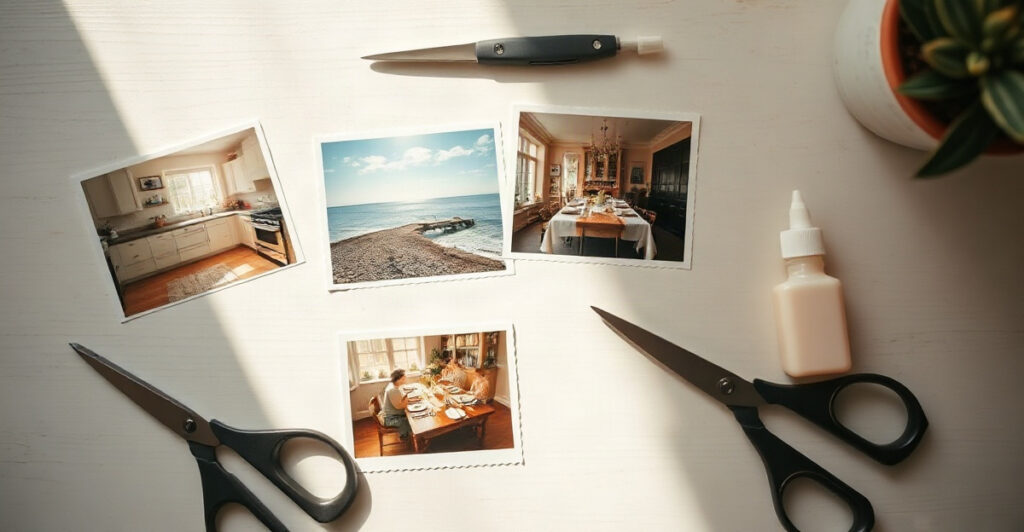
The best vision board pictures are specific photos of the life you want, chosen because they make you feel something, not because they look pretty. Pick 1 to 3 pictures for each area of life you care about, find them in your own photos, magazines or free stock sites, and place the biggest one in the center. This guide tells you which pictures to choose for each life area, what to type into a search box to find them, and how to arrange them so the board gets looked at every day.
What pictures should you put on a vision board?
Put pictures on your vision board that show a specific piece of the life you want and that give you a small lift in your chest when you look at them. That second part is the real test. A photo can be gorgeous and do nothing for you. Another photo can be a little blurry and make you sit up straighter.
Before you add any picture, ask it three questions.
- Is it specific? “A small white kitchen with a window over the sink” beats “a nice house.”
- Do I feel it? If you feel nothing, it’s decoration. Leave it off.
- Is it mine? If you only want it because someone else wants it, it belongs on their board.
Pictures that pass all three tests tend to fall into a few groups: the life you want to live, the people and places that give you peace, the progress you’ve already made, and the daily actions that lead there. We’ll go through each group by life area below, and the last group, the daily actions, is the one most people forget.
Which vision board pictures work for each area of your life?
Each area of life has its own kind of picture that works best, and the table below gives you what to look for, what to search, and what to avoid. Use it like a menu. You don’t need all 8 areas, so choose the 3 or 4 that matter most right now.
| Life area | Pictures to look for | Search words to try | Avoid |
|---|---|---|---|
| Money | What the money is for: a debt-free letter, a savings jar, a paid-off home | “savings jar,” “paid in full,” “cozy home keys” | Piles of cash and luxury cars you don’t want |
| Career | The real workspace, tools in use, people doing the work | “studio desk,” “teacher classroom,” “chef kitchen” | Generic handshake and suit photos |
| Health | Habits and feeling: a morning walk, a full plate, a rested bed | “morning walk,” “healthy meal prep,” “stretching at sunrise” | Airbrushed bodies you’ll compare yourself to |
| Love and family | Real photos of your people, or shared activities | “picnic table,” “walking hand in hand,” “family dinner” | Pictures of one specific person you haven’t met |
| Home | Rooms and light you’d actually live in | “reading nook,” “sunny kitchen,” “garden bench” | Mansions that don’t suit your life |
| Travel | One place, one season, one thing you’ll do there | “coastal village morning,” “mountain trail,” “market street” | A dozen random landmarks |
| Inner life | Stillness: candles, open journals, quiet water | “morning meditation,” “open journal,” “still lake” | Clutter and busy collages |
| Joy and giving | Play, hobbies, service, laughter | “painting outdoors,” “community garden,” “friends laughing” | Pictures of what you think you should enjoy |
What pictures represent money on a vision board?
The best money pictures show what your money will do, not the money itself. A photo of a paid-off house key, a child’s college campus, or a quiet retirement porch connects your mind to a reason, and reasons keep you moving when budgeting gets boring. Put the actual number next to the picture in your own handwriting. If you want to go deeper, our guide to a vision board for finances walks through it step by step.
What pictures represent career and purpose?
Career pictures work best when they show the real place and the real work, such as a ceramics studio, a classroom or a busy restaurant kitchen. BetterUp’s guide to vision boards points out that you can represent a career indirectly, like ocean animals for marine biology. That’s a nice trick when the work itself is hard to photograph. Add a picture of the people you’d work with if you can find one.
What pictures represent health and your body?
Health pictures should show the daily habits and the feeling of being well, rather than a body type. Choose a morning walk on a trail, a table with a colorful meal, a window in a bedroom made for sleep. Pictures of a perfect body invite comparison, and comparison drains energy fast. Pictures of habits invite a Tuesday afternoon walk.
What pictures represent love and family?
The strongest pictures for love and family are real photos of the people you already have, plus one picture of the kind of moment you want more of. A long dinner table works. So does a couple laughing on a porch. If you’re hoping to meet a partner, choose pictures of the life you’d share, not a stranger’s face. That keeps your focus on being the person who’s ready.
What pictures represent home?
Home pictures should show the light, the layout and the feeling of your ideal space, not just its price tag. You might want a reading nook with a lamp, a sunny kitchen, a garden bench. When you find them, notice the repeating pattern: maybe it’s always wood, always windows. That pattern is your real taste, and you can start borrowing from it in the home you have today.
What pictures represent travel?
Choose one destination, one season and one activity for each travel picture, such as spring in a coastal village with a morning walk to the bakery. A long list of landmarks gives your mind nothing to hold. One place with real detail gives you a reason to open a savings account. Then you can add a second picture when the first is booked.
What pictures represent your inner life?
Pictures for your inner life should be quiet: a candle, a still lake, an open journal, an empty chair by a window. This is the area where less is more. Choose one or two images that make your shoulders drop, and leave plenty of empty space around them. Our free printable vision board kit includes calm layouts made for this kind of board.
What pictures represent joy and giving?
Joy pictures show play and service: paint on a palette, a community garden, a group of friends laughing. Many people leave this area off, then wonder why the board feels heavy. A single picture of something you do just for the fun of it tells your mind that your life is allowed to be enjoyed along the way, not only at the finish line.
Should you use pictures of having or pictures of doing?
Use both: pictures of having show where you’re going, and pictures of doing show the steps that get you there, and the second kind matters more than most guides admit. The research is worth knowing. Psychologist Gabriele Oettingen found that people who only fantasize about a good outcome can feel less energized afterward, and her WOOP method pairs the wish with an obstacle and a plan. In a separate study, Lien Pham and Shelley Taylor found that students who pictured the process of studying did better on their exam than students who pictured the grade.
So for each area you’ve chosen, add a small “doing picture” next to the big “having picture.” A paid-off home gets a coin jar. A healthy body gets sneakers by a door. A new career gets a hand on a keyboard. A close family gets a phone being dialed.
That row of small pictures is the part I’d save if I could only keep one tip from this whole guide. It turns a board you admire into a board that asks something of you every day. The evidence is not strong that images alone change outcomes, and I won’t pretend it is. But pictures plus a next step is a combination with real support behind it.
Where can you find vision board pictures?
You can find vision board pictures in your own photo library, in magazines, on free stock photo sites, through image search and on Pinterest. Each source has its own strength, and the best boards mix at least two. The table compares them.
| Source | Cost | Best for | Watch out for |
|---|---|---|---|
| Your own photos | Free | Family, friends, places you’ve loved, progress you’ve made | Blurry or dark pictures that don’t print well |
| Magazines and catalogs | Free to low cost | Cut-and-paste boards, home, travel, food | Limited choice of subjects, and ads in the way |
| Free stock photo sites | Free | Specific scenes, high quality, printable | Reading each site’s license |
| Paid stock sites | Paid | Very specific or professional images | Cost adds up for a hobby project |
| Pinterest and image search | Free | Finding ideas fast, building a private inspiration board | Images owned by others, so keep it personal |
| Stickers and postcards | Low cost | Quick accents and texture | Small size, easy to overcrowd |
One tip that saves hours: before you search, write the list of pictures you need, 1 to 3 per area. Then search for exactly those. Without a list, an hour of browsing turns into 200 saved images and a board you can’t finish.
Magazines are underrated. The slow work of flipping pages, looking for what makes you pause, is a kind of listening. You’ll find magazines at home, from friends, at a doctor’s office waiting room if they’re offering them, or at thrift stores and recycling centers.
Are online pictures copyright protected?
Most online pictures are protected by copyright, so for anything beyond your own private board, use images from your own camera or from sites that grant free use. For a board that hangs in your bedroom, the practical risk is tiny. If you plan to post your board publicly or sell a printable, the rules change.
Free stock sites like Unsplash and Pexels publish licenses that allow broad free use. Read the license page before relying on it, because rules can change. When in doubt, take the picture yourself. A photo of your own front porch, a local trail or a friend’s garden can be more powerful than any stock image, since it’s real.
How do you arrange pictures on a vision board?
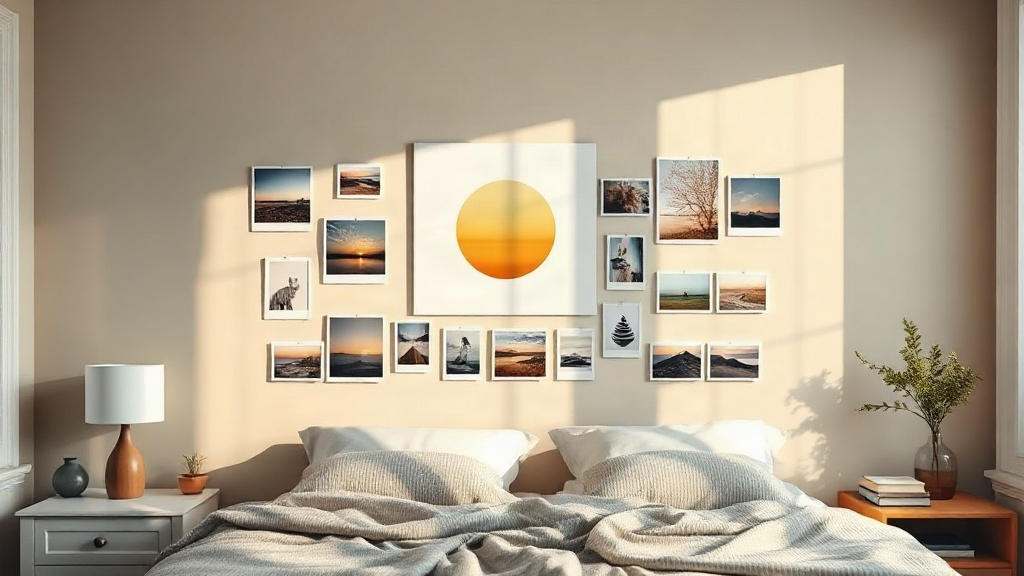
Arrange your pictures in three layers: one large anchor picture in the center, a ring of medium pictures around it, and a strip of small doing pictures along the bottom. The center holds the feeling you want most. The ring covers your chosen life areas. The strip holds the daily steps.
- Choose the anchor. It should be the single picture that makes you smile fastest. Give it about a third of the board.
- Place 4 to 6 medium pictures around it, one per life area, with a little space between them.
- Add the doing strip across the bottom: one small action picture for each area you chose.
- Leave empty space. A board that breathes gets looked at. A crowded board turns into wallpaper within a week.
- Add 3 to 5 words in your own handwriting, such as “enough” or “my kitchen.” Our vision board affirmations guide gives phrases to choose from.
Some traditions, such as feng shui, assign each area of life to a part of the board or room. That’s a lovely ritual if it speaks to you, but there’s no research showing it changes results, so use it for meaning, not for rules. The layout above is built for attention, and attention is what you can measure in your own days.
How many pictures and what size should a vision board have?
A good vision board holds 8 to 15 pictures on a board between 11 by 14 inches and 24 by 36 inches, with the anchor picture at least twice as big as the others. Smaller boards sit well on a desk or fridge. Larger ones suit a bedroom wall. For a phone lock screen, use 4 to 6 pictures so each stays readable at a glance.
Print pictures on matte paper if you can, because glossy surfaces catch the light and make glue wrinkles show. A standard 4 by 6 inch print is a good size for medium pictures, and 2 by 3 inches works for the doing strip.
Can you make a digital vision board or a wallpaper?
Yes, a digital vision board works well as a phone lock screen or desktop wallpaper because you see it many times a day. Use free design tools like Canva or the photo collage tools already on your phone. Size the board for the screen: tall for a phone, wide for a laptop.
Keep the digital version simpler than a paper one, with 4 to 6 pictures and 1 or 2 words, so it stays readable. And if you made a paper board, photograph it and set that photo as your lock screen. Then you have the best of both: the slow hands-on making, and the constant daily glimpse. For more ways to organize, see our guide to vision board ideas and examples and the 15 vision board ideas to manifest your dreams.
What mistakes should you avoid when choosing pictures?
The most common mistakes are choosing pictures that look good but mean nothing to you, using too many, and picking images of other people’s bodies, houses and incomes. Fixing each one takes only a few minutes.
- Pretty but empty. If you feel nothing, remove it.
- Too many. Past 15, your eye can’t land anywhere.
- Comparison pictures. Avoid images that make you feel behind.
- Vague pictures. “A beach” is weak. “That small beach where I can walk to a cafe” is strong.
- No doing pictures. Add the strip so the board asks for action.
A vision board is a way of paying attention on purpose. Choose pictures you can feel, show the steps as well as the finish line, and let your board change as you do.
Frequently asked questions
What are good vision board pictures for manifesting?
Good vision board pictures for manifesting are specific, personal and emotional: a particular kitchen, a particular trail, the faces of people you love, and small images of the daily steps toward your goal. Specific images give your attention something concrete to notice, which is the real working part of a board.
A good rule is 1 to 3 pictures per life area, plus a small action picture beside each. For example, pair a picture of a paid-off home with a coin jar. Skip images that only look impressive. If you feel nothing when you look at a picture, replace it with one that makes you lean forward.
Where can I get free vision board pictures?
You can get free vision board pictures from your own phone photos, from magazines you already have, and from free stock sites such as Unsplash and Pexels, which publish licenses that allow broad free use. Pinterest is useful for finding ideas, though those images belong to other people.
Before you search, write a list of 1 to 3 pictures you need per area, then search by exact words like “morning walk” or “reading nook.” That keeps you from saving hundreds of images. For a private board in your home, the stakes are small, but read each license before posting a board publicly or sharing a printable.
How many pictures should be on a vision board?
A vision board should have 8 to 15 pictures, with one larger anchor picture in the center. That’s enough to cover your chosen life areas and still leave space for your eye to rest. Past 15, a board usually turns into wallpaper and you stop seeing individual pictures.
For a phone lock screen, use only 4 to 6. The test is to point to any picture and say why it’s there in one sentence. If you can’t, take it down. Keep leftover pictures in an envelope for your next update in 3 to 6 months.
Should vision board pictures be of real people or stock photos?
Use real photos for the people you already love, and stock or magazine pictures for places, rooms and experiences you don’t have yet. Real photos carry real feeling, and your mind responds to faces and moments it knows.
For a future partner, avoid a stranger’s face. Choose a picture of the life you’d share, like a table for two or a trail walk, so your board points at readiness and not at one particular person. If your photo of a place is poor quality, a free stock picture of a similar scene works fine.
Do vision board pictures need to be printed?
No, vision board pictures don’t need to be printed; a digital board on your phone or computer can work just as well if you see it every day. Printing has an advantage in slowing you down: cutting, arranging and gluing makes you decide what truly belongs.
Many people do both by building a paper board and photographing it for a lock screen. If you print, use matte paper at about 4 by 6 inches for medium pictures and keep the anchor at least twice as large. Whichever way you go, the daily glance matters more than the format.
What if my vision board pictures stop feeling exciting?
If a picture stops feeling exciting, replace it, because that feeling is the most useful signal a board gives you. Your goals may have changed, been met, or turned out to be someone else’s idea, and any of those is a fine reason to swap the image.
Ask whether the picture still makes you lean forward. If it was reached, write the date on it and keep it on a done page as proof of progress. If you aren’t sure, move it to the edge for a month. A fresh picture every 3 to 6 months keeps the board alive.
The universe loves a clear picture and a willing step. Start collecting yours tonight, and get a free “message from the universe” in your inbox every morning, plus the abundance meditation. If you’re building a new year board, our new year vision board guide is a good next read.
Part of our guide: Vision Boards: The Complete Guide
Keep reading
- Travel Vision Board Ideas for Your Dream Destinations
- Dream Home Vision Board: How to Make One That Works
- Money Vision Board Pictures: What to Choose and Where