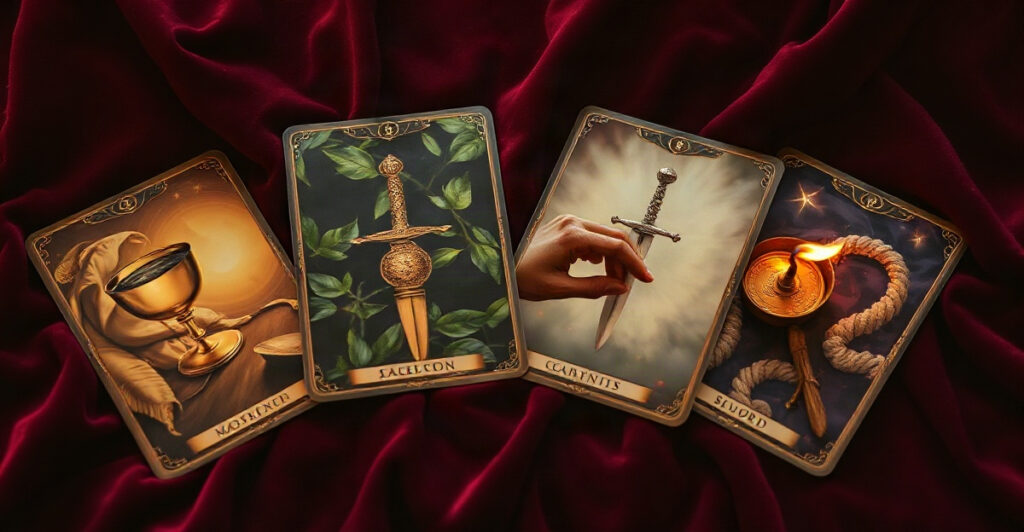
The four tarot suits are Cups (emotions and relationships), Pentacles (money and the physical world), Swords (thoughts and conflict), and Wands (passion and action). Each suit runs from Ace to Ten, then hands off to four court cards. Learn what each suit means and the numbers stop feeling random.
What are the four suits in tarot?
A tarot deck’s Minor Arcana holds 56 cards in four suits: Cups, Pentacles, Swords, and Wands, with 14 cards each. Every suit covers one domain of daily life. Cups govern the heart, Pentacles govern the material world, Swords govern the mind, and Wands govern energy and drive. When you understand which domain a card belongs to, you already know half its meaning before you read a single symbol.
The suits map directly onto the four classical elements, a system recorded in medieval and Renaissance occult texts such as the Liber de Quatuor Elementis tradition and carried into modern tarot by the Hermetic Order of the Golden Dawn in the 1880s. That elemental mapping is still the backbone of how nearly every modern reader interprets the Minor Arcana.
| Suit | Element | Domain | Feels like |
|---|---|---|---|
| Cups | Water | Love, emotions, intuition, relationships | Tender, flowing, heartfelt |
| Pentacles | Earth | Money, work, health, home, the body | Slow, steady, practical |
| Swords | Air | Thoughts, truth, communication, conflict | Sharp, fast, mental |
| Wands | Fire | Passion, creativity, action, adventure | Hot, impulsive, alive |
What do Cups mean in tarot?
Cups are the suit of the heart: love, feelings, intuition, creativity of the emotional kind, and every relationship that matters to you. Water cards move in currents rather than straight lines, so Cups often show feelings arriving, overflowing, or draining away. In a love reading, a spread full of Cups says the question lives in emotional territory. The suit’s shadow is moodiness, escapism, and drowning in feeling instead of expressing it.
What do Pentacles mean in tarot?
Pentacles are the suit of the material world: money, career, health, home, and anything you can touch, save, or build. Earth energy is the slowest in the deck, which is why Pentacles cards so often counsel patience, craft, and steady effort over quick wins. A heavy Pentacles spread points to questions of security and long-term stability. The shadow side is greed, stinginess, workaholism, and mistaking what you own for what you are worth.
What do Swords mean in tarot?
Swords are the suit of the mind: beliefs, decisions, truth-telling, communication, and the battles that happen in thought before they happen anywhere else. Air moves fast, so Swords cards are quick, cutting, and often uncomfortable. This suit has the deck’s toughest images (the Nine and Ten of Swords especially) because anxious thinking is where most suffering is manufactured. Swords also carry the deck’s clearest gift: clarity. A Sword cuts through confusion when you are ready to see the truth.
What do Wands mean in tarot?
Wands are the suit of fire: passion, ambition, creativity, sexuality, and the raw impulse to begin. Where Cups feel and Swords think, Wands move. These cards show projects igniting, careers catching fire, travel, competition, and creative work in progress. A spread thick with Wands says the situation is active and fast-changing. The shadow is burnout, impulsiveness, and leaving a trail of half-finished flames.
What do the numbers in the Minor Arcana mean?
Each suit tells the same 14-stage story: Aces are pure beginnings, pips two through ten develop that energy, and court cards (Page, Knight, Queen, King) show how a person carries it. Once you see the pattern, a Seven of Cups and a Seven of Swords stop being 2 separate facts to memorize. Sevens across suits share a theme (choices, testing, inner work), filtered through each element.
- Ace: the seed, a genuine new start.
- Two: balance, pairing, the first decision.
- Three: first results, growth, collaboration.
- Four: stability, rest, holding still.
- Five: disruption, loss, conflict, the first real test.
- Six: recovery, harmony, moving forward again.
- Seven: assessment, strategy, inner work.
- Eight: mastery in motion, momentum, or feeling stuck by your own patterns.
- Nine: near-completion, the final stretch, often self-knowledge.
- Ten: the end of the cycle, for better or worse.
How do the court cards fit in?
Pages are students and messages, Knights are action and movement, Queens are inner mastery, and Kings are outer authority. A court card can describe someone in your life, but it more often points to the part of you the situation is calling for. A King of Swords moment asks for calm objectivity whether or not you feel like the calm objective type.
How do you use the suits in a real reading?
Count the suits in your spread first, then read the balance as your headline. Five Swords and one Cup says the head is running this situation and the heart is barely consulted. Three Pentacles and no Wands says practical life is stable but passion is absent. Then read the numbers as the plot arc and the images for detail. Beginners who want the full deck laid out this way can start with our tarot for beginners guide, and our yes-or-no tarot card list shows the same suits answering single questions.
Keep a one-line note per card in your journaling practice and within a month the suits will read like familiar neighbors. The deck rewards exactly that kind of daily contact.
Frequently asked questions
Which tarot suit is the strongest?
None is strongest, but Aces carry the purest power in every suit because they hold the element at full strength, undiluted by story. For intensity of feeling, readers often name the suit of Swords as the deck’s most dramatic.
What suit is water in tarot?
Cups. Water corresponds to emotion, intuition, love, and the inner life, which is why Cups dominate readings about relationships and feelings.
What are the Minor Arcana in tarot?
The 56 cards of the four suits, Ace through Ten plus four court cards each. They describe everyday events and emotions, while the 22 Major Arcana cards describe larger soul-level forces.
Why are tarot suits different from playing cards?
Tarot suits evolved alongside playing cards and map onto them: Cups to hearts, Pentacles to diamonds, Swords to spades, and Wands to clubs. Tarot simply added a fifth “suit” of Major Arcana trump cards and kept the richer symbolic system.
Should beginners read reversed suits differently?
No, read the suit the same way. A reversal dims, delays, or turns the energy inward, but the suit’s domain never changes. A reversed Pentacles is still about the material world.
The suits are the vocabulary of daily life, and every card you learn makes the next one easier. If you want a daily companion for the work, get a free “message from the universe” in your inbox every morning, plus the abundance meditation.